Indian Railways’ ₹13 Lakh Crore Infrastructure Pipeline Targets Major Freight Capacity Expansion by 2032

Indian Railways is preparing a massive ₹13 lakh crore (₹13 trillion) infrastructure pipeline aimed at expanding railway capacity, eliminating network bottlenecks and increasing the role of rail in India’s freight transportation system.
The long-term programme covers more than 400 infrastructure projects, with the government targeting substantial completion by around 2032. The initiative is expected to strengthen freight corridors, improve network capacity and support India’s broader objective of creating a more efficient and competitive multimodal logistics ecosystem.
For freight forwarders, manufacturers, exporters, importers and logistics companies, the expansion could create additional rail capacity and more routing options for moving cargo across major production and consumption centres.

Key Highlights

Parameter

Details

Total infrastructure pipeline

₹13 lakh crore / ₹13 trillion

Number of projects

400+

Target period

Around 2032

Current rail freight modal share

Approximately 27%

Target rail freight share

Around 40–45%

Primary objective

Expand network capacity

Key focus

Bottleneck removal and additional capacity

Major freight infrastructure

Dedicated Freight Corridors and other capacity projects

Expected logistics impact

Better connectivity, efficiency and freight movement

Why Rail Capacity Has Become Critical for India’s Freight Sector

India’s freight transportation system remains heavily dependent on road transport. While roads provide extensive last-mile and point-to-point connectivity, greater use of rail could help improve the efficiency of long-distance cargo movement.
Indian Railways is therefore placing network capacity at the centre of its freight growth strategy.
Congested rail sections can restrict the number and frequency of freight trains that can operate. When passenger and freight services compete for limited network capacity, rail operators may have fewer opportunities to attract additional cargo.
The new infrastructure programme is designed to address these constraints by adding capacity and improving network flexibility.

Capacity Expansion Could Unlock More Freight Movement

Additional tracks, new railway lines, upgraded infrastructure and improved network connectivity can allow Indian Railways to handle more trains while reducing pressure on heavily utilised routes.
This could be particularly important for:

Target to Increase Rail Freight Share to 40–45%

One of the most significant objectives is to increase rail’s share of India’s freight movement from approximately 27% to around 40–45%.
Achieving this target would require more than simply adding railway tracks. It would also depend on reliable transit times, competitive freight pricing, efficient terminals, multimodal connectivity and seamless integration with ports, highways and logistics hubs.
A stronger rail network could therefore become an important component of India’s efforts to reduce logistics costs and improve supply-chain performance.

How the Infrastructure Pipeline Could Strengthen India’s Freight Network

Freight Logistics Impact
The proposed infrastructure expansion could have implications well beyond the railway network.
1. More Freight Capacity
Additional railway capacity can enable more freight trains to operate on congested routes, creating opportunities for businesses to shift suitable cargo from road to rail.
2. Better Port Connectivity
Improved rail infrastructure can strengthen connections between ports, inland logistics hubs, industrial clusters and consumption centres.
This could be particularly relevant for containerised import-export cargo moving between Indian ports and inland markets.
3. Greater Multimodal Integration
Railways are an important component of India’s multimodal logistics strategy. Better integration between rail, road, ports, inland container depots and logistics parks could make end-to-end cargo movement more efficient.
4. Potential Logistics Cost Benefits
Higher rail utilisation for suitable long-distance cargo could help businesses optimise transportation costs, particularly where rail provides a competitive alternative to road freight.
5. Supply-Chain Resilience
Additional railway capacity can provide greater routing flexibility and reduce dependence on individual transport corridors.
For shippers and logistics providers, this could improve contingency planning and supply-chain resilience.

Dedicated Freight Corridors Remain Strategically Important

Dedicated Freight Corridors continue to form an important part of India’s long-term freight infrastructure strategy.
Unlike conventional mixed-traffic railway routes, dedicated freight infrastructure is designed specifically to facilitate the movement of goods. Greater integration between DFCs and the wider railway network can potentially improve freight flows between production centres, logistics hubs and ports.
The future development of freight corridors will therefore remain closely linked to India’s ambition to increase rail’s share of freight transportation.

What This Means for Logistics Companies

The infrastructure pipeline could create new opportunities for logistics companies to redesign transportation networks around expanded rail capacity.

Freight forwarders, 3PL providers, manufacturers and exporters may increasingly evaluate:

The result could be a gradual shift from road-dominated freight planning toward data-driven multimodal transportation strategies.

What Could Change for Indian Shippers by 2032?

If the planned projects are delivered effectively, shippers could benefit from a railway network with greater capacity and more routing flexibility.
The potential transformation can be summarised as:
Today:
Road-heavy freight movement → Congested rail sections → Limited rail capacity
2032 Vision:
Expanded rail infrastructure → Higher freight capacity → Better multimodal connectivity → More competitive rail freight
The actual impact, however, will depend on project execution, commissioning timelines, terminal capacity, service reliability and integration with other modes of transport.

Outlook

India’s ₹13 lakh crore railway infrastructure pipeline represents a major long-term investment in transportation capacity.
The success of the programme will not be measured only by the number of projects sanctioned. Its larger significance will depend on how effectively new infrastructure translates into additional freight capacity, faster cargo movement, stronger multimodal connections and greater use of rail for long-distance transportation.
If the targeted projects are delivered around 2032, Indian Railways could play a substantially larger role in India’s freight ecosystem, supporting the country’s ambitions to reduce logistics inefficiencies and strengthen its position in global supply chains.
For the logistics industry, the key opportunity is clear: more railway capacity could mean more choices for moving cargo efficiently across India.

Frequently Asked Questions

What is the value of Indian Railways’ new infrastructure pipeline?
Indian Railways has outlined an infrastructure pipeline worth approximately ₹13 lakh crore (₹13 trillion), covering more than 400 projects.
The government is targeting completion of the identified projects by around 2032, although individual projects may have different implementation schedules.
India aims to increase rail’s freight modal share from approximately 27% to around 40–45%.
Higher railway capacity could provide more freight train paths, improve port and inland connectivity, support multimodal transportation and potentially reduce logistics costs for suitable long-distance cargo.
Dedicated Freight Corridors are designed to provide dedicated infrastructure for freight movement and can help improve the speed, capacity and reliability of cargo transportation across major freight routes.
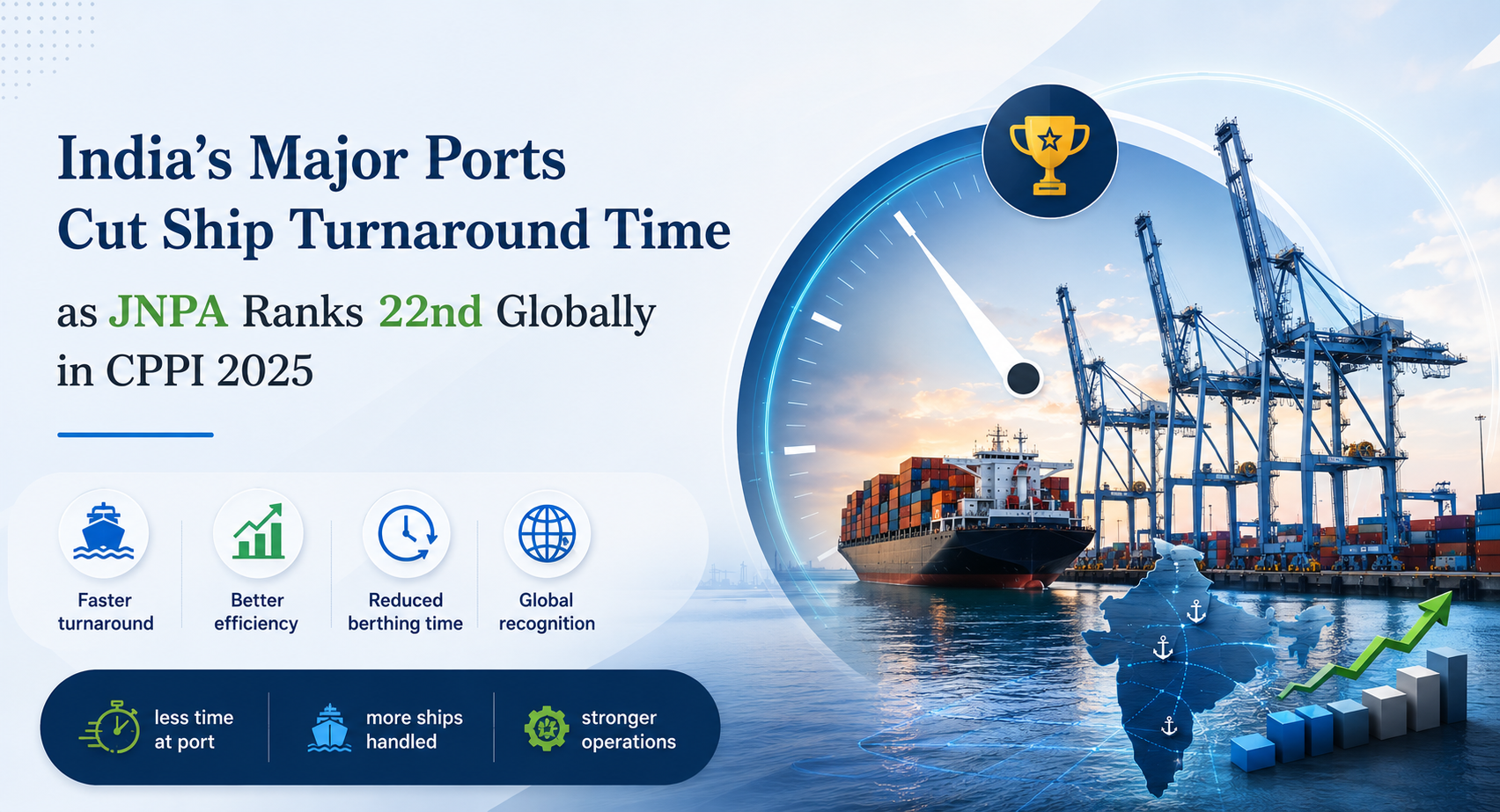
India’s Major Ports Cut Ship Turnaround Time as JNPA Ranks 22nd Globally in CPPI 2025

India’s major ports are showing measurable gains in operational efficiency, with average ship turnaround time improving to 48.84 hours in FY 2025-26, down from 52.87 hours in FY 2021-22. The improvement highlights the impact of port modernisation, mechanisation, infrastructure upgrades and streamlined digital processes across India’s maritime gateways.
A major global recognition has also strengthened India’s maritime performance story. Jawaharlal Nehru Port Authority (JNPA) ranked 22nd globally in the World Bank’s Container Port Performance Index (CPPI) 2025, retaining its position as India’s best-performing container port. JNPA was ranked just behind Singapore at 21st and ahead of Shanghai at 23rd.

Major Ports Improve Vessel Turnaround Time

According to the Ministry of Ports, Shipping and Waterways, the average turnaround time across India’s major ports has improved over the past five years:

Financial Year

Average Ship Turnaround Time

2021-22

52.87 hours

2022-23

52.90 hours

2023-24

48.06 hours

2024-25

49.47 hours

2025-26

48.84 hours

Overall, turnaround time has fallen by approximately 4.03 hours, or 7.6%, compared with FY 2021-22.
The latest performance indicates that Indian ports are gradually reducing the time vessels spend in port, an important factor in improving cargo velocity, asset utilisation and supply-chain efficiency.

JNPA Enters the Global Top 25

JNPA’s 22nd position in the CPPI 2025 is one of the strongest indicators of India’s progress in container port efficiency.
The World Bank’s CPPI measures container port performance based on the time vessels spend in port. JNPA also ranked 14th among the world’s top 20 ports showing improvement between 2020 and 2025, according to the port authority.
JNPA’s Global Position

Port

CPPI 2025 Rank

Singapore

21

JNPA, India

22

Shanghai

23

Rotterdam

333

The ranking places JNPA alongside some of the world’s major container gateways and reinforces India’s growing presence in global maritime logistics.

What Is Driving Better Port Performance?

The improvement in India’s port turnaround time is being supported by a combination of physical infrastructure and process reforms.
Key measures include:
The government launched One Nation One Port Process in February 2025 to standardise and streamline operations across India’s major ports. The initiative initially reduced container-operation documentation from 143 to 96 documents and bulk-cargo documentation from 150 to 106.

Port Efficiency: Why Turnaround Time Matters

Ship turnaround time is a critical logistics performance indicator. A vessel that spends less time waiting, berthing, loading or unloading can complete more voyages and move cargo through the supply chain faster.
The improvement can create benefits across the wider logistics ecosystem:
For exporters, importers, shipping lines and freight forwarders, faster port operations can translate into more predictable cargo movement and improved schedule reliability.

Implications for India’s Logistics Industry

The latest port performance data is significant for India’s broader logistics sector. As ports handle growing volumes of international trade, operational efficiency becomes increasingly important for controlling logistics costs and improving cargo-flow reliability.
For freight forwarders and logistics companies, faster vessel turnaround can support:
India’s progress is therefore not limited to individual port rankings. It reflects a broader shift toward technology-enabled, standardised and data-driven port operations.

India’s Port Performance at a Glance

Indicator

Latest Performance

Average major-port turnaround time

48.84 hours

FY 2021-22 turnaround time

52.87 hours

Improvement

4.03 hours / 7.6%

JNPA CPPI 2025 rank

22nd globally

Singapore CPPI rank

21st

Shanghai CPPI rank

23rd

JNPA improvement ranking

14th among top 20 improving ports, 2020-2025

Frequently Asked Questions

What is India's average ship turnaround time?
India’s major ports recorded an average ship turnaround time of 48.84 hours in FY 2025-26, compared with 52.87 hours in FY 2021-22.
Jawaharlal Nehru Port Authority (JNPA) is India’s highest-ranked port in the World Bank’s CPPI 2025, ranking 22nd globally.
The Container Port Performance Index (CPPI) is a World Bank-published measure that evaluates container port performance based on the time vessels spend in port.
One Nation One Port Process (ONOP) is an Indian government initiative designed to standardise and simplify port procedures across major ports, reducing documentation inconsistencies and operational delays.
Lower turnaround time allows vessels to spend less time in port, supporting faster cargo movement, better vessel utilisation and more efficient maritime supply chains.

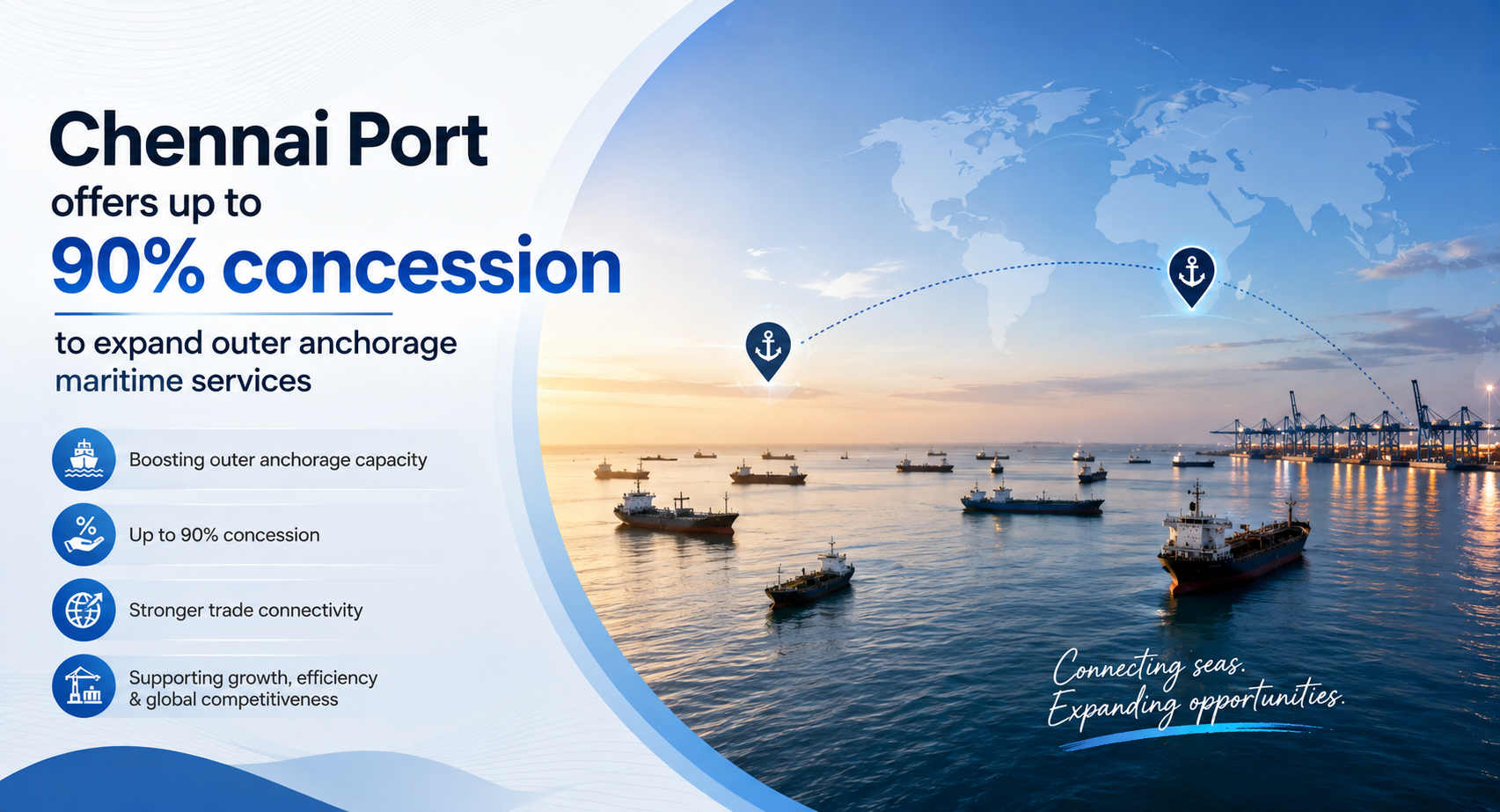
Chennai Port Offers Up to 90% Concession to Expand Outer Anchorage Maritime Services

Chennai Port Authority has introduced a new Promotional Concession Scheme for vessels using Chennai Port Outer Anchorage, offering substantial discounts on Port Dues and Anchorage Fees for ships arriving exclusively for bunkering and other eligible maritime services.
Under the scheme, vessels up to 50,000 GRT will receive an 85% concession, while vessels above 50,000 GRT will qualify for a 90% concession on applicable Port Dues and Anchorage Fees.
The initiative, effective from August 10, 2026, is aimed at positioning Chennai Port Outer Anchorage as an Integrated Offshore Maritime Services Hub and attracting vessels that need essential services without entering the main port facilities.

Chennai Port Outer Anchorage Concession: Key Highlights

Which Maritime Services Are Covered?

The concession scheme covers a wide range of services that vessels may require while remaining at the outer anchorage.

Maritime Service

Application

Bunkering

Fuel supply to vessels

Provisions & Stores

Supply of food, consumables and vessel stores

Spares

Delivery of vessel machinery and equipment spares

Crew Changes

Embarkation and disembarkation of crew

Sick Crew Disembarkation

Transfer of crew requiring medical attention

Vessel Repairs

Repair and maintenance activities

Underwater Operations

Subsea inspection and related work

Surveys & Inspections

Technical, safety and vessel inspections

What Does Concession Mean for Shipping Lines?

The new incentive could make Chennai Outer Anchorage more attractive for vessels requiring quick and cost-efficient maritime services.
Instead of entering the main port area for certain activities, eligible vessels can access services at the outer anchorage. This can potentially help operators reduce port-related costs while improving turnaround flexibility.
The financial incentive becomes particularly significant for larger vessels, with ships above 50,000 GRT eligible for a 90% concession on applicable Port Dues and Anchorage Fees.
Concession Structure

Vessel Size

Concession on Applicable Port Dues & Anchorage Fees

Up to 50,000 GRT

85%

Above 50,000 GRT

90%

Chennai Port's Push Towards an Offshore Maritime Services Hub

The initiative forms part of Chennai Port’s broader effort to expand its role beyond conventional cargo handling.
By developing an Integrated Offshore Maritime Services Hub at Outer Anchorage, the port can create an ecosystem for services such as bunkering, ship repairs, crew support, underwater operations and technical inspections.
This could also strengthen Chennai’s position within India’s growing maritime services ecosystem, particularly for vessels operating along the Indian coastline and regional shipping routes.

Why This Matters for India's Maritime Logistics Sector

India’s ports are increasingly looking beyond cargo handling to develop value-added maritime and ancillary services.
Chennai Port’s concession scheme could support this shift by encouraging vessels to use the port’s outer anchorage for essential services. A larger offshore services ecosystem can create opportunities for bunker suppliers, marine repair companies, ship chandlers, inspection agencies, underwater service providers and other maritime businesses.
For shipping operators, the availability of multiple services at a competitive cost can also contribute to more efficient vessel planning and port operations.

What It Means for the Logistics Industry

Chennai Port’s new concession scheme could give shipping lines and vessel operators a stronger financial incentive to use the Outer Anchorage for offshore maritime services.
With discounts of up to 90%, the initiative has the potential to increase vessel activity at the anchorage while supporting the growth of ancillary maritime businesses around Chennai.
For India’s logistics and maritime sector, the move also highlights a broader trend: ports are increasingly evolving from cargo gateways into integrated logistics and maritime service centres.

Frequently Asked Questions

What is Chennai Port's new concession scheme?
Chennai Port Authority has introduced a Promotional Concession Scheme providing discounts on applicable Port Dues and Anchorage Fees for eligible vessels using Chennai Port Outer Anchorage for bunkering and other approved maritime services.
Vessels up to 50,000 GRT are eligible for an 85% concession, while vessels above 50,000 GRT can receive a 90% concession on applicable Port Dues and Anchorage Fees.
The scheme came into effect on August 10, 2026.
Eligible activities include bunkering, provisions and stores supply, spares, crew changes, sick crew disembarkation, vessel repairs, underwater operations, surveys, inspections and other permitted maritime services.
The initiative is intended to promote Chennai Port Outer Anchorage as an Integrated Offshore Maritime Services Hub, attract more vessels for ancillary services and strengthen the port’s competitiveness in offshore maritime services.

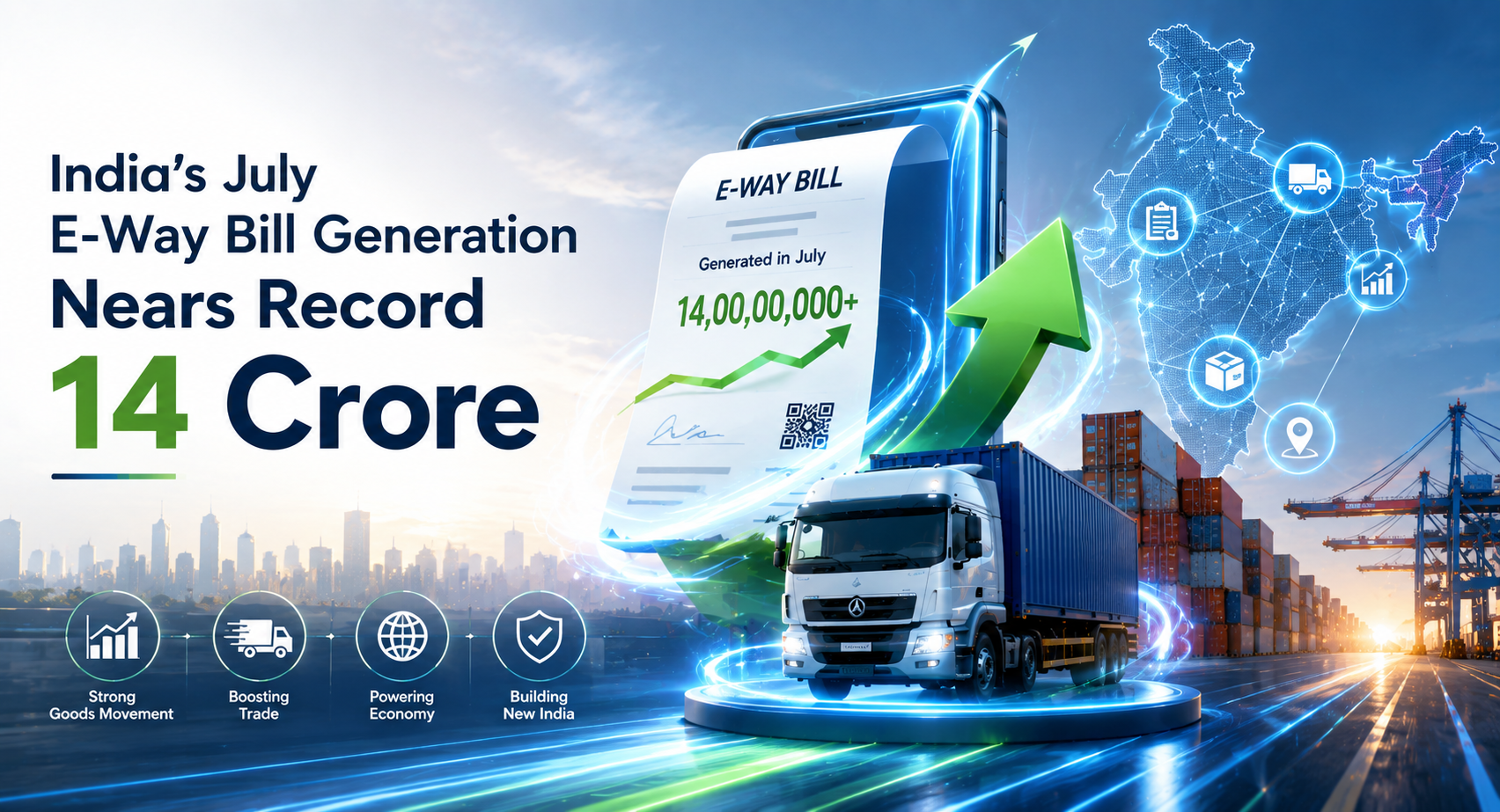
India’s July E-Way Bill Generation Nears Record 14 Crore, Signalling Strong Goods Movement

India’s goods movement showed continued strength in July, with 13.98 crore e-way bills (139.8 million) generated during the month, bringing activity close to record levels, according to data from the Goods and Services Tax Network (GSTN).
The latest figures point to sustained movement of goods across India’s domestic supply chains despite continuing geopolitical and economic uncertainties. For the logistics sector, the increase provides a useful indicator of transportation activity across manufacturing, distribution, wholesale and retail networks.

Key Highlights

Why July’s E-Way Bill Numbers Matter

E-way bills are electronic documents generated on the GST portal to track the movement of goods. They provide an important window into the scale and intensity of goods transportation across the country.
However, e-way bill generation should not be treated as a direct measure of GST collections. GST revenue is influenced by actual consumption, tax rates, compliance, imports and several other factors. In addition, services and certain categories of goods movement fall outside the e-way bill framework.
Even so, sustained growth in e-way bills can serve as an important high-frequency indicator of economic and logistics activity.
According to Saurabh Agarwal, Tax Partner at EY India, the continued increase reflects strong goods movement across supply chains. He also pointed to the combined effect of GST rate rationalisation and stronger compliance enforcement, which could help expand India’s taxable base and support GST revenue during the year.

E-Way Bills and GST Revenue: What Is the Connection?

The relationship between e-way bills and GST collections is indirect but significant.

Indicator

July/FY27 Development

Potential Significance

E-way bills

13.98 crore in July

Indicates strong goods movement

GST revenue growth in FY26

5.60%

Slower than the previous year

GST growth in first four months of FY27

More than 10%

Signals improving revenue momentum

SBI FY27 GST growth projection

8–9%

Indicates potential recovery

The July e-way bill numbers could therefore provide an early indication of continued economic activity ahead of the August GST collection data, scheduled for release on September 1.

GST Revenue Shows Signs of Recovery

The latest e-way bill data comes against a backdrop of improving GST revenue growth.
A State Bank of India (SBI) research report noted that overall GST revenue, including compensation cess, grew by 5.6% in FY26, compared with 9.4% in FY25.
The picture has improved in the early months of FY27, with GST revenue growth exceeding 10% during the first four months.
SBI expects GST collections to recover further, projecting annual growth of approximately 8–9% in FY27.
The report attributed part of the earlier moderation to GST rate rationalisation and described the resulting impact as an expected consequence of the policy changes.

Compensation Cess and State Revenues

The SBI report also questioned concerns about the financial impact on States following the discontinuation of compensation cess.
Rather than an estimated annual loss of ₹15,000–20,000 crore, the report projects that States could potentially receive approximately ₹1.43 lakh crore more in FY27 than in FY26.
This adds another dimension to the broader GST revenue outlook as India moves through the current financial year.

What the Numbers Mean for India’s Logistics Sector

For logistics and supply-chain businesses, the near-record e-way bill activity is particularly significant because the document is closely associated with the movement of goods by road and other transport modes.
Higher goods movement can translate into greater demand for:
For freight forwarders and logistics companies, sustained cargo movement also reinforces the need for real-time shipment visibility, automated documentation, GST compliance and integrated freight management systems.
The Bigger Picture
The July e-way bill numbers tell a broader story about India’s economic and logistics activity.
Strong goods movement → Higher e-way bill generation → Increased supply-chain activity → Greater transaction visibility → Potentially stronger tax compliance
While e-way bills alone cannot determine India’s GST revenue trajectory, the combination of near-record goods movement and improving GST growth suggests that economic activity remains relatively resilient entering FY27.
For India’s logistics industry, the trend is another indication that domestic freight volumes remain an important driver of demand for transportation, warehousing, freight technology and supply-chain services.

What Is an E-Way Bill?

An e-way bill is an electronic document generated through the GST system for the movement of goods. Under Rule 138 of the Central Goods and Services Tax (CGST) Rules, 2017, registered persons generally need to generate an e-way bill when transporting goods with a consignment value exceeding ₹50,000, subject to specified exemptions and applicable rules.
The system is designed to improve visibility of goods movement and strengthen GST compliance.

Rising E-Way Bills Point to Resilient Trade and Supply-Chain Activity

India’s 13.98-crore e-way bill generation in July points to sustained goods movement and resilient domestic supply-chain activity. Combined with improving GST revenue growth in the early months of FY27, the data suggests that India’s tax base and economic activity may be gaining momentum.
For the logistics industry, the trend reinforces the importance of efficient transportation networks, digital compliance, freight visibility and technology-driven supply-chain management as cargo volumes continue to expand.

Frequently Asked Questions

How many e-way bills were generated in July 2026?
India generated approximately 13.98 crore e-way bills, or 139.8 million, in July 2026.
Not directly. E-way bills indicate goods movement, while GST collections depend on several factors including consumption, taxable transactions, tax rates, imports and compliance.
E-way bills provide an electronic record associated with the movement of goods and therefore offer an important indicator of transportation and supply-chain activity.
The near-record generation of e-way bills indicates strong and sustained movement of goods across India’s supply chains, suggesting continued resilience in economic activity.
An SBI research report has projected 8–9% annual GST revenue growth for FY27, while noting that revenue growth during the opening months of the financial year has exceeded 10%.

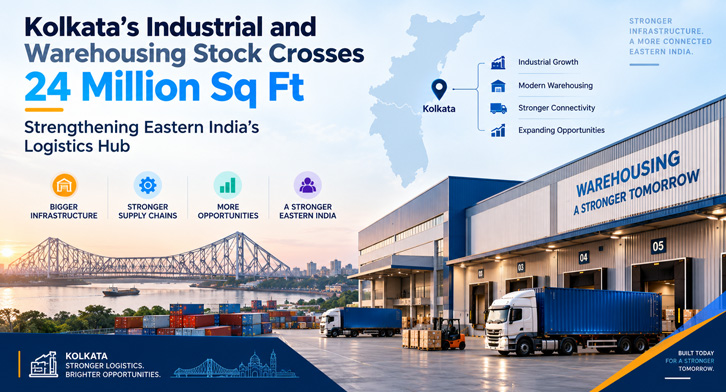
Kolkata’s Industrial and Warehousing Stock Crosses 24 Million Sq Ft, Strengthening Eastern India’s Logistics Hub

Kolkata’s industrial and warehousing stock has surpassed 24 million sq ft, reinforcing the city’s growing position as a major logistics and distribution hub for Eastern and Northeastern India.
The expansion reflects rising demand for modern logistics infrastructure from third-party logistics (3PL) providers, e-commerce companies, manufacturers and other supply-chain-intensive businesses. Growing connectivity with key consumption centres is also encouraging the development of industrial and warehousing facilities around the city.

Key Highlights

Kolkata’s Warehousing Market Gains Momentum

Kolkata’s strategic location gives it an important role in India’s eastern logistics network. The city provides access to major consumption and industrial markets while serving as a gateway for cargo moving toward Northeastern states and neighbouring markets.
The growing presence of 3PL operators and e-commerce businesses is increasing demand for strategically located warehouses capable of supporting faster order fulfilment, inventory consolidation and regional distribution.
Manufacturing and engineering companies are also contributing to demand, creating requirements for industrial facilities that can support production, storage and movement of goods.

Kolkata’s Leasing Activity Signals Strong Demand

According to CBRE, Kolkata recorded approximately 3.8 million sq ft of industrial and logistics leasing during the first nine months of 2025, highlighting the city’s contribution to India’s broader logistics real estate market.

Market Indicator

Volume

Kolkata industrial & warehousing stock

24+ million sq ft

Kolkata industrial & logistics leasing, 9M 2025

3.8 million sq ft

India warehousing absorption, H2 2025

30+ million sq ft

Key demand sectors

3PL, e-commerce, manufacturing & engineering

Why Kolkata Matters for Eastern India’s Supply Chain

Kolkata’s logistics importance extends beyond the city’s immediate market.
Its location makes it a natural distribution point for cargo destined for West Bengal, Odisha, Bihar, Jharkhand and the Northeastern region. As businesses increasingly seek faster delivery and regional inventory networks, demand for strategically positioned warehousing facilities is likely to remain important.
Modern warehouses can also improve supply-chain performance by enabling:

The Bigger Picture

India’s industrial and logistics real estate market continues to benefit from structural changes in supply chains. Companies are increasingly investing in regional distribution centres, fulfilment facilities and modern warehouses to reduce delivery times and improve inventory efficiency.
For Kolkata, the combination of growing industrial and warehousing stock, strong leasing activity and its strategic regional position could further strengthen its role in India’s logistics network.
As more modern facilities come online, the city could attract additional logistics operators, manufacturers, e-commerce businesses and supply-chain investments.

What Does the Growth Mean for Logistics?

For freight forwarders, 3PL companies, manufacturers, e-commerce operators and transport providers, the expansion of Kolkata’s warehousing ecosystem could create new opportunities across storage, distribution and transportation.
A larger and more modern warehouse base can support more efficient cargo flows while enabling businesses to position inventory closer to regional demand centres.
For the logistics industry, this means potential growth in warehousing, road freight, freight forwarding, distribution, inventory management and supply-chain technology.

Frequently Asked Questions

What is the size of Kolkata’s industrial and warehousing stock?
Kolkata’s industrial and warehousing stock has surpassed 24 million sq ft.
Kolkata recorded around 3.8 million sq ft of industrial and logistics leasing during the first nine months of 2025, according to CBRE.
Major demand drivers include 3PL providers, e-commerce companies, manufacturers, engineering companies and other supply-chain-intensive businesses.
Kolkata is strategically positioned as a gateway to Eastern and Northeastern India, providing access to major regional consumption and industrial markets.
Increasing warehousing capacity could support regional distribution, faster cargo movement, inventory optimisation, e-commerce fulfilment and greater demand for transportation and logistics services.

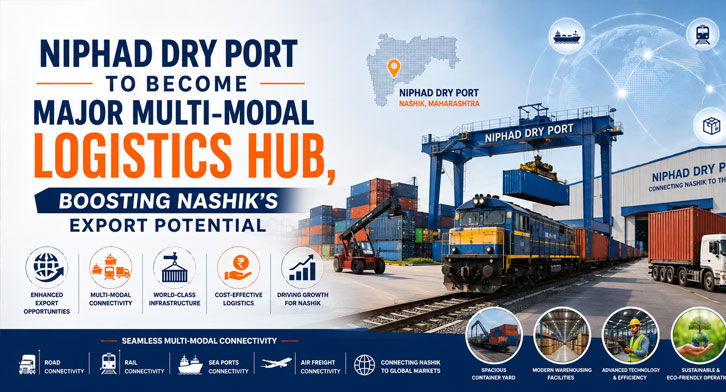
Niphad Dry Port to Become Major Multi-Modal Logistics Hub, Boosting Nashik’s Export Potential

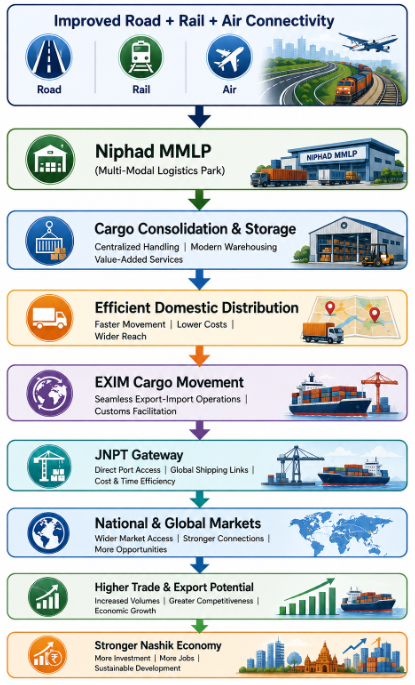
niphad-port

NASHIK: The proposed Niphad Multi-Modal Logistics Park (MMLP) is set to play a significant role in transforming Nashik into a stronger logistics and export hub, with improved connectivity for agricultural producers, manufacturers, exporters and domestic cargo operators.

The development of the proposed Niphad Dry Port was discussed during a meeting between Nashik District Collector Ayush Prasad and JNPT Vice Chairman Ravish Kumar Singh at the Nashik Collector’s Office.

The proposed logistics park is envisioned as more than an Export-Import (EXIM) cargo facility. Authorities are planning an integrated logistics hub capable of handling both domestic and international cargo, supported by road, rail, air and warehousing infrastructure.

Niphad MMLP to Support EXIM and Domestic Cargo

A key focus of the project is to create an integrated logistics ecosystem that can improve cargo movement, storage and distribution across Nashik district.

The proposed dry port is expected to provide exporters and industries with better access to transportation and logistics services while reducing dependence on fragmented logistics operations.

Niphad MMLP to Support EXIM and Domestic Cargo

Why Niphad Is Strategically Important for Nashik Logistics

Niphad’s location gives the proposed logistics park access to multiple transportation corridors.

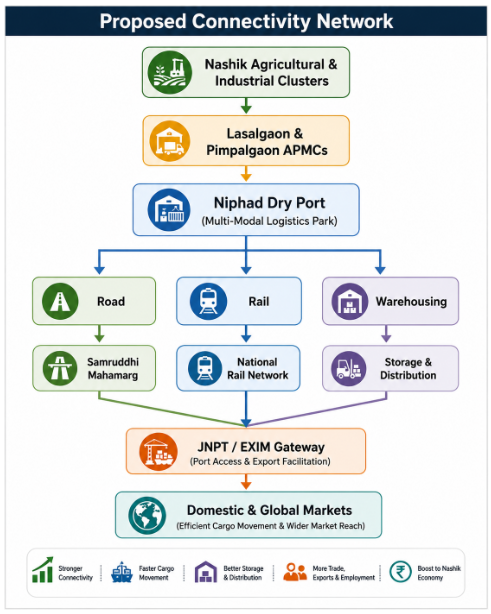
The project is expected to leverage connectivity through the Nashik–Chennai Highway, Nashik Ring Road, Samruddhi Mahamarg, Ozar Airport and the railway network.

This combination could allow cargo to move more efficiently between production centres, logistics facilities, ports and domestic consumption markets.

Connectivity-network

Agricultural Supply Chain Could Be a Major Beneficiary

Agriculture is expected to be one of the major beneficiaries of the proposed logistics infrastructure.

The District Collector has proposed connecting the Lasalgaon and Pimpalgaon Baswant APMCs with the Niphad Dry Port. Other agricultural market committees in Nashik district could potentially be integrated during subsequent phases.

The proposed linkage could create a more organised supply chain between farms, agricultural markets, storage facilities, the dry port and export gateways.

This could be particularly important for agricultural commodities that require efficient transportation, storage and market access.

Potential Agricultural Logistics Flow

Supply Chain Stage

Potential Benefit

Farmers & Producers

Better access to organised logistics

APMCs

Direct connectivity with the dry port

Warehousing

Improved storage and inventory management

Niphad Dry Port

Cargo consolidation and multimodal movement

JNPT

Access to international shipping networks

Export Markets

Improved connectivity and market reach

Grain Storage Integration Could Strengthen the Food Supply Chain

Another proposal discussed during the meeting was linking the Niphad Dry Port with the Centre’s grain storage initiative.

Such integration could help create a stronger connection between agricultural production, storage, transportation and distribution.

For farmers and traders, better storage and logistics infrastructure could help reduce supply-chain inefficiencies and improve access to wider domestic and export markets.

JNPT Steps Up Support for Nashik Exporters

JNPT is also strengthening its engagement with Nashik’s industrial and export ecosystem.

According to the district administration, the Economic Development Cell of Nashik district has been connected with JNPT’s main transport office. The objective is to simplify export-related processes for local industries and exporters.

JNPT will also participate as a key stakeholder in the District Export Promotion Committee meeting scheduled for August 4, 2026.

This collaboration could help local businesses better understand port procedures, export logistics and opportunities to access international markets.

Expected Impact on Nashik's Logistics Ecosystem

The proposed Niphad MMLP could have a broader impact beyond cargo handling.

Area

Expected Impact

Agriculture

Improved movement and export of agricultural commodities

Manufacturing

Better access to logistics and distribution networks

Exports

Easier access to port-based EXIM infrastructure

Warehousing

Increased demand for modern storage facilities

Transportation

Greater requirement for road and rail cargo movement

Employment

New opportunities across logistics and allied sectors

Trade

Wider access to domestic and international markets

Supply Chains

More integrated multimodal cargo movement

What the Niphad Dry Port Could Mean for Logistics in Nashik

niphad-dry-port

What the Niphad Dry Port Could Mean for Nashik’s Future

The proposed Niphad Multi-Modal Logistics Park represents an important step toward building a more integrated logistics ecosystem in Nashik district.

With road and rail connectivity, access to Ozar Airport, proximity to agricultural production centres and collaboration with JNPT, the project could strengthen the movement of both domestic and EXIM cargo.

The proposed integration of APMCs and grain-storage infrastructure could further enhance Nashik’s agricultural supply chain, while improved export facilitation could support local manufacturers and businesses.

If implemented as planned, the Niphad Dry Port could position Nashik as an important multimodal logistics and export hub in Maharashtra, connecting the district’s agricultural and industrial economy with national supply chains and international markets.

Key Takeaways

Frequently Asked Questions

What is the Niphad Dry Port?

The Niphad Dry Port is part of the proposed Multi-Modal Logistics Park (MMLP) in Nashik district, Maharashtra. It is planned as an integrated facility for handling both domestic and EXIM cargo.

The logistics park is expected to improve cargo transportation, warehousing, distribution and export connectivity while supporting agricultural and industrial supply chains.

The proposed logistics hub will benefit from connectivity through the Nashik–Chennai Highway, Nashik Ring Road, Samruddhi Mahamarg, railway network and Ozar Airport.

Proposed connectivity with Lasalgaon and Pimpalgaon Baswant APMCs could improve the movement of agricultural commodities from market yards to storage facilities, the dry port and export gateways.

JNPT is collaborating with the Nashik district administration and has connected the district’s Economic Development Cell with its main transport office to help facilitate export-related processes for local industries and exporters.

TRAC1 Logistics Launches Double-Stack Rail Service Connecting Nhava Sheva with Faridabad

trace-1
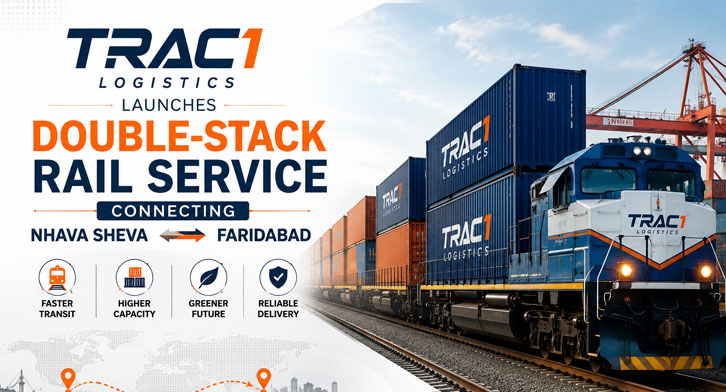
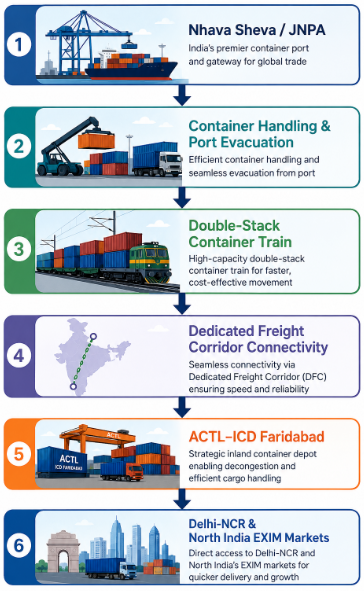
TRAC1 Logistics has commenced a new double-stack container rail service from Nhava Sheva (JNPA) to ACTL–ICD Faridabad in Haryana, strengthening rail connectivity between India’s western gateway ports and the Delhi-NCR region.

According to DynaLiners, the revised service will introduce Karachi and Sohar into the rotation, creating a broader regional network connecting India, Pakistan, the UAE and Oman.

Key Highlights

Why the Nhava Sheva–Faridabad Rail Link Matters

Nhava Sheva is one of India’s major gateways for containerised international trade. Moving cargo from the port region to North India by rail can help logistics operators reduce dependence on long-distance road transportation.

The introduction of double-stack container operations is particularly significant because it allows more containers to be moved per train, potentially improving wagon utilisation and overall rail freight efficiency.

The service also benefits from India’s expanding Dedicated Freight Corridor network, which is designed to improve the speed, capacity and reliability of freight movement across major industrial and consumption centres.

Logistics Impact

Area

Potential Impact

Rail capacity

Higher container carrying capacity through double-stack operations

Port connectivity

Faster evacuation of Nhava Sheva cargo

Delhi-NCR access

Improved connectivity with Faridabad and surrounding markets

Road freight

Potential reduction in long-haul road dependency

Asset utilisation

Better utilisation of rail freight capacity

Reefer logistics

Rail movement capability for temperature-sensitive cargo

Sustainability

Lower road congestion and potential emissions reduction

Multimodal logistics

Stronger integration of port, rail and inland terminals

From Port to North India: Supply Chain Impact

suppl-chain-impact

The new rail service strengthens the connection between India’s western maritime gateway and one of the country’s largest consumption and industrial regions.

What Double-Stack Rail Operations Mean for Freight Forwarders

For freight forwarders, exporters, importers and logistics companies, double-stack rail services can create opportunities to improve the economics of long-distance container transportation.

Higher capacity → Better train utilisation → More containers moved per service → Greater rail freight efficiency

The ability to move both dry and reefer containers also expands the potential cargo base that can be served through rail-linked inland logistics networks.

DFC's Role in Strengthening Freight Connectivity

The Dedicated Freight Corridor is an important component of India’s strategy to shift more freight onto dedicated rail infrastructure.

For the Nhava Sheva–Faridabad corridor, stronger rail connectivity can support:

Why This Matters for India's Multimodal Logistics Network

The development represents more than the launch of a new train service. It demonstrates the growing role of rail-based multimodal transportation in India’s EXIM supply chain.

As container volumes increase and logistics companies look for more efficient inland transportation options, connections between major ports, freight corridors and ICDs are becoming increasingly important.

The successful operation also highlights the importance of coordination among shipping lines, port terminals, Indian Railways and logistics operators in creating integrated freight solutions.

TRAC1 Logistics’ double-stack service between Nhava Sheva and ACTL–ICD Faridabad strengthens rail connectivity between western India and the Delhi-NCR market. With higher-capacity container movement and DFC connectivity, the service could contribute to more efficient, sustainable and multimodal EXIM logistics across North India.

FAQs

What is the new TRAC1 Logistics rail service?

TRAC1 Logistics has commenced a double-stack container train service connecting Nhava Sheva (JNPA) with ACTL–ICD Faridabad in Haryana.

The first service was successfully operated on July 23, 2026.

 The inaugural train carried a mixed load of dry and refrigerated (reefer) containers.

The service is expected to improve connectivity between Nhava Sheva and Delhi-NCR, as well as other key EXIM markets in North India.

 Double-stack trains can carry more containers per train, improving carrying capacity and asset utilisation while supporting more efficient long-distance freight movement.

 DFC infrastructure supports more efficient freight movement across major Indian logistics corridors and strengthens rail connectivity between ports and inland markets.

Double-Stack Reefer Train Flagged Off from MMLP Dadri on New Dedicated Rail Line to JN Port

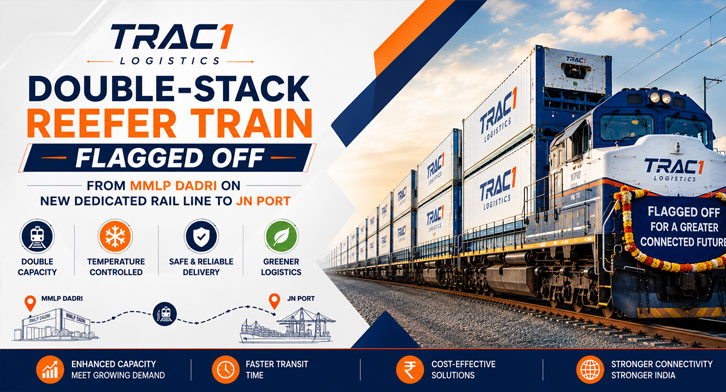
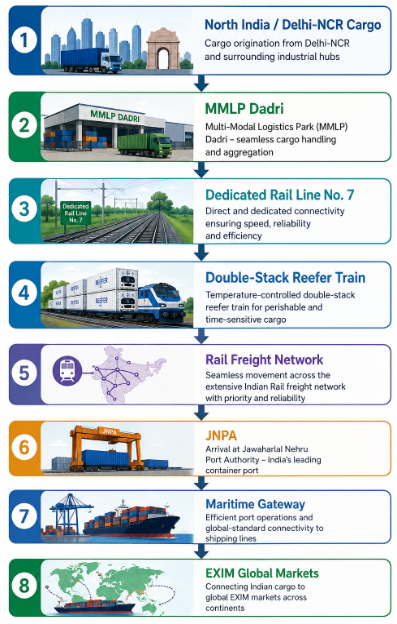
Container Corporation of India (CONCOR) has strengthened rail-based container logistics between North India and the west coast with the commissioning of Dedicated Line No. 7 at the Multimodal Logistics Park (MMLP) Dadri.

CONCOR CMD Sanjay Swarup inaugurated the new rail line on July 28, 2026, in an event that also marked the flag-off of a double-stack reefer container train bound for Jawaharlal Nehru Port (JNPA).

The new dedicated rail infrastructure is expected to increase container-handling capacity at MMLP Dadri, improve train turnaround times and strengthen the movement of temperature-sensitive cargo between North India and a major maritime gateway.

Key Highlights

Why the New Rail Line Matters

MMLP Dadri is an important logistics hub serving the Delhi-NCR and North Indian cargo market. Improving its dedicated rail infrastructure can help move larger container volumes between inland markets and ports more efficiently.

The commissioning of Line No. 7 provides additional rail-handling capability and can reduce operational constraints associated with container train movements.

The flag-off of a double-stack reefer train is particularly significant because it combines higher rail carrying capacity with temperature-controlled container transportation.

Logistics Flow
logistics-flow

Supply Chain Impact

Development

Expected Impact

Dedicated Line No. 7

Higher rail-handling capacity

Double-stack trains

Greater container carrying capacity

Reefer rail movement

Better connectivity for temperature-sensitive cargo

Faster train turnaround

Improved operational efficiency

Dadri–JNPA connectivity

Stronger North India–port integration

Rail-based container movement

Potentially more cost-efficient long-distance transportation

Multimodal integration

Better connection between inland logistics hubs and maritime trade

What It Means for North India's EXIM Supply Chain

The development could strengthen the role of MMLP Dadri as an inland container logistics hub by improving its connection with JNPA.

For exporters and importers in Delhi-NCR and surrounding industrial regions, efficient rail connectivity to a major container port can support more predictable movement of cargo while reducing dependence on road transportation for long-haul container movements.

The use of double-stack trains is also important for improving rail productivity because more containers can potentially be transported in a single train movement, subject to infrastructure and operational constraints.

For reefer cargo, dedicated rail connectivity could provide an additional transportation option for commodities requiring controlled temperatures, including food products, pharmaceuticals and other temperature-sensitive shipments.

CONCOR, Railways and DFCCIL Collaboration

The inauguration was attended by senior officials from CONCOR, North Central Railway and the Dedicated Freight Corridor Corporation of India Ltd. (DFCCIL).

The participation of stakeholders across the rail and container logistics ecosystem highlights the importance of coordinated infrastructure development in improving India’s multimodal freight network.

MMLP Dadri’s new Dedicated Line No. 7 and the launch of double-stack reefer services mark another step toward strengthening India’s multimodal container logistics network.

By combining dedicated rail infrastructure, double-stack capacity, reefer transportation and port connectivity, the development can improve the efficiency of cargo flows between North India’s inland markets and JNPA.

FAQs

What happened at MMLP Dadri on July 28, 2026?

CONCOR commissioned Dedicated Line No. 7 at MMLP Dadri and flagged off a double-stack reefer container train to JNPA.

The new dedicated rail line is expected to increase rail-handling capacity, improve operational efficiency and support faster turnaround of container trains at MMLP Dadri.

The train was flagged off from MMLP Dadri for Jawaharlal Nehru Port Authority (JNPA).

Double-stack trains can carry two layers of containers where infrastructure permits, increasing the number of containers moved per train and improving rail freight productivity.

Improved rail connectivity between MMLP Dadri and JNPA can provide North Indian cargo owners with stronger access to a major maritime gateway and support more efficient multimodal freight movement.

Reefer containers maintain controlled temperatures for sensitive cargo. Rail connectivity can provide another transportation option for moving temperature-sensitive goods over long distances.

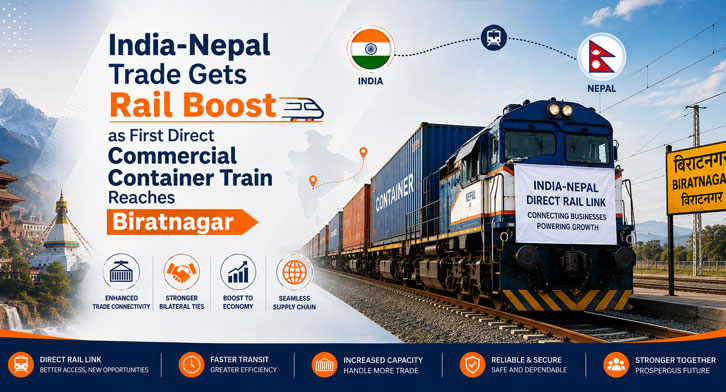
India-Nepal Trade Gets Rail Boost as First Direct Commercial Container Train Reaches Biratnagar

rail-boost
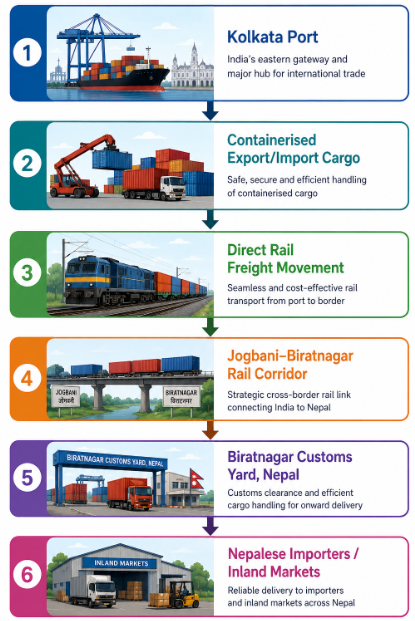
First direct container freight train from Kolkata Port to Biratnagar Customs Yard eliminates border transshipment, paving the way for faster and more cost-efficient India-Nepal trade

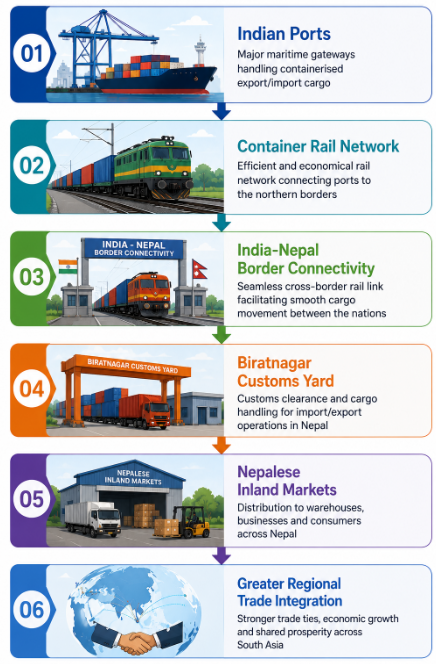
India has taken a major step toward strengthening cross-border freight connectivity with Nepal following the successful operation of the first direct commercial container freight train from Kolkata Port to Biratnagar Customs Yard.

The 40-wagon train, carrying a consignment of canola, travelled directly to Nepal without the need for transshipment at the India-Nepal border. The movement was enabled by the revised India-Nepal Rail Transit Protocol, which allows containerised cargo to move seamlessly by rail between the two countries.

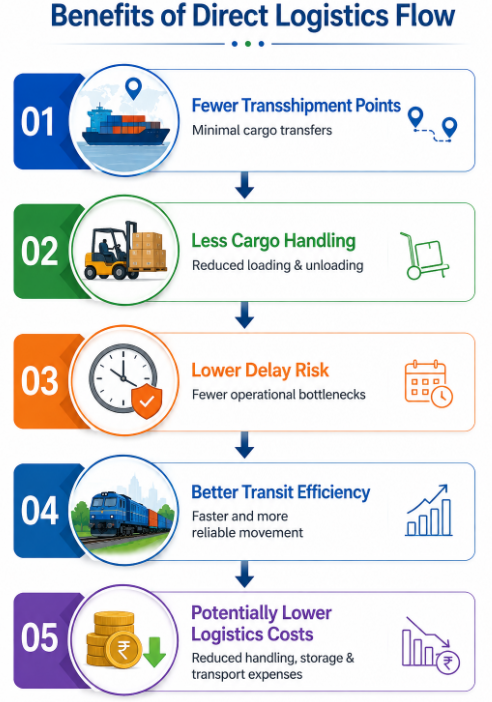
The development is significant for exporters, importers, freight forwarders and logistics operators because eliminating an additional cargo-handling stage can help reduce transit time, handling costs, cargo risks and supply-chain delays.

Key Highlights

Why the Direct Rail Service Matters

Previously, cross-border cargo movements could involve additional handling and transshipment processes. The new direct rail arrangement is designed to simplify the movement of containerised cargo between India and Nepal.

For businesses, fewer cargo-handling stages can translate into a more predictable supply chain. Reduced handling can also lower the risk of delays and cargo damage while improving overall shipment visibility and reliability.

The development is particularly relevant for importers and exporters using eastern Indian gateways to access the Nepalese market.

India-Nepal Direct Rail Freight: Potential Supply Chain Impact

Supply Chain Factor

Earlier Challenge

Impact of Direct Rail Movement

Border handling

Additional cargo handling/transshipment

Reduced handling requirements

Transit time

Delays caused by multiple processes

Potentially faster cargo movement

Logistics cost

Handling and transfer-related costs

Potential cost efficiencies

Cargo risk

More handling points

Lower handling-related risk

Reliability

Dependence on multiple movement stages

More streamlined rail movement

Sustainability

Greater dependence on road-based movement

Greater scope for rail freight

Trade competitiveness

Higher logistics friction

Improved cross-border connectivity

Kolkata Port–Biratnagar Freight Corridor

The new service builds on the Jogbani–Biratnagar broad-gauge rail connection, which was inaugurated in June 2023.

A key policy development followed in November 2025, when India and Nepal signed a revised Letter of Exchange (LoE). The revised framework subsequently enabled direct commercial rail movement to Biratnagar.

The latest train operation therefore represents more than an individual freight movement. It demonstrates the transition from infrastructure development and policy facilitation toward regular commercial rail connectivity.

How the New Freight Movement Works
freight-movement

Key Logistics Benefit

Logistics

What It Means for India-Nepal Trade

The direct rail service could create new opportunities for industries involved in bilateral trade by providing a more efficient transportation option.

For Indian exporters, improved rail connectivity can strengthen access to Nepalese markets. For Nepalese importers, direct movement from an Indian port can offer an additional freight option for bringing containerised goods into the country.

The service could also create opportunities for freight forwarders, customs brokers, rail operators, container logistics providers and warehousing companies supporting India-Nepal trade.

Wider Logistics Significance

The development comes as India continues to expand its international rail connectivity and multimodal freight infrastructure.

International rail freight can play an important role in reducing dependence on road transportation for suitable cargo flows. Greater rail utilisation can also improve cargo capacity, reduce road congestion and contribute to lower emissions per tonne-kilometre compared with some road-based alternatives.

For the logistics sector, the Kolkata–Biratnagar connection highlights the growing importance of integrated port-to-inland rail corridors in facilitating regional trade.

Impact on Freight Forwarders and Logistics Operators

The new direct rail service could influence logistics planning in several areas:

International rail freight can play an important role in reducing dependence on road transportation for suitable cargo flows. Greater rail utilisation can also improve cargo capacity, reduce road congestion and contribute to lower emissions per tonne-kilometre compared with some road-based alternatives.

For the logistics sector, the Kolkata–Biratnagar connection highlights the growing importance of integrated port-to-inland rail corridors in facilitating regional trade.

India-Nepal Rail Connectivity: From Infrastructure to Commercial Freight

The development of the Jogbani–Biratnagar rail link provided the physical foundation for stronger rail connectivity between the two countries.

The revised transit arrangements have now enabled that infrastructure to support direct commercial container freight movement.

This progression demonstrates how infrastructure + policy reform + commercial operations can collectively improve regional supply-chain connectivity.

Regional Trade Connectivity Chain

connectivity-chain

What Happens Next?

The successful inaugural service could provide a foundation for greater use of direct rail freight between India and Nepal.

If commercial volumes increase, the corridor could support a wider range of commodities and encourage logistics companies to develop more integrated port-to-destination rail solutions.

For India and Nepal, the development represents an important step toward creating a more seamless regional freight network, while for the logistics industry it reinforces the importance of efficient cross-border rail infrastructure in reducing supply-chain friction.

Conclusion

The arrival of the first direct commercial container freight train from Kolkata Port to Biratnagar Customs Yard marks an important milestone in India-Nepal logistics connectivity.

By eliminating border transshipment for the direct rail movement, the new arrangement has the potential to reduce handling, improve transit efficiency and strengthen the competitiveness of bilateral trade.

More broadly, the development demonstrates how modern rail infrastructure and streamlined transit arrangements can transform cross-border freight corridors and support a more integrated, cost-efficient and sustainable regional supply chain.

FAQs

What is the significance of the first direct India-Nepal container train?

The first direct commercial container freight train from Kolkata Port to Biratnagar Customs Yard enables containerised cargo to move between India and Nepal without transshipment at the border. The service is expected to improve transit efficiency, reduce cargo handling and support lower logistics costs while strengthening bilateral trade connectivity.


It is a direct commercial container freight service connecting Kolkata Port in India with Biratnagar Customs Yard in Nepal.

The inaugural train originated from Kolkata Port.

The train reached Biratnagar Customs Yard in Nepal.

The inaugural train consisted of 40 wagons carrying a consignment of canola.

The direct arrangement allows containerised cargo to move without transshipment at the India-Nepal border.

It provides the framework governing rail-based movement of freight between India and Nepal. The revised protocol enables direct commercial rail movement to Biratnagar.

It can provide freight forwarders and logistics operators with a more streamlined rail option, potentially reducing handling, delays and logistics costs.

The broad-gauge connection provides critical rail infrastructure linking India’s railway network with Biratnagar in Nepal and supports stronger bilateral freight connectivity.

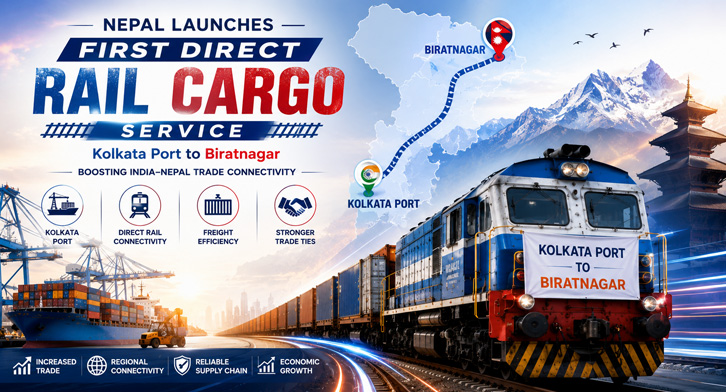
Nepal Launches First Direct Rail Cargo Service from Kolkata Port to Biratnagar, Boosting India–Nepal Trade Connectivity

Nepal has achieved a significant milestone in regional logistics by launching its first-ever direct rail cargo service between Kolkata Port and Biratnagar, strengthening cross-border trade with India and improving supply chain efficiency for eastern Nepal.
The new rail corridor allows third-country import cargo arriving at Indian seaports to move directly by rail to Biratnagar Customs Yard under the Nepal–India Transit Treaty, eliminating several logistical bottlenecks and reducing dependence on road transportation.
The inaugural shipment departed from Kolkata Port aboard a Container Corporation of India (CONCOR) freight train carrying 40 high-capacity 40-foot containers operated by Maersk Line. The cargo consisted of Canola Grain – Farmer Dressed, imported for Swastik Oil Industries in Nepal.

Key Highlights

Nepal Expands Rail-Based Import Network

Until now, Birgunj was Nepal’s only customs point connected to Indian ports through rail for handling third-country imports.
With the operationalisation of the Biratnagar rail corridor, businesses located in eastern Nepal can now receive imported cargo much faster, improving inventory planning and lowering transportation expenses.
The train will travel via the Jogbani Integrated Check Post (ICP) before arriving at the Biratnagar Customs Yard.
This new logistics corridor is expected to become a strategic gateway for industries located in Nepal’s Koshi Province.

Regulatory Changes Made the Service Possible

The new service became operational following India’s expansion of the Electronic Cargo Tracking System (ECTS) framework.
The initiative was enabled through:

Regulation

Details

CBIC Notification

No. 73/2025-Customs

Issued

4 November 2025

Regulation Updated

Electronic Cargo Tracking System Regulations, 2019

Customs Operational Notice

26 February 2026

Route Approved

Kolkata/Haldia → Jogbani → Biratnagar

These regulatory changes now permit rail transportation of Nepal-bound third-country cargo from multiple Indian ports.

Real-Time Cargo Visibility Through ECTS

Every container in the inaugural shipment has been fitted with India’s Electronic Cargo Tracking System (ECTS).
Benefits include:
Digital tracking is expected to enhance supply chain reliability while improving cross-border customs coordination.

Inaugural Shipment Details

Item

Information

Origin Port

Kolkata Port

Destination

Biratnagar Customs Yard, Nepal

Operator

CONCOR

Shipping Line

Maersk Line

Cargo

Canola Grain – Farmer Dressed

Importer

Swastik Oil Industries

Containers

40 x 40-foot Containers

Future Capacity

Up to 45 Containers per Train

Transit Route

Kolkata → Jogbani ICP → Biratnagar

Benefits for Nepal's Trade

The new corridor is expected to generate significant economic benefits.
Faster Transit
Lower Logistics Costs
Businesses can reduce:
Higher Supply Chain Efficiency
The dedicated rail route offers:

Industry Welcomes the Initiative

According to the Federation of Nepalese Chambers of Commerce and Industry (FNCCI), the new rail service addresses a long-standing demand from Nepal’s business community.
Industry leaders believe the corridor will:

Impact on Regional Logistics

The direct rail connection is expected to reshape freight movement between India and Nepal.

Previous System

New Direct Rail Service

Heavy dependence on road transport

Direct rail connectivity

Higher logistics costs

Lower transportation costs

Longer transit time

Around 24-hour delivery

Limited rail access via Birgunj

Biratnagar added as second rail-linked customs point

Higher detention charges

Reduced container detention

Limited cargo visibility

Real-time ECTS monitoring

Why This Matters

The launch of the Kolkata–Biratnagar rail cargo corridor represents a major advancement in South Asian logistics connectivity.
As trade volumes between India and Nepal continue to grow, the new rail service is expected to:
The initiative also reflects the growing emphasis on digital customs procedures, rail-based freight transport, and integrated cross-border logistics across South Asia.

FAQs

What is Nepal's new direct rail cargo service?
It is Nepal’s first direct rail freight service connecting Kolkata Port in India to Biratnagar Customs Yard, enabling faster transportation of third-country imports.
The service supports cargo originating from Kolkata, Haldia, and Visakhapatnam ports.
The rail corridor is expected to reduce transit time between Kolkata and Biratnagar to approximately 24 hours.
ECTS is a GPS-based cargo monitoring system that enables customs authorities to track containers in real time throughout transit.
Businesses will benefit from lower logistics costs, reduced demurrage, faster cargo movement, better supply chain visibility, and improved reliability.
cargonet-logo-icon
Cargonet Cargo Software Logo

Feedback & Reward program

Submit the Feedback and avail the Rewards.

1. Your satisfaction & reliability on CargoNet ?

2. Your Rating on Support & co-ordination team?

3. Satisfaction on the look and feel of CargoNet ?

4. Please specify any 2 best features that you feel more helpful in CargoNet?

5. Please specify any 2 best reports that you are taking on regular basis?

6. Are you using Copy Job option in CargoNet Software?

7. Are you using Automatic DSR (Daily Status Report) Option? It automatically sends reports to customer about the shipment status

8. Are you using Automatic Outstanding Reports option? Period Auto outstanding reminders to customer

9. Any other thoughts to improve in CargoNet? Please share.

* Join our Reward Program by recommending CargoNet (Cash Rewards Awaiting)

“Thanks for your feedback. Our goal is to create the best possible product, support & service, and your thoughts, ideas & suggestions play a major role in helping us identify opportunities to improve.”

Cut AI cost ,
not performance

discover how top Freight Forwarding companies  reduce AI-related expense and speed up operation with CargoNet AI, we will show it how
Share your information for instant access :