
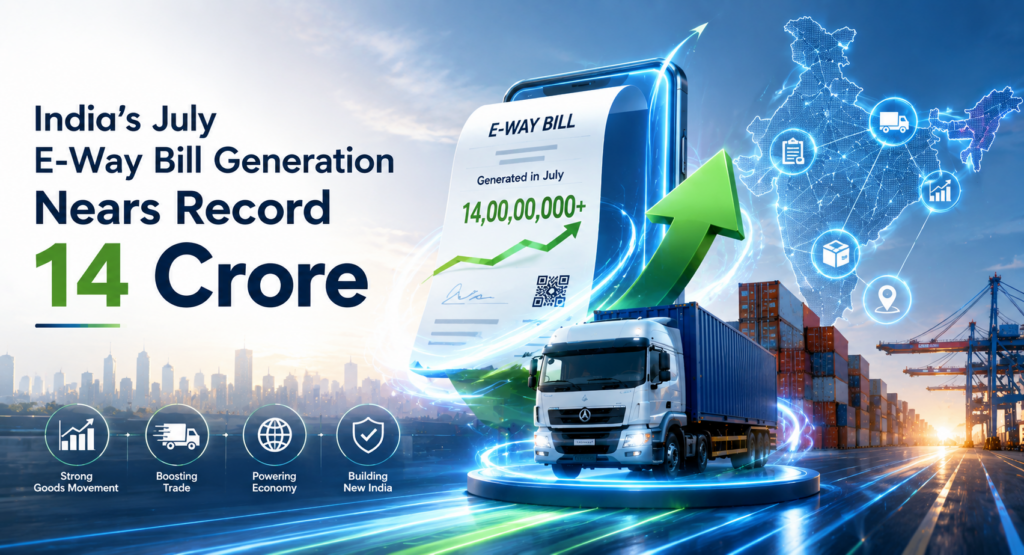
India’s goods movement showed continued strength in July, with 13.98 crore e-way bills (139.8 million) generated during the month, bringing activity close to record levels, according to data from the Goods and Services Tax Network (GSTN).
The latest figures point to sustained movement of goods across India’s domestic supply chains despite continuing geopolitical and economic uncertainties. For the logistics sector, the increase provides a useful indicator of transportation activity across manufacturing, distribution, wholesale and retail networks.
Key Highlights
- 13.98 crore e-way bills were generated across India in July.
- The figure is close to record monthly e-way bill generation.
- Rising e-way bill activity indicates sustained movement of goods through domestic supply chains.
- July's activity could have implications for GST collections reported in September.
- GST revenue growth has shown signs of improvement during the opening months of FY27.
- SBI expects annual GST revenue growth of around 8–9% in FY27.
- Stronger compliance and GST rate rationalisation could contribute to expansion of the taxable base.
Why July’s E-Way Bill Numbers Matter
E-way bills are electronic documents generated on the GST portal to track the movement of goods. They provide an important window into the scale and intensity of goods transportation across the country.
However, e-way bill generation should not be treated as a direct measure of GST collections. GST revenue is influenced by actual consumption, tax rates, compliance, imports and several other factors. In addition, services and certain categories of goods movement fall outside the e-way bill framework.
Even so, sustained growth in e-way bills can serve as an important high-frequency indicator of economic and logistics activity.
According to Saurabh Agarwal, Tax Partner at EY India, the continued increase reflects strong goods movement across supply chains. He also pointed to the combined effect of GST rate rationalisation and stronger compliance enforcement, which could help expand India’s taxable base and support GST revenue during the year.
E-Way Bills and GST Revenue: What Is the Connection?
The relationship between e-way bills and GST collections is indirect but significant.
Indicator
July/FY27 Development
Potential Significance
E-way bills
13.98 crore in July
Indicates strong goods movement
GST revenue growth in FY26
5.60%
Slower than the previous year
GST growth in first four months of FY27
More than 10%
Signals improving revenue momentum
SBI FY27 GST growth projection
8–9%
Indicates potential recovery
The July e-way bill numbers could therefore provide an early indication of continued economic activity ahead of the August GST collection data, scheduled for release on September 1.
GST Revenue Shows Signs of Recovery
The latest e-way bill data comes against a backdrop of improving GST revenue growth.
A State Bank of India (SBI) research report noted that overall GST revenue, including compensation cess, grew by 5.6% in FY26, compared with 9.4% in FY25.
The picture has improved in the early months of FY27, with GST revenue growth exceeding 10% during the first four months.
SBI expects GST collections to recover further, projecting annual growth of approximately 8–9% in FY27.
The report attributed part of the earlier moderation to GST rate rationalisation and described the resulting impact as an expected consequence of the policy changes.
Compensation Cess and State Revenues
The SBI report also questioned concerns about the financial impact on States following the discontinuation of compensation cess.
Rather than an estimated annual loss of ₹15,000–20,000 crore, the report projects that States could potentially receive approximately ₹1.43 lakh crore more in FY27 than in FY26.
This adds another dimension to the broader GST revenue outlook as India moves through the current financial year.
What the Numbers Mean for India’s Logistics Sector
For logistics and supply-chain businesses, the near-record e-way bill activity is particularly significant because the document is closely associated with the movement of goods by road and other transport modes.
Higher goods movement can translate into greater demand for:
- Freight transportation
- Trucking and fleet capacity
- Warehousing and distribution
- Freight forwarding
- Last-mile and regional delivery
- Multimodal transportation
- Supply-chain visibility and tracking
- Digital documentation and compliance
For freight forwarders and logistics companies, sustained cargo movement also reinforces the need for real-time shipment visibility, automated documentation, GST compliance and integrated freight management systems.
The Bigger Picture
The July e-way bill numbers tell a broader story about India’s economic and logistics activity.
Strong goods movement → Higher e-way bill generation → Increased supply-chain activity → Greater transaction visibility → Potentially stronger tax compliance
While e-way bills alone cannot determine India’s GST revenue trajectory, the combination of near-record goods movement and improving GST growth suggests that economic activity remains relatively resilient entering FY27.
For India’s logistics industry, the trend is another indication that domestic freight volumes remain an important driver of demand for transportation, warehousing, freight technology and supply-chain services.
What Is an E-Way Bill?
An e-way bill is an electronic document generated through the GST system for the movement of goods. Under Rule 138 of the Central Goods and Services Tax (CGST) Rules, 2017, registered persons generally need to generate an e-way bill when transporting goods with a consignment value exceeding ₹50,000, subject to specified exemptions and applicable rules.
The system is designed to improve visibility of goods movement and strengthen GST compliance.
Rising E-Way Bills Point to Resilient Trade and Supply-Chain Activity
India’s 13.98-crore e-way bill generation in July points to sustained goods movement and resilient domestic supply-chain activity. Combined with improving GST revenue growth in the early months of FY27, the data suggests that India’s tax base and economic activity may be gaining momentum.
For the logistics industry, the trend reinforces the importance of efficient transportation networks, digital compliance, freight visibility and technology-driven supply-chain management as cargo volumes continue to expand.
Frequently Asked Questions
How many e-way bills were generated in July 2026?
India generated approximately 13.98 crore e-way bills, or 139.8 million, in July 2026.
Does higher e-way bill generation mean higher GST collections?
Not directly. E-way bills indicate goods movement, while GST collections depend on several factors including consumption, taxable transactions, tax rates, imports and compliance.
Why are e-way bills important for logistics?
E-way bills provide an electronic record associated with the movement of goods and therefore offer an important indicator of transportation and supply-chain activity.
What does the July e-way bill data indicate about India's economy?
The near-record generation of e-way bills indicates strong and sustained movement of goods across India’s supply chains, suggesting continued resilience in economic activity.
What is the GST revenue outlook for FY27?
An SBI research report has projected 8–9% annual GST revenue growth for FY27, while noting that revenue growth during the opening months of the financial year has exceeded 10%.