
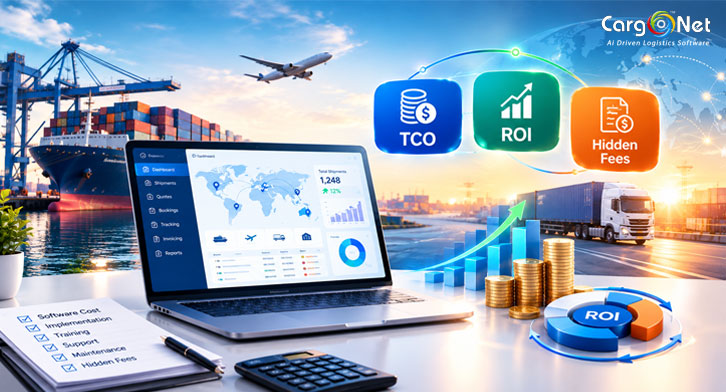
Freight forwarding software cost depends on business size, user count, shipment volume, required modules, integrations, deployment model, and automation capabilities. There is no universal sticker price that applies to every freight forwarding or logistics operation.
For freight forwarders evaluating new technology, the core question is not simply:
“What is the software price?”
The more important questions are:
What is the total cost of ownership (TCO)?
What functionality is included?
What additional costs should we expect?
What operational value can the software deliver?
Modern freight forwarding platforms such as CargoNet can go beyond basic shipment management by connecting sales, operations, finance, documentation, tracking, customer management, integrations, and AI-powered automation.
This complete guide explains freight forwarding software cost, freight forwarder software pricing models, implementation expenses, hidden fees, TCO, cost per shipment, ROI, AI automation, deployment costs, and the key questions to ask before selecting a freight management platform.
Quick Answer: How Much Does Freight Forwarding Software Cost?
There is no single standard price for freight forwarding software. Cost varies according to users, shipment volume, branches, freight modes, modules, integrations, implementation, deployment, support, and automation requirements.
Freight software providers commonly use per-user, per-shipment, modular, subscription, or customized enterprise pricing models.
For a meaningful comparison, freight forwarders should calculate the total cost of ownership (TCO) rather than comparing subscription prices alone.
For example, the actual investment may include:
Software Subscription + Implementation + Data Migration + Integrations + Training + Support + Other Required Costs
CargoNet follows a configurable approach because the requirements of a single-branch freight forwarder can be very different from those of a multi-branch or enterprise logistics organization.
Quick Summary: Freight Forwarding Software Cost Drivers
- Pricing model: Per-user, per-shipment, modular, subscription, or customized enterprise pricing.
- User count: Sales, operations, finance, documentation, management, warehouse, and other users.
- Shipment volume: Monthly and annual shipment or transaction volumes.
- Branch network: Number of offices, countries, business units, and entities.
- Freight modes: Air, ocean, road, rail, FCL, LCL, consolidation, CFS, and other operations.
- Modules: Operations, CRM, rates, quotations, documentation, finance, tracking, WMS, TMS, BI, and automation.
- Integrations: Carrier APIs, EDI, customs, accounting, CRM, TMS, WMS, and other systems.
- AI and automation: Document extraction, validation, intelligent workflows, AI agents, and automated actions.
- Implementation: Configuration, migration, training, integrations, and deployment. ● Support: Standard support, premium support, SLAs, and account management
The most useful value metric is not simply the subscription price. It is the total software cost compared with the operational time, errors, manual effort, and business opportunities the platform can affect.
What Is Freight Forwarding Software?
Freight forwarding software is a digital platform used to manage and automate core freight forwarding activities such as quotations, freight rates, bookings, shipment management, documentation, tracking, invoicing, financial processes, customer communication, and reporting.
Modern freight management software can connect:
Sales → Quotation → Booking → Shipment → Documentation → Tracking → Invoicing → Finance → Reporting
Instead of managing each stage through disconnected spreadsheets, emails, applications, and databases, a centralized freight platform can provide a shared operational environment.
What Can Freight Forwarding Software Manage?
Depending on the platform and configuration, freight software can support:
- Air freight
- Ocean freight
- Road freight
- Rail freight
- Inland transportation
- FCL
- LCL
- Reporting
- Exhibition cargo
- Warehousing
- Port operations
- Courier operations
- Customer portals
- Agent portals
- Tracking
- Workflow automation
- LCL
- Consolidation
- Break-bulk
- CFS and ICD operations
- NVOCC operations
- GSA operations
- Finance
CargoNet extends this model with AI-powered freight intelligence, workflow automation, document processing, integrations, and connected business processes across sales, operations, finance, and documentation.
7 Factors That Determine Freight Forwarding Software Cost
Cost Factor
Operational Impact
What to Check
1. User Count
Pricing may scale with users across sales, operations, finance, and management.
Are full, limited, and view-only users priced differently?
2. Shipment Volume
Transaction-based pricing can increase with shipment volume.
Does pricing increase during seasonal peaks?
3. Branch Network
Multi-branch operations require centralized data and permissions.
Are additional branches charged separately?
4. Freight Modes
Air, ocean, road, rail, FCL, LCL, and CFS operations require different workflows.
Are required modes included?
5. Module Scope
CRM, WMS, TMS, finance, BI, tracking, and automation expand the software scope.
Which modules are included in the base plan?
6. Integrations
APIs and EDI connect freight software with external systems.
Are standard integrations included?
7. AI & Automation
AI can automate document processing and repetitive workflows.
Is AI included or charged separately?
1. User Count
The number of users is one of the most common factors associated with software pricing.
A freight forwarding organization may have users across:
- Sales
- Customer service
- Operations
- Documentation
- Finance
- Management
- Warehouse
- Branch offices
Some providers use a per-user subscription model, while others may include a defined number of users within a package.
- How many users are included?
- Are additional users charged separately?
- Are view-only users charged?
- Are branch users included?
- Are customer and agent portal users included?
For growing organizations, understanding how user pricing scales is important.
2. Shipment Volume
Some freight software providers link pricing to shipment or transaction volume.
A freight forwarder’s transaction volume may include:
- HAWBs
- HBLs
- MAWBs
- Master bills
- Bookings
- Consolidations
- Import shipments
- Export shipments
- Road shipments
- Other transactions
A transactional pricing model can make costs more closely related to usage, but organizations should understand how the model behaves during peak periods.
Questions to ask
3. Branch Network
- Centralized master data
- Branch-level permissions
- Multi-currency support
- Consolidated reporting
- Inter-branch transactions
- Branch profitability
- Centralized rate management
- Shared customer information
- Management dashboards
4. Freight Modes and Operational Scope
- FCL
- LCL
- Consolidation
- CFS
- ICD
- NVOCC
- Project cargo
- Exhibition cargo
- Courier operations
5. Module Requirements
Freight forwarding software is often modular.
A company may start with core operational functionality and later add capabilities such as:
- Sales CRM
- RFQ management
- Rate management
- Quotation
- Shipment management
- Documentation
- Tracking
- Customer portals
- Agent portals
- Invoicing
- Accounts receivable
- Accounts payable
- Profitability
- Warehouse management
- Transport management
- Business intelligence
- Workflow automation
- AI document processing
- AI agents
The more functionality required, the more important it becomes to understand exactly what is included in the software price.
CargoNet Approach
CargoNet brings multiple freight business functions into one connected environment, helping organizations manage sales, operations, finance, documentation, customer processes, and automation from a common data foundation.
6. System Integrations
Freight forwarding rarely operates in isolation.
A freight forwarder may need to connect its software with:
- Shipping lines
- Airlines
- Customs platforms
- Accounting systems
- CRM software
- TMS
- WMS
- Customer systems
- Payment platforms
- Tracking providers
- EDI networks
- APIs
Integration costs can include:
Configuration + Development + Testing + Maintenance + Third-Party Usage Fees
CargoNet supports API and EDI-based connectivity to help organizations connect freight operations with external systems.
Before selecting a platform, ask:
Which integrations are standard, which are configurable, and which require custom development?
7. AI and Automation
AI is becoming an important part of modern freight forwarding software.
Traditional systems digitized data and workflows. AI-powered systems can help interpret documents, identify exceptions, automate repetitive tasks, and support operational decisions.
For example:
Traditional Document Process
Document → Employee Reads → Data Entry → Manual Validation → System Update
AI-Assisted Process
Document → AI Extraction → Validation → Exception Detection → Workflow Action
AI can assist with:
- Exporter invoice and packing list export data extraction
- Bill of Lading /Air way Bill/ shipping data extraction
- Bill of Entry and import document Data extraction
- Invoice data extraction
- Document validation
- Advance Ai powered OCR
- NLP(Natural Language Processing)
- Exception detection
- Freight rate analysis
- Quote assistance
- Tracking workflows
- Invoice processing
- Customer communication
- AI agents
- Workflow automation
CargoNet incorporates AI-powered capabilities into freight workflows, helping transform documents and operational data into actionable information.
The key cost question
Do not ask only:
“How much does the AI feature cost?”
Also ask:
“How many manual hours can the AI eliminate or reduce?”
That provides a more useful basis for calculating business value.
Common Freight Forwarding Software Pricing Models
1. Per-User Subscription
How it works
The customer pays a recurring fee based on the number of users.
Suitable for
Organizations with relatively predictable team sizes.
Watch for
Costs may increase as the organization adds employees or branches.
2. Per-Shipment or Transactional Pricing
How it works
Pricing is connected to the number of shipments or transactions processed.
Suitable for
Businesses that prefer software costs to scale with usage.
Watch for
Peak seasons can increase transaction volumes and therefore software costs.
3. Modular Pricing
How it works
The business selects specific modules and pays according to the required configuration.
For example:
Core Operations + Documentation + Billing
can later expand to:
CRM + Tracking + WMS + AI Automation
Suitable for
Businesses that want to expand their software capabilities gradually.
4. Custom Enterprise Pricing
Enterprise freight forwarding software often requires customized configurations.
The quotation may consider:
- Users
- Branches
- Countries
- Business units
- Freight modes
- Modules
- Integrations
- Security
- Deployment
- Custom workflows
- Support requirements
- Service-level agreements
This approach can be relevant for large freight forwarding and logistics organizations with complex operational environments.
CargoNet can be configured for large and enterprise-level freight forwarding operations, where software requirements may extend beyond standard shipment management.
What Is Included in Freight Forwarding Software Cost?
- Platform access
- Hosting
- Software updates
- Security updates
- Core modules
- User management
- Standard support
- Reporting
- Customer portals
- Agent portals
- Standard integrations
- Workflow automation
- AI capabilities
Hidden Costs of Freight Forwarding Software
The initial quotation rarely represents the entire investment.
A complete evaluation should consider the following.
Implementation and Configuration
Implementation can include:
- Business process configuration
- User roles
- Permissions
- Document templates
- Workflow rules
- Notifications
- Financial configuration
- Operational setup
Data Migration
Moving from an existing system can require:
- Data extraction
- Data cleaning
- Data mapping
- Data transformation
- Data validation
- Data import
Potential migration data includes:
- Customers
- Vendors
- Rates
- Contacts
- Shipments
- Open invoices
- Historical records
- Master data
Third-Party API and EDI Fees
Some integrations may involve external charges from:
- Carrier systems
- Tracking providers
- Customs systems
- Data providers
- Communication platforms
Ask whether these costs are included in the software proposal.
Training and Onboarding
Implementation also requires employee adoption.
Teams may need training across:
- Sales
- Operations
- Documentation
- Finance
- Customer service
- Management
There can also be a temporary productivity impact while teams learn new workflows.
Custom Development
Some organizations require custom workflows, reports, integrations, or business rules.
Ask:
Is customization included, configurable, or charged separately?
Calculate Total Cost of Ownership (TCO)
The most useful way to compare freight forwarding software is to calculate its Total Cost of Ownership.
TCO Formula
TCO = Software Subscription + Implementation + Data Migration + Integrations + Training + Support + Other Required Costs
For a multi-year comparison, calculate these costs across the full evaluation period.
How to Calculate Freight Software Cost Per Shipment
Cost per shipment provides another useful metric.
Formula
Cost Per Shipment = Total Annual Software Expenditure ÷ Total Annual Shipments Processed
Example
Suppose a freight forwarder spends ₹12,00,000 per year on software-related costs and processes 1,20,000 shipments annually.
The calculation is:
₹12,00,000 ÷ 1,20,000 = ₹10 per shipment
This metric can help organizations compare software expenditure with operational volume.
How to Calculate Freight Software ROI
Software should not be evaluated only as a cost.
It can also generate financial value by reducing manual work and improving operational efficiency.
ROI Formula
ROI (%) = (Financial Benefits − Total Software Cost) ÷ Total Software Cost × 100
The financial benefit can include measurable improvements such as:
- Reduced manual data entry
- Lower document processing time
- Faster quotations
- Reduced billing errors
- Faster invoicing
- Reduced repetitive follow-ups
- Improved employee productivity
- Reduced operational errors
- Better shipment visibility
- Improved profitability monitoring
Where Can Freight Software Generate ROI?
1. Manual Data Entry Reduction
AI-powered document processing can extract information from freight documents rather than requiring employees to manually enter every field.
For example:
Bill of Lading → AI Extraction → Validation → Shipment Record
This can reduce repetitive data-entry work.
2. Faster Quotation
A centralized rate management system can help sales teams access relevant rates and prepare quotations faster.
The business impact can include:
● Faster RFQ response
● Reduced manual rate searches
● Improved sales productivity
● Faster customer communication
3. Error Reduction
Automated validation can help identify inconsistent or missing information before it reaches downstream processes.
Potential validation areas include:
- Container numbers
- Shipment references
- Port codes
- Weight
- Customer details
- Tax information
- Billing information
Reducing errors can help prevent rework and downstream operational costs.
4. Faster Invoicing
Connected shipment and finance workflows can reduce repetitive invoice preparation and improve the flow of billing information.
For freight forwarders, faster invoicing can also support improved receivables management.
Cloud vs On-Premise Freight Software Cost
Cloud-Based Freight Software
Cloud deployment can offer:
● Lower initial infrastructure investment
● Remote access
● Centralized updates
● Easier scalability
● Provider-managed infrastructure
● Reduced server management
However, businesses should still evaluate subscription costs over the full contract period.
On-Premise Freight Software
On-premise deployment can involve additional infrastructure costs, including:
● Servers
● Storage
● Network infrastructure
● Security
● Backups
● IT personnel
● Maintenance
● Upgrades
Organizations with specific infrastructure, security, or data-management requirements may still consider local deployment.
Hybrid and Local Cloud Deployment
Some organizations require a combination of centralized cloud services and local infrastructure.
Hybrid or local-cloud deployment can be considered when businesses have specific:
● Security requirements
● Infrastructure policies
● Data-management requirements
● IT policies
● Operational requirements
CargoNet supports flexible deployment models, including cloud, hybrid, local cloud, and on-premise environments, depending on business requirements.
How CargoNet Approaches Freight Software
CargoNet is an AI-powered freight forwarding software platform designed to connect sales, operations, finance, documentation, tracking, and automation.
Instead of treating each department as an isolated workflow, CargoNet provides a connected environment where operational information can move between business functions.
CargoNet can support:
Sales
● Leads
● RFQs
● Quotations
● Freight rates
● Rate negotiation
● Sales follow-up
● CRM
Operations
● Air freight
● Ocean freight
● Road freight
● FCL
● LCL
● Consolidation
● Bookings
● Shipment management
● Documentation
● Tracking
Finance
● Invoicing
● Receivables
● Payables
● Profitability
● P&L
● Multi-currency operations
● Financial workflows
Customer Experience
● Customer portals
● Agent portals
● Shipment visibility
● Self-service
● Notifications
AI and Automation
● Document intelligence
● OCR
● Data extraction
● Validation
● Exception detection
● AI-assisted workflows
● AI agents
● Automated actions
The underlying objective is simple:
One login. One dataset. Total control.
Is CargoNet Suitable for Enterprise Freight Forwarders?
CargoNet supports large and enterprise-level freight forwarding environments where organizations may have complex operational, financial, integration, and automation requirements.
Enterprise requirements can include:
● Multiple branches
● Multiple business units
● Multi-currency operations
● Multiple freight modes
● Customer and agent portals
● API integrations
● EDI
● Advanced reporting
● Complex workflows
● Financial controls
● AI automation
● Flexible deployment
The appropriate CargoNet configuration depends on the operational requirements of each organization.
CargoNet Pricing: What Determines the Cost?
There is no single CargoNet configuration that fits every freight forwarding business.
The appropriate configuration can depend on:
● Number of users
● Business locations
● Freight modes
● Required modules
● Shipment operations
● Integrations
● Automation requirements
● Deployment model
● Enterprise requirements
This allows the software discussion to focus on business requirements rather than a generic one-size-fits-all package.
For current CargoNet plans and pricing information, visit the CargoNet freight forwarding software pricing page.
Freight Forwarding Software Evaluation Checklist
Pricing
- What pricing model is used?
- What is included in the base price?
- Are additional users charged?
- Are additional branches charged?
- Is shipment volume part of pricing?
Implementation
- Is implementation included?
- Is configuration included?
- Is data migration included?
- Is employee training included?
Integrations
- Are APIs included?
- Are EDI integrations included?
- Are carrier integrations included?
- Are customs integrations included?
- Are accounting integrations included?
AI and Automation
- Is AI included?
- Is OCR included?
- Is document extraction included?
- Are AI agents available?
- Are AI features usage-based?
Support
- What support is included?
- What SLA applies?
- Is dedicated support available?
- Is account management included?
Scalability
- Can the platform support additional branches?
- Can new users be added easily?
- Can new freight modes be added?
- Can additional modules be activated?
- Can integrations be expanded?
10 Questions to Ask a Freight Software Vendor
What pricing model do you use?
What exactly is included?
What implementation costs should we expect?
What does data migration cost?
Are integrations included?
How does the price change as we grow?
Are AI features included?
What support is included?
What deployment options are available?
What is the estimated three-year TCO?
Freight Forwarding Software Cost: Price vs. Value
The lowest software quotation is not necessarily the lowest overall business cost.
A better evaluation considers four dimensions:
1. Functional Fit
Does the software support your actual freight forwarding processes?
2. Total Cost of Ownership
What will the organization spend over the expected period?
3. Operational Value
How much manual work, rework, and processing time can the software reduce?
4. Scalability
Can the platform support future users, branches, shipments, freight modes, integrations, and automation?
This approach shifts the discussion from:
“What is the cheapest freight software?”
to:
“Which software provides the required capabilities at an acceptable total cost and creates measurable operational value?”
Why AI Matters When Evaluating Freight Software Cost
AI can change the economics of freight operations by reducing repetitive manual processes.
Consider document processing.
Traditional Workflow
Document → Read → Enter Data → Check Data → Update System → Follow Up
AI-Assisted Workflow
Document → Extract → Validate → Detect Exception → Trigger Action
The difference is not simply technological.
It can change how employees spend their time.
Instead of repeatedly entering and checking information, employees can focus on:
- Customer communication
- Exception management
- Negotiation
- Sales
- Shipment coordination
- Problem solving
- Business development
CargoNet’s AI capabilities are designed to support this transition from manual data processing to intelligent freight workflows.
Final Takeaway: Evaluate the Full Cost of Freight Forwarding Software
The real cost of freight forwarding software is more than the number on a pricing proposal.
A complete evaluation should consider:
Software + Implementation + Migration + Integrations + Training + Support
and compare those costs against:
Time Saved + Errors Reduced + Productivity Gains + Operational Improvements + Business Value
For freight forwarders, the right platform should support current operations while providing room for future growth.
CargoNet brings sales, freight operations, documentation, finance, tracking, customer processes, workflows, and AI-powered automation together in one connected freight forwarding software platform.
Whether you are evaluating software for a single operation, multiple branches, or an enterprise freight network, the most useful comparison is based on total cost of ownership, functional fit, scalability, automation potential, and measurable business value.
Explore CargoNet Freight Forwarding Software Pricing
Ready to understand what freight forwarding software could cost for your business?
Explore CargoNet’s pricing options and flexible software configurations based on your users, shipment volumes, freight modes, modules, integrations, deployment model, and automation requirements.
Compare the capabilities you need and request a customized CargoNet pricing estimate designed around your operational requirements.
CargoNet — AI-Powered Freight Forwarding Software
Smart. Secure. Seamless. Scalable.
Frequently Asked Questions About Freight Forwarding Software Cost
How much does freight forwarding software cost?
What is freight forwarder software pricing based on?
What is the difference between freight software price and total cost of ownership?
Does CargoNet have a fixed price?
Does CargoNet support large freight forwarders?
Does CargoNet support air and ocean freight?
Does freight forwarding software support finance?
What are the hidden costs of freight forwarding software?
How do you calculate freight software ROI?
A basic formula is:
ROI (%) = (Financial Benefits − Total Software Cost) ÷ Total Software Cost × 100
Financial benefits can include measurable reductions in manual processing, errors, administrative work, and processing time, as well as improvements in productivity and operational visibility.