
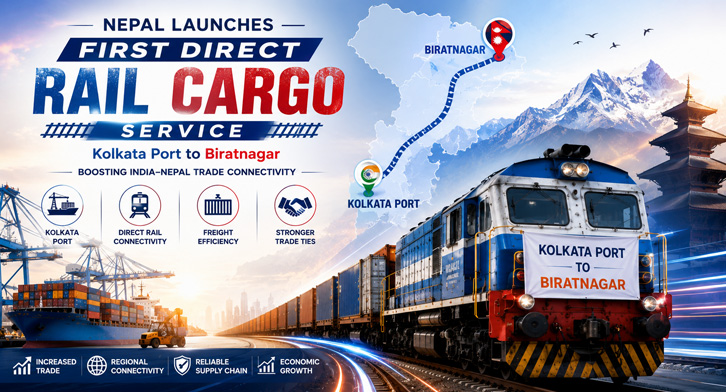
Nepal has achieved a significant milestone in regional logistics by launching its first-ever direct rail cargo service between Kolkata Port and Biratnagar, strengthening cross-border trade with India and improving supply chain efficiency for eastern Nepal.
The new rail corridor allows third-country import cargo arriving at Indian seaports to move directly by rail to Biratnagar Customs Yard under the Nepal–India Transit Treaty, eliminating several logistical bottlenecks and reducing dependence on road transportation.
The inaugural shipment departed from Kolkata Port aboard a Container Corporation of India (CONCOR) freight train carrying 40 high-capacity 40-foot containers operated by Maersk Line. The cargo consisted of Canola Grain – Farmer Dressed, imported for Swastik Oil Industries in Nepal.
Key Highlights
- Nepal launches its first direct rail cargo service to Biratnagar.
- Direct connectivity established from Kolkata Port to Biratnagar Customs Yard.
- Cargo transported under the Nepal–India Transit Treaty.
- Supports imports from Kolkata, Haldia and Visakhapatnam ports.
- Transit time expected to reduce to nearly 24 hours.
- Lower logistics costs, container detention and demurrage charges.
- Electronic Cargo Tracking System (ECTS) enables real-time cargo monitoring.
- Single train can eventually transport up to 45 forty-foot containers.
- Major boost for eastern Nepal's manufacturing and import sector.
Nepal Expands Rail-Based Import Network
Until now, Birgunj was Nepal’s only customs point connected to Indian ports through rail for handling third-country imports.
With the operationalisation of the Biratnagar rail corridor, businesses located in eastern Nepal can now receive imported cargo much faster, improving inventory planning and lowering transportation expenses.
The train will travel via the Jogbani Integrated Check Post (ICP) before arriving at the Biratnagar Customs Yard.
This new logistics corridor is expected to become a strategic gateway for industries located in Nepal’s Koshi Province.
Regulatory Changes Made the Service Possible
The new service became operational following India’s expansion of the Electronic Cargo Tracking System (ECTS) framework.
The initiative was enabled through:
Regulation
Details
CBIC Notification
No. 73/2025-Customs
Issued
4 November 2025
Regulation Updated
Electronic Cargo Tracking System Regulations, 2019
Customs Operational Notice
26 February 2026
Route Approved
Kolkata/Haldia → Jogbani → Biratnagar
These regulatory changes now permit rail transportation of Nepal-bound third-country cargo from multiple Indian ports.
Real-Time Cargo Visibility Through ECTS
Every container in the inaugural shipment has been fitted with India’s Electronic Cargo Tracking System (ECTS).
Benefits include:
- Live cargo tracking
- Improved customs transparency
- Reduced cargo diversion risk
- Faster customs clearance
- Better shipment visibility for importers
Digital tracking is expected to enhance supply chain reliability while improving cross-border customs coordination.
Inaugural Shipment Details
Item
Information
Origin Port
Kolkata Port
Destination
Biratnagar Customs Yard, Nepal
Operator
CONCOR
Shipping Line
Maersk Line
Cargo
Canola Grain – Farmer Dressed
Importer
Swastik Oil Industries
Containers
40 x 40-foot Containers
Future Capacity
Up to 45 Containers per Train
Transit Route
Kolkata → Jogbani ICP → Biratnagar
Benefits for Nepal's Trade
The new corridor is expected to generate significant economic benefits.
Faster Transit
- Approximately 24-hour rail movement
- Less waiting at border crossings
Lower Logistics Costs
Businesses can reduce:
- Road transport expenses
- Container detention charges
- Demurrage costs
- Cargo handling costs
Higher Supply Chain Efficiency
The dedicated rail route offers:
- Better scheduling
- Higher cargo capacity
- Reduced congestion
- Reliable delivery timelines
Industry Welcomes the Initiative
According to the Federation of Nepalese Chambers of Commerce and Industry (FNCCI), the new rail service addresses a long-standing demand from Nepal’s business community.
Industry leaders believe the corridor will:
- Improve Nepal's international trade competitiveness
- Strengthen India–Nepal logistics cooperation
- Encourage greater use of rail freight
- Support industrial growth in eastern Nepal
Impact on Regional Logistics
The direct rail connection is expected to reshape freight movement between India and Nepal.
Previous System
New Direct Rail Service
Heavy dependence on road transport
Direct rail connectivity
Higher logistics costs
Lower transportation costs
Longer transit time
Around 24-hour delivery
Limited rail access via Birgunj
Biratnagar added as second rail-linked customs point
Higher detention charges
Reduced container detention
Limited cargo visibility
Real-time ECTS monitoring
Why This Matters
The launch of the Kolkata–Biratnagar rail cargo corridor represents a major advancement in South Asian logistics connectivity.
As trade volumes between India and Nepal continue to grow, the new rail service is expected to:
- Increase cargo movement efficiency
- Strengthen multimodal logistics
- Support regional economic integration
- Enhance supply chain resilience
- Improve ease of doing business for Nepalese importers
The initiative also reflects the growing emphasis on digital customs procedures, rail-based freight transport, and integrated cross-border logistics across South Asia.
FAQs
What is Nepal's new direct rail cargo service?
It is Nepal’s first direct rail freight service connecting Kolkata Port in India to Biratnagar Customs Yard, enabling faster transportation of third-country imports.
Which ports are covered under the new rail service?
The service supports cargo originating from Kolkata, Haldia, and Visakhapatnam ports.
How much transit time can the service save?
The rail corridor is expected to reduce transit time between Kolkata and Biratnagar to approximately 24 hours.
What is the Electronic Cargo Tracking System (ECTS)?
ECTS is a GPS-based cargo monitoring system that enables customs authorities to track containers in real time throughout transit.
What are the key benefits for Nepalese businesses?
Businesses will benefit from lower logistics costs, reduced demurrage, faster cargo movement, better supply chain visibility, and improved reliability.