
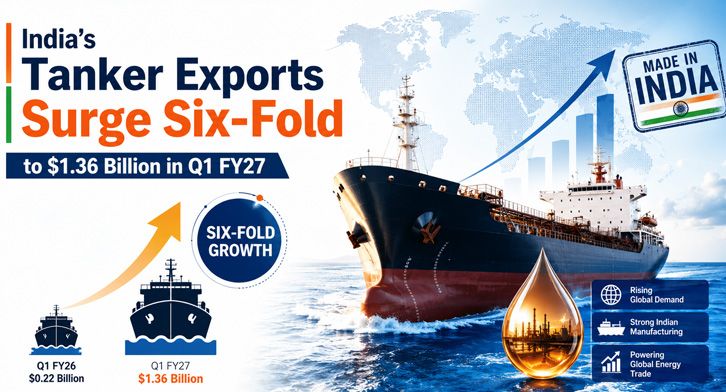
India’s tanker exports climbed to US$1.36 billion during April–June 2026, more than six times the US$221.1 million recorded in the same quarter a year earlier. The number of tankers exported also increased from 10 to 23 vessels, according to Commerce Ministry data.
The sharp increase reflects stronger overseas demand for Indian-built tankers and the country’s expanding capabilities in commercial shipbuilding, maritime engineering and vessel delivery.
Key Highlights
- India exported 23 tankers worth US$1.36 billion in Q1 FY27.
- Export value increased by approximately 515% year-on-year.
- The number of vessels shipped rose by 130%, from 10 to 23.
- The UAE accounted for approximately 66% of total tanker export value.
- Singapore was the second-largest destination at US$146.4 million.
- Tanker exports reached new markets across Africa and Southeast Asia.
- Higher vessel exports could support Indian shipyards, ports, equipment manufacturers and marine logistics providers.
India’s Tanker Export Growth at a Glance
Indicator
Q1 FY26
Q1 FY27
Year-on-year change
Tanker export value
US$221.1 million
US$1.36 billion
Approximately 515%
Number of tankers exported
10
23
130%
UAE export value
US$103.6 million
US$900.8 million
130%Approximately 770%
UAE export value
4
7
75%
Singapore export value
US$45.5 million
US$146.4 million
Approximately 222%
Singapore vessels
2
6
200%
Oman export value
US$28.6 million
US$131.6 million
Approximately 360%
Sri Lanka export value
US$7.9 million
US$56.5 million
Approximately 615%
UAE Leads India’s Tanker Export Market
The United Arab Emirates was the largest buyer of Indian tankers during the quarter. India shipped seven vessels worth US$900.8 million to the UAE, compared with four vessels valued at US$103.6 million in Q1 FY26.
The UAE alone generated approximately two-thirds of India’s tanker export earnings during the period. Its position as a major energy, shipping and logistics centre makes it an important market for Indian shipbuilders and marine equipment suppliers.
Singapore ranked second, purchasing six tankers worth US$146.4 million. This was up from two vessels valued at US$45.5 million in the corresponding quarter last year.
Tanker Exports by Destination in Q1 FY27
Destination
Export value
Approximate share
United Arab Emirates
US$900.8 million
66.20%
Singapore
US$146.4 million
10.80%
Oman
US$131.6 million
9.70%
Sri Lanka
US$56.5 million
4.20%
Egypt
US$39.3 million
2.90%
South Africa
US$39.3 million
2.50%
Vietnam
US$31.5 million
2.30%
Indonesia
US$12.2 million
0.90%
Mozambique
US$7.7 million
0.60%
India Expands into New Tanker Export Markets
The growth was not limited to the UAE, Singapore and Oman. India also supplied tankers to a wider group of maritime markets during Q1 FY27.
Exports to Sri Lanka rose from US$7.9 million to US$56.5 million. New shipments were reported to:
- Egypt: US$39.3 million
- South Africa: US$34.2 million
- Vietnam: US$31.5 million
- Indonesia: US$12.2 million
- Mozambique: US$7.7 million
This geographic spread indicates growing acceptance of Indian-built vessels across the Middle East, Southeast Asia and Africa. It also reduces dependence on a small number of traditional export markets, although the UAE continued to dominate overall earnings.
Why Are India’s Tanker Exports Important?
Tankers are specialised commercial vessels designed to transport liquid or gaseous cargo, including petroleum products, chemicals, liquefied gases and water. Building them requires advanced engineering, specialised materials, safety systems and skilled maritime labour.
Higher exports can generate business across the wider maritime supply chain, including:
- Commercial shipyards and vessel designers
- Marine equipment and component manufacturers
- Classification and inspection companies
- Port and terminal operators
- Ship agents and freight service providers
- Heavy-lift and project logistics companies
- Vessel commissioning and delivery specialists
- Repair and maintenance service providers
The increase in both export value and vessel volume suggests that the growth was supported by more deliveries as well as a higher-value product mix.
Impact on India’s Shipping and Logistics Sector
Growing tanker exports could increase demand for specialised logistics services around Indian shipbuilding clusters. Shipyards require the movement of steel, engines, electrical systems, navigation equipment and other heavy or high-value components.
Ports may also handle more vessel commissioning, bunkering, inspection and delivery activity. Marine service companies could benefit from requirements related to crew movement, technical supplies, certification and post-delivery support.
However, one quarter of exceptional growth does not by itself establish a long-term trend. Future performance will depend on shipyard order books, delivery schedules, global vessel demand and India’s ability to remain competitive on price, quality and delivery time.
Key Takeaway
India’s tanker export value rose from US$221.1 million to US$1.36 billion in one year, while the number of vessels shipped increased from 10 to 23. The UAE drove most of the growth, but new deliveries to Asian and African markets show that India’s tanker export network is becoming more geographically diverse.
The figures strengthen India’s position as an emerging supplier of high-value commercial vessels and could support further growth across shipbuilding, marine manufacturing, ports and specialised logistics.
Frequently Asked Questions
How much were India’s tanker exports in Q1 FY27?
India exported tankers worth US$1.36 billion during April–June 2026, compared with US$221.1 million in the same period a year earlier.
How many tankers did India export during Q1 FY27?
India exported 23 tankers, up from 10 vessels in Q1 FY26.
Which country was the largest buyer of Indian tankers?
The United Arab Emirates was the largest destination, purchasing seven tankers worth US$900.8 million.
What was the UAE’s share of India’s tanker exports?
The UAE accounted for approximately 66% of India’s total tanker export value in Q1 FY27.
Which was the second-largest destination?
Singapore ranked second with tanker imports worth US$146.4 million, covering six vessels.
Why did India’s tanker exports increase?
The available trade data show higher vessel deliveries and stronger international demand. The increase also points to improving commercial shipbuilding and maritime engineering capacity in India.
How can tanker exports benefit India’s logistics industry?
They can create opportunities in project cargo, port services, marine equipment movement, vessel commissioning, ship agency, bunkering and delivery support.