

India’s private-sector business activity strengthened in October 2026, reaching its highest level in four months as improving demand and stronger new orders supported economic expansion. However, the recovery came with a slowdown in employment growth, as companies increasingly relied on existing staff to manage rising workloads.
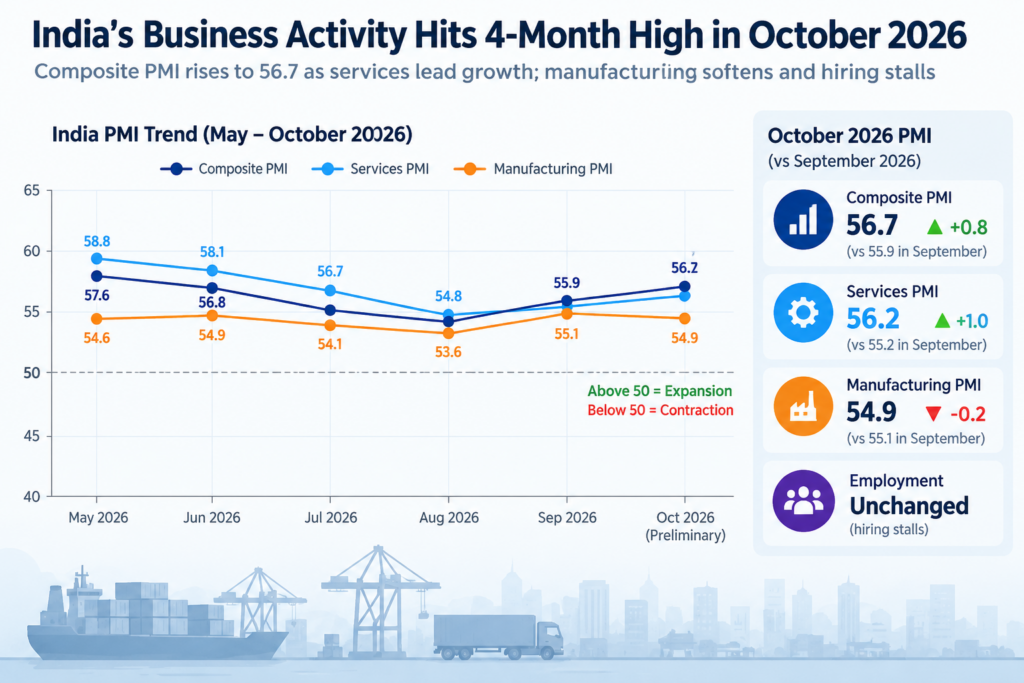
According to the preliminary HSBC India Composite Purchasing Managers’ Index (PMI), compiled by S&P Global, the composite PMI increased to 56.7 in October from 55.9 in September, exceeding the Reuters poll forecast of 56.1.
The latest reading indicates continued expansion in India’s private sector, as a PMI score above 50 represents growth, while a reading below 50 signals contraction.
The improvement was primarily driven by the services sector, which recorded stronger business activity and demand. Manufacturing also reported higher output, although slower recruitment and softer overall sector momentum affected its headline PMI reading.
Key Highlights of India’s October 2026 PMI Report
- Composite PMI: Increased to 56.7 in October from 55.9 in September, marking a four-month high.
- Services PMI: Improved to 56.2 from 55.2, becoming the primary driver of private-sector growth.
- Manufacturing PMI: Declined slightly to 54.9 from 55.1, although manufacturing output continued to increase.
- Employment: Hiring remained unchanged, ending a nine-month period of employment growth.
- Export Orders: International demand strengthened, with total export orders recording their fastest expansion in six months.
- Input Costs: Inflation in input costs eased to its lowest level in nearly 12 months.
- Business Confidence: Improved to its highest level since May 2026.
Services Sector Drives India’s Business Growth
The services industry played a significant role in accelerating India’s private-sector activity during October.
The HSBC India Services PMI increased to 56.2 from 55.2 in September, reflecting stronger demand and improving business conditions.
Service providers reported higher new business volumes, supporting overall output growth. However, employment levels remained unchanged, indicating that businesses were managing additional demand without significantly expanding their workforce.
This suggests that companies are focusing on improving workforce utilisation and operational efficiency rather than increasing headcount.
Manufacturing Activity Continues to Expand Despite Slower Momentum
India’s manufacturing sector continued to record expansion in October, although its headline PMI declined slightly.
The manufacturing PMI fell to 54.9 from 55.1 in September. Despite this marginal decline, the sector remained comfortably above the 50-point expansion threshold.
Manufacturers continued to benefit from improving output and international demand. However, slower recruitment weighed on the overall sector reading.
The data indicates that manufacturing activity remains positive, even as businesses adopt a more cautious approach towards workforce expansion.
Employment Growth Stalls Despite Higher Business Demand
One of the important developments in the October PMI survey was the slowdown in employment growth.
Private-sector hiring remained unchanged, ending a nine-month consecutive period of employment expansion.
Businesses indicated that their existing workforce was sufficient to manage current operational requirements. At the same time, outstanding business backlogs declined at a pace matching the joint-fastest rate recorded in nearly six-and-a-half years.
This suggests that companies are managing workloads more efficiently, although sustained demand could eventually create additional capacity requirements.
India’s Export Orders Record Fastest Growth in Six Months
International demand provided another positive signal for India’s economy in October.
Total export orders expanded at their fastest pace in six months, indicating stronger demand for Indian goods and services in international markets.
However, the improvement was not uniform across sectors.
- Goods manufacturers benefited from stronger international orders.
- Export demand for services weakened compared with previous growth levels.
- Overall export activity nevertheless recorded its strongest expansion in six months.
For India’s export-oriented industries, sustained international demand could support manufacturing output, freight movement, shipping activity and cross-border trade volumes.
Input Cost Inflation Eases, Offering Relief to Businesses
Cost pressures showed signs of moderation during October.
The PMI survey indicated that input-cost inflation declined to its lowest level in almost a year. Selling-price increases also weakened, reaching their slowest pace since March 2025.
This could provide some relief to businesses facing pressure from raw materials, operating expenses and other input costs.
Lower cost inflation may also help companies manage margins more effectively, provided demand remains stable.
India’s PMI Performance: September vs October 2026
The following table highlights the changes in India’s key private-sector PMI indicators.
PMI Indicator
September 2026
October 2026
Movement
Composite PMI
55.9
56.7
Increased
Services PMI
55.2
56.2
Increased
Manufacturing PMI
55.1
54.9
Declined
Source: HSBC India Flash PMI, compiled by S&P Global. October figures are preliminary.
What India’s October PMI Growth Means for Logistics and Freight Forwarding
India’s improving business activity and stronger international orders could have important implications for the logistics and freight forwarding industry.
As manufacturing output and export demand increase, businesses may require greater transportation capacity, international freight services, warehousing and supply chain coordination.
Some potential implications include:
1. Higher export logistics demand
Stronger international orders could support demand for ocean freight, air cargo and cross-border transportation.
2. Increased shipment volumes
Sustained manufacturing and services activity could create additional requirements for domestic distribution and international cargo movement.
3. Greater demand for supply chain visibility
Businesses handling increasing shipment volumes may need better shipment tracking, documentation management and operational coordination.
4. Focus on operational efficiency
With hiring growth stalling, companies may increasingly prioritise automation, digital workflows and technology-enabled productivity.
5. Cost management
Easing input-cost inflation could help businesses manage operating expenses, although freight rates and transportation costs will remain influenced by other market conditions.
For freight forwarders, the developments highlight the importance of scalable operations, accurate documentation and efficient shipment management as trade activity evolves.
Business Confidence Improves as Companies Assess Future Demand
Business confidence recovered in October, reaching its highest level since May 2026. However, sentiment remained below this year’s average.
The improvement indicates that companies are becoming more optimistic about future business conditions, supported by stronger orders and moderating cost pressures.
Nevertheless, slower hiring and uneven international demand across goods and services suggest that businesses remain cautious about expanding capacity.
Frequently Asked Questions
What was India’s Composite PMI in October 2026?
India’s HSBC Flash Composite PMI increased to 56.7 in October 2026, compared with 55.9 in September, indicating the fastest private-sector business expansion in four months.
Why did India’s business activity increase in October 2026?
Stronger new orders, improving demand and increased services sector activity contributed to the acceleration in India’s private-sector business growth.
What was India’s Services PMI in October 2026?
India’s Services PMI increased to 56.2 in October from 55.2, making services the primary driver of overall business activity growth.
What was India’s Manufacturing PMI in October 2026?
India’s Manufacturing PMI declined slightly to 54.9 from 55.1 in September. Despite the decline, the manufacturing sector continued to expand.
Why did hiring stall in India during October 2026?
Businesses reported that existing staffing levels were sufficient to manage current workloads, resulting in unchanged employment levels after nine consecutive months of hiring growth.
How did India’s export orders perform in October 2026?
Overall export orders recorded their fastest expansion in six months, supported primarily by stronger international demand for manufactured goods.
How could India’s October PMI growth affect the logistics industry?
Stronger manufacturing activity and export orders could support demand for freight forwarding, shipping, air cargo, warehousing, transportation and supply chain management services.