
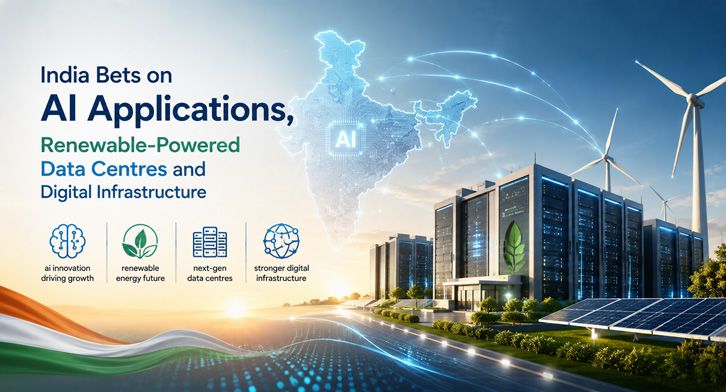
India’s strongest opportunity in artificial intelligence lies in building practical AI applications for businesses and public services, according to Union Electronics and Information Technology Minister Ashwini Vaishnaw.
The country’s established IT sector, large developer base and understanding of enterprise requirements could help Indian companies develop AI solutions for industries including logistics, manufacturing, healthcare, finance and retail.
The minister said nearly 80% of emerging Indian startups are developing AI-based solutions, showing how quickly artificial intelligence is becoming part of the country’s innovation ecosystem.
Important Points
- India’s main AI advantage lies in the applications layer.
- Nearly 80% of emerging startups are reportedly developing AI-powered solutions.
- India has around 250 GW of renewable energy capacity, supporting data-centre expansion.
- The country represents approximately 20% of the global semiconductor design workforce.
- Advanced chip-design tools have been made available to 318 universities.
- Around 90% of India has access to 5G services.
- Railway freight traffic has increased from about 1,000 million tonnes to 1,670 million tonnes over the past decade.
- Stronger digital and transport infrastructure could improve industrial productivity and logistics efficiency.
India’s AI Opportunity Is in Practical Applications
Instead of competing only in the development of large foundational AI models, India is positioning itself as a major developer of AI applications that solve specific business and public-service problems.
India’s IT services industry already has experience in understanding enterprise processes, integrating technology platforms and developing solutions for international customers. This gives the country a strong foundation for applying AI to areas such as:
- Freight and supply-chain management
- Manufacturing automation
- Financial services
- Healthcare delivery
- Agriculture
- Customer support
- Government services
- Document and workflow automation
The growing number of AI-focused startups suggests that artificial intelligence is moving beyond experimentation and becoming part of everyday business operations.
Renewable Energy Could Support Data-Centre Growth
Data centres require large and continuous supplies of electricity to operate servers, cooling systems and network infrastructure. As AI adoption increases, demand for computing power and data-centre capacity is also expected to rise.
India currently has around 250 GW of renewable energy capacity, according to the minister. This could help data-centre operators access cleaner electricity while managing the growing energy requirements of cloud computing and AI workloads.
Renewable-energy availability alone, however, will not determine future data-centre locations. Reliable power supply, transmission capacity, land, water availability, connectivity and cooling efficiency will also influence investment decisions.
India’s Technology and Infrastructure Position
Area
Reported position
Potential impact
AI startups
Nearly 80% of emerging startups developing AI solutions
Faster adoption of industry-specific AI
Renewable energy
Around 250 GW
Cleaner power options for data centres
Semiconductor talent
20% of global chip-design workforce
Strong base for chip design and electronics
University access
318 universities provided chip-design tools
Expansion of semiconductor skills
5G availability
Around 90% coverage
Faster deployment of connected digital services
Railway freight
Increased from 1,000 MT to 1,670 MT
Greater freight capacity and industrial connectivity
Semiconductor Design Strengthens India’s AI Ecosystem
Semiconductors are essential for AI computing, telecommunications, vehicles, industrial equipment and consumer electronics.
India accounts for approximately 20% of the global semiconductor design workforce. Advanced electronic-design automation tools have also been provided to 318 universities, enabling students to gain experience in chip design, fabrication, assembly and testing.
This talent base could help India expand from electronics assembly into higher-value activities such as component manufacturing, semiconductor design, advanced packaging and technology research.
India is also developing capabilities across finished electronic products, modules, sub-modules and components. The government’s broader semiconductor programme covers chip design, fabrication, packaging, materials, equipment and talent development.
5G and Digital Public Infrastructure Support AI Adoption
Around 90% of India reportedly has access to 5G, placing the country among the world’s largest 5G ecosystems.
Wider connectivity can help companies deploy AI-enabled services across factories, warehouses, ports, transport networks and customer-service operations. It could also support connected devices, real-time data exchange and remote access to digital services.
India’s digital public infrastructure provides another foundation for innovation. Shared digital systems can reduce the cost of developing services and allow startups to reach users more efficiently.
Rail Freight Growth Supports Industrial Competitiveness
India’s physical infrastructure is developing alongside its digital ecosystem. Railway freight volumes have risen from approximately 1,000 million tonnes a decade ago to 1,670 million tonnes, according to the minister.
Higher rail-freight capacity can support the movement of raw materials and finished products between industrial clusters, ports, warehouses and consumption centres.
For logistics companies, the combination of better railway infrastructure, 5G connectivity and AI applications could enable:
- More accurate shipment monitoring
- Faster identification of transport delays
- Improved route and capacity planning
- Automated freight documentation
- Better coordination between rail, road, ports and warehouses
- Predictive maintenance of logistics assets
Why This Matters for Freight and Supply Chains
India’s technology and infrastructure investments are becoming increasingly connected. Renewable energy can support data centres, data centres can provide the computing capacity needed for AI, and 5G can connect companies and assets in real time.
At the same time, higher railway freight capacity can improve cargo movement across the country.
Together, these developments could allow freight forwarders, manufacturers, transport operators and warehouses to use AI for document processing, shipment planning, predictive alerts, capacity management and customer communication.
Frequently Asked Questions
What is India’s main strength in artificial intelligence?
India’s main AI strength is considered to be the applications layer. Its IT expertise and large developer ecosystem can help companies create AI solutions for specific business, industrial and public-service requirements.
Why is renewable energy important for data centres in India?
Data centres consume significant amounts of electricity. India’s renewable energy capacity could provide data-centre operators with cleaner power options and support the expansion of energy-intensive AI infrastructure.
How much renewable energy capacity does India have?
Union Minister Ashwini Vaishnaw said India has approximately 250 GW of renewable energy capacity.
What share of the global semiconductor design workforce is based in India?
India accounts for approximately 20% of the global semiconductor design workforce, according to figures cited by the minister.
How can AI improve freight and logistics operations?
AI can help logistics companies extract information from documents, automate repetitive workflows, predict delays, optimize routes, monitor shipments and provide faster customer updates.
How has India’s railway freight volume changed?
Railway freight volumes have reportedly increased from around 1,000 million tonnes a decade ago to approximately 1,670 million tonnes currently.