
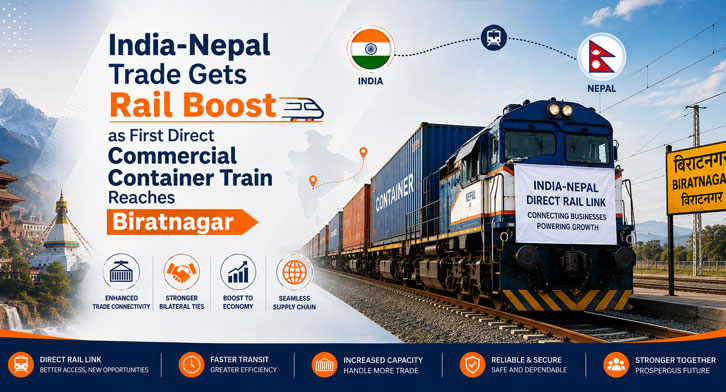
India has taken a major step toward strengthening cross-border freight connectivity with Nepal following the successful operation of the first direct commercial container freight train from Kolkata Port to Biratnagar Customs Yard.
The 40-wagon train, carrying a consignment of canola, travelled directly to Nepal without the need for transshipment at the India-Nepal border. The movement was enabled by the revised India-Nepal Rail Transit Protocol, which allows containerised cargo to move seamlessly by rail between the two countries.
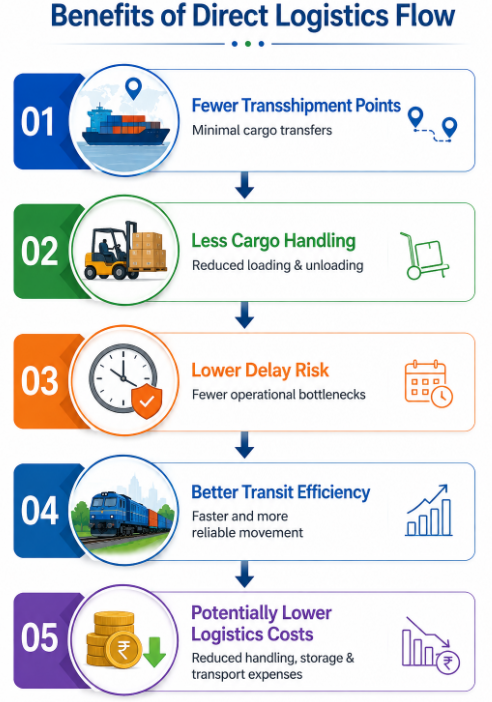
The development is significant for exporters, importers, freight forwarders and logistics operators because eliminating an additional cargo-handling stage can help reduce transit time, handling costs, cargo risks and supply-chain delays.
Key Highlights
- First direct commercial container train: The service connects Kolkata Port directly with Biratnagar Customs Yard in Nepal.
- 40 wagons: The inaugural train carried a consignment of canola.
- No border transshipment: Containerised cargo can move directly by rail, reducing an important handling point.
- Revised transit framework: The service operates under the revised India-Nepal Rail Transit Protocol.
- Stronger Kolkata–Nepal connectivity: The development strengthens the rail-based trade corridor between eastern India and Nepal.
- Lower logistics friction: Direct rail movement can reduce handling, delays and associated logistics costs.
- Greener freight movement: Greater use of rail could support more sustainable cross-border transportation.
- Trade facilitation: The service is expected to improve the efficiency and competitiveness of India-Nepal trade.
Why the Direct Rail Service Matters
Previously, cross-border cargo movements could involve additional handling and transshipment processes. The new direct rail arrangement is designed to simplify the movement of containerised cargo between India and Nepal.
For businesses, fewer cargo-handling stages can translate into a more predictable supply chain. Reduced handling can also lower the risk of delays and cargo damage while improving overall shipment visibility and reliability.
The development is particularly relevant for importers and exporters using eastern Indian gateways to access the Nepalese market.
India-Nepal Direct Rail Freight: Potential Supply Chain Impact
Supply Chain Factor
Earlier Challenge
Impact of Direct Rail Movement
Border handling
Additional cargo handling/transshipment
Reduced handling requirements
Transit time
Delays caused by multiple processes
Potentially faster cargo movement
Logistics cost
Handling and transfer-related costs
Potential cost efficiencies
Cargo risk
More handling points
Lower handling-related risk
Reliability
Dependence on multiple movement stages
More streamlined rail movement
Sustainability
Greater dependence on road-based movement
Greater scope for rail freight
Trade competitiveness
Higher logistics friction
Improved cross-border connectivity
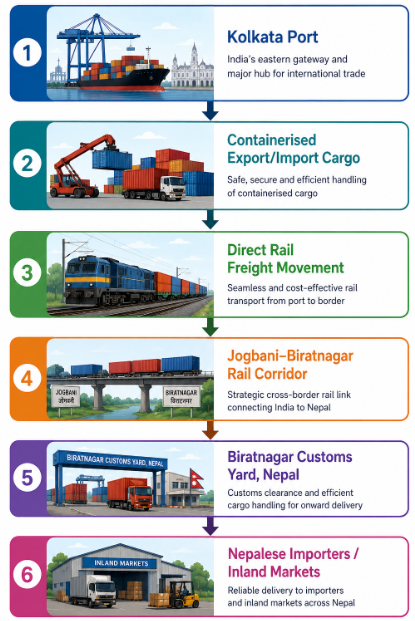
Kolkata Port–Biratnagar Freight Corridor
The new service builds on the Jogbani–Biratnagar broad-gauge rail connection, which was inaugurated in June 2023.
A key policy development followed in November 2025, when India and Nepal signed a revised Letter of Exchange (LoE). The revised framework subsequently enabled direct commercial rail movement to Biratnagar.
The latest train operation therefore represents more than an individual freight movement. It demonstrates the transition from infrastructure development and policy facilitation toward regular commercial rail connectivity.
Key Logistics Benefit
What It Means for India-Nepal Trade
The direct rail service could create new opportunities for industries involved in bilateral trade by providing a more efficient transportation option.
For Indian exporters, improved rail connectivity can strengthen access to Nepalese markets. For Nepalese importers, direct movement from an Indian port can offer an additional freight option for bringing containerised goods into the country.
The service could also create opportunities for freight forwarders, customs brokers, rail operators, container logistics providers and warehousing companies supporting India-Nepal trade.
Wider Logistics Significance
The development comes as India continues to expand its international rail connectivity and multimodal freight infrastructure.
International rail freight can play an important role in reducing dependence on road transportation for suitable cargo flows. Greater rail utilisation can also improve cargo capacity, reduce road congestion and contribute to lower emissions per tonne-kilometre compared with some road-based alternatives.
For the logistics sector, the Kolkata–Biratnagar connection highlights the growing importance of integrated port-to-inland rail corridors in facilitating regional trade.
Impact on Freight Forwarders and Logistics Operators
The new direct rail service could influence logistics planning in several areas:
International rail freight can play an important role in reducing dependence on road transportation for suitable cargo flows. Greater rail utilisation can also improve cargo capacity, reduce road congestion and contribute to lower emissions per tonne-kilometre compared with some road-based alternatives.
For the logistics sector, the Kolkata–Biratnagar connection highlights the growing importance of integrated port-to-inland rail corridors in facilitating regional trade.
- Route optimisation: Freight forwarders can evaluate rail as an alternative or complementary mode for Nepal-bound cargo.
- Lower handling exposure: Fewer cargo transfers can simplify shipment planning.
- Improved service reliability: Direct movement can help reduce delays associated with intermediate handling.
- Multimodal opportunities: Port, rail, customs and inland delivery services can be integrated into a single logistics chain.
- Better cost management: Reduced handling and transfer requirements could improve overall freight economics.
- New logistics demand: Increased rail volumes may support demand for container handling, warehousing, customs clearance and last-mile delivery services.
India-Nepal Rail Connectivity: From Infrastructure to Commercial Freight
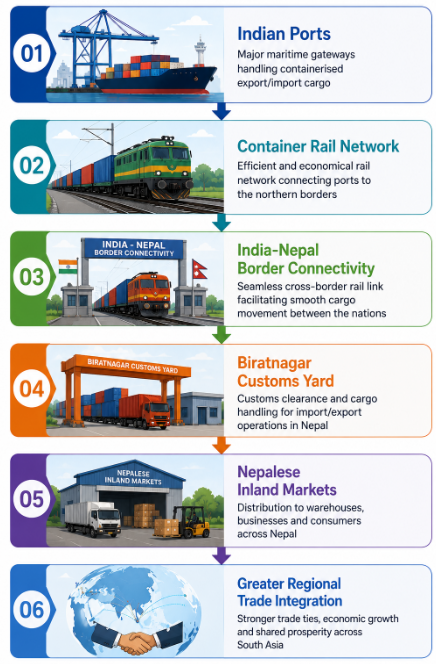
The development of the Jogbani–Biratnagar rail link provided the physical foundation for stronger rail connectivity between the two countries.
The revised transit arrangements have now enabled that infrastructure to support direct commercial container freight movement.
This progression demonstrates how infrastructure + policy reform + commercial operations can collectively improve regional supply-chain connectivity.
Regional Trade Connectivity Chain
What Happens Next?
The successful inaugural service could provide a foundation for greater use of direct rail freight between India and Nepal.
If commercial volumes increase, the corridor could support a wider range of commodities and encourage logistics companies to develop more integrated port-to-destination rail solutions.
For India and Nepal, the development represents an important step toward creating a more seamless regional freight network, while for the logistics industry it reinforces the importance of efficient cross-border rail infrastructure in reducing supply-chain friction.
Conclusion
The arrival of the first direct commercial container freight train from Kolkata Port to Biratnagar Customs Yard marks an important milestone in India-Nepal logistics connectivity.
By eliminating border transshipment for the direct rail movement, the new arrangement has the potential to reduce handling, improve transit efficiency and strengthen the competitiveness of bilateral trade.
More broadly, the development demonstrates how modern rail infrastructure and streamlined transit arrangements can transform cross-border freight corridors and support a more integrated, cost-efficient and sustainable regional supply chain.
FAQs
What is the significance of the first direct India-Nepal container train?
The first direct commercial container freight train from Kolkata Port to Biratnagar Customs Yard enables containerised cargo to move between India and Nepal without transshipment at the border. The service is expected to improve transit efficiency, reduce cargo handling and support lower logistics costs while strengthening bilateral trade connectivity.
What is the new India-Nepal freight rail service?
It is a direct commercial container freight service connecting Kolkata Port in India with Biratnagar Customs Yard in Nepal.
Where did the first direct container train originate?
The inaugural train originated from Kolkata Port.
Where did the train arrive in Nepal?
The train reached Biratnagar Customs Yard in Nepal.
How many wagons were used in the first train?
The inaugural train consisted of 40 wagons carrying a consignment of canola.
Does the new service require transshipment at the border?
The direct arrangement allows containerised cargo to move without transshipment at the India-Nepal border.
What is the India-Nepal Rail Transit Protocol?
It provides the framework governing rail-based movement of freight between India and Nepal. The revised protocol enables direct commercial rail movement to Biratnagar.
How could the service benefit logistics companies?
It can provide freight forwarders and logistics operators with a more streamlined rail option, potentially reducing handling, delays and logistics costs.
Why is the Jogbani-Biratnagar rail link important?
The broad-gauge connection provides critical rail infrastructure linking India’s railway network with Biratnagar in Nepal and supports stronger bilateral freight connectivity.