
According to DynaLiners, the revised service will introduce Karachi and Sohar into the rotation, creating a broader regional network connecting India, Pakistan, the UAE and Oman.
Key Highlights
- Service: Double-stack container train
- Route: Nhava Sheva (JNPA) → ACTL–ICD Faridabad
- Launch date: July 23, 2026
- Cargo: Dry and reefer containers
- Destination: Faridabad, Haryana
- Key infrastructure: Dedicated Freight Corridor (DFC)
- Primary benefit: Higher rail carrying capacity
- Market served: Delhi-NCR and North India's EXIM trade
- Sustainability impact: Potential reduction in road congestion and transport-related emissions
Why the Nhava Sheva–Faridabad Rail Link Matters
Nhava Sheva is one of India’s major gateways for containerised international trade. Moving cargo from the port region to North India by rail can help logistics operators reduce dependence on long-distance road transportation.
The introduction of double-stack container operations is particularly significant because it allows more containers to be moved per train, potentially improving wagon utilisation and overall rail freight efficiency.
The service also benefits from India’s expanding Dedicated Freight Corridor network, which is designed to improve the speed, capacity and reliability of freight movement across major industrial and consumption centres.
Area
Potential Impact
Rail capacity
Higher container carrying capacity through double-stack operations
Port connectivity
Faster evacuation of Nhava Sheva cargo
Delhi-NCR access
Improved connectivity with Faridabad and surrounding markets
Road freight
Potential reduction in long-haul road dependency
Asset utilisation
Better utilisation of rail freight capacity
Reefer logistics
Rail movement capability for temperature-sensitive cargo
Sustainability
Lower road congestion and potential emissions reduction
Multimodal logistics
Stronger integration of port, rail and inland terminals
From Port to North India: Supply Chain Impact
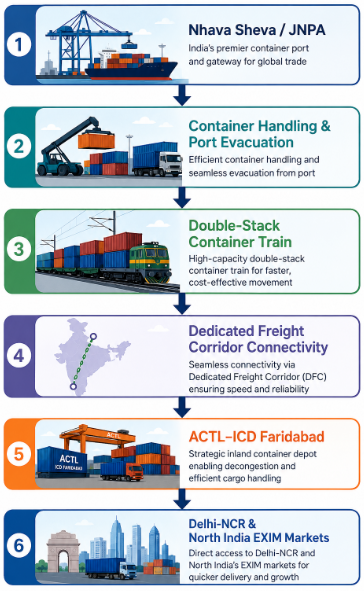
The new rail service strengthens the connection between India’s western maritime gateway and one of the country’s largest consumption and industrial regions.
What Double-Stack Rail Operations Mean for Freight Forwarders
For freight forwarders, exporters, importers and logistics companies, double-stack rail services can create opportunities to improve the economics of long-distance container transportation.
Higher capacity → Better train utilisation → More containers moved per service → Greater rail freight efficiency
The ability to move both dry and reefer containers also expands the potential cargo base that can be served through rail-linked inland logistics networks.
DFC's Role in Strengthening Freight Connectivity
The Dedicated Freight Corridor is an important component of India’s strategy to shift more freight onto dedicated rail infrastructure.
For the Nhava Sheva–Faridabad corridor, stronger rail connectivity can support:
- More efficient inland movement of containers
- Improved port evacuation
- Better connectivity with North Indian markets
- Reduced pressure on road freight corridors
- More predictable multimodal transportation
- Greater integration between ports and inland container depots
Why This Matters for India's Multimodal Logistics Network
The development represents more than the launch of a new train service. It demonstrates the growing role of rail-based multimodal transportation in India’s EXIM supply chain.
As container volumes increase and logistics companies look for more efficient inland transportation options, connections between major ports, freight corridors and ICDs are becoming increasingly important.
The successful operation also highlights the importance of coordination among shipping lines, port terminals, Indian Railways and logistics operators in creating integrated freight solutions.
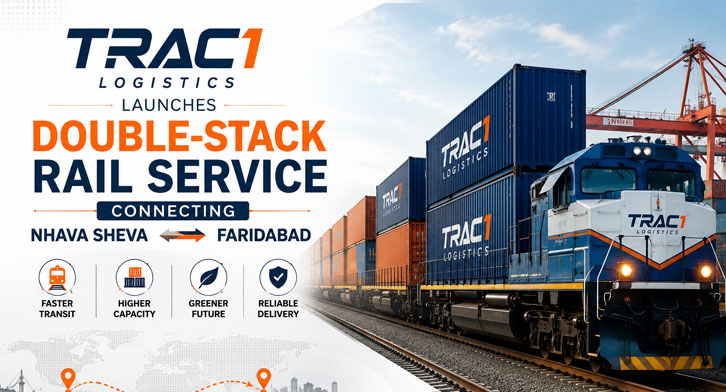
TRAC1 Logistics’ double-stack service between Nhava Sheva and ACTL–ICD Faridabad strengthens rail connectivity between western India and the Delhi-NCR market. With higher-capacity container movement and DFC connectivity, the service could contribute to more efficient, sustainable and multimodal EXIM logistics across North India.
FAQs
What is the new TRAC1 Logistics rail service?
TRAC1 Logistics has commenced a double-stack container train service connecting Nhava Sheva (JNPA) with ACTL–ICD Faridabad in Haryana.
When did the TRAC1 double-stack service begin?
The first service was successfully operated on July 23, 2026.
What type of containers does the service carry?
The inaugural train carried a mixed load of dry and refrigerated (reefer) containers.
Which regions will benefit from the service?
The service is expected to improve connectivity between Nhava Sheva and Delhi-NCR, as well as other key EXIM markets in North India.
How does double-stack rail transportation improve logistics?
Double-stack trains can carry more containers per train, improving carrying capacity and asset utilisation while supporting more efficient long-distance freight movement.
What role does the Dedicated Freight Corridor play?
DFC infrastructure supports more efficient freight movement across major Indian logistics corridors and strengthens rail connectivity between ports and inland markets.