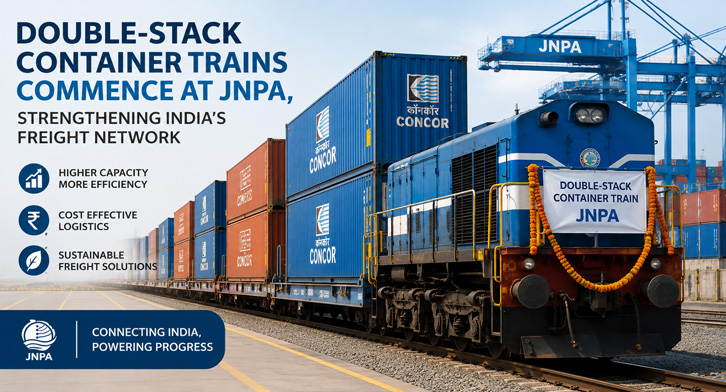
Double-Stack Container Trains Commence at JNPA, Strengthening India’s Freight Network

In a major boost to India’s rail-based logistics network, the Container Corporation of India (CONCOR) has successfully commenced double-stack container train operations on the Western Dedicated Freight Corridor (DFC) from Jawaharlal Nehru Port Authority (JNPA).
The new service connects JNPA with CONCOR Multi-Modal Logistics Parks (MMLPs) at Dadri (Delhi-NCR), Khatuwas (Rajasthan), and Varnama (Gujarat), enabling faster, more efficient, and cost-effective movement of import and export containers across key industrial and consumption centres.

Enhanced Rail Connectivity Across Major Logistics Hubs

The double-stack container train service is now operational in both directions between JNPA and the three MMLPs. It also provides extended connectivity to important inland cargo destinations, including:
The expanded network improves multimodal logistics by offering seamless rail connectivity between ports and inland freight hubs.

Faster Cargo Movement and Lower Logistics Costs

The introduction of double-stack container trains is expected to significantly improve supply chain efficiency by:
The initiative strengthens India’s freight infrastructure while supporting faster evacuation of import and export cargo through the Western DFC.

Strengthening India's Freight and Logistics Ecosystem

The launch of double-stack operations marks another milestone in India’s efforts to modernize its logistics sector through dedicated freight corridors and multimodal transport solutions.
By improving operational efficiency and reducing logistics costs, the service supports India’s ambition to build a faster, more sustainable, and globally competitive freight transportation network.

Key Highlights:

CONCOR Activates 2,400-km Inter-State Logistics Corridor to Boost Industrial Freight Mobility

The Container Corporation of India (CONCOR) has launched a new 2,400-kilometer logistics corridor for the transportation of pig iron, creating a direct freight link between Andhra Pradesh and key industrial markets in North India. The initiative is aimed at improving supply chain efficiency, reducing transit times, and supporting the growing demand for bulk raw materials across the country’s manufacturing sector. By leveraging rail-based logistics, the service is expected to provide a more cost-effective and environmentally sustainable alternative to long-distance road transportation, ensuring reliable transportation of large cargo volumes.
Furthermore, shifting bulk industrial freight from road to rail delivers a major environmental advantage. Rail transport consumes significantly less fuel per ton-mile than long-haul diesel trucks, allowing industrial conglomerates to drastically cut their supply chain carbon emissions and meet national sustainability goals. By building an efficient, low-emission link between southern production centers and northern industrial hubs, this corridor helps create a cleaner, more integrated national supply chain.

Key Highlights:

Maharashtra Proposes Dedicated Multimodal Rail Freight Corridor Linking JNPT and Vadhvan Port

Maharashtra Chief Minister Devendra Fadnavis has proposed the development of a dedicated rail freight corridor connecting Jawaharlal Nehru Port (JNPT) and the upcoming Vadhvan Port with the Samruddhi Expressway. This move aims to significantly reduce logistics costs and enhance the state’s integration into global supply chains by creating a seamless multimodal logistics network. The planned freight corridor would run alongside the 701-km Samruddhi Expressway, where land has already been reserved for railway infrastructure. The corridor would connect dry ports at Jalna and Wardha before extending to Gadchiroli, India’s emerging steel hub.
The construction of this dedicated rail freight corridor will establish a highly efficient multimodal logistics grid across Maharashtra. By laying rail lines directly alongside the existing Samruddhi Expressway, the project utilizes pre-acquired land corridors, skipping the long regulatory delays usually tied to building new rail networks. This close connection between road and rail allows logistics operators to easily switch high-volume container freight between trucks and trains, ensuring a smooth, uninterrupted flow of goods from deep inland factories straight to ocean export docks.
This infrastructure upgrade is designed to bring down India’s overall logistics costs, aiming for a highly competitive level of 7-8% of GDP. Connecting inland dry ports with the upcoming mega-port at Vadhvan—which is designed to be three times larger than JNPT—ensures that manufacturing centers deep in the interior can access global shipping lanes efficiently. This network spreads economic benefits far beyond the coast, transforming inland areas into active industrial zones by giving them a fast, affordable route to international markets.

Key Highlights:

Kerala Maritime Board Invites Commercial Bids for Strategic Warehouse Facility Near Vizhinjam Port

The Kerala Maritime Board (KMB) has invited bids from eligible firms for leasing a strategically located godown facility at Kovalam-Vizhinjam Port, offering businesses a unique opportunity to establish operations in the immediate vicinity of the rapidly emerging Vizhinjam International Seaport. Positioned as a high-potential commercial destination, the facility is expected to attract logistics operators, warehousing companies, exporters, and importers seeking to leverage Vizhinjam’s growing role as a global transshipment hub. The site offers customs-notified non-major port status with ISPS Level-1 compliance and seamless connectivity to road, rail, and air transport networks.
Leasing this specialized storage facility offers a major operational advantage for forward-looking logistics providers. Because the site has customs-notified status and holds strict ISPS Level-1 security compliance, businesses can store high-value export and import cargo securely right next to the main seaport. This proximity cuts out long container hauls from distant inland depots, lowering drayage costs and allowing freight forwarders to move goods onto arriving vessels quickly, maximizing supply chain efficiency.
The facility comes fully equipped with essential heavy handling assets, including an on-site tug boat, a high-capacity crane, an 85-meter wharf, and a certified 60-tonne weighbridge. Having these tools available on-site removes the need for operators to rent third-party equipment, making bulk and breakbulk handling much simpler. With the pre-bid meeting set for June 24 and final submissions due by July 25, 2026, the bidding window gives logistics firms a clear timeline to secure a footprint in one of South India’s fastest-growing maritime corridors.

Key Highlights:

Madhya Pradesh Approves ₹600 Crore Logistics Park in Indore to Strengthen Supply Chain and Freight Infrastructure

The Madhya Pradesh Government has approved the development of a new ₹600 crore logistics park in Indore district, marking a significant step towards strengthening the state’s logistics infrastructure and supply chain capabilities. The project is expected to enhance freight movement, improve connectivity, and support industrial growth across the region.
The Madhya Pradesh Industrial Development Corporation (MPIDC) has allocated approximately 23 hectares of land in Machal village for the project, which will be developed by a private sector company. The initiative aligns with the state’s vision of becoming a major logistics and manufacturing hub in Central India.

Strategic Location to Improve Cargo Connectivity

The upcoming logistics park will benefit from direct connectivity to the Indore–Ahmedabad National Highway, one of the key freight corridors in western and central India. This strategic location will facilitate faster transportation of goods and improve supply chain efficiency for businesses operating in the region.
The facility will also be linked to the Pithampur industrial area, often referred to as the manufacturing hub of Madhya Pradesh, enabling seamless movement of raw materials and finished products.

Strengthening Regional Supply Chain Infrastructure

The logistics park is expected to significantly improve warehousing, cargo handling, transportation, and distribution capabilities in Indore and surrounding industrial zones. By providing modern logistics infrastructure, the project will help industries reduce transportation costs and improve operational efficiency.
The development is likely to benefit sectors such as manufacturing, automotive, pharmaceuticals, engineering, FMCG, and e-commerce, all of which depend on efficient logistics networks for business growth.

Indore Strengthens Position as a Logistics Hub

With continuous investments in industrial and logistics infrastructure, Indore is emerging as one of India’s leading logistics and manufacturing destinations. The addition of the new logistics park will further strengthen the city’s role in facilitating domestic trade and supporting national supply chain networks.
The project aligns with India’s broader logistics modernization agenda aimed at reducing logistics costs, improving multimodal connectivity, and enhancing freight movement efficiency across the country.

Key Highlights:

CONCOR Launches First Domestic Container Rail Service from Mysore to Kolkata, Strengthening India’s Logistics Network

Container Corporation of India (CONCOR) has launched its first outward domestic container service connecting Mysore (MMLP-Kadakola) with Shalimar, Kolkata, marking a significant milestone in India’s rail-based freight transportation sector. The inaugural movement, which took place during the first week of June 2026, involved the dispatch of 80 domestic 20-foot containers, creating a new logistics corridor linking Southern and Eastern India.
The initiative is expected to enhance multimodal connectivity, improve cargo movement efficiency, and provide businesses with a cost-effective and reliable transportation alternative for long-distance freight movement.

New Rail Corridor Enhances Domestic Supply Chain Connectivity

The launch of the Mysore–Kolkata container service strengthens logistics connectivity between key manufacturing, consumption, and distribution centres across India. By providing a dedicated rail-based cargo solution, the service will help industries move goods more efficiently while reducing transit times and transportation costs.
The corridor is expected to benefit a wide range of sectors, including manufacturing, consumer goods, industrial products, agriculture, and retail distribution.

Rail-Based Logistics to Improve Operational Efficiency

The new service reinforces CONCOR’s strategy of promoting rail-led logistics solutions to support India’s growing freight transportation requirements. Rail transportation offers advantages such as higher cargo capacity, lower carbon emissions, improved reliability, and reduced dependence on road transport.
The service is expected to enhance supply chain efficiency, optimize cargo handling operations, and provide greater flexibility for customers seeking sustainable logistics solutions.

Mysore Emerges as a Key Logistics Hub

Industry experts believe the launch will further strengthen the position of MMLP-Kadakola, Mysore, as an emerging logistics hub in Southern India. Improved connectivity with Eastern India will enable businesses in Karnataka to access new markets while facilitating smoother cargo flows between production centres and consumption hubs.
The development is also expected to support regional economic growth by improving freight accessibility and encouraging greater use of multimodal transportation networks.

Supporting India's Multimodal Logistics Vision

The new container service aligns with the Government of India’s broader objectives of increasing the share of rail in freight transportation, reducing logistics costs, and developing an integrated multimodal logistics ecosystem.
As investments continue in freight corridors, logistics parks, and rail infrastructure, initiatives such as this are expected to play a crucial role in improving supply chain resilience and supporting India’s economic growth ambitions.

Key Highlights:

India–UK Relations Strengthened by New Critical Minerals and Maritime Sector Initiatives

India and the United Kingdom have taken significant steps to deepen their strategic partnership with the launch of new initiatives focused on critical minerals, maritime security, trade, defence, and technology cooperation.
The announcements were made during the visit of UK Foreign Secretary Yvette Cooper to India, highlighting the growing alignment between the two countries on economic resilience, supply chain security, and regional stability.

Critical Minerals Observatory to Strengthen Supply Chain Resilience

One of the key outcomes of the visit was the launch of the Critical Minerals Global Supply Chain Observatory. The initiative is aimed at enhancing cooperation in critical minerals, strengthening supply chain resilience, and supporting secure access to essential resources required for clean energy technologies, advanced manufacturing, and strategic industries.
The observatory is expected to improve collaboration on mineral supply chains while addressing emerging global challenges related to resource security and sustainable development.

India and UK Sign Maritime Security Cooperation Agreement

India and the UK also signed a Memorandum of Understanding (MoU) to establish a Regional Maritime Security Centre of Excellence.
The proposed centre will support Indian Ocean nations in building capacity to tackle non-traditional maritime security challenges, including maritime crime, illegal activities at sea, disaster response, and emerging security threats.
The initiative reflects the growing importance of maritime cooperation in ensuring a secure and stable Indo-Pacific region.

Focus on Trade, Defence, Technology, and Clean Energy

During discussions, External Affairs Minister S. Jaishankar and UK Foreign Secretary Yvette Cooper reviewed progress across several key areas of bilateral cooperation, including:
The leaders also discussed new opportunities in artificial intelligence (AI), clean energy technologies, and critical minerals development.

Comprehensive Trade Deal and Defence Roadmap Drive Growth

India and the UK recently finalized the Comprehensive Economic and Trade Agreement (CETA), which is expected to strengthen economic cooperation, increase bilateral trade, and enhance supply chain resilience.
Alongside the trade agreement, both countries have adopted a Comprehensive Strategic Partnership and a Defence Industrial Roadmap designed to expand collaboration in defence manufacturing, innovation, and strategic technologies.
According to Jaishankar, these developments mark a transition in India–UK relations from a primarily historical connection to a future-focused partnership driven by economic growth, advanced technology, and shared strategic interests.

Vision 2035 to Guide Long-Term Partnership

The two nations continue to advance their shared Vision 2035 framework, launched to promote mutual prosperity, sustainable development, and global cooperation.
Prime Minister Narendra Modi highlighted that the deepening India–UK partnership has created unprecedented opportunities for growth and innovation and will continue to contribute to global development and stability.

Key Highlights:

India’s Logistics Sector Gets Boost as YCH Group Plans ₹1,000 Crore Investment

Singapore-based logistics giant YCH Group has unveiled plans to invest up to ₹1,000 crore over the next three to five years to expand its presence in India’s rapidly growing logistics and supply chain sector.
The investment will focus on developing large-scale logistics parks, advanced warehousing facilities, and technology-driven supply chain infrastructure to meet rising demand from industries such as electronics, e-commerce, and semiconductors.

Expansion Plans Target Key Industrial Hubs

YCH Group is planning major logistics park developments in Chennai, Bengaluru, and Mumbai, strengthening its footprint in some of India’s most important manufacturing and consumption centers.
The company aims to build integrated logistics ecosystems that support:
These facilities are expected to enhance supply chain efficiency while supporting India’s growing role in global manufacturing and trade.

Chennai Emerges as a Key Growth Hub

The first phase of expansion is expected to take place near Sriperumbudur in the Chennai region, one of India’s leading industrial and electronics manufacturing clusters.
YCH already operates its largest Indian logistics facility in the region:
The planned expansion is expected to further strengthen Chennai’s position as a major logistics and manufacturing gateway for southern India.

Focus on Technology-Driven Supply Chain Solutions

YCH Group’s investment strategy is centered on next-generation logistics infrastructure that integrates automation, digital technologies, and intelligent supply chain management systems.
The company aims to capitalize on growing demand for:
These capabilities are becoming increasingly important as companies seek greater operational efficiency and supply chain resilience.

Strong Growth Outlook for India Operations

Having operated in India for over 17 years, YCH Group sees significant growth opportunities in the country’s expanding logistics market.
The company expects its India revenues to increase substantially over the next three years:
This represents a potential threefold increase driven by infrastructure expansion, growing customer demand, and rising adoption of organized logistics services.

Expanding National Logistics Network

YCH Group currently maintains an extensive operational presence across India, including:
The planned investments are expected to strengthen the company’s nationwide logistics network while supporting India’s supply chain modernization efforts.

Key Highlights:

Rajasthan’s Global Trade Ambitions Get a Boost with The Thar Dry Port ICD Hirnoda

Hasti Petrochemical & Shipping Ltd (HPCSL) has officially launched The Thar Dry Port ICD Hirnoda, a strategically located Inland Container Depot (ICD) near Jaipur, Rajasthan. The facility was inaugurated on May 30, 2026, marking a significant milestone in the state’s efforts to strengthen logistics infrastructure, enhance export competitiveness, and accelerate industrial growth.
The inauguration ceremony was attended by Rajasthan Chief Minister Bhajanlal Sharma as the Chief Guest, along with Industries Minister Col. Rajvardhan Singh Rathore, Jaipur Rural Member of Parliament Rao Rajendra Singh, and State Minister K.K. Bishnoi.

Strengthening Rajasthan’s Position as a Trade and Logistics Hub

The Thar Dry Port ICD Hirnoda is expected to play a crucial role in improving cargo movement and strengthening Rajasthan’s connectivity with domestic and international markets.

Its strategic location near Jaipur will provide exporters, manufacturers, and logistics operators with enhanced access to containerized cargo services, reducing transportation bottlenecks and improving supply chain efficiency.
The facility is expected to support key industries across Rajasthan by offering faster and more cost-effective logistics solutions.

Lower Logistics Costs and Improved Market Access

According to HPCSL, the new dry port will help reduce logistics costs while improving access to global markets for businesses across the state.
The infrastructure is designed to:
The project is expected to provide a significant boost to exporters seeking greater competitiveness in international markets.

Driving Industrial Growth and Investment

Industry leaders and government officials highlighted the project’s importance in supporting Rajasthan’s long-term economic development objectives.
The Thar Dry Port is expected to:
The facility aligns with broader national initiatives aimed at improving trade infrastructure and strengthening India’s position in global supply chains.

Supporting India's Vision of a Developed Economy

Government representatives emphasized that enhanced logistics infrastructure will be critical in achieving India’s vision of becoming a developed economy (Viksit Bharat).
With its strategic location, improved connectivity, and modern cargo handling capabilities, The Thar Dry Port ICD Hirnoda is expected to contribute significantly to regional economic growth while supporting India’s trade and manufacturing ambitions.

Key Highlights:

Western DFC Strengthens India’s Logistics Infrastructure and Industrial Connectivity

India’s logistics sector is undergoing a major transformation with the rapid development of the Western Dedicated Freight Corridor (WDFC), a 1,506-kilometre freight railway connecting Dadri in Uttar Pradesh to the Jawaharlal Nehru Port Authority (JNPA) near Mumbai. The corridor links some of India’s most important industrial, manufacturing, and agricultural regions with key export gateways, creating a more efficient and reliable freight transportation network.
Designed exclusively for cargo movement, the WDFC is helping reduce transit times, lower logistics costs, and improve supply chain efficiency across multiple industries.

Faster and More Efficient Freight Movement

Unlike conventional rail routes where freight trains share tracks with passenger services, the WDFC operates on dedicated freight lines. This allows trains to run at speeds of up to 100 km/h, compared to the average freight train speed of around 25 km/h on traditional routes.
The corridor also supports double-stacked container trains, significantly increasing cargo capacity while improving operational efficiency. These advantages are enabling businesses to move goods faster and more predictably across the country.

Benefits for Key Industries

The impact of the WDFC is being felt across several sectors. Textile manufacturers in Gujarat, Rajasthan, and Punjab are benefiting from quicker access to major ports such as Mundra and JNPA. Automotive and engineering companies in Haryana and Uttar Pradesh are leveraging lower transportation costs, while agricultural exporters are moving products such as cotton, spices, and pulses more efficiently to global markets.
The pharmaceutical sector is also exploring the corridor’s potential for handling time-sensitive export shipments, supported by improved transit reliability.

Reducing Logistics Costs and Boosting Competitiveness

India’s logistics costs currently account for approximately 13–14% of GDP, significantly higher than the global average of around 8%. By improving freight efficiency and reducing transportation delays, the WDFC is expected to help lower logistics costs and enhance the competitiveness of Indian exporters.
The corridor plays a central role in the government’s PM GatiShakti initiative, which aims to create an integrated, multimodal infrastructure network to support economic growth and trade expansion.

Encouraging Private Sector Innovation

The WDFC is also creating new opportunities for logistics service providers. Recently, logistics technology company Zipaworld Innovation Pvt. Ltd. launched a dedicated warehouse-stuffed full-train service connecting Haryana’s ICD Dhirpur to Mundra Port. The service integrates warehousing, cargo handling, and rail transportation into a single logistics solution, demonstrating how private players are building value-added services around the freight corridor.

Building the Backbone of India's Export Network

Alongside the Eastern Dedicated Freight Corridor (EDFC), the WDFC is set to become a critical pillar of India’s multimodal logistics infrastructure. Together, these corridors will improve connectivity between industrial centers and major ports on both coasts, supporting the country’s ambitions to expand merchandise exports and strengthen its position in global supply chains.

Key Highlights:

cargonet-logo-icon
Cargonet Cargo Software Logo

Feedback & Reward program

Submit the Feedback and avail the Rewards.

1. Your satisfaction & reliability on CargoNet ?

2. Your Rating on Support & co-ordination team?

3. Satisfaction on the look and feel of CargoNet ?

4. Please specify any 2 best features that you feel more helpful in CargoNet?

5. Please specify any 2 best reports that you are taking on regular basis?

6. Are you using Copy Job option in CargoNet Software?

7. Are you using Automatic DSR (Daily Status Report) Option? It automatically sends reports to customer about the shipment status

8. Are you using Automatic Outstanding Reports option? Period Auto outstanding reminders to customer

9. Any other thoughts to improve in CargoNet? Please share.

* Join our Reward Program by recommending CargoNet (Cash Rewards Awaiting)

“Thanks for your feedback. Our goal is to create the best possible product, support & service, and your thoughts, ideas & suggestions play a major role in helping us identify opportunities to improve.”

Cut AI cost ,
not performance

discover how top Freight Forwarding companies  reduce AI-related expense and speed up operation with CargoNet AI, we will show it how

Share your information for instant access :

Get a Demo Now