Indian Railways Freight Loading Rises 4% in June, Strengthening India’s Logistics Growth

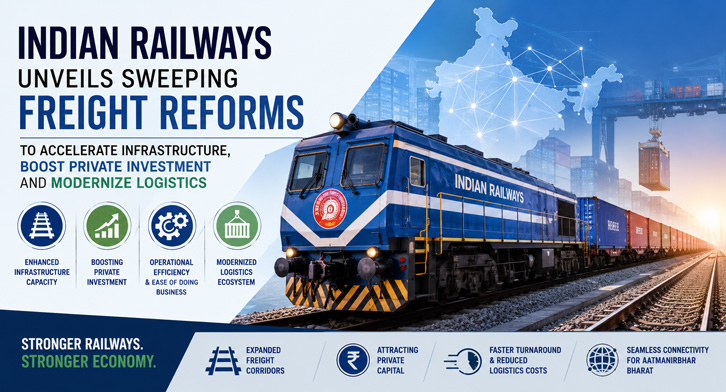
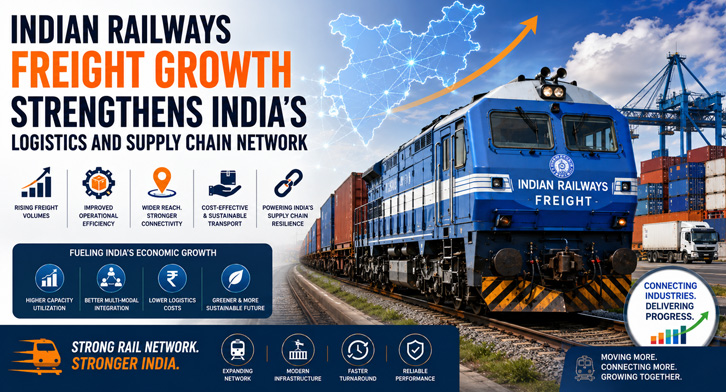
Indian Railways continued its strong freight performance in June, recording a 4% increase in freight loading, reflecting steady growth in cargo transportation and reinforcing its role as the backbone of India’s logistics and supply chain network.
The rise in freight volumes was driven by robust demand from core sectors such as coal, iron ore, steel, cement, fertilizers, and other industrial commodities, highlighting sustained industrial activity and economic resilience. The continued growth also underscores the increasing preference for rail transport as businesses seek cost-effective, reliable, and environmentally sustainable freight solutions.

Indian Railways Maintains Freight Growth in FY27

Freight operations remained resilient during the first quarter (Q1) of FY2026-27, with overall freight loading growing by approximately 1.5% year-on-year despite evolving market conditions and changing cargo demand patterns.
The steady performance demonstrates Indian Railways’ ability to maintain consistent cargo movement while supporting key industries including power generation, manufacturing, mining, agriculture, and infrastructure development.

Infrastructure Investments Driving Higher Freight Efficiency

Indian Railways has been investing heavily in modernizing its freight ecosystem to improve operational efficiency and attract additional cargo from road transport.
Key initiatives include:
These initiatives are helping reduce transit times, improve supply chain reliability, and lower transportation costs for businesses.

Rail Freight Plays a Critical Role in India's Logistics Sector

With rising industrial production and growing domestic consumption, rail freight continues to play a crucial role in moving bulk commodities efficiently across the country.
The government’s continued focus on logistics infrastructure, multimodal connectivity, and freight corridor expansion is expected to further strengthen Indian Railways’ position as one of the most efficient freight transportation networks in Asia.
Industry experts believe sustained investments in rail infrastructure, digitalization, and logistics integration will support long-term freight growth while reducing logistics costs and improving India’s global competitiveness.

Key Highlights

FAQs

Why did Indian Railways freight loading increase in June 2026?
Freight loading increased by 4% due to strong demand from coal, minerals, steel, cement, fertilizers, and other industrial sectors, supported by improvements in rail infrastructure and operational efficiency.
Indian Railways reported approximately 1.5% growth in freight loading during the first quarter of FY2026-27, reflecting stable cargo demand across key industries.
Growth is being driven by infrastructure upgrades, Dedicated Freight Corridors, faster train turnaround, digital freight management, multimodal logistics integration, and increasing demand for bulk commodity transportation.
The initiative aligns with PM Gati Shakti by promoting integrated infrastructure planning, multimodal transportation, and seamless cargo movement across India’s logistics network.
Rail freight offers lower transportation costs, higher fuel efficiency, reduced carbon emissions, and the ability to move large cargo volumes over long distances, making it a vital component of India’s logistics and supply chain network.

CONCOR and RITES Sign Strategic MoU to Accelerate India’s Multimodal Logistics Infrastructure

In a major boost to India’s logistics and infrastructure sector, Container Corporation of India Ltd. (CONCOR) and RITES Limited have signed a strategic Memorandum of Understanding (MoU) to jointly develop next-generation logistics infrastructure across the country. The partnership aims to enhance Project Management Consultancy (PMC) services while supporting India’s vision of creating an integrated, technology-driven, and globally competitive logistics network.
(MoU) to jointly develop next-generation logistics infrastructure across the country. The partnership aims to enhance Project Management Consultancy (PMC) services while supporting India’s vision of creating an integrated, technology-driven, and globally competitive logistics network.
By combining CONCOR’s leadership in containerized cargo transportation and multimodal logistics with RITES’ expertise in engineering consultancy, infrastructure planning, and project execution, the collaboration is expected to accelerate the development of modern freight infrastructure and improve supply chain efficiency nationwide.network.

CONCOR and RITES Partner to Develop Future-Ready Logistics Infrastructure

The newly signed MoU establishes a framework for both public sector enterprises to collaborate on planning, designing, managing, and executing large-scale logistics infrastructure projects across India.
The partnership will focus on delivering efficient and sustainable logistics solutions by integrating advanced engineering capabilities with modern supply chain planning. Through enhanced Project Management Consultancy (PMC) services, both organizations aim to improve project execution, optimize timelines, and strengthen India’s logistics ecosystem.
The collaboration is expected to support the country’s growing demand for efficient freight transportation driven by manufacturing expansion, exports, and industrial development.

Key Areas of Collaboration

Under the strategic agreement, CONCOR and RITES will jointly explore opportunities in developing critical logistics infrastructure, including:
The partnership seeks to introduce global best practices in logistics planning while improving connectivity across India’s transportation network.

Supporting PM Gati Shakti and National Logistics Policy

The collaboration aligns closely with the Government of India’s flagship infrastructure initiatives, including:
By supporting these national programs, CONCOR and RITES aim to help reduce logistics costs, eliminate infrastructure bottlenecks, and enable faster movement of goods across rail, road, ports, and inland logistics hubs.

How the Partnership Benefits India's Logistics Sector

The strategic alliance is expected to deliver several long-term benefits for India’s logistics industry.
Faster Infrastructure Development
Combining engineering expertise with logistics experience can accelerate the execution of major infrastructure projects.
Improved Cargo Movement
Better-designed logistics facilities and multimodal connectivity will enhance cargo handling efficiency and reduce transit delays.
Lower Logistics Costs
Modern infrastructure and optimized freight movement can significantly reduce transportation and operational expenses.
Stronger Supply Chains
Integrated logistics planning will improve reliability, visibility, and resilience across domestic and international supply chains.
Boost to Trade and Manufacturing
Efficient logistics infrastructure supports India’s manufacturing sector, export growth, and overall economic development.

A Step Towards India's Global Logistics Hub Vision

India is investing heavily in modern logistics infrastructure to improve its position in global supply chains. Partnerships between leading public sector enterprises such as CONCOR and RITES play a crucial role in achieving this objective.
Industry experts believe the collaboration could accelerate the development of world-class logistics parks, freight corridors, inland terminals, and integrated cargo facilities while encouraging greater adoption of technology-driven project management practices.
As infrastructure investments continue to grow, such collaborations are expected to strengthen India’s competitiveness as a preferred global manufacturing and logistics destination.

Key Highlights

Why This Matters

India’s logistics sector is undergoing rapid transformation with significant investments in multimodal transportation, digital infrastructure, and supply chain modernization. The collaboration between CONCOR and RITES reflects a broader effort to build efficient freight networks that support manufacturing growth, exports, and economic development.
By leveraging their combined expertise, both organizations are well-positioned to deliver infrastructure projects that enhance connectivity, improve operational efficiency, and contribute to a more resilient logistics ecosystem.

FAQs

Why have CONCOR and RITES signed an MoU?
The MoU aims to combine CONCOR’s logistics expertise with RITES’ engineering and project management capabilities to develop modern logistics infrastructure across India.
The collaboration will focus on multimodal logistics parks, freight terminals, inland container depots, rail-linked logistics infrastructure, engineering consultancy, and integrated supply chain projects.
The partnership is expected to improve infrastructure development, reduce logistics costs, enhance cargo movement efficiency, and strengthen multimodal connectivity.
The initiative aligns with PM Gati Shakti by promoting integrated infrastructure planning, multimodal transportation, and seamless cargo movement across India’s logistics network.
Efficient logistics infrastructure reduces transportation costs, supports exports, strengthens manufacturing, attracts investment, and improves India’s global trade competitiveness.

India’s Logistics Sector Set for Drone Revolution as Market Reaches US$428 Billion

India’s logistics industry is poised for a major transformation as drone deployment is expected to increase by 55% over the next three years, according to a new survey by Nexgen Exhibitions. The rapid adoption of drone technology is expected to improve supply chain efficiency, support sustainable logistics, and enhance last-mile delivery across multiple industries.

The survey comes as India’s logistics market is projected to grow from US$228 billion in 2024 to US$428.7 billion by 2033, highlighting the sector’s strong long-term growth potential.

Drones Driving Smarter and Sustainable Supply Chains

The survey, conducted among 1,000 professionals across major business hubs including Mumbai and Delhi, indicates that drones are rapidly expanding beyond defence applications to become an integral part of commercial logistics operations.
According to the findings:
The increasing use of drones is expected to improve operational efficiency, reduce delivery times, lower transportation costs, and support greener supply chain practices.

Drone Expo to Showcase Industry Innovation

The findings were released ahead of the 7th Drone International Expo, scheduled for June 24–25, 2026, at Bharat Mandapam, New Delhi.
The event will bring together more than 200 global companies, showcasing the latest advancements in drone technology, unmanned aerial systems, logistics solutions, and clean-tech innovations.

Key Highlights:

Dedicated Fly Ash Rail Network to Strengthen Indian Railways Cargo Business

Indian Railways is set to establish a dedicated rail-based logistics network for fly ash transportation, creating a significant opportunity to expand freight business while supporting key industries such as cement, construction, road development, infrastructure, mining, and real estate.
The initiative aims to shift large-scale fly ash transportation from road to rail, improving logistics efficiency, reducing transportation costs, and strengthening India’s bulk cargo supply chain.

Green Logistics Initiative to Improve Supply Chain Efficiency

India generates nearly 340 million tonnes of fly ash annually from thermal power plants. Although much of it is utilized by cement manufacturers, brick makers, and infrastructure projects, a considerable volume remains underutilized due to high transportation costs and logistical challenges.
To address these issues, Indian Railways plans to introduce a green logistics programme featuring specialized containers and dedicated rail corridors connecting fly ash generation centres with major industrial consumption hubs. The network is expected to ensure faster, safer, and more reliable transportation while easing pressure on road infrastructure.

Supporting Sustainability and the Circular Economy

The proposed rail-based transport system will contribute to India’s environmental goals by reducing road freight movement and lowering carbon emissions. Greater utilization of fly ash will also promote the circular economy, reducing landfill disposal while supplying a cost-effective raw material for cement, construction, and infrastructure projects.
The initiative supports sustainable industrial growth by encouraging the recycling and productive use of industrial by-products.

New Freight Opportunity for Indian Railways

The dedicated fly ash transport network is expected to become a major source of additional freight revenue for Indian Railways. As freight transportation remains a key contributor to railway earnings, the initiative aligns with the Railways’ strategy of attracting bulk industrial cargo currently transported by road.
Industry experts believe the programme’s success will depend on modern loading facilities at thermal power plants, efficient handling infrastructure at destination points, and competitive freight pricing. If implemented effectively, the network could create an integrated logistics ecosystem benefiting power producers, industrial consumers, and the railway sector.
With India’s infrastructure and construction activities continuing to expand, demand for fly ash is expected to grow steadily, making dedicated rail transportation an increasingly important component of the country’s industrial supply chain.

Key Highlights:

India Advances Emerging Technologies with AI, 5G, Semiconductors and Digital Infrastructure

India Strengthens Its Position as a Global Technology Leader

India is rapidly emerging as a global technology powerhouse through sustained investments in digital infrastructure, artificial intelligence (AI), semiconductors, quantum computing, cloud computing, blockchain, cybersecurity, and supercomputing. These strategic initiatives are strengthening the country’s innovation ecosystem and supporting the Government’s long-term vision of Viksit Bharat 2047.
With mission-driven technology programmes and robust policy support, India is transforming from a technology consumer into a technology creator while enhancing its global competitiveness.

Digital India Programme Accelerates Digital Transformation

The Digital India Programme has become the foundation of India’s digital transformation by significantly expanding connectivity across the country.
Optical fibre coverage increased from 19.35 lakh route kilometres in 2019 to 42.36 lakh route kilometres in 2025, while internet connections surged from 25.15 crore in 2014 to 102.86 crore in 2026. These developments have improved digital access for businesses, government services, education, healthcare, and financial inclusion.

India Achieves One of the World's Fastest 5G Rollouts

India has successfully completed one of the fastest 5G deployments globally, with services now reaching 99.9% of districts.
The nationwide rollout is enabling faster digital connectivity, supporting Industry 4.0, smart cities, digital businesses, IoT applications, and advanced communication technologies.

India Climbs the Global Innovation Rankings

India’s sustained investment in technology, research, digital governance, and innovation has significantly enhanced its international standing.
The country improved from 81st place in 2015 to 38th in the Global Innovation Index 2025, reflecting stronger research capabilities, digital public infrastructure, startup growth, and technology-driven economic development.

Viksit Bharat 2047: Building a Technology-Driven Future

According to the Government, India’s trusted digital governance systems, expanding research ecosystem, international technology partnerships, and investments in skill development are helping the nation transition into a global technology creator.
Continued investments in AI, semiconductors, quantum technologies, cybersecurity, cloud computing, and digital infrastructure are expected to accelerate innovation-led economic growth, strengthen self-reliance in critical technologies, and position India as a key player in shaping the future global technology landscape.

Key Highlights:

Double-Stack Container Trains Commence at JNPA, Strengthening India’s Freight Network

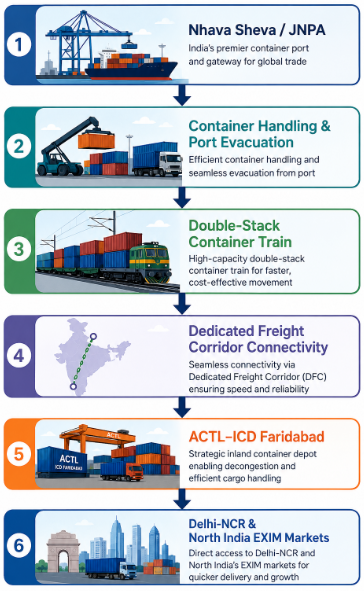
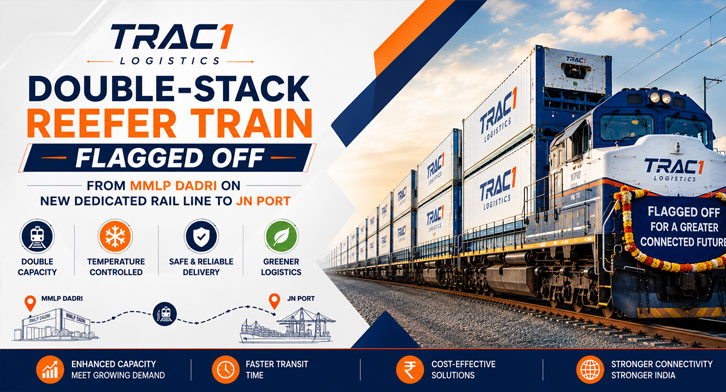
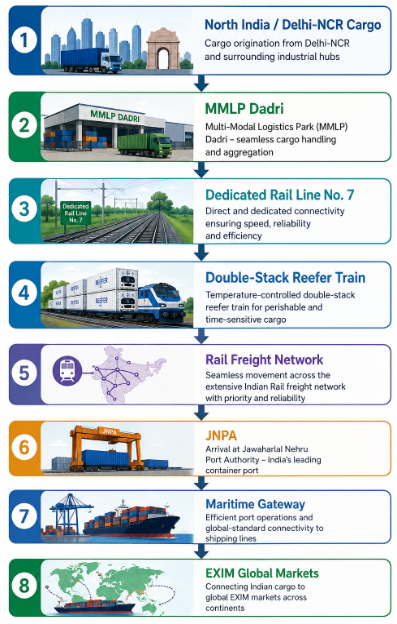
In a major boost to India’s rail-based logistics network, the Container Corporation of India (CONCOR) has successfully commenced double-stack container train operations on the Western Dedicated Freight Corridor (DFC) from Jawaharlal Nehru Port Authority (JNPA).
The new service connects JNPA with CONCOR Multi-Modal Logistics Parks (MMLPs) at Dadri (Delhi-NCR), Khatuwas (Rajasthan), and Varnama (Gujarat), enabling faster, more efficient, and cost-effective movement of import and export containers across key industrial and consumption centres.

Enhanced Rail Connectivity Across Major Logistics Hubs

The double-stack container train service is now operational in both directions between JNPA and the three MMLPs. It also provides extended connectivity to important inland cargo destinations, including:
The expanded network improves multimodal logistics by offering seamless rail connectivity between ports and inland freight hubs.

Faster Cargo Movement and Lower Logistics Costs

The introduction of double-stack container trains is expected to significantly improve supply chain efficiency by:
The initiative strengthens India’s freight infrastructure while supporting faster evacuation of import and export cargo through the Western DFC.

Strengthening India's Freight and Logistics Ecosystem

The launch of double-stack operations marks another milestone in India’s efforts to modernize its logistics sector through dedicated freight corridors and multimodal transport solutions.
By improving operational efficiency and reducing logistics costs, the service supports India’s ambition to build a faster, more sustainable, and globally competitive freight transportation network.

Key Highlights:

CONCOR Activates 2,400-km Inter-State Logistics Corridor to Boost Industrial Freight Mobility

The Container Corporation of India (CONCOR) has launched a new 2,400-kilometer logistics corridor for the transportation of pig iron, creating a direct freight link between Andhra Pradesh and key industrial markets in North India. The initiative is aimed at improving supply chain efficiency, reducing transit times, and supporting the growing demand for bulk raw materials across the country’s manufacturing sector. By leveraging rail-based logistics, the service is expected to provide a more cost-effective and environmentally sustainable alternative to long-distance road transportation, ensuring reliable transportation of large cargo volumes.
Furthermore, shifting bulk industrial freight from road to rail delivers a major environmental advantage. Rail transport consumes significantly less fuel per ton-mile than long-haul diesel trucks, allowing industrial conglomerates to drastically cut their supply chain carbon emissions and meet national sustainability goals. By building an efficient, low-emission link between southern production centers and northern industrial hubs, this corridor helps create a cleaner, more integrated national supply chain.

Key Highlights:

Maharashtra Proposes Dedicated Multimodal Rail Freight Corridor Linking JNPT and Vadhvan Port

Maharashtra Chief Minister Devendra Fadnavis has proposed the development of a dedicated rail freight corridor connecting Jawaharlal Nehru Port (JNPT) and the upcoming Vadhvan Port with the Samruddhi Expressway. This move aims to significantly reduce logistics costs and enhance the state’s integration into global supply chains by creating a seamless multimodal logistics network. The planned freight corridor would run alongside the 701-km Samruddhi Expressway, where land has already been reserved for railway infrastructure. The corridor would connect dry ports at Jalna and Wardha before extending to Gadchiroli, India’s emerging steel hub.
The construction of this dedicated rail freight corridor will establish a highly efficient multimodal logistics grid across Maharashtra. By laying rail lines directly alongside the existing Samruddhi Expressway, the project utilizes pre-acquired land corridors, skipping the long regulatory delays usually tied to building new rail networks. This close connection between road and rail allows logistics operators to easily switch high-volume container freight between trucks and trains, ensuring a smooth, uninterrupted flow of goods from deep inland factories straight to ocean export docks.
This infrastructure upgrade is designed to bring down India’s overall logistics costs, aiming for a highly competitive level of 7-8% of GDP. Connecting inland dry ports with the upcoming mega-port at Vadhvan—which is designed to be three times larger than JNPT—ensures that manufacturing centers deep in the interior can access global shipping lanes efficiently. This network spreads economic benefits far beyond the coast, transforming inland areas into active industrial zones by giving them a fast, affordable route to international markets.

Key Highlights:

Kerala Maritime Board Invites Commercial Bids for Strategic Warehouse Facility Near Vizhinjam Port

The Kerala Maritime Board (KMB) has invited bids from eligible firms for leasing a strategically located godown facility at Kovalam-Vizhinjam Port, offering businesses a unique opportunity to establish operations in the immediate vicinity of the rapidly emerging Vizhinjam International Seaport. Positioned as a high-potential commercial destination, the facility is expected to attract logistics operators, warehousing companies, exporters, and importers seeking to leverage Vizhinjam’s growing role as a global transshipment hub. The site offers customs-notified non-major port status with ISPS Level-1 compliance and seamless connectivity to road, rail, and air transport networks.
Leasing this specialized storage facility offers a major operational advantage for forward-looking logistics providers. Because the site has customs-notified status and holds strict ISPS Level-1 security compliance, businesses can store high-value export and import cargo securely right next to the main seaport. This proximity cuts out long container hauls from distant inland depots, lowering drayage costs and allowing freight forwarders to move goods onto arriving vessels quickly, maximizing supply chain efficiency.
The facility comes fully equipped with essential heavy handling assets, including an on-site tug boat, a high-capacity crane, an 85-meter wharf, and a certified 60-tonne weighbridge. Having these tools available on-site removes the need for operators to rent third-party equipment, making bulk and breakbulk handling much simpler. With the pre-bid meeting set for June 24 and final submissions due by July 25, 2026, the bidding window gives logistics firms a clear timeline to secure a footprint in one of South India’s fastest-growing maritime corridors.

Key Highlights:

Madhya Pradesh Approves ₹600 Crore Logistics Park in Indore to Strengthen Supply Chain and Freight Infrastructure

The Madhya Pradesh Government has approved the development of a new ₹600 crore logistics park in Indore district, marking a significant step towards strengthening the state’s logistics infrastructure and supply chain capabilities. The project is expected to enhance freight movement, improve connectivity, and support industrial growth across the region.
The Madhya Pradesh Industrial Development Corporation (MPIDC) has allocated approximately 23 hectares of land in Machal village for the project, which will be developed by a private sector company. The initiative aligns with the state’s vision of becoming a major logistics and manufacturing hub in Central India.

Strategic Location to Improve Cargo Connectivity

The upcoming logistics park will benefit from direct connectivity to the Indore–Ahmedabad National Highway, one of the key freight corridors in western and central India. This strategic location will facilitate faster transportation of goods and improve supply chain efficiency for businesses operating in the region.
The facility will also be linked to the Pithampur industrial area, often referred to as the manufacturing hub of Madhya Pradesh, enabling seamless movement of raw materials and finished products.

Strengthening Regional Supply Chain Infrastructure

The logistics park is expected to significantly improve warehousing, cargo handling, transportation, and distribution capabilities in Indore and surrounding industrial zones. By providing modern logistics infrastructure, the project will help industries reduce transportation costs and improve operational efficiency.
The development is likely to benefit sectors such as manufacturing, automotive, pharmaceuticals, engineering, FMCG, and e-commerce, all of which depend on efficient logistics networks for business growth.

Indore Strengthens Position as a Logistics Hub

With continuous investments in industrial and logistics infrastructure, Indore is emerging as one of India’s leading logistics and manufacturing destinations. The addition of the new logistics park will further strengthen the city’s role in facilitating domestic trade and supporting national supply chain networks.
The project aligns with India’s broader logistics modernization agenda aimed at reducing logistics costs, improving multimodal connectivity, and enhancing freight movement efficiency across the country.

Key Highlights:

cargonet-logo-icon
Cargonet Cargo Software Logo

Feedback & Reward program

Submit the Feedback and avail the Rewards.

1. Your satisfaction & reliability on CargoNet ?

2. Your Rating on Support & co-ordination team?

3. Satisfaction on the look and feel of CargoNet ?

4. Please specify any 2 best features that you feel more helpful in CargoNet?

5. Please specify any 2 best reports that you are taking on regular basis?

6. Are you using Copy Job option in CargoNet Software?

7. Are you using Automatic DSR (Daily Status Report) Option? It automatically sends reports to customer about the shipment status

8. Are you using Automatic Outstanding Reports option? Period Auto outstanding reminders to customer

9. Any other thoughts to improve in CargoNet? Please share.

* Join our Reward Program by recommending CargoNet (Cash Rewards Awaiting)

“Thanks for your feedback. Our goal is to create the best possible product, support & service, and your thoughts, ideas & suggestions play a major role in helping us identify opportunities to improve.”

Cut AI cost ,
not performance

discover how top Freight Forwarding companies  reduce AI-related expense and speed up operation with CargoNet AI, we will show it how

Share your information for instant access :

Get a Demo Now