
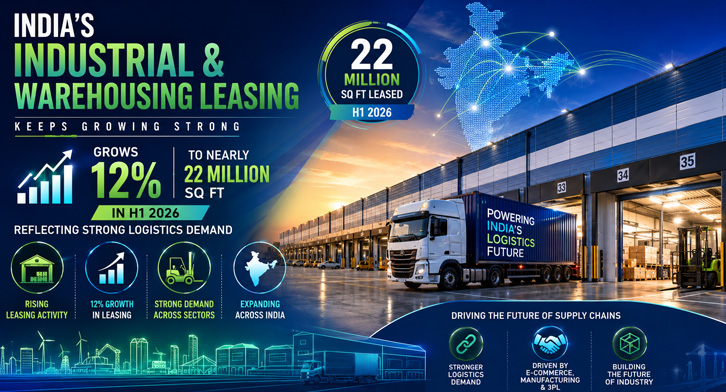
India’s industrial and warehousing real estate market continued its impressive growth trajectory during the first half of 2026, with Grade A leasing activity reaching nearly 22 million square feet, marking a 12% year-on-year increase, according to the latest report by Colliers India. The robust performance highlights the country’s expanding logistics ecosystem, rising manufacturing activity, and sustained demand for modern warehousing infrastructure.
Despite global geopolitical uncertainties affecting supply chains during the second quarter, the sector demonstrated resilience, supported by strong occupier demand, infrastructure investments, and India’s growing role as a global manufacturing and distribution hub.
Key Highlights
- Industrial and warehousing leasing reached nearly 22 million sq ft in H1 2026.
- Leasing activity increased 12% compared to the same period last year.
- Approximately 25 million sq ft of new Grade A warehouse space was added, exceeding leasing demand.
- Delhi-NCR and Chennai jointly contributed over 45% of total leasing activity.
- Third-Party Logistics (3PL) companies remained the largest occupiers with a 30% share.
- Engineering and e-commerce sectors continued to drive warehouse demand.
- Pune, Ahmedabad, and Kolkata recorded more than 30% annual growth in leasing activity.
- Developers remain optimistic, backed by infrastructure development and manufacturing expansion.
India's Industrial Real Estate Market Maintains Strong Momentum
India’s logistics and industrial real estate sector remained one of the country’s strongest-performing commercial real estate segments during the first six months of 2026.
According to Colliers India, leasing activity touched nearly 22 million sq ft, while developers completed approximately 25 million sq ft of new Grade A industrial and warehousing space. The higher supply reflects growing confidence among developers that demand for modern logistics parks and warehouses will continue to expand over the coming years.
The increasing adoption of organized warehousing, improved multimodal connectivity, and the rapid growth of manufacturing have significantly strengthened the market.
New Warehouse Supply Outpaces Leasing Demand
Developers delivered nearly 25 million sq ft of Grade A industrial and warehousing facilities during H1 2026, exceeding leasing volumes.
The continuous addition of high-quality logistics infrastructure indicates confidence in India’s long-term economic outlook, particularly as government initiatives such as infrastructure modernization, industrial corridors, and logistics policy reforms continue to attract domestic and international investment.
Delhi-NCR and Chennai Lead India's Logistics Market
Among India’s major logistics hubs, Delhi-NCR and Chennai emerged as the strongest-performing markets, accounting for more than 45% of total leasing activity during the first half of the year.
Other leading logistics destinations also recorded healthy demand:
City
Market Performance
Delhi-NCR
Largest leasing market
Chennai
Strong manufacturing-led demand
Mumbai
Over 2 million sq ft leased
Pune
Over 2 million sq ft leased
Bengaluru
Over 2 million sq ft leased
These cities continue to benefit from expanding industrial clusters, improved transportation infrastructure, and increasing investments in logistics parks.
3PL Companies Continue to Drive Warehouse Demand
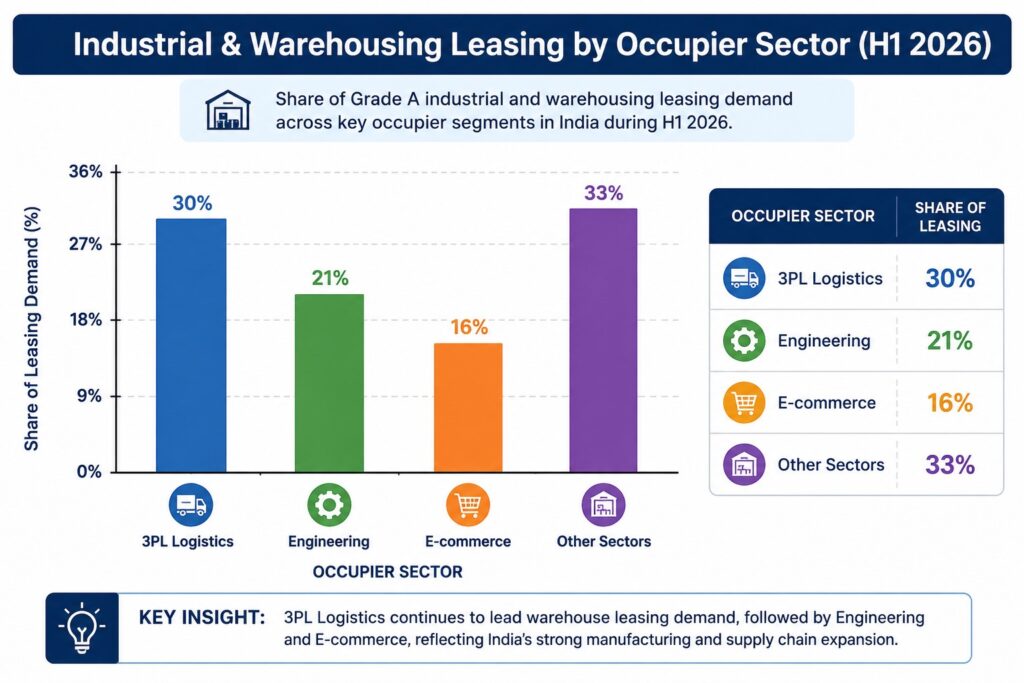
Third-party logistics (3PL) providers remained the largest occupiers of warehouse space during H1 2026, accounting for nearly 30% of total leasing activity.
The engineering sector represented 21% of demand, while e-commerce companies contributed 16%, reflecting sustained investment in distribution networks and supply chain expansion.
Occupier Segment
Share of Leasing
Third-Party Logistics (3PL)
30%
Engineering
21%
E-commerce
16%
Other Industries
33%
Q2 Leasing Slows Slightly Amid Global Supply Chain Challenges
While the first-half performance remained positive, leasing activity experienced a modest slowdown during the second quarter.
Grade A leasing totaled approximately 11 million sq ft in Q2 2026, representing a marginal 1% quarter-on-quarter decline. The slowdown was largely attributed to supply chain disruptions linked to ongoing geopolitical tensions in West Asia, which temporarily impacted business expansion decisions.
However, industry experts believe these challenges are likely to be short-term.
Expert Outlook Remains Positive
Commenting on the market’s performance, Vijay Ganesh, Managing Director – Industrial & Logistics Services, Colliers India, noted that achieving double-digit annual growth despite global uncertainties demonstrates the resilience of India’s industrial and logistics sector.
He also highlighted that emerging markets such as Pune, Ahmedabad, and Kolkata registered annual leasing growth exceeding 30%, indicating that demand is becoming increasingly diversified across multiple regions.
What This Means for India's Logistics Industry
The sustained expansion of industrial and warehousing leasing reflects several long-term trends shaping India’s logistics sector:
- Rising domestic manufacturing under the "Make in India" initiative.
- Increased demand for organized warehousing and logistics parks.
- Continued investment in multimodal transport infrastructure.
- Expansion of e-commerce fulfillment networks.
- Growing adoption of supply chain automation and modern warehouse technologies.
- Increasing foreign investment in industrial and logistics real estate.
These developments are expected to strengthen India’s position as a global manufacturing and logistics hub over the coming years.
Industrial & Warehousing Market at a Glance
Metric
H1 2026
Total Leasing Activity
Nearly 22 Million Sq Ft
Year-on-Year Growth
12%
New Grade A Supply
Approximately 25 Million Sq Ft
Q2 2026 Leasing
Around 11 Million Sq Ft
Largest Occupier
Third-Party Logistics (30%)
Leading Markets
Delhi-NCR & Chennai
Industrial & Warehousing Leasing by Occupier Sector (H1 2026)
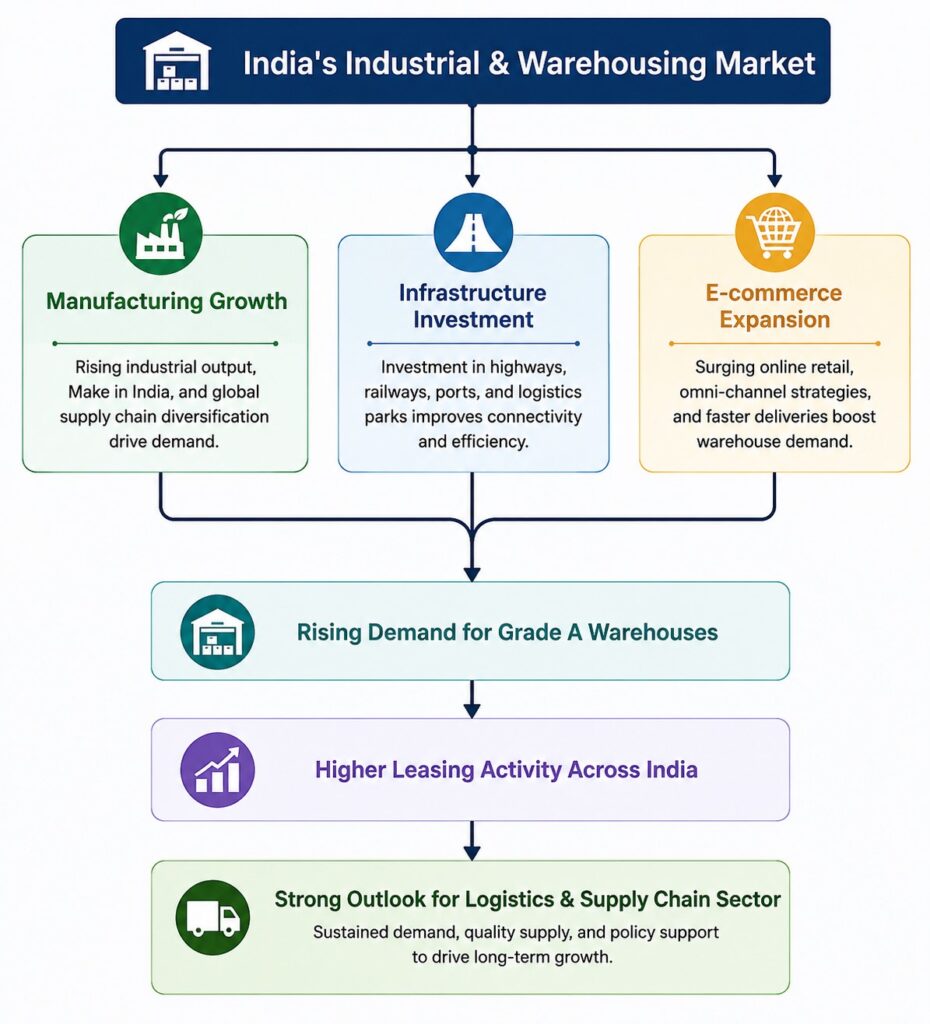
India's Warehouse Demand Growth Framework
Key Takeaways
- India's industrial and warehousing sector continues to demonstrate strong long-term growth.
- Developers are increasing investments in Grade A logistics facilities.
- Delhi-NCR and Chennai remain the country's leading logistics markets.
- Third-party logistics providers continue to dominate warehouse leasing demand.
- Manufacturing expansion, infrastructure development, and supply chain modernization are expected to sustain market growth throughout 2026.
- Trade Associations
Conclusion
India’s industrial and warehousing sector remains one of the strongest pillars of the country’s commercial real estate and logistics ecosystem. With leasing activity reaching nearly 22 million square feet in the first half of 2026, the market continues to benefit from rising manufacturing output, expanding logistics networks, and sustained infrastructure development. As supply chains evolve and businesses invest in modern warehousing solutions, the sector is well-positioned for continued growth through the remainder of 2026 and beyond.
FAQs
How much industrial and warehousing space was leased in India during H1 2026?
Nearly 22 million square feet, representing a 12% year-on-year increase.
Which cities recorded the highest leasing activity?
Delhi-NCR and Chennai led the market, while Mumbai, Pune, and Bengaluru each recorded more than 2 million square feet of leasing.
Which industry leased the most warehouse space?
Third-Party Logistics (3PL) companies accounted for approximately 30% of total leasing demand.
Why did leasing activity slow during Q2 2026?
Temporary supply chain disruptions caused by geopolitical tensions in West Asia led to a slight decline in quarterly leasing activity.
What is the outlook for India's industrial and warehousing sector?
Industry experts expect continued growth, supported by manufacturing expansion, infrastructure investment, logistics modernization, and increasing demand for high-quality warehouse space.