
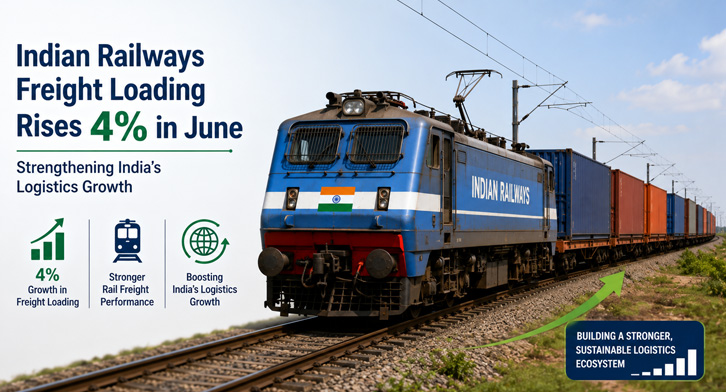
Indian Railways continued its strong freight performance in June, recording a 4% increase in freight loading, reflecting steady growth in cargo transportation and reinforcing its role as the backbone of India’s logistics and supply chain network.
The rise in freight volumes was driven by robust demand from core sectors such as coal, iron ore, steel, cement, fertilizers, and other industrial commodities, highlighting sustained industrial activity and economic resilience. The continued growth also underscores the increasing preference for rail transport as businesses seek cost-effective, reliable, and environmentally sustainable freight solutions.
Indian Railways Maintains Freight Growth in FY27
Freight operations remained resilient during the first quarter (Q1) of FY2026-27, with overall freight loading growing by approximately 1.5% year-on-year despite evolving market conditions and changing cargo demand patterns.
The steady performance demonstrates Indian Railways’ ability to maintain consistent cargo movement while supporting key industries including power generation, manufacturing, mining, agriculture, and infrastructure development.
Infrastructure Investments Driving Higher Freight Efficiency
Indian Railways has been investing heavily in modernizing its freight ecosystem to improve operational efficiency and attract additional cargo from road transport.
Key initiatives include:
- Expansion of Dedicated Freight Corridors (DFCs) to increase freight capacity.
- Faster train turnaround times through operational improvements.
- Faster train turnaround times through operational improvements.
- Digital freight management and cargo tracking systems.
- Capacity enhancement across high-density freight routes.
- Improved last-mile connectivity for industries and ports.
These initiatives are helping reduce transit times, improve supply chain reliability, and lower transportation costs for businesses.
Rail Freight Plays a Critical Role in India's Logistics Sector
With rising industrial production and growing domestic consumption, rail freight continues to play a crucial role in moving bulk commodities efficiently across the country.
The government’s continued focus on logistics infrastructure, multimodal connectivity, and freight corridor expansion is expected to further strengthen Indian Railways’ position as one of the most efficient freight transportation networks in Asia.
Industry experts believe sustained investments in rail infrastructure, digitalization, and logistics integration will support long-term freight growth while reducing logistics costs and improving India’s global competitiveness.
Key Highlights
- Indian Railways freight loading increased 4% in June.
- Q1 FY2026-27 freight loading grew approximately 1.5%.
- Growth supported by coal, minerals, steel, cement, fertilizers, and industrial cargo.
- Dedicated Freight Corridors continue to improve freight capacity.
- Faster turnaround times are enhancing operational efficiency.
- Investments in multimodal logistics infrastructure are strengthening supply chains.
- Rail freight remains a cost-effective and sustainable transportation mode
- Continued infrastructure development is expected to support future freight growth.
FAQs
Why did Indian Railways freight loading increase in June 2026?
Freight loading increased by 4% due to strong demand from coal, minerals, steel, cement, fertilizers, and other industrial sectors, supported by improvements in rail infrastructure and operational efficiency.
How much did Indian Railways freight loading grow in Q1 FY27?
Indian Railways reported approximately 1.5% growth in freight loading during the first quarter of FY2026-27, reflecting stable cargo demand across key industries.
What is driving rail freight growth in India?
Growth is being driven by infrastructure upgrades, Dedicated Freight Corridors, faster train turnaround, digital freight management, multimodal logistics integration, and increasing demand for bulk commodity transportation.
Why is rail freight important for India's logistics sector?
The initiative aligns with PM Gati Shakti by promoting integrated infrastructure planning, multimodal transportation, and seamless cargo movement across India’s logistics network.
Why is this important for India's economy?
Rail freight offers lower transportation costs, higher fuel efficiency, reduced carbon emissions, and the ability to move large cargo volumes over long distances, making it a vital component of India’s logistics and supply chain network.