

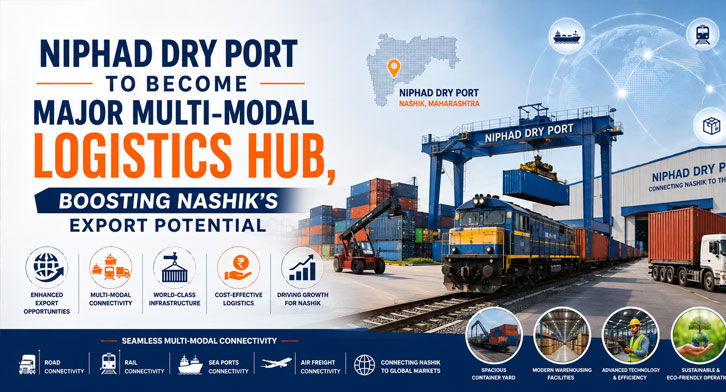
NASHIK: The proposed Niphad Multi-Modal Logistics Park (MMLP) is set to play a significant role in transforming Nashik into a stronger logistics and export hub, with improved connectivity for agricultural producers, manufacturers, exporters and domestic cargo operators.
The development of the proposed Niphad Dry Port was discussed during a meeting between Nashik District Collector Ayush Prasad and JNPT Vice Chairman Ravish Kumar Singh at the Nashik Collector’s Office.
The proposed logistics park is envisioned as more than an Export-Import (EXIM) cargo facility. Authorities are planning an integrated logistics hub capable of handling both domestic and international cargo, supported by road, rail, air and warehousing infrastructure.
Niphad MMLP to Support EXIM and Domestic Cargo
A key focus of the project is to create an integrated logistics ecosystem that can improve cargo movement, storage and distribution across Nashik district.
The proposed dry port is expected to provide exporters and industries with better access to transportation and logistics services while reducing dependence on fragmented logistics operations.
Niphad MMLP to Support EXIM and Domestic Cargo
- Multi-modal logistics hub: Designed to integrate road, rail, warehousing and cargo-handling infrastructure.
- EXIM cargo gateway: Expected to support exporters and importers in Nashik and surrounding industrial areas.
- Domestic logistics: The facility will also handle domestic cargo, distribution and supply-chain activities.
- Agricultural export support: Proposed connectivity with Lasalgaon and Pimpalgaon Baswant APMCs could streamline movement of agricultural commodities.
- Storage infrastructure: Integration with the Centre's grain storage initiative could strengthen agricultural storage and food-supply chains.
- JNPT collaboration: JNPT is working with the district administration to facilitate export-related processes for local industries.
- Strong connectivity: The project will benefit from access to major highways, the Samruddhi Mahamarg, Nashik Ring Road, Ozar Airport and the railway network.
- Employment potential: Improved logistics infrastructure could generate new opportunities in transportation, warehousing, distribution and related services.
Why Niphad Is Strategically Important for Nashik Logistics
Niphad’s location gives the proposed logistics park access to multiple transportation corridors.
The project is expected to leverage connectivity through the Nashik–Chennai Highway, Nashik Ring Road, Samruddhi Mahamarg, Ozar Airport and the railway network.
This combination could allow cargo to move more efficiently between production centres, logistics facilities, ports and domestic consumption markets.
Agricultural Supply Chain Could Be a Major Beneficiary
Agriculture is expected to be one of the major beneficiaries of the proposed logistics infrastructure.
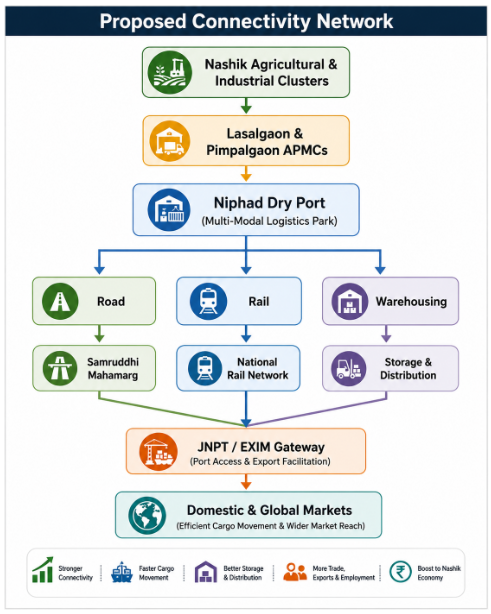
The District Collector has proposed connecting the Lasalgaon and Pimpalgaon Baswant APMCs with the Niphad Dry Port. Other agricultural market committees in Nashik district could potentially be integrated during subsequent phases.
The proposed linkage could create a more organised supply chain between farms, agricultural markets, storage facilities, the dry port and export gateways.
This could be particularly important for agricultural commodities that require efficient transportation, storage and market access.
Potential Agricultural Logistics Flow
Supply Chain Stage
Potential Benefit
Farmers & Producers
Better access to organised logistics
APMCs
Direct connectivity with the dry port
Warehousing
Improved storage and inventory management
Niphad Dry Port
Cargo consolidation and multimodal movement
JNPT
Access to international shipping networks
Export Markets
Improved connectivity and market reach
Grain Storage Integration Could Strengthen the Food Supply Chain
Another proposal discussed during the meeting was linking the Niphad Dry Port with the Centre’s grain storage initiative.
Such integration could help create a stronger connection between agricultural production, storage, transportation and distribution.
For farmers and traders, better storage and logistics infrastructure could help reduce supply-chain inefficiencies and improve access to wider domestic and export markets.
JNPT Steps Up Support for Nashik Exporters
JNPT is also strengthening its engagement with Nashik’s industrial and export ecosystem.
According to the district administration, the Economic Development Cell of Nashik district has been connected with JNPT’s main transport office. The objective is to simplify export-related processes for local industries and exporters.
JNPT will also participate as a key stakeholder in the District Export Promotion Committee meeting scheduled for August 4, 2026.
This collaboration could help local businesses better understand port procedures, export logistics and opportunities to access international markets.
Expected Impact on Nashik's Logistics Ecosystem
Area
Expected Impact
Agriculture
Improved movement and export of agricultural commodities
Manufacturing
Better access to logistics and distribution networks
Exports
Easier access to port-based EXIM infrastructure
Warehousing
Increased demand for modern storage facilities
Transportation
Greater requirement for road and rail cargo movement
Employment
New opportunities across logistics and allied sectors
Trade
Wider access to domestic and international markets
Supply Chains
More integrated multimodal cargo movement
What the Niphad Dry Port Could Mean for Logistics in Nashik
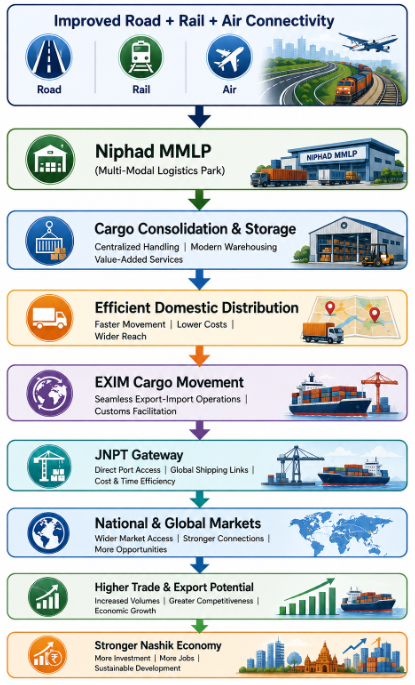
What the Niphad Dry Port Could Mean for Nashik’s Future
The proposed Niphad Multi-Modal Logistics Park represents an important step toward building a more integrated logistics ecosystem in Nashik district.
With road and rail connectivity, access to Ozar Airport, proximity to agricultural production centres and collaboration with JNPT, the project could strengthen the movement of both domestic and EXIM cargo.
The proposed integration of APMCs and grain-storage infrastructure could further enhance Nashik’s agricultural supply chain, while improved export facilitation could support local manufacturers and businesses.
If implemented as planned, the Niphad Dry Port could position Nashik as an important multimodal logistics and export hub in Maharashtra, connecting the district’s agricultural and industrial economy with national supply chains and international markets.
Key Takeaways
- Niphad MMLP is being developed as an integrated domestic and EXIM logistics hub.
- The project is expected to combine road, rail, warehousing and cargo-handling infrastructure.
- Connectivity with Lasalgaon and Pimpalgaon Baswant APMCs could strengthen agricultural exports.
- Integration with the Centre's grain storage initiative could improve the agricultural supply chain.
- JNPT's collaboration could help simplify export processes for Nashik-based industries.
- The project could increase demand for transportation, warehousing, distribution and logistics services.
- Niphad could emerge as a strategic logistics gateway connecting Nashik with national and international markets.
Frequently Asked Questions
What is the Niphad Dry Port?
The Niphad Dry Port is part of the proposed Multi-Modal Logistics Park (MMLP) in Nashik district, Maharashtra. It is planned as an integrated facility for handling both domestic and EXIM cargo.
How will the Niphad MMLP benefit Nashik?
The logistics park is expected to improve cargo transportation, warehousing, distribution and export connectivity while supporting agricultural and industrial supply chains.
Which transport networks will connect the Niphad Dry Port?
The proposed logistics hub will benefit from connectivity through the Nashik–Chennai Highway, Nashik Ring Road, Samruddhi Mahamarg, railway network and Ozar Airport.
How will farmers benefit from the Niphad Dry Port?
Proposed connectivity with Lasalgaon and Pimpalgaon Baswant APMCs could improve the movement of agricultural commodities from market yards to storage facilities, the dry port and export gateways.
What is JNPT's role in the Niphad logistics project?
JNPT is collaborating with the Nashik district administration and has connected the district’s Economic Development Cell with its main transport office to help facilitate export-related processes for local industries and exporters.