Kerala Maritime Board Invites Commercial Bids for Strategic Warehouse Facility Near Vizhinjam Port

The Kerala Maritime Board (KMB) has invited bids from eligible firms for leasing a strategically located godown facility at Kovalam-Vizhinjam Port, offering businesses a unique opportunity to establish operations in the immediate vicinity of the rapidly emerging Vizhinjam International Seaport. Positioned as a high-potential commercial destination, the facility is expected to attract logistics operators, warehousing companies, exporters, and importers seeking to leverage Vizhinjam’s growing role as a global transshipment hub. The site offers customs-notified non-major port status with ISPS Level-1 compliance and seamless connectivity to road, rail, and air transport networks.
Leasing this specialized storage facility offers a major operational advantage for forward-looking logistics providers. Because the site has customs-notified status and holds strict ISPS Level-1 security compliance, businesses can store high-value export and import cargo securely right next to the main seaport. This proximity cuts out long container hauls from distant inland depots, lowering drayage costs and allowing freight forwarders to move goods onto arriving vessels quickly, maximizing supply chain efficiency.
The facility comes fully equipped with essential heavy handling assets, including an on-site tug boat, a high-capacity crane, an 85-meter wharf, and a certified 60-tonne weighbridge. Having these tools available on-site removes the need for operators to rent third-party equipment, making bulk and breakbulk handling much simpler. With the pre-bid meeting set for June 24 and final submissions due by July 25, 2026, the bidding window gives logistics firms a clear timeline to secure a footprint in one of South India’s fastest-growing maritime corridors.

Key Highlights:

India-France Tech Partnership Accelerates Global Innovation Ecosystems

India-France ties are witnessing renewed momentum across technology, innovation, and strategic sectors under the leadership of Prime Minister Mr. Narendra Modi and French President Mr. Emmanuel Macron. French businesses and investors have been invited to become active participants in India’s growth journey as a global innovation and manufacturing hub. As part of a recent official visit, Union Minister Mr. Piyush Goyal toured Sophia Antipolis, Europe’s largest science and technology hub, to model how research, talent, and enterprise drive innovation-led economic growth. Furthermore, Bharat Innovates 2026 showcased India’s thriving startup ecosystem to over 350 global investors.
This technology partnership bridges France’s advanced industrial design capabilities with India’s massive software and engineering workforce. By linking French research institutes with Indian manufacturing centers, both nations are co-developing next-generation technologies in artificial intelligence, green aerospace, and clean energy storage. This collaborative approach helps move the relationship beyond simple import-export trade, turning it into a deep technical alliance that creates high-value IP and builds robust, secure supply chains for advanced technology.
The Bharat Innovates 2026 summit highlighted the strong global confidence venture capitalists place in Indian tech. Over 120 cutting-edge startups and 20 Institutes of Excellence presented solutions across 13 major technology domains, including deep-tech, fintech, and advanced robotics. By providing French and European investors with direct access to top-tier Indian engineering talent, this platform is accelerating cross-border funding, setting the stage for international joint ventures that will deploy advanced tech solutions at scale.

Key Highlights:

India Well Positioned for Growth: Global Reforms and Foreign Capital Infusion

Union Minister of Finance and Corporate Affairs Ms. Nirmala Sitharaman stated that India remains well positioned for long-term economic growth, supported by strong domestic demand and a resilient economy. Speaking at the Mindmine Summit 2026, she emphasized that the Government and the Reserve Bank of India (RBI) are taking structured steps to attract greater foreign capital participation and improve access to global financial markets. Key initiatives include measures under the Fully Accessible Route (FAR) framework and favorable withholding tax provisions for foreign investors.
The structural evolution of the Indian financial ecosystem is designed to build deep market liquidity, allowing global asset managers to seamlessly participate in domestic debt and equity markets. By standardizing tax treatments and removing procedural red tape under the FAR route, India is establishing an institutional framework comparable to mature western financial hubs. This systematic inflow of stable foreign capital acts as an economic buffer, providing the treasury with non-inflationary funding to back heavy infrastructure projects.
While challenges like crude oil price volatility, supply chain disruptions, geopolitical tensions, and climate risks persist, the country’s rising consumption levels provide strong resilience against global uncertainties. This massive consumer base acts as a shock absorber against global inflation cycles. As global trade blocks realign, India’s internal consumption engine ensures that industries remain profitable and active, even during severe contractions in external western consumer demand.

Key Highlights:

VOC Port Records Exponential 114% Traffic Growth in Renewable Windmill Cargo Handling

During the period of April–May in FY 2026-27, V.O. Chidambaranar Port handled significantly higher volumes of windmill blades, registering a massive growth of 113.95 percent compared to the corresponding period of FY 2025-26. The substantial increase reflects the growing momentum of India’s clean energy transition and the rising demand for wind power infrastructure across the country. Windmill blades are a critical component of renewable energy projects, and their efficient movement through ports is essential for timely project execution, positioning the port as a key gateway for clean energy ambitions.
The 114% spike in windmill blade volume highlights the port’s growing reputation as a premier hub for specialized project logistics. Moving oversized, fragile green energy components like windmill blades requires highly specialized equipment, precise crane handling, and extensive open storage space to prevent damage. The port’s strong performance in managing these complex shipments shows that its terminal teams and specialized storage yards can handle difficult, out-of-gauge (OOG) industrial cargo safely and efficiently.
This specialized logistics capability directly supports the timely rollout of large-scale renewable energy installations across India. By ensuring that imported and domestically manufactured wind components move through the terminal without hitches, VOC Port helps clean energy developers avoid costly construction delays. This proven reliability builds deep trust with international energy conglomerates, cementing the port’s role as a vital gateway for the region’s expanding green infrastructure network.

Key Highlights:

India and Slovakia Record Highest Bilateral Trade Volume of $1.81 Billion

India and Slovakia are strengthening their economic partnership, with bilateral trade reaching a record Rs. 15,305.43 crore ($1.81 billion) in 2025, reflecting growing cooperation across manufacturing, automobiles, engineering, information technology, and infrastructure. Bilateral trade crossed the Rs. 8,456.04 crore ($1 billion) mark for the first time in 2024 before rising by nearly 28% in 2025. India’s exports to Slovakia are driven by automotive components, engineering goods, machinery, mobile phones, pharmaceuticals, and electrical equipment. Investment ties have also strengthened significantly, with major Indian conglomerates expanding their active operational footprints in Slovakia.
The rapid growth in trade shows how both nations are leveraging their unique industrial strengths. Slovakia, positioned at the geographic heart of the European Union, serves as a premier automotive manufacturing base, boasting the world’s highest per-capita car production. Indian auto-component manufacturers have integrated directly into this ecosystem, setting up highly dependable supply lines that deliver critical sub-assemblies to Central European factories. This deep operational link helps cushion both economies against regional demand fluctuations by balancing manufacturing loads across different geographies.
A key pillar of this bilateral economic relationship is the Tata Group’s massive investment in the Jaguar Land Rover (JLR) plant in Nitra, Slovakia. Spanning a modern manufacturing footprint, this facility employs over 4,400 people and serves as a vital production hub for premium vehicles sold worldwide. Concurrently, Slovak engineering and technology firms are increasing their presence in India, bringing advanced expertise in railway signaling, heavy machinery components, and renewable energy technologies to actively support India’s national infrastructure upgrades.

Key Highlights:

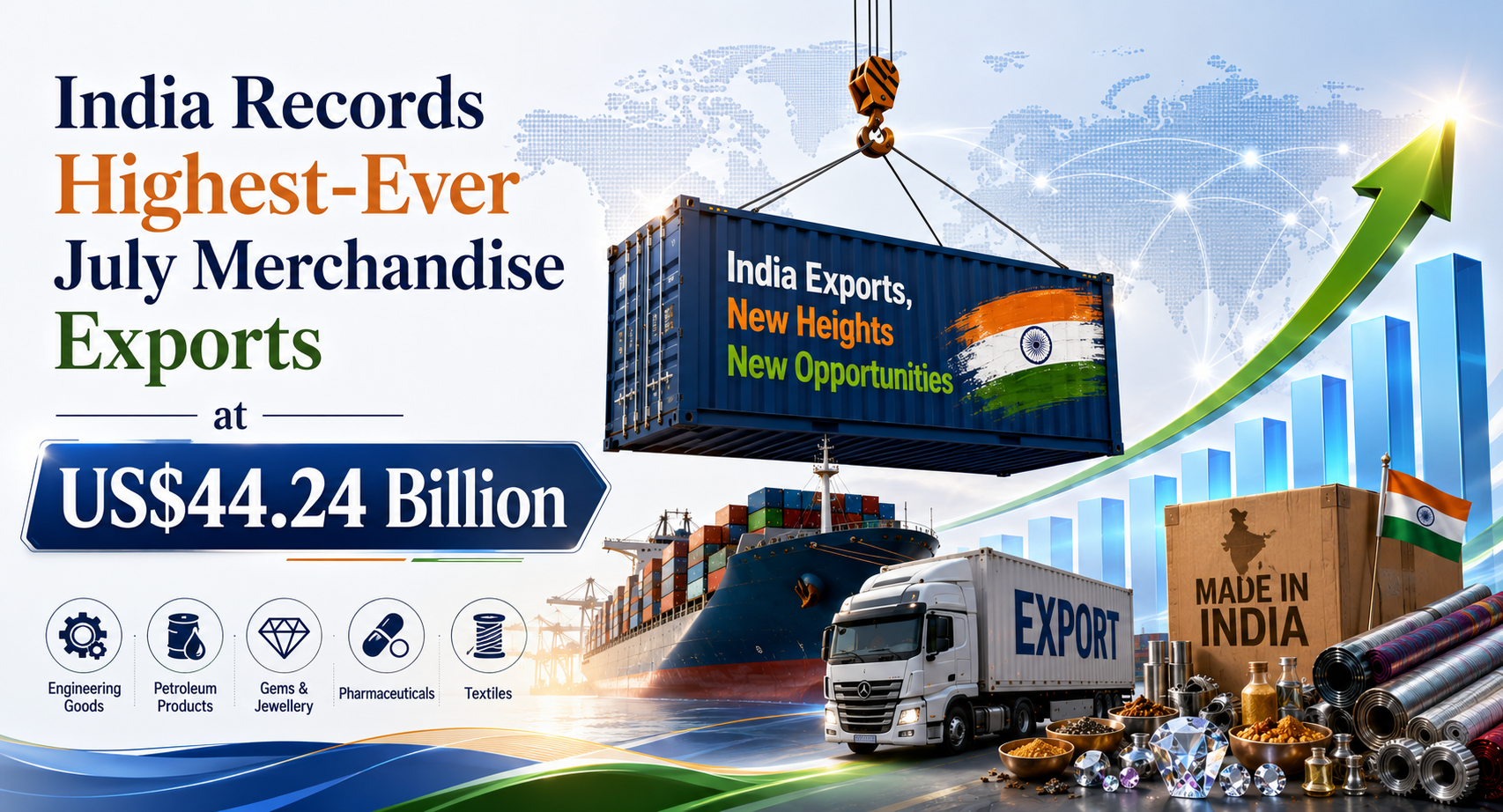
India’s May Goods Exports Reach Historic $45.2 Billion High Amid 18% Surge

India’s merchandise exports jumped to a record monthly high of $45.2 billion in May 2026, marking an 18% year-on-year surge—the sharpest growth seen in six months. Outbound shipments were driven by a massive 55% surge in petroleum products ($8.4 billion) and a 24.5% jump in engineering goods ($12.3 billion). On the import front, elevated net energy bills pushed crude and petroleum imports up 53% to $22.6 billion, while gold imports grew 34% to $3.4 billion, widening the overall trade deficit.
The geometric expansion of engineering and petroleum exports indicates a deeper integration into the global midstream and downstream value chains. Indian refining hubs and precision engineering clusters are outperforming regional competitors by ensuring strict compliance with western quality benchmarks and maintaining stable delivery timelines. This manufacturing shift is drawing multi-national supply chain networks to establish permanent purchasing operations within the Indian subcontinent, transforming local manufacturers from regional suppliers into critical global anchors.
Commerce Secretary Mr. Rajesh Agrawal noted that forward momentum should strengthen further following recent regional peace developments and the anticipated full reopening of the Strait of Hormuz. For international ocean shipping lines, the normalization of transit through this critical choke point will immediately reduce war-risk insurance premiums, lower spot bunker costs, and stabilize transit times between India and Western Europe. The resulting operational predictability will help freight forwarders quote fixed multi-month contract rates, cutting out the sudden surcharges that disrupted trade over the last fiscal year.

Key Highlights:

VOC Port Initiates ₹5,720-Crore Basin Deepening Project to Accommodate Evolving Mega Vessels

The V.O. Chidambaranar Port Authority in Thoothukudi is set to take up a Rs. 5,720-crore project to deepen its harbor basin and approach channel, a move aimed at enabling the port to handle larger container, bulk, and tanker vessels. The project will increase the port’s draught depth to 15.2 meters from the current 12.8 meters, extend the approach channel from 3.8 km to 10.04 km, modify the port entrance, and construct six new berths. Once completed, the enhanced depth will allow the port to handle fully laden Panamax vessels carrying up to 90,000 tonnes and very large container ships with capacities of up to 14,000 TEUs, preventing cargo diversion to nearby regional ports.
The ₹5,720-crore investment to deepen the harbor basin will bring major changes to freight logistics across South India. Currently, the port’s 12.8-meter draught prevents modern, deep-draft mainline vessels from docking fully loaded, forcing them to route cargo through intermediate ports. By deepening the basin to 15.2 meters and extending the navigation channel to 10.04 km, VOC Port will be fully equipped to handle massive 14,000 TEU container ships directly, cutting out extra handling steps and saving time for regional shippers.
This infrastructure upgrade will help lower overall shipping costs across the region. Allowing large mainline vessels to dock directly in Thoothukudi enables shipping lines to take advantage of economies of scale, reducing ocean freight rates per container. This increased efficiency positions VOC Port as a highly competitive maritime hub, allowing it to retain local cargo volumes and stand strong alongside neighboring deep-water hubs like Vizhinjam and Colombo.

Key Highlights:

CULines Expands Maritime Network via Strategic Vessel Deployment on Hercules Route

CU Lines has announced the deployment of its vessels on the Hercules service, a move aimed at expanding the carrier’s network reach and enhancing cargo connectivity across key regional trade lanes. The decision reflects the company’s strategy to strengthen its market presence while offering customers additional shipping capacity and service options. By assigning vessels to the Hercules route, CU Lines is expected to improve coverage for shippers moving cargo between major commercial hubs served by the network, helping to maintain reliable sailing schedules across the route.
This route expansion comes at a time when shippers are actively looking for reliable alternatives to congested main trade lanes. By adding vessels to the Hercules loop, CU Lines gives freight forwarders more options to bypass port bottlenecks, helping to keep cargo moving steadily between key manufacturing centers. This deployment helps distribute the cargo load more evenly across regional networks, reducing transit delays and protecting supply chains from unexpected disruptions on primary shipping routes.
Additionally, the strategy shows how container lines are collaborating through slot-sharing and vessel-sharing agreements to maximize fleet efficiency. Instead of operating isolated routes, carriers are linking their networks to offer more frequent sailings and broader port coverage without needing to build new ships. For logistics providers, this integrated approach translates into highly reliable schedules and greater flexibility when booking space for time-sensitive cargo across growing regional economies.

Key Highlights:

Indian Tractor Exports Breach 10,000-Unit Milestone to Record 13-Month High

India’s tractor manufacturers achieved a major international trade breakthrough in May 2026, with monthly exports up 14% year-on-year to a 13-month high of 10,165 units. This milestone shows how Indian-made farm machinery is expanding globally, adding a strong second engine of growth alongside record-breaking domestic performance. The export surge is heavily driven by top domestic conglomerates—including the Mahindra Group, International Tractors Limited (Sonalika), and Escorts Kubota—who are aggressively scaling their presence in key international markets across Africa, Europe, and the Americas.
The rapid global expansion of Indian tractor brands highlights their successful engineering evolution. Originally designed to handle tough, demanding local farming conditions, these vehicles have proven highly resilient and reliable in international markets. Furthermore, Indian agricultural machinery conglomerates have moved beyond simply exporting standard models. They have established local assembly plants and deep spare-parts distribution networks across Africa and Latin America, providing long-term maintenance support that makes them highly competitive alternatives to traditional western and East Asian brands.

To unlock premium, highly regulated agricultural markets across North America and the European Union, domestic manufacturers have systematically upgraded their engineering frameworks. Heavy investments in research and development have produced high-horsepower engines that strictly comply with stringent international emission standards. Additionally, the integration of advanced digital telematics, GPS-guided precision farming modules, and ergonomic cab designs has enabled Indian heavy machinery to compete directly with premier global brands, changing the perception of Indian manufacturing in western markets.

Key Highlights:

Free Trade Agreements Drive Surge in Electronics, Pharma, and Engineering Exports

India’s export sector is increasingly benefiting from its expanding network of Free Trade Agreements (FTAs), with electronics, pharmaceuticals, and engineering goods emerging as key drivers of export growth. These sectors have recorded strong gains in overseas markets by leveraging preferential market access and reduced trade barriers offered under various trade agreements. Industry stakeholders have highlighted that FTAs are helping Indian exporters improve competitiveness, diversify markets, and strengthen integration with global value chains.
The real value of these modern FTAs lies in their comprehensive Rules of Origin (RoO) and Mutual Recognition Agreements (MRAs). By standardizing compliance verification processes, these provisions allow advanced Indian-made electronics and complex life-saving pharmaceuticals to pass through destination customs gates without facing repetitive testing and inspection bottlenecks. This administrative synchronization accelerates supply chain velocity, helping domestic manufacturing hubs integrate directly into the tight, just-in-time production schedules of global technology and healthcare giants.
This shift reflects a gradual transformation in India’s export basket from traditional commodities towards higher-value manufactured products and technology-intensive goods. Moving away from low-margin raw material exports like iron ore or unprocessed agricultural goods fundamentally alters the country’s macroeconomic positioning. High-value engineering goods, advanced telecommunications hardware, and specialized pharmaceuticals yield significantly higher profit margins, creating a highly resilient industrial ecosystem that supports well-paying engineering and manufacturing jobs nationwide.

Key Highlights:

cargonet-logo-icon
Cargonet Cargo Software Logo

Feedback & Reward program

Submit the Feedback and avail the Rewards.

1. Your satisfaction & reliability on CargoNet ?

2. Your Rating on Support & co-ordination team?

3. Satisfaction on the look and feel of CargoNet ?

4. Please specify any 2 best features that you feel more helpful in CargoNet?

5. Please specify any 2 best reports that you are taking on regular basis?

6. Are you using Copy Job option in CargoNet Software?

7. Are you using Automatic DSR (Daily Status Report) Option? It automatically sends reports to customer about the shipment status

8. Are you using Automatic Outstanding Reports option? Period Auto outstanding reminders to customer

9. Any other thoughts to improve in CargoNet? Please share.

* Join our Reward Program by recommending CargoNet (Cash Rewards Awaiting)

“Thanks for your feedback. Our goal is to create the best possible product, support & service, and your thoughts, ideas & suggestions play a major role in helping us identify opportunities to improve.”

Cut AI cost ,
not performance

discover how top Freight Forwarding companies  reduce AI-related expense and speed up operation with CargoNet AI, we will show it how

Share your information for instant access :

Get a Demo Now