

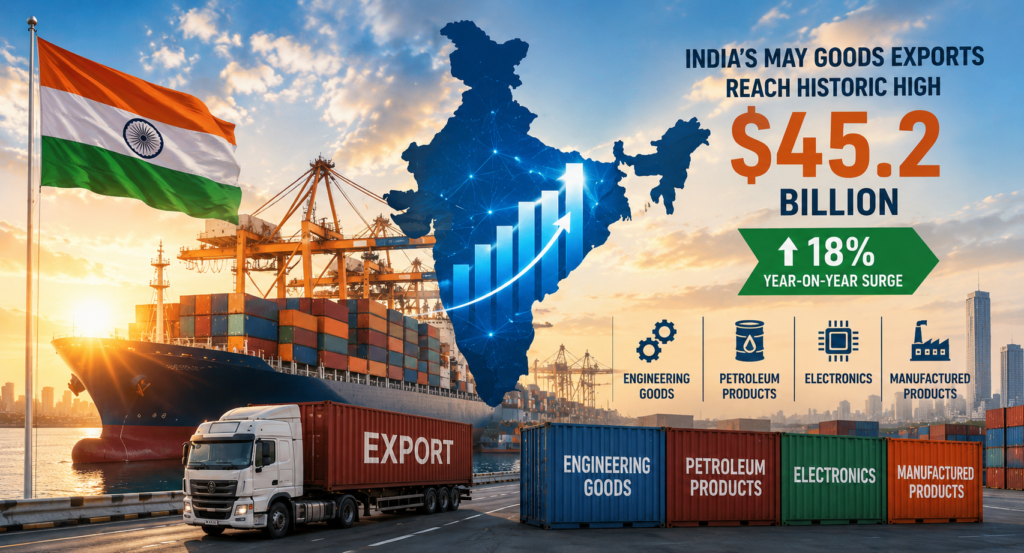
India’s merchandise exports jumped to a record monthly high of $45.2 billion in May 2026, marking an 18% year-on-year surge—the sharpest growth seen in six months. Outbound shipments were driven by a massive 55% surge in petroleum products ($8.4 billion) and a 24.5% jump in engineering goods ($12.3 billion). On the import front, elevated net energy bills pushed crude and petroleum imports up 53% to $22.6 billion, while gold imports grew 34% to $3.4 billion, widening the overall trade deficit.
The geometric expansion of engineering and petroleum exports indicates a deeper integration into the global midstream and downstream value chains. Indian refining hubs and precision engineering clusters are outperforming regional competitors by ensuring strict compliance with western quality benchmarks and maintaining stable delivery timelines. This manufacturing shift is drawing multi-national supply chain networks to establish permanent purchasing operations within the Indian subcontinent, transforming local manufacturers from regional suppliers into critical global anchors.
Commerce Secretary Mr. Rajesh Agrawal noted that forward momentum should strengthen further following recent regional peace developments and the anticipated full reopening of the Strait of Hormuz. For international ocean shipping lines, the normalization of transit through this critical choke point will immediately reduce war-risk insurance premiums, lower spot bunker costs, and stabilize transit times between India and Western Europe. The resulting operational predictability will help freight forwarders quote fixed multi-month contract rates, cutting out the sudden surcharges that disrupted trade over the last fiscal year.
Key Highlights:
- Historic Milestones: Monthly merchandise exports reached an all-time high of $45.2 billion, driven by an 18% growth surge.
- Dominant Product Sectors: Outbound trade was anchored heavily by petroleum products and engineering goods shipments.
- Waterway Trade Stabilization: Strategic global shipping corridors are gaining stability as critical waterways like the Strait of Hormuz prepare to fully reopen.
- Trade Deficit Impact: A steeper expansion in imports ($73.41 billion) widened the merchandise trade deficit to $28.21 billion.