
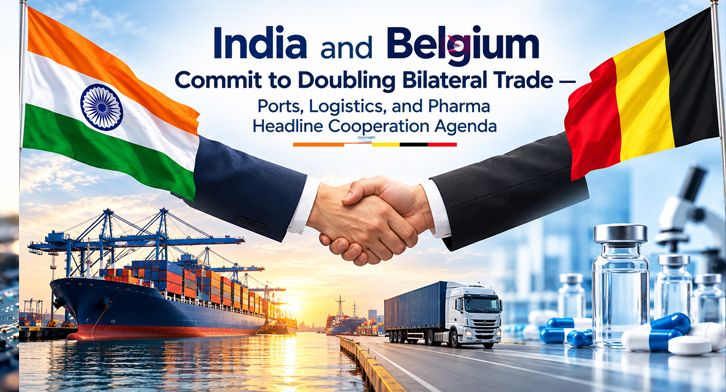
Prime Ministers Narendra Modi and Bart De Wever signed a joint statement committing India and Belgium to doubling bilateral trade over the next five years and launched the India-Belgium Strategic Dialogue. Both leaders welcomed the completion of India-EU Free Trade Agreement negotiations — a landmark that, once implemented, opens tariff-preferenced access between India and the 27-member European Union market. Ports and logistics were explicitly named as a cooperation sector in the joint statement, alongside pharmaceuticals, life sciences, semiconductors, defence manufacturing, critical minerals, and renewable energy.
Belgium serves as one of Europe’s principal gateway ports through Antwerp — the EU’s second-largest container port — giving bilateral logistics cooperation a natural infrastructure dimension. The joint statement also called for expanded visa processing capacity and exploration of direct air connectivity between India and Belgium, both of which carry implications for express freight and time-sensitive cargo flows.
India-EU FTA Significance for Freight: The concluded India-EU FTA creates tariff-preferenced access to a combined market of 450 million EU consumers for Indian exporters. Pharmaceuticals, textiles, engineering goods, chemicals, and IT services are the headline beneficiaries. For cargo operators, expect a gradual uplift in India-Europe lane volumes as the agreement is implemented — with Belgium’s Antwerp hub well-positioned to serve as the northern European distribution point.
Frequently Asked Questions
What does the India-EU FTA mean for freight and logistics operators?
The India-EU FTA, once implemented, creates tariff-preferenced market access for Indian exporters to 450 million EU consumers. For freight operators, this means gradual uplift in India-Europe ocean FCL and LCL volumes across pharmaceuticals, textiles, engineering goods, chemicals, and IT equipment. Belgium’s Port of Antwerp (EU’s second-largest container port) is well-positioned as the northern European distribution hub for India-origin cargo — expect increased Antwerp call frequency from India mainline services.
What is the India-Belgium trade target and which sectors are involved?
India and Belgium have committed to doubling bilateral trade over five years. Named cooperation sectors in the joint statement include pharmaceuticals, life sciences, semiconductors, defence manufacturing, critical minerals, renewable energy, and ports and logistics. Direct air connectivity expansion is also under exploration — relevant for express freight and pharmaceutical cold-chain air cargo between Bengaluru/Hyderabad and Brussels Airport.