
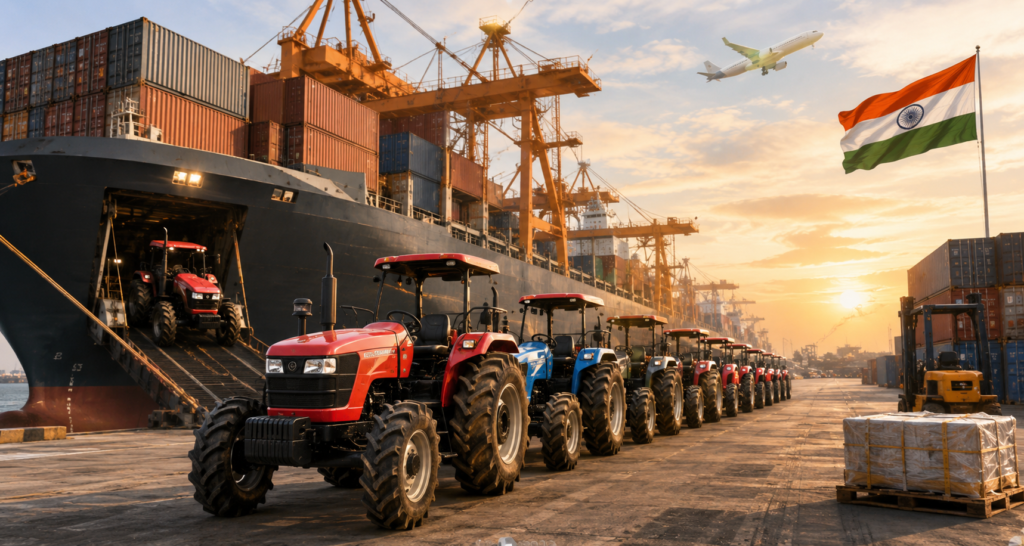
India’s tractor manufacturers achieved a major international trade breakthrough in May 2026, with monthly exports up 14% year-on-year to a 13-month high of 10,165 units. This milestone shows how Indian-made farm machinery is expanding globally, adding a strong second engine of growth alongside record-breaking domestic performance. The export surge is heavily driven by top domestic conglomerates—including the Mahindra Group, International Tractors Limited (Sonalika), and Escorts Kubota—who are aggressively scaling their presence in key international markets across Africa, Europe, and the Americas.
The rapid global expansion of Indian tractor brands highlights their successful engineering evolution. Originally designed to handle tough, demanding local farming conditions, these vehicles have proven highly resilient and reliable in international markets. Furthermore, Indian agricultural machinery conglomerates have moved beyond simply exporting standard models. They have established local assembly plants and deep spare-parts distribution networks across Africa and Latin America, providing long-term maintenance support that makes them highly competitive alternatives to traditional western and East Asian brands.
To unlock premium, highly regulated agricultural markets across North America and the European Union, domestic manufacturers have systematically upgraded their engineering frameworks. Heavy investments in research and development have produced high-horsepower engines that strictly comply with stringent international emission standards. Additionally, the integration of advanced digital telematics, GPS-guided precision farming modules, and ergonomic cab designs has enabled Indian heavy machinery to compete directly with premier global brands, changing the perception of Indian manufacturing in western markets.
Key Highlights:
- Volume Milestones: Monthly heavy machinery exports surpassed the 10,000-unit mark, showing strong global demand.
- Global Footprint Expansion: Top manufacturing conglomerates are successfully scaling up their supply chains across Africa, Europe, and the Americas.
- Regulatory Compliance: Adopting advanced international emission frameworks has successfully positioned domestic OEMs as highly competitive alternatives.
- Customized Engineering: Industry leaders are leveraging customized, high-horsepower engine variants tailored for diverse global soil conditions. .