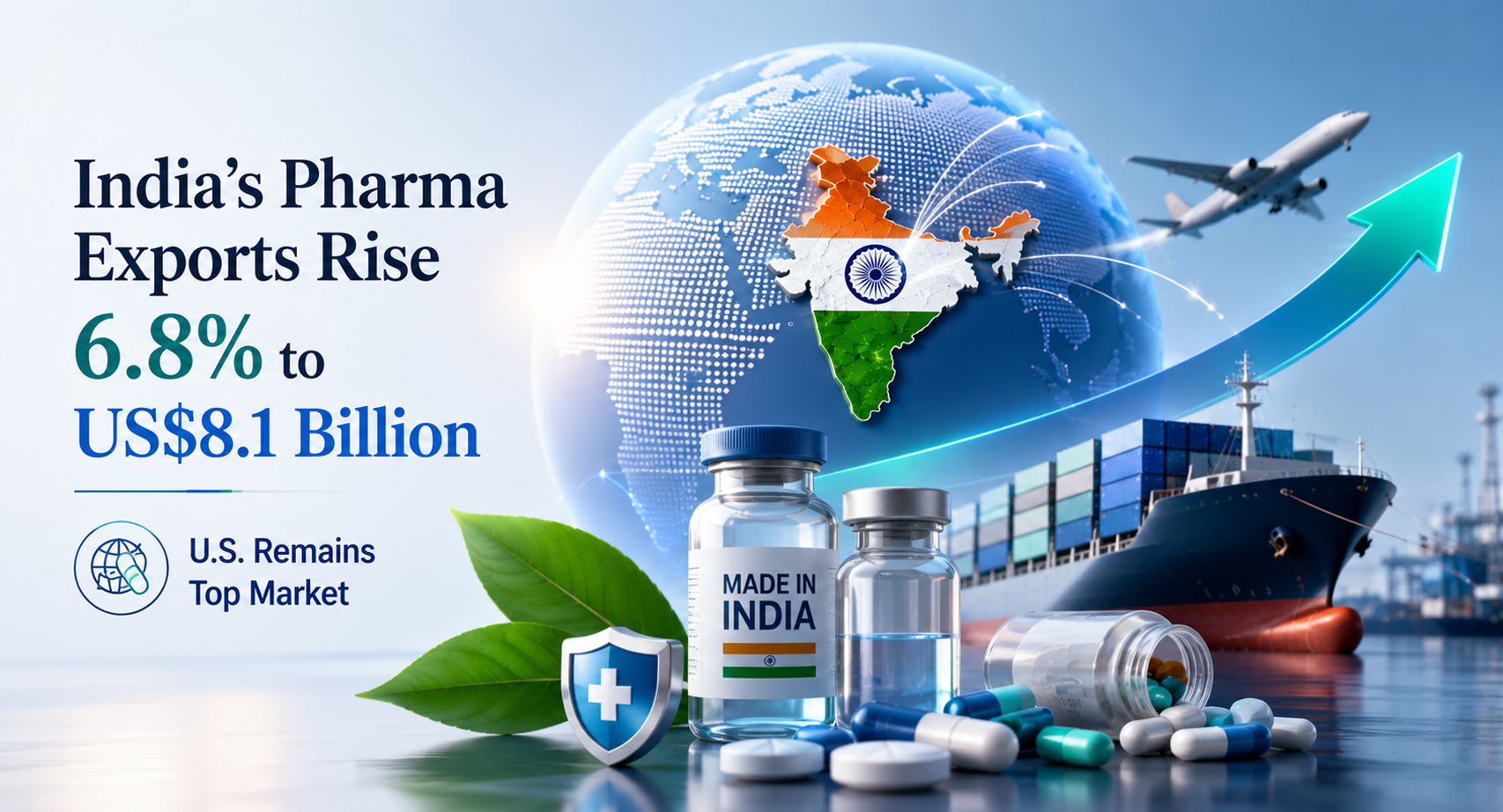
India’s Pharma Exports Rise 6.8% to US$8.1 Billion in Q1 FY2026-27; U.S. Remains Top Market

India’s pharmaceutical exports recorded a strong start to FY2026-27, rising 6.8% year-on-year to US$8.1 billion in Q1, according to data from the Pharmaceuticals Export Promotion Council of India (Pharmexcil).
The growth highlights continued international demand for Indian medicines, particularly generic drugs, vaccines and pharmaceutical intermediates. The United States remained India’s largest pharmaceutical export market, accounting for US$2.50 billion, or nearly 31% of total pharma exports during the quarter.
The latest performance reinforces India’s position as a major global pharmaceutical manufacturing and export hub, supported by competitive production capabilities, regulatory compliance and expanding market diversification.

Key Highlights

Pharma Formulations Lead India’s Export Basket

Drug formulations and biologicals continued to dominate India’s pharmaceutical export basket during Q1, generating US$5.98 billion in export revenue.
This category accounted for approximately 73.85% of India’s total pharmaceutical exports and grew 4.14% compared with the same period a year earlier.
Bulk drugs and drug intermediates recorded stronger growth, increasing 13.84% to US$1.36 billion. Vaccine exports delivered one of the fastest growth rates, jumping 35.68% to US$390 million.

India Pharmaceutical Export Categories — Q1 FY2026-27

Export Category

Q1 Export Value

YoY Growth

Share/Significance

Drug formulations & biologicals

US$5.98 bn

4.14%

73.85% of total

Bulk drugs & intermediates

US$1.36 bn

13.84%

2nd-largest category

Vaccines

US$0.39 bn

35.68%

Fastest-growing major category

Surgical products

US$0.21 bn

11.95%

Strong double-digit growth

Total pharmaceutical exports

US$8.10 bn

6.80%

Q1 FY2026-27

U.S. Continues to Drive India’s Pharmaceutical Exports

The United States remained India’s largest pharmaceutical export destination, with shipments valued at approximately US$2.50 billion during Q1.
The U.S. accounted for 30.89% of India’s pharmaceutical exports, underlining the importance of the American market to India’s pharmaceutical manufacturing and export ecosystem.
Brazil, the United Kingdom, the Netherlands and France followed the U.S. among India’s leading country-level export destinations.
The top 25 destinations collectively accounted for nearly 70% of India’s pharmaceutical exports, with shipments worth approximately US$5.65 billion, representing 5.50% year-on-year growth.

Top Pharmaceutical Export Markets

Rank

Market

Q1 Export Value / Position

1

United States

US$2.50 billion

2

Brazil

Major growth market

3

United Kingdom

Key developed market

4

Netherlands

Major European destination

5

France

Growing European market

India’s Pharmaceutical Export Growth Is Becoming More Diversified

While North America continues to be a critical market, India’s pharmaceutical exports are increasingly spread across multiple regions.
North America, Europe, Africa and Latin America & the Caribbean collectively represented nearly three-fourths of India’s pharmaceutical exports during the quarter.
Double-digit growth across several regions, including Europe, Africa, Latin America, ASEAN and South Asia, points to increasing geographical diversification.
This diversification could help Indian pharmaceutical exporters reduce their dependence on individual markets while creating opportunities across emerging healthcare markets.

Growth Drivers Behind India’s Pharma Export Performance

Several factors are supporting the expansion of India’s pharmaceutical exports:
1. Strong Global Demand for Generics
Indian manufacturers remain major suppliers of affordable generic medicines to healthcare systems around the world.
2. Expanding Vaccine Exports
Vaccine shipments grew by more than 35% during Q1, demonstrating India’s continued strength in vaccine manufacturing and international supply.
3. Growing Pharmaceutical Intermediates Demand
Exports of bulk drugs and drug intermediates increased 13.84%, reflecting demand for pharmaceutical inputs and India’s expanding role in global supply chains.
4. Market Diversification
Increasing exports to Europe, Africa, ASEAN, South Asia and Latin America are broadening India’s pharmaceutical trade footprint.
5. Manufacturing Scale and Regulatory Capability
India’s combination of manufacturing capacity, competitive costs, regulatory experience and established global supply relationships continues to support pharmaceutical exports.

June Pharma Exports Also Show Strong Momentum

India’s pharmaceutical exports continued to perform strongly in June.
Pharmaceutical shipments increased 7.13% year-on-year to US$2.81 billion, compared with approximately US$2.62 billion in June of the previous year.
June exports were also 6.86% higher than the US$2.63 billion recorded in May FY2026-27, indicating continued momentum at the beginning of the new financial year.

India’s FY2025-26 Pharma Exports Cross US$31 Billion

India’s pharmaceutical exports reached approximately US$31.11 billion in FY2025-26, representing growth of more than 2% compared with the previous financial year.

The latest Q1 performance suggests that pharmaceutical exports remain an important contributor to India’s broader merchandise export strategy.

What This Means for Global Logistics

The growth in pharmaceutical exports also has implications for the logistics and supply chain industry.
Pharmaceutical products require tightly controlled transportation, documentation and compliance processes. Rising export volumes can increase demand for:
For freight forwarders and logistics providers, India’s expanding pharmaceutical trade represents an opportunity to develop more specialized pharma logistics and healthcare supply-chain solutions.

Conclusion

India’s 6.8% growth in pharmaceutical exports to US$8.1 billion during Q1 FY2026-27 signals continued strength in one of the country’s most strategically important export sectors.
The United States remains the dominant market, but strong growth across Europe, Africa, Latin America, ASEAN and South Asia indicates that Indian pharmaceutical companies are increasingly diversifying their global presence.
With vaccine exports, pharmaceutical intermediates and other categories recording strong growth, India’s pharmaceutical industry is positioned to play an increasingly important role in global healthcare supply chains.
For the logistics industry, the trend also points to rising demand for specialized pharma freight forwarding, cold-chain logistics, compliance, visibility and digitally managed supply chains.

Frequently Asked Questions

What was India’s pharmaceutical export value in Q1 FY2026-27?
India exported pharmaceutical products worth approximately US$8.1 billion in Q1 FY2026-27, representing 6.8% year-on-year growth.
The United States remained India’s largest pharmaceutical export destination, with exports of approximately US$2.50 billion, representing 30.89% of total pharmaceutical exports during the quarter.
Drug formulations and biologicals were the largest category, generating approximately US$5.98 billion and accounting for 73.85% of India’s pharmaceutical exports.
Vaccine exports recorded the strongest growth among the major categories, increasing 35.68% year-on-year to US$0.39 billion.
India’s pharmaceutical exports reached approximately US$31.11 billion in FY2025-26, growing by more than 2% year-on-year.
Pharmaceutical exports require specialized supply-chain capabilities, including temperature-controlled transportation, regulatory documentation, cargo tracking, secure warehousing and fast customs clearance. Rising export volumes can therefore increase demand for specialized pharmaceutical logistics services.
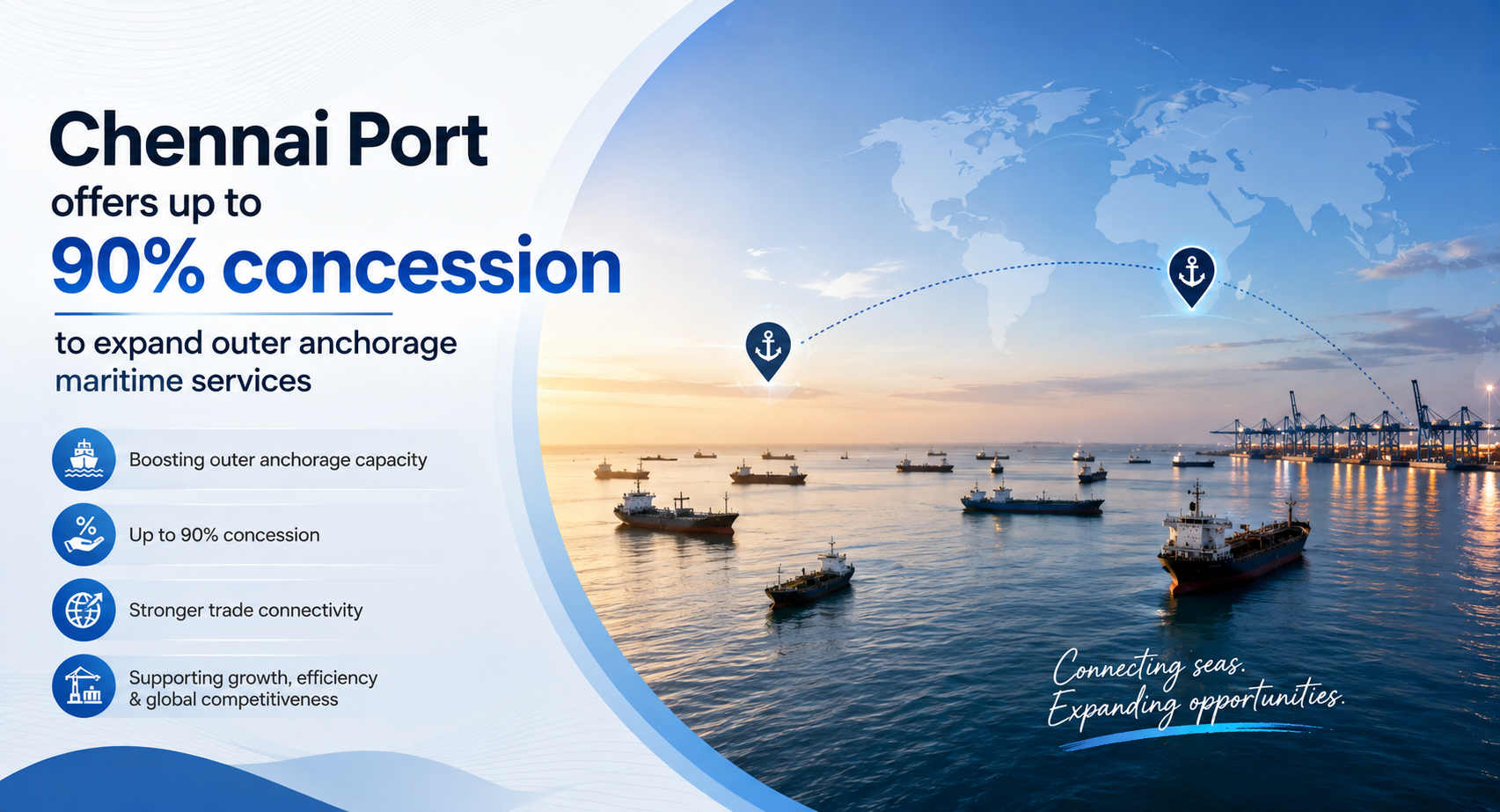
Chennai Port Offers Up to 90% Concession to Expand Outer Anchorage Maritime Services

Chennai Port Authority has introduced a new Promotional Concession Scheme for vessels using Chennai Port Outer Anchorage, offering substantial discounts on Port Dues and Anchorage Fees for ships arriving exclusively for bunkering and other eligible maritime services.
Under the scheme, vessels up to 50,000 GRT will receive an 85% concession, while vessels above 50,000 GRT will qualify for a 90% concession on applicable Port Dues and Anchorage Fees.
The initiative, effective from August 10, 2026, is aimed at positioning Chennai Port Outer Anchorage as an Integrated Offshore Maritime Services Hub and attracting vessels that need essential services without entering the main port facilities.

Chennai Port Outer Anchorage Concession: Key Highlights

Which Maritime Services Are Covered?

The concession scheme covers a wide range of services that vessels may require while remaining at the outer anchorage.

Maritime Service

Application

Bunkering

Fuel supply to vessels

Provisions & Stores

Supply of food, consumables and vessel stores

Spares

Delivery of vessel machinery and equipment spares

Crew Changes

Embarkation and disembarkation of crew

Sick Crew Disembarkation

Transfer of crew requiring medical attention

Vessel Repairs

Repair and maintenance activities

Underwater Operations

Subsea inspection and related work

Surveys & Inspections

Technical, safety and vessel inspections

What Does Concession Mean for Shipping Lines?

The new incentive could make Chennai Outer Anchorage more attractive for vessels requiring quick and cost-efficient maritime services.
Instead of entering the main port area for certain activities, eligible vessels can access services at the outer anchorage. This can potentially help operators reduce port-related costs while improving turnaround flexibility.
The financial incentive becomes particularly significant for larger vessels, with ships above 50,000 GRT eligible for a 90% concession on applicable Port Dues and Anchorage Fees.
Concession Structure

Vessel Size

Concession on Applicable Port Dues & Anchorage Fees

Up to 50,000 GRT

85%

Above 50,000 GRT

90%

Chennai Port's Push Towards an Offshore Maritime Services Hub

The initiative forms part of Chennai Port’s broader effort to expand its role beyond conventional cargo handling.
By developing an Integrated Offshore Maritime Services Hub at Outer Anchorage, the port can create an ecosystem for services such as bunkering, ship repairs, crew support, underwater operations and technical inspections.
This could also strengthen Chennai’s position within India’s growing maritime services ecosystem, particularly for vessels operating along the Indian coastline and regional shipping routes.

Why This Matters for India's Maritime Logistics Sector

India’s ports are increasingly looking beyond cargo handling to develop value-added maritime and ancillary services.
Chennai Port’s concession scheme could support this shift by encouraging vessels to use the port’s outer anchorage for essential services. A larger offshore services ecosystem can create opportunities for bunker suppliers, marine repair companies, ship chandlers, inspection agencies, underwater service providers and other maritime businesses.
For shipping operators, the availability of multiple services at a competitive cost can also contribute to more efficient vessel planning and port operations.

What It Means for the Logistics Industry

Chennai Port’s new concession scheme could give shipping lines and vessel operators a stronger financial incentive to use the Outer Anchorage for offshore maritime services.
With discounts of up to 90%, the initiative has the potential to increase vessel activity at the anchorage while supporting the growth of ancillary maritime businesses around Chennai.
For India’s logistics and maritime sector, the move also highlights a broader trend: ports are increasingly evolving from cargo gateways into integrated logistics and maritime service centres.

Frequently Asked Questions

What is Chennai Port's new concession scheme?
Chennai Port Authority has introduced a Promotional Concession Scheme providing discounts on applicable Port Dues and Anchorage Fees for eligible vessels using Chennai Port Outer Anchorage for bunkering and other approved maritime services.
Vessels up to 50,000 GRT are eligible for an 85% concession, while vessels above 50,000 GRT can receive a 90% concession on applicable Port Dues and Anchorage Fees.
The scheme came into effect on August 10, 2026.
Eligible activities include bunkering, provisions and stores supply, spares, crew changes, sick crew disembarkation, vessel repairs, underwater operations, surveys, inspections and other permitted maritime services.
The initiative is intended to promote Chennai Port Outer Anchorage as an Integrated Offshore Maritime Services Hub, attract more vessels for ancillary services and strengthen the port’s competitiveness in offshore maritime services.

GT LINES Upgrades KIX 1 Service to Weekly Frequency, Boosting India–Gulf Trade Connectivity

The India–Gulf shipping corridor has received a significant boost as GT LINES announced the upgrade of its KIX 1 (Khorfakkan India Express) service from its previous schedule to a weekly frequency. The enhancement is designed to provide exporters, importers, freight forwarders, and logistics companies with greater schedule reliability, faster transit times, and improved cargo capacity between India’s west coast and the UAE.
The move comes amid rising trade volumes between India and the Gulf Cooperation Council (GCC) region, where demand for dependable container shipping services continues to grow.
By increasing sailing frequency, GT LINES aims to strengthen supply chain efficiency while providing customers with more flexible shipping options and seamless regional connectivity through its integrated Gulf logistics network.

Key Highlights

GT LINES KIX 1 Weekly Service Overview

Feature

Details

Service Name

KIX 1 (Khorfakkan India Express)

Frequency

Weekly

Rotation

Nhava Sheva → Mundra → Khorfakkan

Vessel Capacity

1,100–1,400 TEUs

Mundra → Khorfakkan

4 Days

Khorfakkan → Nhava Sheva

3.5 Days

Network Coverage

GCC Countries & Iraq

Logistics Support

Gulftainer Ports & Feeder Network

Enhanced Connectivity for India–Gulf Trade

The upgraded weekly schedule significantly improves shipping reliability for businesses transporting cargo between India and the Gulf region. Regular departures reduce waiting times for exporters while enabling importers to better manage inventory and delivery schedules.
The service connects two of India’s busiest container gateways—Nhava Sheva (JNPA) and Mundra Port—with Khorfakkan, one of the Middle East’s leading transshipment hubs. This strategic routing provides efficient access to major regional markets.

Faster Transit Times Improve Supply Chain Performance

One of the most notable advantages of the upgraded KIX 1 service is its competitive transit schedule:
Shorter transit times help businesses reduce inventory holding costs, improve delivery predictability, and respond more effectively to customer demand.

Wider GCC Coverage Through Integrated Feeder Network

The KIX 1 service is fully integrated with Gulftainer’s port infrastructure, logistics facilities, and Gulf Connect feeder network. This allows containers arriving at Khorfakkan to be efficiently distributed across:
The expanded feeder connectivity offers exporters easier access to multiple Gulf destinations through a single shipping service.

Growing Importance of India–Gulf Maritime Trade

Trade between India and the Gulf region continues to expand, driven by increasing demand for manufactured goods, engineering products, food commodities, chemicals, automotive components, and consumer goods.
As shipping volumes rise, carriers are investing in higher service frequency and stronger regional connectivity to support resilient supply chains. Weekly services also help reduce cargo congestion while improving schedule reliability for freight forwarders and logistics providers.

GT LINES KIX 1 Weekly Shipping Service Network

Why This Upgrade Matters

The increase in sailing frequency is expected to deliver several benefits:

Future Growth Prospects

The upgrade of GT LINES’ KIX 1 service reflects the growing importance of the India–Gulf maritime corridor. By introducing weekly sailings, improving transit efficiency, and leveraging Gulftainer’s integrated logistics network, the service is well-positioned to support rising trade volumes and strengthen supply chain connectivity between India and the Middle East.

FAQs

What is the GT LINES KIX 1 service?
KIX 1 (Khorfakkan India Express) is a container shipping service operated by GT LINES connecting Nhava Sheva, Mundra, and Khorfakkan with onward connectivity across GCC countries.
The KIX 1 service now operates on a weekly schedule, improving cargo availability and shipping reliability.
The service connects Nhava Sheva, Mundra, and Khorfakkan, with feeder links to destinations across the GCC and Iraq.
Weekly sailings provide more shipping options, shorter waiting times, improved schedule reliability, faster deliveries, and wider regional market access.

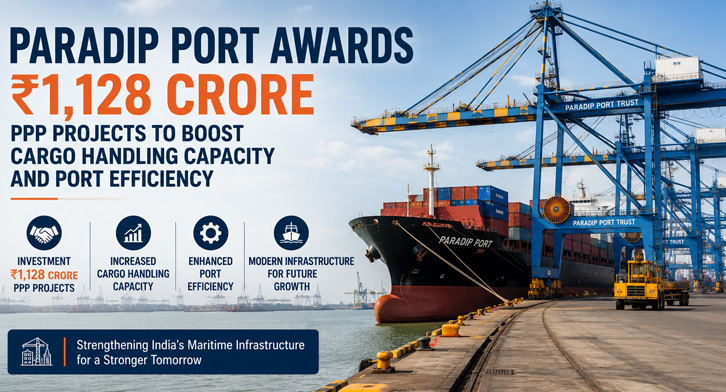
Paradip Port Awards ₹1,128 Crore PPP Projects to Boost Cargo Handling Capacity and Port Efficiency

In a major infrastructure push, Paradip Port Authority (PPA) has awarded two Public-Private Partnership (PPP) projects worth ₹1,128 crore to mechanise key cargo berths under the Build, Operate and Transfer (BOT) model. The investment is expected to significantly expand the port’s cargo handling capacity, improve operational efficiency, and strengthen Paradip’s position as one of India’s busiest maritime gateways.
The projects were awarded to two private sector consortia following a competitive bidding process based on the highest royalty offers.

Key Highlights

₹630 Crore Mechanised Dry Bulk Berth Project

Paradip Port has awarded the contract for developing a mechanised 8 million tonne (MT) multipurpose dry bulk cargo berth to the consortium of Bothra Shipping Services Pvt. Ltd. and Ripley & Co. Stevedoring and Handling Pvt. Ltd.
The consortium secured the project after submitting the highest royalty bid of ₹120.50 per tonne and will invest approximately ₹630 crore in developing the facility.
Cargo to be handled
The fully mechanised berth is expected to reduce cargo turnaround time, improve operational safety, and increase loading and unloading efficiency.

₹498 Crore South Quay Berth Modernisation

In a separate award, the consortium of Yogayatan Ports Pvt. Ltd. and Man Infraconstruction Ltd. has secured the contract to mechanise the South Quay Berth (SQB).
The project was awarded after the consortium quoted the highest royalty bid of ₹103 per tonne and involves an investment of approximately ₹498 crore.
Once completed, the upgraded berth will handle 5 million tonnes of cargo annually.
Cargo to be handled

Cargo to be handled

The upgraded berth will diversify Paradip Port’s cargo portfolio while enhancing operational flexibility.

Why These Projects Matter

The twin mechanisation projects represent a significant milestone in Paradip Port’s long-term expansion strategy.
Expected Benefits

Paradip Port Strengthens Its Position

Paradip Port is currently the second-largest major state-owned cargo handling port in India, playing a crucial role in handling bulk commodities and supporting eastern India’s industrial and export sectors.
The latest investments are expected to reinforce the port’s role as a strategic logistics hub, improve supply chain efficiency, and attract additional cargo traffic in the coming years.

Industry Impact

With India’s maritime sector witnessing rapid growth, investments in mechanised cargo handling infrastructure have become essential for improving efficiency and reducing logistics costs. Paradip Port’s latest PPP projects align with the country’s broader objective of modernising port infrastructure, increasing private participation, and enhancing global trade competitiveness.

FAQs

What projects has Paradip Port awarded?
Paradip Port Authority has awarded two PPP-based mechanisation projects worth ₹1,128 crore to modernise cargo handling facilities under the BOT model.
The two projects will add a combined 13 million tonnes (MT) per annum of mechanised cargo handling capacity.
The projects will handle dry bulk cargo, coal, iron ore, limestone, breakbulk cargo, steel products, and containers, depending on the berth.
Mechanisation improves cargo handling speed, reduces vessel turnaround time, lowers logistics costs, enhances safety, and increases overall port productivity.

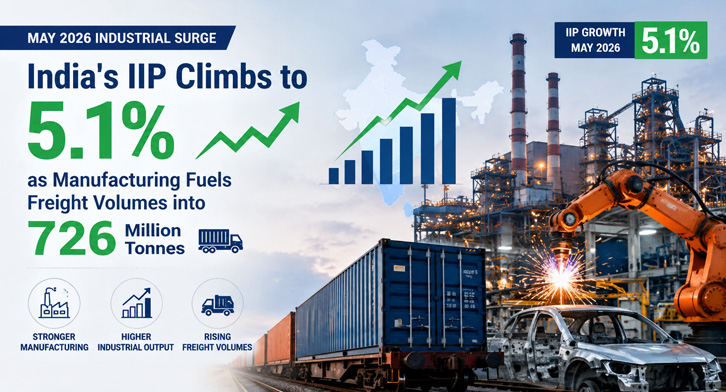
May 2026 Industrial Surge: India’s IIP Climbs to 5.1% as Manufacturing Fuels Freight Volumes

Fresh government data reveals that India’s Index of Industrial Production (IIP) accelerated to a 5.1% year-on-year growth rate in May 2026, outperforming April’s 4.9% mark. Driven by a 5.5% expansion in manufacturing and a 12.9% spike in capital goods, this industrial uptick directly triggers higher domestic cargo movement, rising freight demand, and increased container utilization for NVOCCs and freight forwarders.

Manufacturing and Capital Goods Lead the Economic Momentum

India’s industrial sector is demonstrating sustained upward momentum, backed by strong domestic consumption and robust infrastructure spending. Despite a minor 1.6% contraction in the mining segment, the broader production landscape has shown remarkable resilience. According to the Ministry of Statistics and Programme Implementation (MoSPI), positive growth was recorded in 16 out of the 23 major manufacturing segments.
Key Growth Sectors by Output (May 2026):
The double-digit leap in capital goods is a vital leading indicator for the economy. It proves that businesses are actively investing in heavy machinery, factory expansions, and physical infrastructure—factors that inevitably generate sustained, long-term commercial freight.

MoSPI Adjusts Strategy with New Output PPI Deflator

In a significant structural update, MoSPI has modernized its data gathering by introducing an updated methodology for the IIP Base Year 2022–23 tracking series.
The agency has phased out the Wholesale Price Index (WPI) in favor of the Output Producer Price Index (Output PPI) as its primary deflator. By capturing actual factory-gate transaction prices rather than volatile wholesale market shifts, this transition aligns India’s economic reporting with global statistical benchmarks. The overhaul directly adjusts how volume is calculated across 234 product groups, which account for roughly 36% of the total IIP weight.

Logistics and Freight Forwarding: Preparing for Higher Throughput

This 5.1% industrial expansion has a direct, cascading effect on Indian supply chains. Increased production mandates rapid logistical adaptation across multiple operational fronts:
With macroeconomic indicators pointing toward a stable growth trajectory, the outlook for logistics, warehousing, and transport networks remains highly favorable heading into the second half of the year. MoSPI’s next data release for June 2026 is scheduled for July 28, 2026.

FAQs

What is the latest update on India's industrial growth for May 2026?
India’s Index of Industrial Production (IIP) registered a year-on-year growth of 5.1% in May 2026, reflecting an upward shift from the 4.9% expansion noted during April 2026.
The manufacturing industry led the way with a 5.5% expansion, heavily supported by a 20.8% surge in electrical equipment and a 14.5% rise in motor vehicles. Additionally, the electricity and gas utilities sector expanded by 9.9%.
MoSPI transitioned from the Wholesale Price Index (WPI) to the Output Producer Price Index (Output PPI). This update provides a more accurate reflection of true factory output and producer-side pricing, matching global standards.
Higher factory output increases the total volume of goods entering the supply chain. This directly boosts demand for shipping containers, increases port and warehouse utilization, and creates more business for NVOCCs and freight forwarding networks.

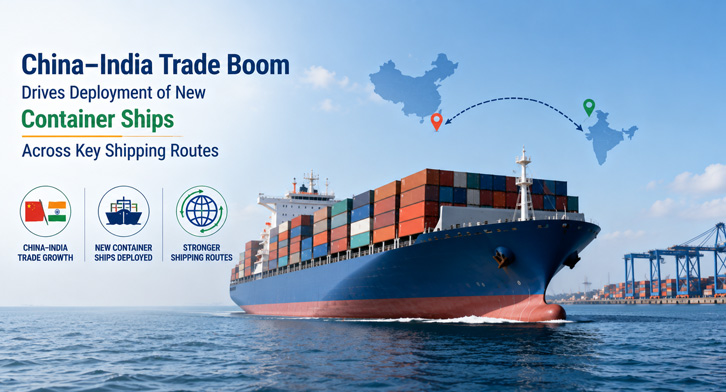
China–India Trade Boom Drives Deployment of New Container Ships Across Key Shipping Routes

The China–India shipping corridor is witnessing a significant capacity expansion as global container shipping lines introduce new-generation container vessels to capitalize on rapidly growing trade volumes between Asia’s two largest economies.
Rising demand for manufactured goods, industrial equipment, raw materials, electronics, chemicals, and consumer products is driving stronger cargo movement between major Chinese and Indian ports. In response, carriers are strengthening their regional networks by deploying larger and more efficient container ships designed to improve schedule reliability, cargo capacity, and operational performance.
The move highlights the increasing strategic importance of the China–India maritime trade lane, which has emerged as one of the fastest-growing container shipping markets in Asia. Shipping companies are investing in modern fleets to accommodate higher cargo demand while improving fuel efficiency and reducing operating costs.
Industry experts believe the introduction of newbuild vessels will support faster cargo movement, enhanced port connectivity, and greater supply chain resilience for businesses engaged in bilateral trade.

Key Highlights

Why Shipping Lines Are Expanding Capacity on China–India Routes

Several factors are contributing to the growing importance of the China–India container trade market:
Rising Bilateral Trade
Trade between China and India continues to generate strong containerized cargo volumes across sectors such as electronics, machinery, chemicals, textiles, automotive components, consumer goods, and industrial equipment.
Demand for Reliable Supply Chains
Importers and exporters are increasingly seeking dependable shipping services to support inventory management and production schedules. New vessels help carriers improve service consistency and reduce disruptions.
Operational Efficiency Gains
Modern container ships are equipped with advanced technologies that enhance fuel efficiency, lower emissions, and improve overall voyage performance, helping carriers remain competitive in a challenging market environment.
Strong Regional Growth Prospects
Asia remains the world’s largest manufacturing and trading hub, and the China–India corridor is expected to remain a major contributor to regional container shipping growth over the coming years.

Impact on Indian Ports and Logistics Sector

The deployment of additional container capacity could benefit India’s logistics ecosystem by:
As shipping lines continue investing in larger and more technologically advanced fleets, the China–India trade corridor is expected to play an increasingly important role in shaping Asia’s maritime logistics landscape.

FAQs

Why are shipping companies deploying new container ships on China–India routes?
Shipping companies are adding new vessels to meet rising cargo demand, improve service reliability, and increase capacity on one of Asia’s fastest-growing trade corridors.
Common cargo includes electronics, machinery, industrial equipment, chemicals, textiles, consumer goods, automotive parts, and raw materials.
Newbuild vessels offer greater cargo capacity, improved fuel efficiency, lower operating costs, and enhanced environmental performance.
Additional shipping capacity can improve cargo availability, strengthen supply chains, support port growth, and enhance trade connectivity with China.
Industry analysts expect continued growth in container volumes, supported by expanding trade activity, supply chain diversification, and ongoing investment in shipping infrastructure.

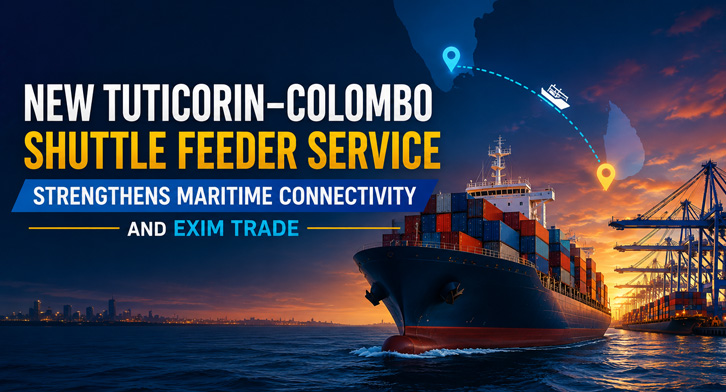
New Tuticorin–Colombo Shuttle Feeder Service Strengthens Maritime Connectivity and EXIM Trade

Major container shipping operators are reshaping their Far East–India service networks as a long-standing joint service is being divided into two separate loops. The restructuring reflects evolving market dynamics, changing cargo demand patterns, and the industry’s focus on improving operational flexibility and schedule reliability across key Asia–India trade corridors.
According to shipping industry analysts, the move highlights how carriers are adapting their service offerings to better serve customers while optimizing vessel deployment and port coverage in a competitive and rapidly changing market environment.

Gold Star Line and Global Feeder Shipping Launch Revamped NIX Service

Under the new arrangement, Gold Star Line and Global Feeder Shipping (GFS) will jointly operate an enhanced NIX service using five vessels with capacities of approximately 5,000 TEUs each.
The revised service rotation will connect major trade hubs including:
The service is designed to provide efficient cargo connectivity between China, Southeast Asia, and India’s major west coast ports, supporting growing trade flows across the region.

Shipping Lines Seek Greater Flexibility in Network Design

Industry experts note that splitting the long-running joint loop into two independent services provides carriers with greater flexibility in managing operations.
The new structure allows operators to optimize:
By operating separate service products, carriers can better respond to customer requirements and changing trade patterns while maintaining operational efficiency.

Market Conditions Drive Strategic Service Adjustments

The restructuring reflects broader trends within the container shipping industry, particularly on intra-Asia and Asia–India routes. Shipping companies are increasingly adjusting service networks to address fluctuating cargo demand, congestion risks, and evolving supply chain requirements.
Major transshipment hubs such as Port Klang and gateway ports like Nhava Sheva continue to experience varying levels of congestion and operational pressure, prompting carriers to redesign service networks for improved reliability.
These adjustments are also helping operators navigate volatile freight markets while maintaining competitive service offerings.

Key Highlights:

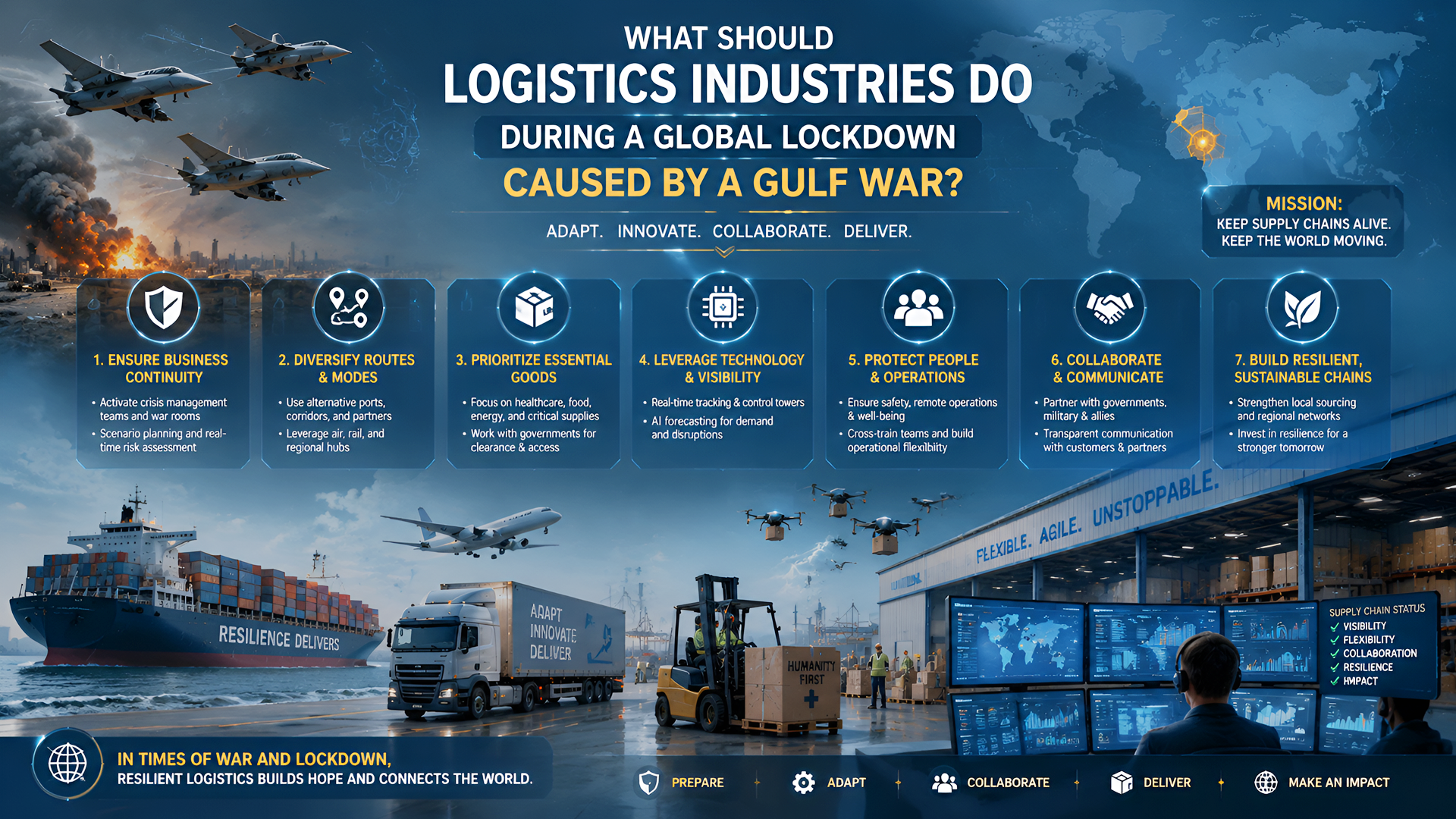
What Should Logistics Industries Do During a Global Lockdown Caused by a Gulf War?

A global lockdown during a Gulf war can create major disruptions in transportation, fuel supply, international trade, and supply chain operations. The logistics industry must act quickly, strategically, and responsibly to continue operations and reduce business losses.
Countries in the Gulf region such as Saudi Arabia, United Arab Emirates, Qatar, and Iran are important for global oil transportation and shipping routes. If conflict increases and worldwide lockdowns happen, logistics companies must be prepared with emergency plans and alternative solutions.

Important Actions Logistics Industries Should Take During Lockdown

1. Create Emergency Logistics Plans
Every logistics company should prepare a crisis management plan that includes:
Quick decision-making becomes critical during global emergencies.
2. Use Alternative Shipping Routes
War zones and restricted regions may become unsafe for transportation.
Companies should:
This helps reduce delays and maintain cargo movement.
3. Increase Warehouse Storage Capacity
During lockdown situations, transportation delays are common. Companies should store additional inventory for:
Maintaining safety stock helps businesses continue operations during supply chain interruptions.
4. Focus on Local Supply Chains
Global trade disruptions can affect imported goods. Logistics companies should support:
Strong local supply chains reduce dependence on international shipping during crises.
5. Invest in Technology and Automation
Digital logistics systems become extremely important during emergencies.
Companies should use:
Technology improves visibility, reduces delays, and increases operational efficiency.
6. Protect Employees and Drivers
Employee safety must be a top priority during lockdown conditions
Companies should:
A protected workforce helps maintain stable logistics operations.
7. Manage Fuel Consumption Efficiently
Fuel prices may increase sharply during a Gulf war. Logistics companies should:
Efficient fuel management helps reduce operating costs.
8. Strengthen Communication With Customers
During crises, customers need regular updates about shipment status and delivery timelines.
Logistics companies should:
Good communication builds trust during uncertain situations.
9. Improve Financial Planning
Lockdowns and global disruptions can increase operational expenses.
Businesses should:
Strong financial planning helps companies survive longer disruptions.
10. Work Closely With Governments and Authorities
Logistics companies should coordinate with:
This helps businesses receive updated regulations, movement permissions, and operational support during lockdown periods

Conclusion

A global lockdown during a Gulf war can seriously affect the logistics industry through fuel price increases, transportation disruptions, shipping delays, and supply chain shortages. However, companies that prepare in advance can reduce risks and maintain smoother operations.
By focusing on emergency planning, technology, employee safety, local supply chains, and flexible transportation strategies, logistics industries can continue supporting global trade even during difficult times. Strong preparation and smart decision-making are the keys to surviving global logistics crises.

India Targets Middle Eastern and Asian Nations to Diversify Steel Exports

India is accelerating its push to diversify steel export destinations, turning its focus toward fast-growing markets in the Middle East and Asia as global trade dynamics continue to shift.

With demand softening and protectionist policies tightening in traditional markets such as Europe and North America, India is strategically repositioning its steel exports to tap into regions driven by infrastructure growth, urbanisation, and industrial expansion.

A Strategic Shift in Global Steel Trade

Indian steelmakers are increasingly eyeing the Gulf Cooperation Council (GCC) and emerging Asian economies to sustain export volumes and strengthen long-term market presence.
In the Middle East, massive investments in infrastructure and energy transition projects are driving strong demand for:
Countries such as United Arab Emirates, Saudi Arabia, and Qatar are rolling out mega projects that present fresh opportunities for Indian exporters.

Asia Opens New Trade Corridors

Across Asia, rapid construction activity and manufacturing growth are reshaping steel demand. Markets including Vietnam, Thailand, Indonesia, and Malaysia are emerging as key focus areas.
Indian mills are also targeting specialised and higher-margin segments such as:
This approach helps differentiate Indian exports from regional competitors.

Policy Support and Competitive Advantage

Government-backed trade negotiations and diplomatic engagement are reinforcing this export push by:

Industry estimates continue to rank India among the world’s top steel producers, with expanding capacity making export diversification critical—especially during periods of subdued domestic demand.
Outlook: Opportunities Amid Volatility
Despite ongoing volatility caused by geopolitical tensions and raw material price fluctuations, analysts believe India’s:

Key Takeaways

With targeted marketing and strategic partnerships, Indian steelmakers aim to secure long-term contracts and strengthen trade ties—reinforcing India’s role in the evolving global steel landscape.

India–UK Free Trade Agreement 2025: A Game-Changer for Global Trade, Logistics & Business Expansion

The India–UK Free Trade Agreement (FTA), signed on July 24, 2025, is a strategic milestone in global trade. Officially known as the Comprehensive Economic and Trade Agreement (CETA), this deal aims to double bilateral trade, reduce tariffs, and open market access across key sectors. One of the biggest beneficiaries? The logistics and freight industry, which will play a critical role in executing the surge in cross-border trade.

What Is the India–UK FTA 2025?

The India–UK FTA 2025 is a comprehensive trade agreement between India and the United Kingdom, focusing on reducing trade barriers, encouraging investment, and simplifying digital trade.

Key Highlights:

How Does the India–UK FTA Impact the Logistics Industry?

The logistics sector is central to implementing this agreement. Here’s how freight and logistics businesses will benefit:

1. Higher Cargo Volume

Lower tariffs = increased imports and exports = more shipping, warehousing, and last-mile delivery.

2. Simplified Customs & Border Clearance

The FTA introduces:
Freight forwarders will save time and reduce detention/demurrage costs at ports.

3. SME-Friendly Logistics Environment

4. Growth in Specialized Logistics Segments

Sector-Wise Logistics Impact: At a Glance

Sector

Trade Growth

Logistics Impact

Automotive

310% exports

Ro-Ro vessels, spare parts supply chains

Whisky & Alcohol

180% exports

Cold chain logistics, bonded warehouse demand

Machinery & Equipment

£527M GVA

ODC logistics, project cargo handling

Textiles & Leather

High Indian exports

Export container growth, multi-origin shipping

Professional Services

Easier market access

Cross-border documentation, courier networks

Infrastructure & Regional Logistics Benefits

United Kingdom:

India:

Trade Simplification Features That Help Logistics

Economic Impact of the India–UK FTA 2025

Metric

India

United Kingdom

GDP Growth

£5.1 billion

£4.8 billion

Export Growth

Surge in textiles, agri

60% exports to India

Real Wages Impact

Moderate

0.19% in UK (£2.2B yearly)

Sustainability and Green Logistics

Global Ripple Effects & Fair Competition

Monitoring, Flexibility & Review Mechanism

Key Takeaways for Logistics and Freight Companies

Empower Your Logistics with CargoNet’s Intelligent AI Automation

CargoNet AI Agents automate essential logistics tasks such as customs documentation, shipment tracking, and compliance management. These AI Agents provide real-time data insights and proactive recommendations, improving supply chain visibility and helping logistics teams make faster, smarter decisions. By streamlining operations and reducing manual workload, CargoNet enhances efficiency and accuracy across the entire logistics lifecycle.

Experience the power of CargoNet AI Agents— and see how intelligent automation can transform your supply chain.

Frequently Asked Questions (FAQs)

A modern FTA that eliminates or reduces tariffs on 90% of traded goods between India and the UK, encouraging trade and investment.

The logistics sector will see higher cargo volumes, simplified customs, and greater demand for multimodal transport and digital workflows.

Yes. Lower compliance costs and faster clearance will benefit SMEs and regional logistics providers significantly.

Yes. The FTA promotes paperless trade, single-window customs clearance, and interoperable digital systems.

CargoNet helps manage trade documentation, booking, customs compliance, and cargo visibility—making it easier to operate under evolving global trade frameworks.

cargonet-logo-icon
Cargonet Cargo Software Logo

Feedback & Reward program

Submit the Feedback and avail the Rewards.

1. Your satisfaction & reliability on CargoNet ?

2. Your Rating on Support & co-ordination team?

3. Satisfaction on the look and feel of CargoNet ?

4. Please specify any 2 best features that you feel more helpful in CargoNet?

5. Please specify any 2 best reports that you are taking on regular basis?

6. Are you using Copy Job option in CargoNet Software?

7. Are you using Automatic DSR (Daily Status Report) Option? It automatically sends reports to customer about the shipment status

8. Are you using Automatic Outstanding Reports option? Period Auto outstanding reminders to customer

9. Any other thoughts to improve in CargoNet? Please share.

* Join our Reward Program by recommending CargoNet (Cash Rewards Awaiting)

“Thanks for your feedback. Our goal is to create the best possible product, support & service, and your thoughts, ideas & suggestions play a major role in helping us identify opportunities to improve.”

Cut AI cost ,
not performance

discover how top Freight Forwarding companies  reduce AI-related expense and speed up operation with CargoNet AI, we will show it how
Share your information for instant access :

Get a Demo Now