
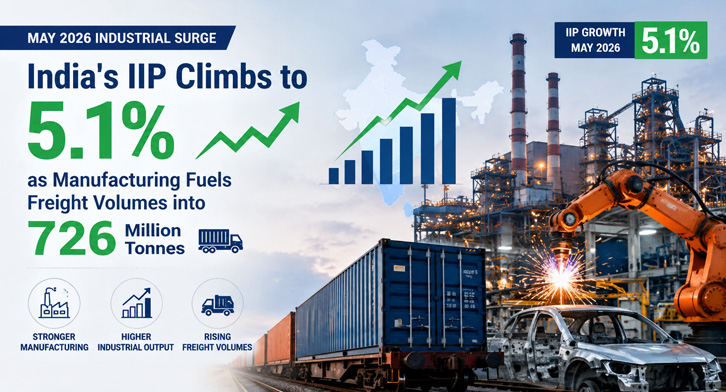
Fresh government data reveals that India’s Index of Industrial Production (IIP) accelerated to a 5.1% year-on-year growth rate in May 2026, outperforming April’s 4.9% mark. Driven by a 5.5% expansion in manufacturing and a 12.9% spike in capital goods, this industrial uptick directly triggers higher domestic cargo movement, rising freight demand, and increased container utilization for NVOCCs and freight forwarders.
Manufacturing and Capital Goods Lead the Economic Momentum
India’s industrial sector is demonstrating sustained upward momentum, backed by strong domestic consumption and robust infrastructure spending. Despite a minor 1.6% contraction in the mining segment, the broader production landscape has shown remarkable resilience.
According to the Ministry of Statistics and Programme Implementation (MoSPI), positive growth was recorded in 16 out of the 23 major manufacturing segments.
Key Growth Sectors by Output (May 2026):
- Electrical Equipment Manufacturing: ▲ 20.8%
- Automotive & Trailer Production: ▲ 14.5%
- Capital Goods Allocation: ▲ 12.9%
- Electricity & Gas Utilities: ▲ 9.9%
- Consumer Durables Segment: ▲ 7.2%
The double-digit leap in capital goods is a vital leading indicator for the economy. It proves that businesses are actively investing in heavy machinery, factory expansions, and physical infrastructure—factors that inevitably generate sustained, long-term commercial freight.
MoSPI Adjusts Strategy with New Output PPI Deflator
In a significant structural update, MoSPI has modernized its data gathering by introducing an updated methodology for the IIP Base Year 2022–23 tracking series.
The agency has phased out the Wholesale Price Index (WPI) in favor of the Output Producer Price Index (Output PPI) as its primary deflator. By capturing actual factory-gate transaction prices rather than volatile wholesale market shifts, this transition aligns India’s economic reporting with global statistical benchmarks. The overhaul directly adjusts how volume is calculated across 234 product groups, which account for roughly 36% of the total IIP weight.
Logistics and Freight Forwarding: Preparing for Higher Throughput
This 5.1% industrial expansion has a direct, cascading effect on Indian supply chains. Increased production mandates rapid logistical adaptation across multiple operational fronts:
- Elevated Freight Demands: With intermediate goods rising by 5.8%, raw materials and finished goods are moving simultaneously, creating a competitive market for road, rail, and maritime transport.
- NVOCC & Container Availability: The rapid growth of the automotive and electronics sectors boosts export-import (EXIM) container requirements. Non-Vessel Operating Common Carriers (NVOCCs) must optimize container allocations to handle this influx.
- The Shift to Digital Workflow: Managing this sudden volume spike requires deep operational visibility. Freight forwarders utilizing modern logistics portals and automated software platforms like CargoNet are better positioned to handle complex customs clearance and documentation without experiencing operational bottlenecks.
- Warehouse Turnaround Times: Higher domestic cargo distribution will reduce available square footage in key manufacturing hubs, making real-time warehouse management systems essential for keeping inventory moving.
With macroeconomic indicators pointing toward a stable growth trajectory, the outlook for logistics, warehousing, and transport networks remains highly favorable heading into the second half of the year. MoSPI’s next data release for June 2026 is scheduled for July 28, 2026.
FAQs
What is the latest update on India's industrial growth for May 2026?
India’s Index of Industrial Production (IIP) registered a year-on-year growth of 5.1% in May 2026, reflecting an upward shift from the 4.9% expansion noted during April 2026.
Which industrial sectors are performing the best right now?
The manufacturing industry led the way with a 5.5% expansion, heavily supported by a 20.8% surge in electrical equipment and a 14.5% rise in motor vehicles. Additionally, the electricity and gas utilities sector expanded by 9.9%.
Why did India change its IIP calculation method?
MoSPI transitioned from the Wholesale Price Index (WPI) to the Output Producer Price Index (Output PPI). This update provides a more accurate reflection of true factory output and producer-side pricing, matching global standards.
How does an increase in industrial production impact freight companies?
Higher factory output increases the total volume of goods entering the supply chain. This directly boosts demand for shipping containers, increases port and warehouse utilization, and creates more business for NVOCCs and freight forwarding networks.