
India and Belgium Commit to Doubling Bilateral Trade — Ports, Logistics, and Pharma Headline Cooperation Agenda

Prime Ministers Narendra Modi and Bart De Wever signed a joint statement committing India and Belgium to doubling bilateral trade over the next five years and launched the India-Belgium Strategic Dialogue. Both leaders welcomed the completion of India-EU Free Trade Agreement negotiations — a landmark that, once implemented, opens tariff-preferenced access between India and the 27-member European Union market. Ports and logistics were explicitly named as a cooperation sector in the joint statement, alongside pharmaceuticals, life sciences, semiconductors, defence manufacturing, critical minerals, and renewable energy.
Belgium serves as one of Europe’s principal gateway ports through Antwerp — the EU’s second-largest container port — giving bilateral logistics cooperation a natural infrastructure dimension. The joint statement also called for expanded visa processing capacity and exploration of direct air connectivity between India and Belgium, both of which carry implications for express freight and time-sensitive cargo flows.
India-EU FTA Significance for Freight: The concluded India-EU FTA creates tariff-preferenced access to a combined market of 450 million EU consumers for Indian exporters. Pharmaceuticals, textiles, engineering goods, chemicals, and IT services are the headline beneficiaries. For cargo operators, expect a gradual uplift in India-Europe lane volumes as the agreement is implemented — with Belgium’s Antwerp hub well-positioned to serve as the northern European distribution point.

Frequently Asked Questions

What does the India-EU FTA mean for freight and logistics operators?
The India-EU FTA, once implemented, creates tariff-preferenced market access for Indian exporters to 450 million EU consumers. For freight operators, this means gradual uplift in India-Europe ocean FCL and LCL volumes across pharmaceuticals, textiles, engineering goods, chemicals, and IT equipment. Belgium’s Port of Antwerp (EU’s second-largest container port) is well-positioned as the northern European distribution hub for India-origin cargo — expect increased Antwerp call frequency from India mainline services.
India and Belgium have committed to doubling bilateral trade over five years. Named cooperation sectors in the joint statement include pharmaceuticals, life sciences, semiconductors, defence manufacturing, critical minerals, renewable energy, and ports and logistics. Direct air connectivity expansion is also under exploration — relevant for express freight and pharmaceutical cold-chain air cargo between Bengaluru/Hyderabad and Brussels Airport.
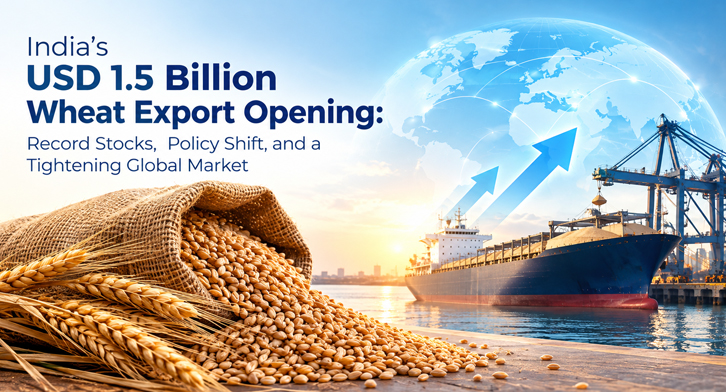
India’s USD 1.5 Billion Wheat Export Opening: Record Stocks, Policy Shift, and a Tightening Global Market

India could unlock more than USD 1.5 billion in wheat export revenue following a convergence of three favourable conditions: record domestic production, historically elevated government stocks, and a policy shift reclassifying specified wheat and wheat flour products from “Prohibited” to “Free” export status in August 2026. The opportunity is assessed by the Associated Chambers of Commerce and Industry of India (ASSOCHAM).
Wheat output in 2025-26 reached 121 million tonnes (MMT) — a national record — against estimated domestic consumption of approximately 111 MMT, generating a 10 MMT surplus. Central Pool wheat stocks as of May 28, 2026 stood at 51.3 MMT, nearly double the prescribed July 1 buffer norm of 27.5 MMT. India also holds a price advantage: its minimum support price of approximately USD 268 per tonne compares favourably against the international benchmark of approximately USD 303 per tonne in May 2026.
India Wheat Export Opportunity — Supply and Market Context

Parameter

Figure / Status

Record production 2025-26

121 MMT

Estimated domestic consumption

~111 MMT

Central Pool stocks (May 28, 2026)

51.3 MMT

Prescribed buffer norm (July 1)

27.5 MMT — stocks nearly double the norm

India MSP (wheat)

~USD 268/tonne

International wheat price (May 2026)

~USD 303/tonne — India has price advantage

USDA global production forecast (2026-27)

819 MMT — down from 844 MMT in 2025-26

Export policy change (August 2026)

Wheat + wheat flour moved from Prohibited to Free

Earlier Feb 2026 authorisation

2.5 MMT wheat + 500,000 tonnes wheat products

Top target markets

Egypt, Indonesia, Bangladesh, Algeria, Philippines

Value-added products included

Atta, maida, semolina — not just bulk grain

ASSOCHAM identifies Egypt, Indonesia, Bangladesh, Algeria, and the Philippines as priority export destinations. Bangladesh is already showing elevated demand following the August policy relaxation. For bulk freight operators and agri-logistics specialists, the wheat export window will drive demand for bulk vessel capacity, port evacuation services, and inland grain movement from major production states — Punjab, Haryana, Madhya Pradesh — to maritime gateways.

Frequently Asked Questions

Can India export wheat in 2026?
Yes. India changed wheat export policy in August 2026, moving wheat and wheat flour products from “Prohibited” to “Free” export status. With 121 MMT record production, ~10 MMT surplus over domestic consumption, and Central Pool stocks of 51.3 MMT (nearly double the buffer norm), India has strong exportable surplus. India’s MSP of ~USD 268/tonne competes against the global price of ~USD 303/tonne. Priority markets include Egypt, Indonesia, Bangladesh, Algeria, and the Philippines.
Wheat exports typically move through Kandla, Mundra, and Vizag for bulk grain, and through JNPT and Nhava Sheva for containerised wheat products (atta, maida, semolina). Inland evacuation from Punjab and Haryana relies heavily on rail via Northern Railway, with Ludhiana and Amritsar ICDs serving as key consolidation points. For Egypt and North Africa, vessels typically call at Mediterranean-range ports after transiting the Suez Canal.

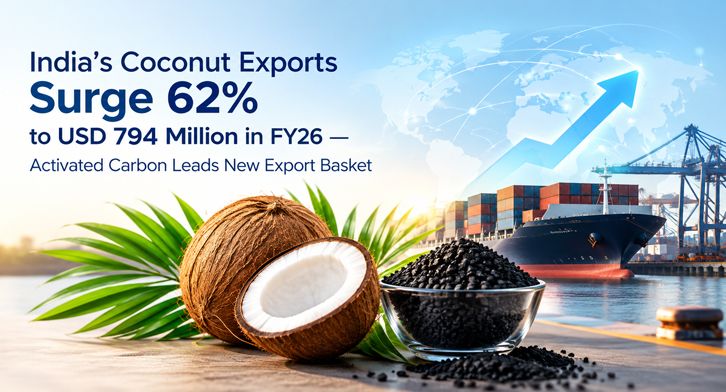
India’s Coconut Exports Surge 62% to USD 794 Million in FY26 — Activated Carbon Leads New Export Basket

India’s coconut product exports registered 62% year-on-year growth in FY26, reaching Rs. 7,038.35 crore (USD 794.70 million), up from Rs. 4,349.03 crore in FY25. The jump marks a structural shift rather than a seasonal spike: the export basket has diversified well beyond traditional coconut oil and desiccated coconut to encompass virgin coconut oil, coconut milk, coconut water, activated carbon, fresh and frozen coconut, grated coconut, and copra.
Activated carbon has emerged as the standout new contributor to export earnings. The product category — used in water filtration, industrial processes, and air purification — commands higher per-tonne value than primary coconut products and has opened industrial buyer relationships in Europe and the Americas that traditional coconut suppliers were not reaching. India holds approximately 31.24% of global coconut production, making it the world’s largest producer — a structural advantage that competitors cannot replicate quickly.
India Coconut Export Growth — Key Statistics (Source: Government of India)

Metric

FY26 / Current

Total export value FY26

Rs. 7,038.35 crore (USD 794.70 million)

Year-on-year growth

+62%

Prior year (FY25)

Rs. 4,349.03 crore

FY02 baseline (for context)

Rs. 25.3 crore — 278× growth in 24 years

Registered exporters (Jul 31, 2026)

8,700

India's global production share

~31.24% — world's largest producer

Key export markets

US, UAE, Sri Lanka, Germany, Russia, Turkey, Belgium, UK, Netherlands

Standout new product

Activated carbon — industrial buyers in Europe/Americas

The Coconut Promotion Scheme introduced under the FY27 Union Budget provides state support for sustainability improvements, export promotion, and farmer income enhancement. For cargo managers, the growth in value-added coconut products means a shift from bulk commodity movements toward packaged consumer and industrial goods — higher revenue per container, different packaging and cold-chain requirements.

Frequently Asked Questions

Why did India's coconut exports jump 62% in FY26?
India’s coconut exports grew 62% to USD 794.70 million in FY26 because of product diversification beyond traditional coconut oil into activated carbon (higher value, industrial buyers in Europe/Americas), virgin coconut oil, coconut milk, coconut water, and frozen coconut. India holds ~31.24% of global coconut production (world’s largest), providing a structural supply advantage. 8,700 registered exporters are active, serving markets including the US, UAE, Germany, and Russia.
The shift from bulk commodity (coconut oil in tankers) to value-added packaged products (activated carbon, coconut water, virgin coconut oil in retail packaging) changes freight dynamics: smaller FCL/LCL shipments, more ocean FCL to Europe and Americas, cold-chain requirements for fresh/frozen coconut, and labelling complexity for consumer-packaged goods. Revenue per container rises significantly compared with bulk oil movements.

Tamil Nadu Announces Semiconductor Park, Multimodal Logistics Hub, and Fintech Centre in Assembly Session

Tamil Nadu Chief Minister C Joseph Vijay announced three major state infrastructure projects in a single Assembly session — a combination that signals the state’s intention to compete as a destination for high-technology manufacturing, digital finance, and efficient logistics simultaneously.
Tamil Nadu Infrastructure Announcements — September 2, 2026

Project

Location

Developer

Estimated Cost

Target Outcome

Semiconductor & Electronics Park

Maduranthagam, Kancheepuram

SIPCOT

Rs. 175 crore

Rs. 2,000 crore investment; 5,000 jobs; R&D facility

Digital Finance Centre

Coimbatore

TIDCO (PPP)

Rs. 400 crore

Global fintech investment; emerging tech adoption; high-value jobs

Multimodal Logistics Hub

Tiruchy region

TIDCO

Study complete; cost TBD

Cargo evacuation; connectivity for manufacturing clusters and MSMEs

The Tiruchy multimodal logistics hub directly addresses freight infrastructure gaps in one of Tamil Nadu’s most active manufacturing belts — home to major industries and a dense MSME base. The hub will consolidate cargo handling, improve evacuation capacity, and connect manufacturing clusters to wider logistics networks. The semiconductor park at Kancheepuram will generate its own inbound components logistics demand as capacity builds, adding a new freight corridor from Chennai port into the district.

Frequently Asked Questions

What is Tamil Nadu's new multimodal logistics hub?
Tamil Nadu’s multimodal logistics hub is planned for the Tiruchy region, developed by TIDCO (Tamil Nadu Industrial Development Corporation). The project aims to consolidate cargo handling, improve freight evacuation from manufacturing clusters, and connect the region’s dense MSME base to wider logistics networks including rail, road, and air freight. A feasibility study has been completed; construction cost and timeline are pending announcement.
The SIPCOT Semiconductor and Electronics Park at Maduranthagam (Kancheepuram district) will generate sustained inbound components freight via Chennai port (Kamarajar Port or CTPL) from suppliers in Taiwan, South Korea, Japan, and Malaysia. Outbound finished goods will flow to global electronics markets. Projected Rs. 2,000 crore investment and 5,000 jobs indicates a significant medium-term cargo volume addition to the Chennai port catchment.

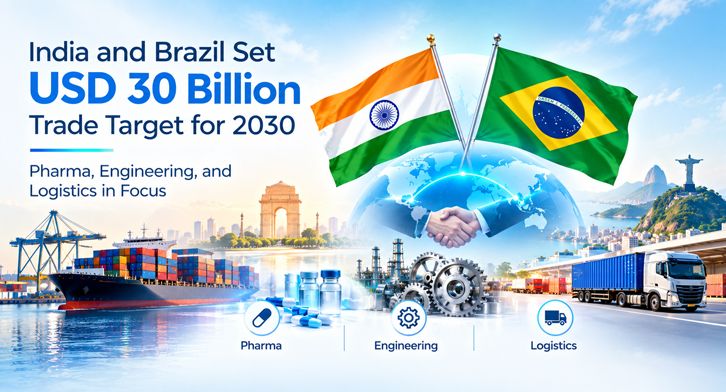
India and Brazil Set USD 30 Billion Trade Target for 2030 — Pharma, Engineering, and Logistics in Focus

India and Brazil have formally committed to doubling bilateral trade — from USD 15.07 billion in FY26 to USD 30 billion by 2030 — at the eighth India-Brazil Trade Monitoring Mechanism meeting in Brasília, co-chaired by India’s Commerce Secretary Rajesh Agrawal and Brazil’s Secretary of Foreign Trade Tatiana Lacerda Prazeres. The India-MERCOSUR (Southern Common Market) relationship has already reached USD 20.84 billion in trade volume, adding further scale to the corridor.
Discussions covered pharmaceuticals (with a CDSCO-ANVISA MOU signed in February 2026 providing regulatory cooperation), chemicals, engineering goods, machinery, and agriculture. Both countries agreed to push toward the finalisation of India-MERCOSUR Terms of Reference and the expansion of the existing India-MERCOSUR Preferential Trade Agreement. Mutual recognition of Electronic Certificates of Origin is also under negotiation.

Metric

Current / Recent

Target / 2030

Bilateral trade volume

USD 15.07B (FY26)

USD 30B by 2030

India–MERCOSUR trade

USD 20.84B (2025)

Expanding

Key sectors

Pharma, chemicals, engineering

Also: logistics, critical minerals

Regulatory cooperation

CDSCO-ANVISA MOU (Feb 2026)

Operational framework active

Policy coordination forums

BRICS, G20, WTO

GVC Action Plan 2026–2030

An Indian business delegation of more than 25 companies attended a High Level Business Reception in Brasília, exploring partnerships across critical minerals, renewable energy, digital services, and logistics. The planned establishment of an ApexBrasil office in New Delhi will further compress the business-to-business connection cycle between the two economies.

Frequently Asked Questions

What is the India-Brazil trade target for 2030?
India and Brazil have committed to doubling bilateral trade from USD 15.07 billion (FY26) to USD 30 billion by 2030. Key sectors include pharmaceuticals, chemicals, engineering goods, machinery, agriculture, critical minerals, and logistics. The India-MERCOSUR trade relationship adds further scale at USD 20.84 billion. An India-MERCOSUR PTA expansion and mutual recognition of Electronic Certificates of Origin are under negotiation.
Pharmaceutical shipments (India exports generics; CDSCO-ANVISA MOU eases regulatory clearance), engineering goods and machinery (both ways), agricultural commodities (soya, corn, sugar), chemical intermediates, and critical minerals for the energy transition. For freight operators, this corridor will drive demand for reefer capacity (pharma), bulk tonnage (agri), and breakbulk/project cargo (machinery).

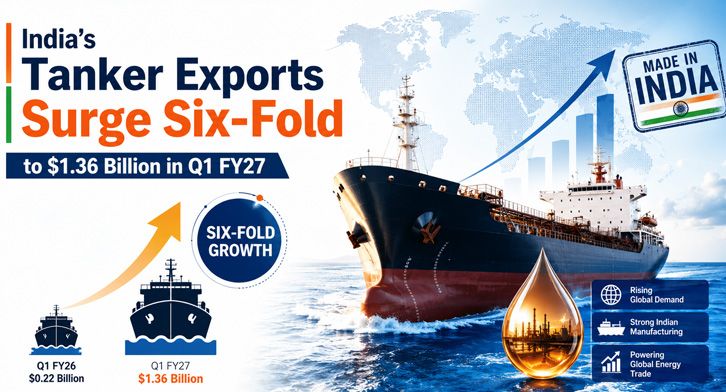
India’s Tanker Exports Surge Six-Fold to $1.36 Billion in Q1 FY27

India’s tanker exports climbed to US$1.36 billion during April–June 2026, more than six times the US$221.1 million recorded in the same quarter a year earlier. The number of tankers exported also increased from 10 to 23 vessels, according to Commerce Ministry data.
The sharp increase reflects stronger overseas demand for Indian-built tankers and the country’s expanding capabilities in commercial shipbuilding, maritime engineering and vessel delivery.

Key Highlights

India’s Tanker Export Growth at a Glance

Indicator

Q1 FY26

Q1 FY27

Year-on-year change

Tanker export value

US$221.1 million

US$1.36 billion

Approximately 515%

Number of tankers exported

10

23

130%

UAE export value

US$103.6 million

US$900.8 million

130%Approximately 770%

UAE export value

4

7

75%

Singapore export value

US$45.5 million

US$146.4 million

Approximately 222%

Singapore vessels

2

6

200%

Oman export value

US$28.6 million

US$131.6 million

Approximately 360%

Sri Lanka export value

US$7.9 million

US$56.5 million

Approximately 615%

UAE Leads India’s Tanker Export Market

The United Arab Emirates was the largest buyer of Indian tankers during the quarter. India shipped seven vessels worth US$900.8 million to the UAE, compared with four vessels valued at US$103.6 million in Q1 FY26.
The UAE alone generated approximately two-thirds of India’s tanker export earnings during the period. Its position as a major energy, shipping and logistics centre makes it an important market for Indian shipbuilders and marine equipment suppliers.
Singapore ranked second, purchasing six tankers worth US$146.4 million. This was up from two vessels valued at US$45.5 million in the corresponding quarter last year.

Tanker Exports by Destination in Q1 FY27

Destination

Export value

Approximate share

United Arab Emirates

US$900.8 million

66.20%

Singapore

US$146.4 million

10.80%

Oman

US$131.6 million

9.70%

Sri Lanka

US$56.5 million

4.20%

Egypt

US$39.3 million

2.90%

South Africa

US$39.3 million

2.50%

Vietnam

US$31.5 million

2.30%

Indonesia

US$12.2 million

0.90%

Mozambique

US$7.7 million

0.60%

India Expands into New Tanker Export Markets

The growth was not limited to the UAE, Singapore and Oman. India also supplied tankers to a wider group of maritime markets during Q1 FY27.
Exports to Sri Lanka rose from US$7.9 million to US$56.5 million. New shipments were reported to:
This geographic spread indicates growing acceptance of Indian-built vessels across the Middle East, Southeast Asia and Africa. It also reduces dependence on a small number of traditional export markets, although the UAE continued to dominate overall earnings.

Why Are India’s Tanker Exports Important?

Tankers are specialised commercial vessels designed to transport liquid or gaseous cargo, including petroleum products, chemicals, liquefied gases and water. Building them requires advanced engineering, specialised materials, safety systems and skilled maritime labour.
Higher exports can generate business across the wider maritime supply chain, including:
The increase in both export value and vessel volume suggests that the growth was supported by more deliveries as well as a higher-value product mix.

Impact on India’s Shipping and Logistics Sector

Growing tanker exports could increase demand for specialised logistics services around Indian shipbuilding clusters. Shipyards require the movement of steel, engines, electrical systems, navigation equipment and other heavy or high-value components.
Ports may also handle more vessel commissioning, bunkering, inspection and delivery activity. Marine service companies could benefit from requirements related to crew movement, technical supplies, certification and post-delivery support.
However, one quarter of exceptional growth does not by itself establish a long-term trend. Future performance will depend on shipyard order books, delivery schedules, global vessel demand and India’s ability to remain competitive on price, quality and delivery time.

Key Takeaway

India’s tanker export value rose from US$221.1 million to US$1.36 billion in one year, while the number of vessels shipped increased from 10 to 23. The UAE drove most of the growth, but new deliveries to Asian and African markets show that India’s tanker export network is becoming more geographically diverse.
The figures strengthen India’s position as an emerging supplier of high-value commercial vessels and could support further growth across shipbuilding, marine manufacturing, ports and specialised logistics.

Frequently Asked Questions

How much were India’s tanker exports in Q1 FY27?
India exported tankers worth US$1.36 billion during April–June 2026, compared with US$221.1 million in the same period a year earlier.
India exported 23 tankers, up from 10 vessels in Q1 FY26.
The United Arab Emirates was the largest destination, purchasing seven tankers worth US$900.8 million.
The UAE accounted for approximately 66% of India’s total tanker export value in Q1 FY27.
Singapore ranked second with tanker imports worth US$146.4 million, covering six vessels.
The available trade data show higher vessel deliveries and stronger international demand. The increase also points to improving commercial shipbuilding and maritime engineering capacity in India.
They can create opportunities in project cargo, port services, marine equipment movement, vessel commissioning, ship agency, bunkering and delivery support.

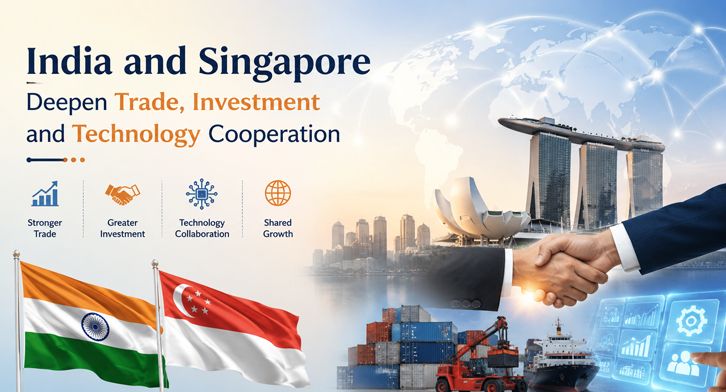
India and Singapore Deepen Trade, Investment and Technology Cooperation

India and Singapore have taken further steps to strengthen their economic partnership through high-level government and business discussions covering trade, investment, fintech, agricultural exports and sustainable infrastructure.
Union Minister of Commerce and Industry Mr. Piyush Goyal held a series of bilateral and business engagements in Singapore on August 20, 2026. The meetings were aimed at expanding commercial cooperation and identifying new opportunities for companies in both countries.

Key Highlights

High-Level India-Singapore Meetings

During his visit, Mr. Goyal called on Singapore Prime Minister Mr. Lawrence Wong at the Istana. Their engagement reflected the importance both countries attach to their strategic and economic relationship.
The Commerce Minister also participated in the fourth India-Singapore Ministerial Roundtable, a platform through which ministers from the two countries explore cooperation in strategically important sectors.
The discussions were followed by the fourth India-Singapore Business Roundtable and an MoU signing ceremony. These engagements brought government representatives and business leaders together to identify practical opportunities for investment and commercial partnerships.

Sectors Discussed During the Visit

Sector

Area of cooperation

Potential business impact

Agricultural trade

Indian food and processed-product exports

Better access to Singapore’s retail and consumer markets

Fintech

Financial technology networks and digital services

More collaboration between financial and technology companies

Commercial infrastructure

GCC-based commercial parks

New opportunities for offices, technology centres and business services

Sustainable infrastructure

Energy-efficient and environmentally responsible projects

Greater investment in long-term infrastructure development

Trade and investment

Business-to-business cooperation

Stronger commercial links and cross-border investment

Technology

Digital and emerging technologies

More partnerships between Indian and Singaporean companies

Focus on Agricultural and Processed-Food Exports

Mr. Goyal and Singapore’s Minister of State for Foreign Affairs and Trade and Industry, Ms. Gan Siow Huang, visited an APEDA-FairPrice initiative at City Square Mall.
The initiative showcased Indian agricultural and processed-food products in Singapore. It also demonstrated how partnerships between Indian export-promotion organisations and Singaporean retailers can help Indian producers reach international consumers.
Stronger retail connections could benefit Indian exporters of processed foods, fresh produce and other agricultural products. Logistics companies may also see increased demand for temperature-controlled transportation, warehousing, customs clearance and last-mile distribution.

Meetings with GFTN and Keppel Infrastructure

The visit included government-to-business discussions with senior representatives from the Global Finance & Technology Network and Keppel Infrastructure.
The discussions covered:
These sectors align with the growing demand for digital services, modern infrastructure and resilient trade networks across India and Southeast Asia.

India-Singapore Business Forum

Mr. Goyal also attended the India-Singapore Business Forum organised by the Federation of Indian Chambers of Commerce and Industry at the INSEAD Asia Campus.
During a fireside chat, he discussed India’s position in the changing global growth landscape and interacted with members of the Singaporean and Indian business communities.
The forum provided companies with an opportunity to explore partnerships, understand investment opportunities and discuss the role of India and Singapore in regional economic growth.

How the Engagements Could Support Trade and Logistics

Closer India-Singapore cooperation could improve trade flows between India and Southeast Asia. Singapore is an important commercial, financial, maritime and transshipment centre, making it a valuable partner for Indian exporters and logistics companies.

The engagements could support:

Frequently Asked Questions

What was the purpose of Mr. Piyush Goyal’s Singapore visit?
The visit focused on strengthening India-Singapore cooperation in trade, investment, technology, agricultural exports, fintech and sustainable infrastructure.
He met Singapore Prime Minister Mr. Lawrence Wong and participated in the fourth India-Singapore Ministerial Roundtable, the fourth India-Singapore Business Roundtable and the India-Singapore Business Forum.
Agriculture, food processing, financial technology, commercial infrastructure, logistics, digital services and sustainable infrastructure could benefit from new partnerships.
Collaboration between APEDA and Singaporean retailers such as FairPrice can improve the visibility and availability of Indian agricultural and processed-food products in Singapore.
Singapore is a major financial, maritime, logistics and commercial hub. It provides Indian companies with access to regional business networks and Southeast Asian markets.
An increase in bilateral trade could generate additional demand for freight forwarding, customs clearance, cold-chain transportation, warehousing, air cargo and maritime services.

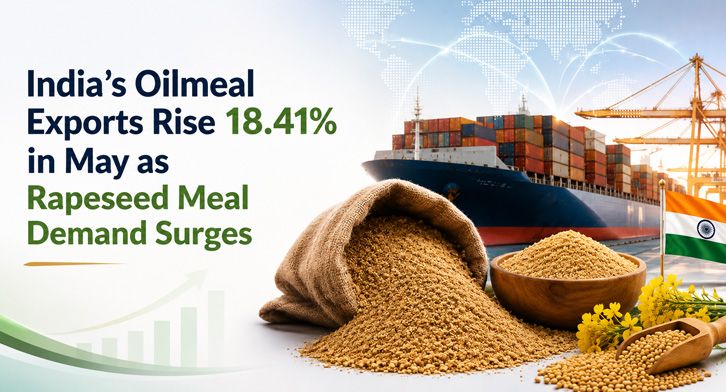
India’s Oilmeal Exports Rise 18.41% in May as Rapeseed Meal Demand Surges

India’s oilmeal exports recovered in May 2026, increasing 18.41% year on year to 3.73 lakh tonnes. Stronger rapeseed meal shipments, led by demand from China and other Asian feed markets, supported the rebound.
The recovery followed a difficult April, when shipping disruptions, higher freight costs and competition from South American suppliers affected export volumes.

Key Highlights

Rapeseed Meal Drives the May Recovery

Rapeseed meal accounted for much of the improvement in India’s oilmeal export performance. Growing demand from China helped Indian exporters increase shipments after the weaker start to the financial year.
Trade-flow data identified the India–China corridor as the largest reported route for canola meal shipments during May. This indicates that China is becoming increasingly important to India’s oilmeal exporters.
Rapeseed meal is widely used as a protein-rich ingredient in animal feed. Its competitive pricing and availability are helping Indian suppliers find buyers across Asian markets.

Oilmeal Export Performance

Period

Export volume

Year-on-year change

May 2026

3.73 lakh tonnes

0.1841

April–May 2026

7.39 lakh tonnes

−5.37%

April–May 2025

7.81 lakh tonnes

-

April–May 2025

Not specified

24.61%

Although May recorded strong growth, India’s total oilmeal exports for April–May 2026 remained below the previous year’s level. This was mainly due to the decline recorded in April.
Based on the reported cumulative figures, April 2026 exports were approximately 3.66 lakh tonnes, compared with an estimated 4.66 lakh tonnes in April 2025.

Monthly Oilmeal Export Comparison

April and May 2025 figures and April 2026 figures are approximate calculations based on the reported May growth rate and April–May totals.
Soybean Meal Faces Strong Price Competition
India’s soybean meal exporters continue to face difficult international market conditions. Brazil and Argentina have large soybean supplies and can offer soybean meal at competitive prices.
This price difference makes it harder for Indian suppliers to secure orders in cost-sensitive markets. India’s soybean meal export performance will depend on domestic soybean prices, processing costs and the availability of competitively priced supplies from South America.

Freight Costs Affect Export Competitiveness

Logistics costs remain an important concern for Indian oilmeal exporters. Higher ocean freight rates can significantly increase the delivered price of oilmeal, particularly in markets located farther from India.
Disruptions affecting international shipping routes, including the Red Sea corridor, may result in:
These challenges make nearby Asian destinations commercially important for Indian exporters.

What Could Influence Oilmeal Exports?

India’s oilmeal export performance during the remainder of FY27 is likely to be influenced by:
Sustained demand from Asian feed manufacturers could help India recover from the decline recorded during April. However, expensive freight and strong soybean meal competition may continue to limit overall growth.

Frequently Asked Questions

How much oilmeal did India export in May 2026?
India exported 3.73 lakh tonnes of oilmeal in May 2026, an increase of 18.41% year on year.
The increase was mainly driven by stronger exports of rapeseed meal, particularly to China and other Asian feed markets.
China emerged as an important destination. The India–China trade corridor was the largest reported route for canola meal shipments in May.
Indian soybean meal faces price competition from Brazil and Argentina, where large soybean crops allow exporters to offer more competitive prices.
No. Oilmeal exports during April–May 2026 declined 5.37% to 7.39 lakh tonnes, compared with 7.81 lakh tonnes during the same period a year earlier.
Higher freight rates increase the delivered cost of Indian oilmeal. This makes exports less competitive, especially in distant international markets.

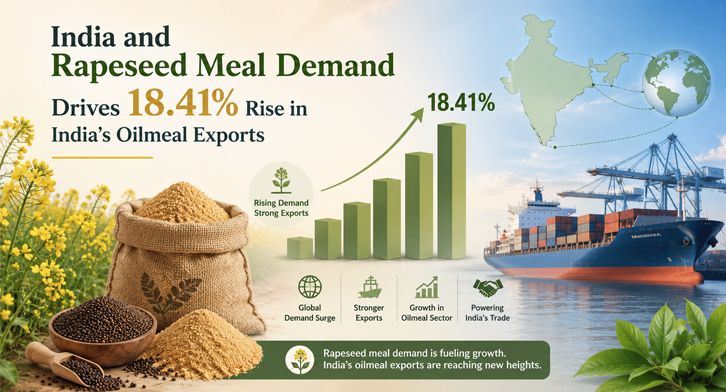
Rapeseed Meal Demand Drives 18.41% Rise in India’s Oilmeal Exports

India’s oilmeal exports recovered in May 2026, increasing 18.41% year on year to 3.73 lakh tonnes, compared with approximately 3.15 lakh tonnes in May 2025. Stronger overseas demand for rapeseed meal, particularly from China and other Asian feed markets, supported the rebound.
The recovery follows a difficult April, when shipping disruptions, elevated freight costs and competition from South American suppliers affected India’s oilmeal shipments.

Important Points

India’s Oilmeal Export Performance

Period

Export volume

Year-on-year change

April 2025

4.66 lakh tonnes

—

May 2025

3.15 lakh tonnes

—

April 2026

3.66 lakh tonnes

Down 21.46%

May 2026

3.73 lakh tonnes

Up 18.41%

April–May 2025

7.81 lakh tonnes

—

April–May 2026

7.39 lakh tonnes

Down 5.37%

Rapeseed Meal Leads the Export Recovery

Rapeseed meal was the principal driver of India’s oilmeal export growth in May. Demand from China and other Asian countries has created additional opportunities for Indian exporters supplying ingredients to livestock, poultry and aquaculture feed manufacturers.
Trade-flow data identified the India–China route as the largest reported corridor for canola or rapeseed meal shipments during the month. This reflects China’s increasing importance within India’s agricultural export market.
India’s proximity to major Asian destinations may also offer shorter transit times than shipments from some competing origins. However, the commercial advantage depends heavily on freight rates, product prices and vessel availability.

Soybean Meal Exports Face Strong Competition

While rapeseed meal shipments improved, Indian soybean meal remained under pressure in international markets.
Brazil and Argentina continue to benefit from large soybean crops and competitive export prices. This makes it difficult for Indian suppliers to secure orders in price-sensitive overseas feed markets.
India’s soybean meal competitiveness will depend on:

Weak April Keeps Cumulative Exports Lower

Despite May’s improvement, India’s cumulative oilmeal exports during April–May 2026 were 5.37% lower year on year.
Exports reached 7.39 lakh tonnes, compared with 7.81 lakh tonnes during the same period in 2025. The decrease was primarily caused by weaker shipments in April, which were not fully offset by May’s recovery.
This comparison shows that one month of stronger exports has improved the position, but sustained demand will be necessary for the sector to return to cumulative growth.

Export Volume Versus Export Value

Oilmeal exports increased 24.61% in value terms during May 2026, exceeding the 18.41% increase recorded in shipment volume.

Indicator

May 2026 year-on-year change

Oilmeal export volume

Up 18.41%

Oilmeal export value

Up 24.61%

April–May export volume

Down 5.37%

The faster increase in export value may indicate a more favourable product mix, improved pricing or stronger demand for higher-value oilmeal products.

Freight Costs Remain a Challenge

Logistics conditions continue to influence India’s oilmeal export competitiveness. Disruptions affecting international shipping routes, including the Red Sea corridor, have contributed to higher transportation costs and longer transit times.
These conditions can particularly affect exports to distant markets because oilmeal is a bulk commodity with price-sensitive margins.
Exporters may face:

What Could Influence Exports in the Coming Months?

India’s oilmeal export performance will depend on demand from China and other Asian feed markets. Continued purchasing of rapeseed meal could help exporters maintain the momentum recorded in May.
Other important factors include global oilmeal prices, India’s domestic oilseed production, South American soybean supplies, currency movements and international freight rates.
Rapeseed meal is becoming increasingly important to India’s oilmeal export basket. However, sustained growth will require stronger shipments across multiple products and continued access to competitively priced logistics services.

Frequently Asked Questions

How much oilmeal did India export in May 2026?
India exported approximately 3.73 lakh tonnes of oilmeals in May 2026, an increase of 18.41% compared with May 2025.
The increase was primarily driven by stronger overseas demand for Indian rapeseed meal, particularly from China and other Asian feed markets.
Indian soybean meal faces price competition from Brazil and Argentina, which have large supplies and can offer competitive prices in international markets.
No. Despite the May rebound, cumulative exports fell 5.37% to 7.39 lakh tonnes, from 7.81 lakh tonnes during April–May 2025.
Higher freight rates increase the delivered cost of Indian oilmeal. This can make Indian cargo less competitive, especially in distant and price-sensitive markets.
China and other Asian countries are increasingly important markets because of their demand for protein-rich ingredients used in animal and aquaculture feed.

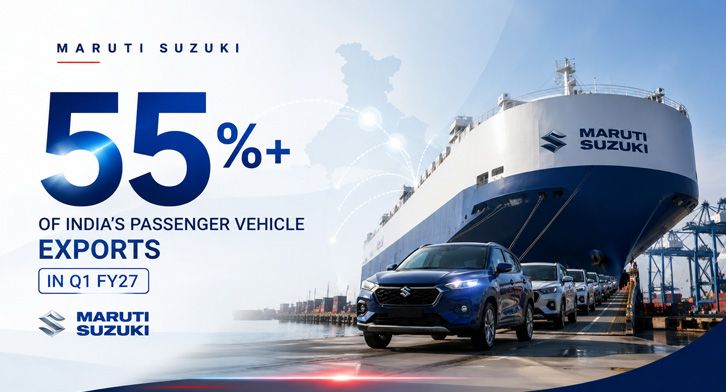
Maruti Suzuki Accounts for Over 55% of India’s Passenger Vehicle Exports in Q1 FY27

Maruti Suzuki India strengthened its leadership in the country’s passenger vehicle export market during the first quarter of FY27. The automaker shipped 123,330 passenger vehicles between April and June 2026, accounting for more than 55% of India’s total passenger vehicle exports.

The company’s exports increased 28.23% from 96,181 units in the same quarter last year. By comparison, India’s overall passenger vehicle exports grew 8.8% year-on-year to 222,392 units.

Important Points

Q1 FY27 Passenger Vehicle Export Performance

Export indicator

Q1 FY26

Q1 FY27

Year-on-year change

Maruti Suzuki passenger vehicle exports

96,181 units

123,330 units

28.23%

Total Indian passenger vehicle exports

Approx. 204,400 units

222,392 units

9%

Maruti Suzuki’s export market share

Approx. 47.1%

Approx. 55.5%

Up 8.4 percentage points

Maruti Suzuki added 27,149 export units during the quarter. Its growth was substantially faster than that of the wider market, pushing its share of national passenger vehicle exports above 55%.

FRONX Leads Maruti Suzuki’s Export Expansion

The FRONX has become one of the strongest contributors to Maruti Suzuki’s overseas growth. The SUV crossed the 200,000-unit export milestone in August 2026, less than 38 months after international shipments began in June 2023.

The first 100,000 FRONX vehicles were exported over approximately 25 months. The following 100,000 units were shipped in around 13 months, indicating a significant acceleration in overseas demand.
Manufactured at Maruti Suzuki’s Hansalpur facility in Gujarat, the FRONX is now supplied to nearly 90 countries. It has remained India’s most-exported passenger vehicle since FY25.

Maruti Suzuki Expands Its International Market Presence

Maruti Suzuki currently exports 17 vehicle models to nearly 120 countries. Its international markets include destinations across:
This geographically diversified market base can help the company manage demand fluctuations and trade-related disruptions in individual regions.
The inclusion of the eVITARA among India’s leading exported models also signals the growing importance of electric vehicles in the country’s automotive export portfolio.

What Export Growth Means for Ports and Logistics Companies

Higher passenger vehicle exports create additional cargo volumes across the automotive logistics chain. The growth can benefit:
Ports with dedicated automobile-handling infrastructure could see stronger demand for vehicle storage yards, RoRo berths, vessel scheduling, customs processing and multimodal connectivity.

How Are Maruti Suzuki Vehicles Exported?

Export vehicles are generally transported from manufacturing facilities to Indian ports by rail or specialised road carriers. At the port, they undergo documentation, customs clearance, inspection and temporary storage before loading.
Vehicles may be shipped using:
The shipping method depends on cargo volume, destination, vessel availability, cost and port infrastructure.

India’s Role as an Automotive Export Hub

The results reinforce India’s growing position as a manufacturing and export centre for passenger vehicles. Competitive production capabilities, an expanding model range and access to multiple international markets are supporting this growth.
Maruti Suzuki’s exports increased more than three times as fast as India’s overall passenger vehicle exports during Q1 FY27. This difference indicates that the company is gaining export market share while helping generate additional demand for Indian ports, shipping lines and finished-vehicle logistics networks.

Frequently Asked Questions

How many passenger vehicles did Maruti Suzuki export in Q1 FY27?
Maruti Suzuki exported 123,330 passenger vehicles between April and June 2026.
The company accounted for approximately 55.5% of India’s passenger vehicle exports in Q1 FY27.
Maruti Suzuki’s passenger vehicle exports increased 28.23% year-on-year, compared with India’s overall export growth of 8.8%.
The FRONX has been India’s leading exported passenger vehicle since FY25. It crossed 200,000 cumulative exports in August 2026.
Maruti Suzuki exports 17 models to nearly 120 international markets. The FRONX alone is shipped to nearly 90 countries.
Rising exports increase demand for vehicle transportation, port storage, customs clearance, RoRo shipping, container services and finished-vehicle logistics.
cargonet-logo-icon
Cargonet Cargo Software Logo

Feedback & Reward program

Submit the Feedback and avail the Rewards.

1. Your satisfaction & reliability on CargoNet ?

2. Your Rating on Support & co-ordination team?

3. Satisfaction on the look and feel of CargoNet ?

4. Please specify any 2 best features that you feel more helpful in CargoNet?

5. Please specify any 2 best reports that you are taking on regular basis?

6. Are you using Copy Job option in CargoNet Software?

7. Are you using Automatic DSR (Daily Status Report) Option? It automatically sends reports to customer about the shipment status

8. Are you using Automatic Outstanding Reports option? Period Auto outstanding reminders to customer

9. Any other thoughts to improve in CargoNet? Please share.

* Join our Reward Program by recommending CargoNet (Cash Rewards Awaiting)

“Thanks for your feedback. Our goal is to create the best possible product, support & service, and your thoughts, ideas & suggestions play a major role in helping us identify opportunities to improve.”

Cut AI cost,
not performance

discover how top Freight Forwarding companies  reduce AI-related expense and speed up operation with CargoNet AI, we will show it how
Share your information for instant access :