
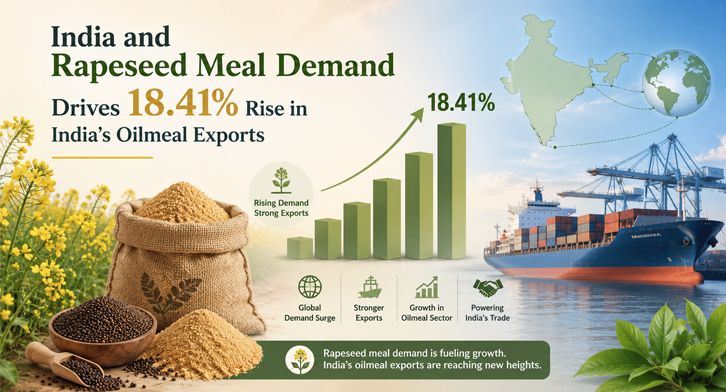
India’s oilmeal exports recovered in May 2026, increasing 18.41% year on year to 3.73 lakh tonnes, compared with approximately 3.15 lakh tonnes in May 2025. Stronger overseas demand for rapeseed meal, particularly from China and other Asian feed markets, supported the rebound.
The recovery follows a difficult April, when shipping disruptions, elevated freight costs and competition from South American suppliers affected India’s oilmeal shipments.
Important Points
- India exported 3.73 lakh tonnes of oilmeals in May 2026.
- Export volume increased 18.41% year on year.
- Rapeseed meal was the main contributor to the monthly growth.
- China emerged as an important destination for Indian rapeseed meal.
- Soybean meal exports continued to face price pressure from Brazil and Argentina.
- Total oilmeal exports during April–May 2026 declined 5.37% to 7.39 lakh tonnes.
- Oilmeal export value increased 24.61% in May 2026.
- High freight rates and shipping-route disruptions remain significant challenges.
India’s Oilmeal Export Performance
Period
Export volume
Year-on-year change
April 2025
4.66 lakh tonnes
—
May 2025
3.15 lakh tonnes
—
April 2026
3.66 lakh tonnes
Down 21.46%
May 2026
3.73 lakh tonnes
Up 18.41%
April–May 2025
7.81 lakh tonnes
—
April–May 2026
7.39 lakh tonnes
Down 5.37%
Rapeseed Meal Leads the Export Recovery
Rapeseed meal was the principal driver of India’s oilmeal export growth in May. Demand from China and other Asian countries has created additional opportunities for Indian exporters supplying ingredients to livestock, poultry and aquaculture feed manufacturers.
Trade-flow data identified the India–China route as the largest reported corridor for canola or rapeseed meal shipments during the month. This reflects China’s increasing importance within India’s agricultural export market.
India’s proximity to major Asian destinations may also offer shorter transit times than shipments from some competing origins. However, the commercial advantage depends heavily on freight rates, product prices and vessel availability.
Soybean Meal Exports Face Strong Competition
While rapeseed meal shipments improved, Indian soybean meal remained under pressure in international markets.
Brazil and Argentina continue to benefit from large soybean crops and competitive export prices. This makes it difficult for Indian suppliers to secure orders in price-sensitive overseas feed markets.
India’s soybean meal competitiveness will depend on:
- Domestic soybean availability and crushing volumes
- International soybean and meal prices
- Export demand from nearby Asian markets
- Currency movements
- Ocean freight costs
- Prices offered by Brazil and Argentina
Weak April Keeps Cumulative Exports Lower
Despite May’s improvement, India’s cumulative oilmeal exports during April–May 2026 were 5.37% lower year on year.
Exports reached 7.39 lakh tonnes, compared with 7.81 lakh tonnes during the same period in 2025. The decrease was primarily caused by weaker shipments in April, which were not fully offset by May’s recovery.
This comparison shows that one month of stronger exports has improved the position, but sustained demand will be necessary for the sector to return to cumulative growth.
Export Volume Versus Export Value
Oilmeal exports increased 24.61% in value terms during May 2026, exceeding the 18.41% increase recorded in shipment volume.
Indicator
May 2026 year-on-year change
Oilmeal export volume
Up 18.41%
Oilmeal export value
Up 24.61%
April–May export volume
Down 5.37%
The faster increase in export value may indicate a more favourable product mix, improved pricing or stronger demand for higher-value oilmeal products.
Freight Costs Remain a Challenge
Logistics conditions continue to influence India’s oilmeal export competitiveness. Disruptions affecting international shipping routes, including the Red Sea corridor, have contributed to higher transportation costs and longer transit times.
These conditions can particularly affect exports to distant markets because oilmeal is a bulk commodity with price-sensitive margins.
Exporters may face:
- Higher ocean freight rates
- Longer shipment transit times
- Changes in vessel schedules
- Limited equipment or cargo-space availability
- Higher insurance and handling costs
- Reduced price competitiveness in distant markets
What Could Influence Exports in the Coming Months?
India’s oilmeal export performance will depend on demand from China and other Asian feed markets. Continued purchasing of rapeseed meal could help exporters maintain the momentum recorded in May.
Other important factors include global oilmeal prices, India’s domestic oilseed production, South American soybean supplies, currency movements and international freight rates.
Rapeseed meal is becoming increasingly important to India’s oilmeal export basket. However, sustained growth will require stronger shipments across multiple products and continued access to competitively priced logistics services.
Frequently Asked Questions
How much oilmeal did India export in May 2026?
India exported approximately 3.73 lakh tonnes of oilmeals in May 2026, an increase of 18.41% compared with May 2025.
What caused India’s oilmeal exports to rise?
The increase was primarily driven by stronger overseas demand for Indian rapeseed meal, particularly from China and other Asian feed markets.
Why are India’s soybean meal exports under pressure?
Indian soybean meal faces price competition from Brazil and Argentina, which have large supplies and can offer competitive prices in international markets.
Did India’s oilmeal exports increase during April–May 2026?
No. Despite the May rebound, cumulative exports fell 5.37% to 7.39 lakh tonnes, from 7.81 lakh tonnes during April–May 2025.
How do freight costs affect oilmeal exports?
Higher freight rates increase the delivered cost of Indian oilmeal. This can make Indian cargo less competitive, especially in distant and price-sensitive markets.
Which countries are important markets for Indian rapeseed meal?
China and other Asian countries are increasingly important markets because of their demand for protein-rich ingredients used in animal and aquaculture feed.