

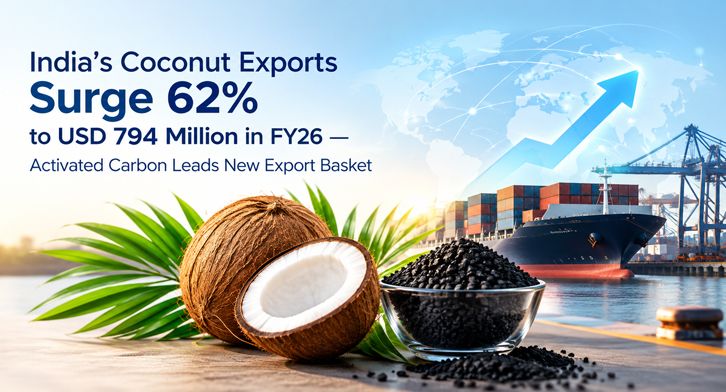
India’s coconut product exports registered 62% year-on-year growth in FY26, reaching Rs. 7,038.35 crore (USD 794.70 million), up from Rs. 4,349.03 crore in FY25. The jump marks a structural shift rather than a seasonal spike: the export basket has diversified well beyond traditional coconut oil and desiccated coconut to encompass virgin coconut oil, coconut milk, coconut water, activated carbon, fresh and frozen coconut, grated coconut, and copra.
Activated carbon has emerged as the standout new contributor to export earnings. The product category — used in water filtration, industrial processes, and air purification — commands higher per-tonne value than primary coconut products and has opened industrial buyer relationships in Europe and the Americas that traditional coconut suppliers were not reaching. India holds approximately 31.24% of global coconut production, making it the world’s largest producer — a structural advantage that competitors cannot replicate quickly.
India Coconut Export Growth — Key Statistics (Source: Government of India)
Metric
FY26 / Current
Total export value FY26
Rs. 7,038.35 crore (USD 794.70 million)
Year-on-year growth
+62%
Prior year (FY25)
Rs. 4,349.03 crore
FY02 baseline (for context)
Rs. 25.3 crore — 278× growth in 24 years
Registered exporters (Jul 31, 2026)
8,700
India's global production share
~31.24% — world's largest producer
Key export markets
US, UAE, Sri Lanka, Germany, Russia, Turkey, Belgium, UK, Netherlands
Standout new product
Activated carbon — industrial buyers in Europe/Americas
The Coconut Promotion Scheme introduced under the FY27 Union Budget provides state support for sustainability improvements, export promotion, and farmer income enhancement. For cargo managers, the growth in value-added coconut products means a shift from bulk commodity movements toward packaged consumer and industrial goods — higher revenue per container, different packaging and cold-chain requirements.
Frequently Asked Questions
Why did India's coconut exports jump 62% in FY26?
India’s coconut exports grew 62% to USD 794.70 million in FY26 because of product diversification beyond traditional coconut oil into activated carbon (higher value, industrial buyers in Europe/Americas), virgin coconut oil, coconut milk, coconut water, and frozen coconut. India holds ~31.24% of global coconut production (world’s largest), providing a structural supply advantage. 8,700 registered exporters are active, serving markets including the US, UAE, Germany, and Russia.
How does coconut export growth affect freight and packaging logistics?
The shift from bulk commodity (coconut oil in tankers) to value-added packaged products (activated carbon, coconut water, virgin coconut oil in retail packaging) changes freight dynamics: smaller FCL/LCL shipments, more ocean FCL to Europe and Americas, cold-chain requirements for fresh/frozen coconut, and labelling complexity for consumer-packaged goods. Revenue per container rises significantly compared with bulk oil movements.