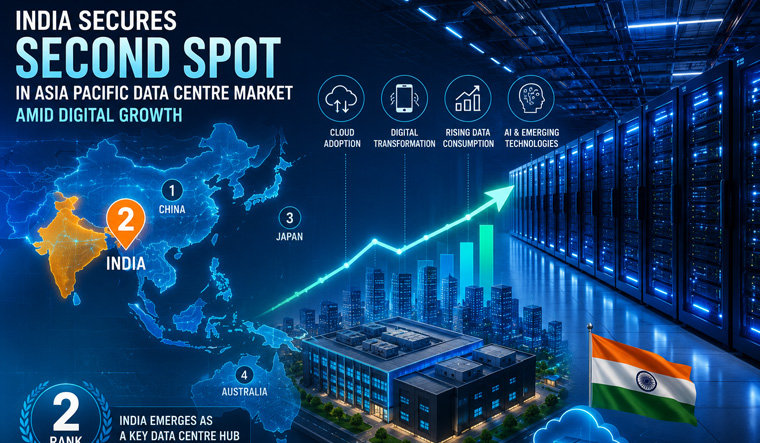
India Secures Second Spot in Asia Pacific Data Centre Market Amid Digital Growth

India has emerged as the second-largest data centre market in the Asia-Pacific region, highlighting its growing role in the global digital economy and increasing appeal for technology investments. According to a report by Cushman & Wakefield, rapid growth in cloud computing, artificial intelligence (AI), digital services, and data consumption has significantly expanded the country’s data centre capacity.
Major cities including Mumbai, Chennai, Hyderabad, Bengaluru, and Delhi-NCR continue to attract investments from hyperscalers, cloud providers, and enterprise customers. Supportive government policies, data localisation requirements, strong connectivity, and competitive operating costs have further strengthened India’s position as a leading data centre destination.
The sector is expected to drive job creation, boost digital capabilities, and support emerging technologies across industries such as finance, healthcare, manufacturing, and e-commerce.

Key Highlights:

India’s Export Performance Reaches Four-Year Peak in May

India’s exports recorded their strongest growth in four years during May, supported by robust demand for engineering goods, electronics, pharmaceuticals, and petroleum products. The strong performance signals improving global demand and increased competitiveness of Indian manufacturing sectors.
Despite the export surge, India’s trade deficit widened as imports rose sharply due to higher purchases of crude oil, gold, machinery, and electronic goods. While stronger imports indicate healthy domestic demand and industrial activity, rising import costs continue to pressure the country’s trade balance.
The government remains focused on boosting exports through Production-Linked Incentive (PLI) schemes, trade agreements, and infrastructure development aimed at strengthening India’s role in global supply chains.

Key Highlights:

100 Industrial Parks Under BHAVYA Scheme to Receive ₹33,660 Crore Infrastructure Push

The Department for Promotion of Industry and Internal Trade (DPIIT), under the Ministry of Commerce and Industry, has released the operational guidelines for the implementation of the BHAVYA Scheme, a major Central Sector initiative aimed at developing investment-ready, world-class industrial parks across India.
The BHAVYA Scheme has been launched to strengthen India’s manufacturing ecosystem through the creation of integrated industrial infrastructure aligned with flagship initiatives such as Make in India and PM Gati Shakti. The scheme is expected to play a crucial role in positioning India as a globally competitive manufacturing and investment destination.

₹33,660 Crore Allocation for 100 Industrial Parks

Under the scheme, 100 industrial parks will be developed over a six-year period from FY 2026-27 to FY 2031-32 with a total financial outlay of approximately ₹33,660 crore.
In the first phase, up to 50 industrial parks will be selected through a challenge-based competitive process. The newly released guidelines establish a comprehensive framework covering eligibility criteria, project selection, funding mechanisms, governance structures, monitoring systems, and implementation procedures.

Focus on Investment-Ready Industrial Infrastructure

The primary objective of the BHAVYA Scheme is to create investment-ready industrial ecosystems equipped with:
These features are designed to attract domestic and global manufacturing investments while enhancing ease of doing business.

Greenfield and Brownfield Industrial Parks Eligible

The scheme allows for the development of both greenfield and eligible brownfield industrial parks.
Land requirements under the scheme include:

Competitive Selection Based on Infrastructure and Connectivity

Project proposals will be assessed through a transparent, challenge-based evaluation framework focusing on:
Infrastructure quality assessments will cover underground utilities, water and waste management systems, common effluent treatment plants, renewable energy infrastructure, worker housing, testing laboratories, skill development centers, and digital single-window platforms.

SPV-Based Development Model

Projects under the BHAVYA Scheme will be implemented through Special Purpose Vehicles (SPVs) incorporated under the Companies Act, 2013.
The SPVs will oversee:
Financial assistance will be provided in the form of equity contributions linked to land value transferred to the SPV and achievement of predefined project milestones.

NICDC Appointed as Project Management Agency

The National Industrial Corridor Development Corporation (NICDC) has been designated as the Project Management Agency (PMA) for overseeing implementation and monitoring of the scheme.
The guidelines also encourage participation from private developers through project-specific SPVs supported by clearly defined governance, transparency, and accountability mechanisms.

Technology-Driven Monitoring and Transparency

To ensure efficient implementation, the BHAVYA Scheme incorporates:
The scheme also promotes convergence with Central and State Government initiatives related to logistics, renewable energy, skilling, sustainability, utility infrastructure, and industrial development.

Key Highlights of the BHAVYA Scheme

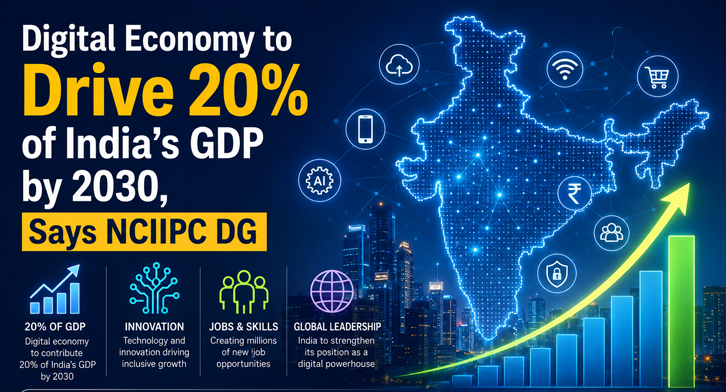
Digital Economy to Drive 20% of India’s GDP by 2030, Says NCIIPC DG

India’s digital economy is projected to contribute nearly 20% to the nation’s GDP by 2030, highlighting the country’s rapid progress in digital transformation and technology-driven growth. According to NCIIPC Director General Mr. M. U. Nair, the expansion of India’s digital ecosystem is being powered by increasing internet penetration, Digital Public Infrastructure (DPI), Aadhaar, UPI, and widespread adoption of emerging technologies. These initiatives have transformed interactions among citizens, businesses, and government institutions while creating significant opportunities for innovation, entrepreneurship, digital investments, and economic development. The rise of technologies such as Artificial Intelligence (AI), cloud computing, data analytics, and the Internet of Things (IoT) is expected to accelerate digitalisation across industries and generate substantial economic value. As dependence on digital platforms continues to increase, cybersecurity and critical information infrastructure protection are becoming essential for sustainable growth and national resilience.
India’s expanding startup ecosystem, digital payments landscape, and technology investments are expected to strengthen its ambition of becoming a multi-trillion-dollar digital economy, improving productivity, competitiveness, and inclusive growth across sectors.

Key Highlights

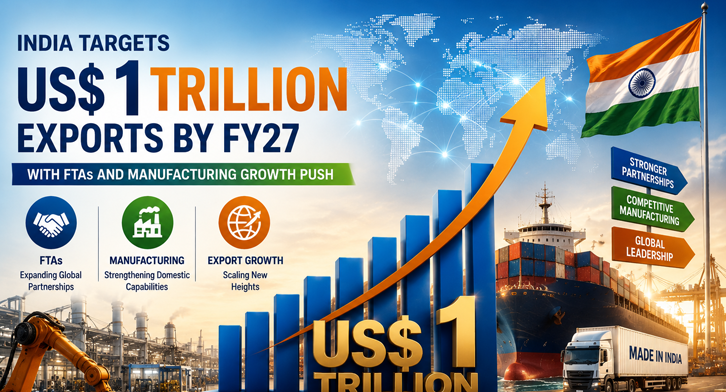
India Targets US$ 1 Trillion Exports by FY27 with FTAs and Manufacturing Growth Push

India is accelerating its global trade ambitions with a target of Rs. 96.30 lakh crore (US$ 1 trillion) in exports by FY27, according to Union Commerce and Industry Minister Mr. Piyush Goyal. Speaking at the launch of the Bharatiya Vyapar Mahotsav in New Delhi, the Minister emphasized that achieving the export milestone is central to the vision of Atmanirbhar Bharat and India’s long-term economic growth strategy. India recorded exports worth Rs. 75.94 lakh crore (US$ 863 billion) in FY 2025–26, registering nearly 5% growth despite global challenges such as geopolitical tensions and trade uncertainties. The government is strengthening Free Trade Agreements (FTAs) with nearly 38 developed countries to improve market access and boost Indian exports globally. The initiative also focuses on import substitution, domestic manufacturing, Swadeshi initiatives, startup participation, and improving trade infrastructure. Enhanced logistics, ease of doing business, and expanding export opportunities are expected to strengthen India’s competitiveness in global markets. Additionally, India’s services exports reached a record US$ 421.32 billion, while merchandise exports stood at US$ 441.78 billion, highlighting the country’s growing role in international trade and manufacturing.

Key Highlights

Merchandise & Services Exports Hit US$ 80.80 Billion in April 2026

India’s export sector recorded strong growth in April 2026, showcasing continued momentum in international trade and global business expansion. Total exports, including merchandise and services, reached Rs. 7.49 lakh crore (US$ 80.80 billion), reflecting a 13.59% year-on-year growth compared to April 2025. Merchandise exports rose to US$ 43.56 billion, while services exports climbed to US$ 37.24 billion, highlighting strong demand for Indian products and services across global markets.
India’s total imports during April 2026 were estimated at US$ 88.61 billion, while the country’s overall trade deficit narrowed significantly to US$ 7.81 billion from US$ 11.16 billion in the previous year. Non-petroleum exports also recorded healthy growth of 9.01%, demonstrating diversification and resilience in India’s export economy.
Key sectors driving export growth included petroleum products, electronic goods, engineering goods, pharmaceuticals, meat, dairy & poultry products. Petroleum exports surged by 34.66%, while electronic goods exports recorded an impressive 40.31% growth, reflecting India’s expanding manufacturing and technology capabilities. Engineering goods exports also increased steadily by 8.76%, supported by rising international demand.
Additional sectors such as marine products, iron ore, coffee, chemicals, and handicrafts also posted positive growth, reinforcing India’s position as a leading global trade and export hub.

Key Highlights

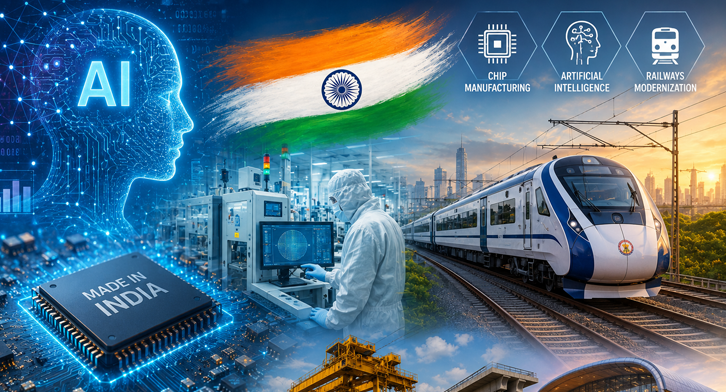
India Focuses on AI, Chip Manufacturing and Railways for Long-Term Economic Growth

India is rapidly emerging as a global technology and manufacturing powerhouse, with artificial intelligence (AI), semiconductors and railway infrastructure expected to play a major role in driving the country’s next phase of economic growth. Speaking at the CII Annual Business Summit 2026, Union Minister Ashwini Vaishnaw stated that India’s continued investments in digital technologies, electronics manufacturing and railway modernisation are strengthening the nation’s industrial competitiveness and long-term economic resilience.
The Minister highlighted that India has made significant progress in railway infrastructure over the past decade, adding nearly 36,000 kilometres of railway tracks and electrifying around 49,000 kilometres of rail lines. Railway capital expenditure also increased sharply to approximately Rs. 2.72 lakh crore (US$ 28.78 billion) in the previous financial year, reflecting the government’s strong focus on infrastructure-led development.
Mr. Vaishnaw noted that India’s emphasis on quality manufacturing, process efficiency and cost competitiveness is helping position the country as a major global manufacturing and technology hub. He further stated that AI is becoming one of the world’s most transformative technologies and can significantly improve productivity, operational efficiency and manufacturing quality across industries.
The Minister also emphasised that expanding semiconductor investments and new electronics manufacturing facilities are laying the foundation for a technologically advanced and self-reliant India. Government initiatives such as the India Semiconductor Mission and India AI Mission are accelerating growth in semiconductor production, digital infrastructure and AI innovation.

Key Highlights

Industry experts believe the combined expansion of railway infrastructure, semiconductor manufacturing and AI technologies could significantly boost employment generation, industrial growth, exports and India’s position in global value chains. The continued focus on technology-driven and infrastructure-led development reflects the government’s broader vision of building a “Viksit Bharat” and transforming India into a leading global innovation and manufacturing economy.

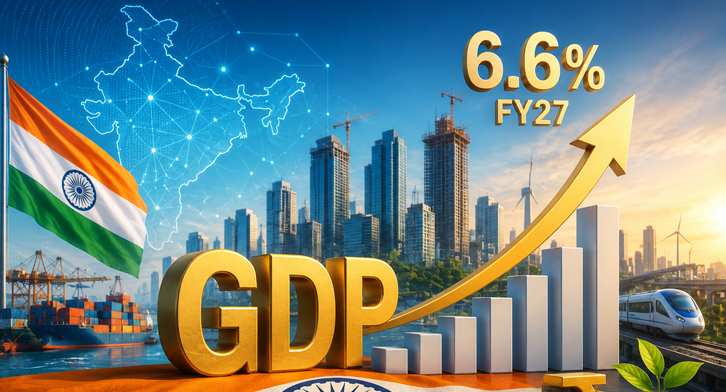
India’s GDP Growth Projected at 6.6% for FY27 Amid Strong Economic Momentum

India’s economy is expected to grow by 6.6% in FY27, according to a latest report released by SBI Research in May 2026. The report highlighted that the Indian economy continues to remain resilient despite ongoing global uncertainties, geopolitical tensions and volatility in international markets.
The report estimates India’s GDP growth for FY26 at 7.5%, while real GDP growth during the fourth quarter of FY26 is expected to remain close to 7.2%, reflecting strong economic fundamentals and sustained domestic demand.

Key Highlights from SBI Research Report

Strong Domestic Consumption Supporting Growth

According to the report, rising domestic consumption, improving rural demand and sustained credit expansion are expected to drive economic momentum in FY27.
Rural consumption remained healthy due to strong agricultural and non-farm activity, while urban demand received support from government fiscal measures, festive spending and improving consumer confidence.

Banking and Credit Growth Remain Robust

The report highlighted significant improvement in banking sector performance during FY26. Credit growth by scheduled commercial banks increased to 16.1%, compared to 11% in the previous financial year.
The second half of FY26 witnessed stronger lending activity, indicating rising investment demand and improving business sentiment across sectors.

Economic Indicators Reflect Stability

SBI Research noted that high-frequency economic indicators continue to reflect stable economic activity despite slight moderation in the final quarter of FY26.
Key sectors including manufacturing, services, infrastructure and retail consumption continued to support India’s growth trajectory amid challenging global conditions.

Challenges and Inflation Risks Ahead

Despite the positive outlook, the report cautioned that fluctuations in crude oil prices, commodity market volatility and possible El Niño weather conditions could create inflationary pressures in the near term.
The report also stressed the importance of structural reforms to:

India Maintains Position as Fast-Growing Major Economy

The latest SBI Research projections reinforce India’s position as one of the world’s fastest-growing major economies. Strong domestic demand, improving financial conditions and continued infrastructure investment are expected to support sustainable economic growth in the coming years.

Strong Infrastructure Demand Drives India’s Construction Equipment Industry Growth

India’s construction equipment industry achieved record-breaking growth in FY 2025-26, driven by rapid infrastructure development, strong government investment and rising global demand for Indian-made heavy machinery. According to the Ministry of Heavy Industries, the sector recorded total sales of 1,40,191 units during the financial year, registering a 3% year-on-year (YoY) increase.

Key Highlights of India’s Construction Equipment Industry Growth

Infrastructure Push Driving Industry Expansion

The continued expansion of India’s infrastructure sector has played a major role in boosting demand for construction machinery and heavy equipment. Large-scale public investments in roads, smart cities, rail connectivity, mining operations and industrial corridors have accelerated mechanisation across the country.
Government-backed infrastructure initiatives have significantly supported manufacturing growth and technology adoption within the industry.

Government Policies Supporting Growth

Several flagship government programmes have strengthened India’s construction equipment ecosystem, including:
Production Linked Incentive (PLI) Scheme
The PLI scheme has encouraged domestic manufacturing, localisation and advanced technology adoption in heavy engineering and industrial equipment production.
National Infrastructure Pipeline (NIP)
The NIP has boosted long-term infrastructure investments across transportation, logistics, energy and urban development sectors.
PM Gati Shakti Programme
The PM Gati Shakti initiative has improved multi-modal infrastructure planning, accelerating construction activities and increasing demand for modern machinery.

Rising Global Demand for Indian Construction Equipment

India’s construction equipment exports witnessed remarkable momentum during FY 2025-26. Indian-made machinery is increasingly gaining acceptance in international markets due to its competitive pricing, improved quality and fuel-efficient technology.
Key export destinations include:
Industry experts believe India is becoming an important player in the global construction equipment supply chain as manufacturers continue expanding production capacity and improving engineering capabilities.

Growing Demand for Advanced Equipment

The market has also seen rising demand for:
This shift reflects the industry’s growing focus on productivity, energy efficiency and modern infrastructure development.

India Set to Lead G20 Growth in FY27: Moody’s Projects 6.4% GDP Expansion

India is expected to remain the fastest-growing major economy in the world.

In its latest outlook, Moody’s Ratings has projected India’s GDP to grow at 6.4% in FY27, the highest among all G20 economies. The growth outlook reflects strong domestic demand, policy momentum, and a resilient banking system — all critical indicators for the logistics and freight sector.

For businesses in shipping, freight forwarding, warehousing, and cross-border trade, this signals continued expansion opportunities.

What’s Driving India’s Growth?

Moody’s highlights several structural strengths powering the Indian economy:

This steady macroeconomic foundation creates a positive outlook for trade volumes, cargo movement, and infrastructure investment.

GDP Forecast: How It Compares

Here’s how the projections stack up:

While Moody’s estimate is slightly conservative compared to government expectations, India still outpaces other G20 economies in projected growth.

Banking System Outlook: A Key Signal for Trade & Logistics

A stable banking system is critical for working capital, trade finance, and freight credit cycles.
Moody’s notes:
For logistics businesses, this means continued access to funding and trade finance, especially important for freight forwarders and exporters.

Credit Growth & Interest Rate Environment

Lower borrowing costs could further stimulate:

What This Means for the Logistics Sector

For freight forwarders, transporters, and supply chain players:
This macro momentum directly supports sectors like:

How CargoNet Helps Logistics Businesses Capture This Growth

As volumes rise and operations scale, logistics companies need greater visibility, control, and financial clarity. Digital logistics platforms like CargoNet play a critical role in enabling this transition.
CargoNet helps logistics and freight businesses:

Key Takeaways

As India’s economic momentum drives higher trade volumes and more complex supply chains, logistics businesses must evolve with speed and precision. CargoNet enables freight forwarders and logistics companies to operate smarter, stay compliant, and scale confidently in the world’s fastest-growing major economy.
cargonet-logo-icon
Cargonet Cargo Software Logo

Feedback & Reward program

Submit the Feedback and avail the Rewards.

1. Your satisfaction & reliability on CargoNet ?

2. Your Rating on Support & co-ordination team?

3. Satisfaction on the look and feel of CargoNet ?

4. Please specify any 2 best features that you feel more helpful in CargoNet?

5. Please specify any 2 best reports that you are taking on regular basis?

6. Are you using Copy Job option in CargoNet Software?

7. Are you using Automatic DSR (Daily Status Report) Option? It automatically sends reports to customer about the shipment status

8. Are you using Automatic Outstanding Reports option? Period Auto outstanding reminders to customer

9. Any other thoughts to improve in CargoNet? Please share.

* Join our Reward Program by recommending CargoNet (Cash Rewards Awaiting)

“Thanks for your feedback. Our goal is to create the best possible product, support & service, and your thoughts, ideas & suggestions play a major role in helping us identify opportunities to improve.”

Cut AI cost,
not performance

discover how top Freight Forwarding companies  reduce AI-related expense and speed up operation with CargoNet AI, we will show it how
Share your information for instant access :

Get a Demo Now