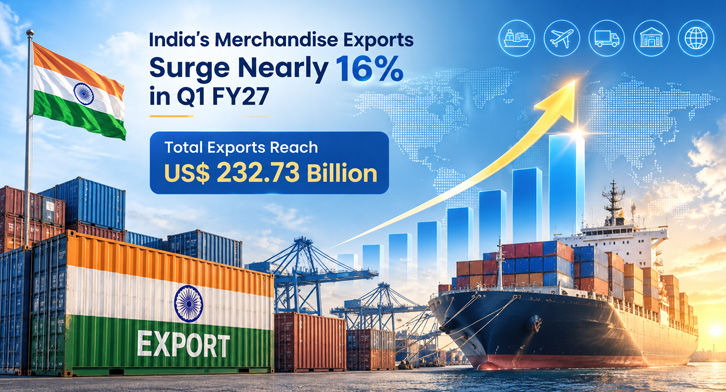
India’s Merchandise Exports Surge Nearly 16% in Q1 FY27; Total Exports Reach US$232.73 Billion

India recorded a robust start to FY27 as merchandise exports climbed 15.92% year-on-year during the April-June quarter, reflecting strong global demand for Indian manufactured products and value-added exports. According to the latest trade data, India’s combined merchandise and services exports reached US$232.73 billion, highlighting the country’s growing strength in international trade despite ongoing global economic uncertainties.
Merchandise exports increased to US$129.32 billion during the first quarter of FY27, while non-petroleum exports expanded by 12.44% to US$106.30 billion, indicating healthy growth across key manufacturing sectors rather than being driven solely by energy-related shipments.
In June 2026, India exported merchandise worth US$40.41 billion, contributing to a total monthly export value of US$73.45 billion when services exports are included.
Several high-value sectors played a significant role in driving export growth. Engineering goods remained India’s largest export category, registering an impressive 20.74% increase, followed by electronic goods, which grew 18.93% as India continued strengthening its position in global electronics manufacturing. Gems & jewellery exports posted the strongest growth among major sectors, rising 34.64%, while organic and inorganic chemicals expanded 19.42%. Rice exports also maintained strong momentum with a 16.48% increase compared to the same period last year.
India’s services exports remained resilient during the quarter, reaching US$103.41 billion, supported by strong global demand for IT, business, financial, and professional services.
Major export destinations including Singapore, South Africa, China, Oman, and Malaysia continued to record healthy demand for Indian products, reinforcing India’s expanding global trade footprint and diversified export portfolio.
The sustained export growth reflects improving manufacturing competitiveness, expanding production capabilities, and increasing international confidence in India’s role as a reliable global supply chain partner.

Key Highlights

Why This Matters

The strong export performance highlights India’s increasing competitiveness in global manufacturing and services. Rising exports support economic growth, improve foreign exchange earnings, create employment opportunities, and strengthen India’s position as a preferred sourcing destination for international buyers. Continued momentum in engineering, electronics, chemicals, and value-added manufacturing is expected to further enhance India’s global trade competitiveness.

FAQs

How much did India's merchandise exports grow in Q1 FY27?
India’s merchandise exports grew 15.92% year-on-year, reaching US$129.32 billion during April-June FY27.
India’s combined merchandise and services exports reached US$232.73 billion in the first quarter of FY27.
The fastest-growing export sectors were:
Services exports reached US$103.41 billion during April-June FY27.
Key export markets included Singapore, China, South Africa, Oman, and Malaysia.
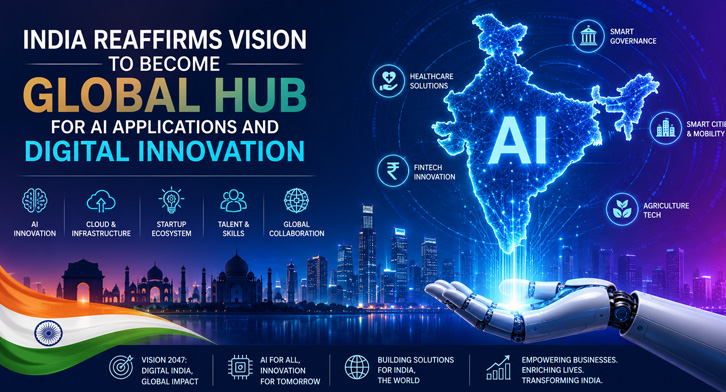
India Reaffirms Vision to Become Global Hub for AI Applications and Digital Innovation

India has reaffirmed its ambition to become the world’s leading hub for Artificial Intelligence (AI) applications and AI-driven innovation, with the Government emphasizing AI as a key pillar of the country’s digital transformation strategy.
Speaking at the Confederation of Indian Industry (CII) Global Capacity Centres (GCCs) Business Summit 2026 in New Delhi, S. Krishnan, Secretary, Ministry of Electronics and Information Technology (MeitY), said the Government is committed to creating an enabling ecosystem that accelerates AI adoption across industries while strengthening India’s position in the global digital economy.
The Government’s AI strategy focuses on promoting innovation, improving productivity, enhancing operational efficiency, and encouraging the development of AI-powered solutions across sectors including manufacturing, healthcare, logistics, finance, education, and public services.

India Aims to Lead the Global AI Revolution

Krishnan stated that India’s long-term objective is to become the preferred global destination for developing AI applications and intelligent digital solutions. The Government is investing in digital infrastructure, AI research, talent development, and technology-driven innovation to build a sustainable AI ecosystem capable of supporting future economic growth.
The initiative complements India’s broader digital transformation agenda and supports the country’s vision of becoming a global innovation powerhouse.

India Hosts Nearly Half of the World's GCCs

Addressing the summit, Chief Economic Advisor Dr. V. Anantha Nageswaran highlighted India’s growing importance in the global business services landscape.
According to him, India now hosts around 50% of the world’s Global Capacity Centres (GCCs), demonstrating the country’s competitive advantage in skilled talent, engineering capabilities, research, technology services, and innovation.
He noted that India’s highly qualified workforce continues to attract multinational corporations seeking advanced engineering, digital transformation, AI development, and high-value business operations.

AI and GCC Growth to Accelerate Innovation

The rapid expansion of Global Capacity Centres, combined with increasing AI adoption, is expected to:
Industry experts believe the combined growth of AI and GCCs will play a crucial role in transforming India into one of the world’s leading technology and knowledge economies.

Key Highlights

Why This Matters

Artificial Intelligence is rapidly becoming the foundation of the global digital economy. India’s proactive policy framework, abundant technology talent, expanding GCC ecosystem, and growing digital infrastructure position the country to become a leading exporter of AI-powered products, enterprise solutions, and digital innovation. As global businesses accelerate AI adoption, India’s role as an AI development and innovation hub is expected to expand significantly over the coming years.

FAQs

Why is India focusing on becoming a global AI hub?
The Government aims to position India as a leading destination for AI innovation by encouraging technology adoption, strengthening digital infrastructure, developing skilled talent, and supporting AI-driven economic growth.
Global Capacity Centres (GCCs) are offshore centers established by multinational companies to manage functions such as technology development, engineering, research, finance, customer support, and digital transformation from India.
According to the Chief Economic Advisor, India currently hosts approximately half of the world’s Global Capacity Centres, making it one of the largest global hubs for business and technology services.
AI is expected to improve productivity, accelerate innovation, create high-skilled jobs, enhance digital services, support research and development, and strengthen India’s competitiveness in the global technology market.

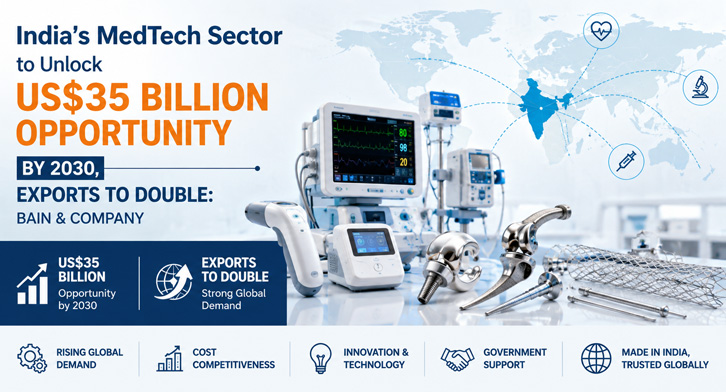
India’s MedTech Sector to Unlock US$35 Billion Opportunity by 2030, Exports to Double: Bain & Company

India’s medical technology (medtech) industry is on track for transformative growth, with the sector expected to become a US$35 billion (₹3.33 lakh crore) market by 2030, according to a new report by Bain & Company, Building Global Champions: The Asia-Pacific Region’s Next Medtech Wave.
The report highlights India’s emergence as one of the world’s fastest-growing medical technology markets, supported by rising healthcare demand, expanding manufacturing capabilities, strong export momentum, and increasing investments in innovation.
Medical device exports are projected to more than double to US$8 billion (₹76,168 crore) by 2030, growing at a compound annual growth rate (CAGR) of over 20%, compared to approximately US$4 billion (₹34,000 crore) in FY2024-25.
As India moves closer to becoming the world’s third-largest economy, the country’s healthcare sector is expected to surpass US$320 billion (₹30.46 lakh crore) within the next few years, creating significant opportunities for domestic medtech manufacturers, global investors, and healthcare innovators.

India Strengthens Position in Global MedTech Supply Chain

India currently exports medical devices to more than 125 countries, establishing itself as a competitive manufacturing and innovation hub for affordable, high-quality healthcare technologies.
The report notes that Indian companies have gained recognition for developing cost-effective medical devices tailored for emerging markets, while steadily expanding their presence across developed healthcare systems.
Despite this progress, India continues to import a significant share of advanced medical equipment. High-end medical device imports reached US$5.5 billion (₹46,750 crore) in FY2024-25, highlighting a major opportunity for domestic manufacturing, innovation, and import substitution under the country’s healthcare and manufacturing initiatives.

Innovation and Manufacturing to Drive the Next Growth Phase

According to Bain & Company, the next stage of India’s medtech expansion will depend on strengthening:
These factors are expected to help Indian companies compete with established global medical technology manufacturers while improving healthcare accessibility across emerging economies.

Asia-Pacific Emerging as the Fastest-Growing MedTech Market

The report also projects that the Asia-Pacific region will generate US$132 billion (₹12.56 lakh crore) in medtech demand by 2030, expanding at an annual growth rate of 6.9%, faster than the global industry average.
India is expected to play a central role in this regional expansion due to its:
Industry experts believe these advantages could position India as one of the world’s leading destinations for medical technology innovation, manufacturing, and exports over the next decade.

Key Highlights

Why This Matters

India’s expanding medtech ecosystem represents one of the country’s fastest-growing manufacturing and healthcare opportunities. Rising domestic demand, increasing exports, supportive government policies, and stronger research capabilities are expected to accelerate investment across medical devices, diagnostics, digital health technologies, and advanced manufacturing.
The sector’s growth will not only improve healthcare accessibility but also strengthen India’s position in global healthcare supply chains, creating new opportunities for manufacturers, exporters, startups, investors, and healthcare providers.

FAQs

How large will India's medtech market be by 2030?
India’s medical technology industry is projected to reach US$35 billion (₹3.33 lakh crore) by 2030, according to Bain & Company.
Medical device exports are expected to grow at a CAGR of more than 20%, reaching US$8 billion by 2030.
Growth is being driven by increasing healthcare demand, government support, manufacturing expansion, innovation, clinical research, exports, and rising investment in healthcare infrastructure.
India currently exports medical devices to over 125 countries worldwide.
India still imports a large volume of advanced medical devices, creating significant opportunities for local manufacturers to replace imports through innovation and domestic production.

India Emerges as a Reliable Global Supplier of Green Fuels Amid Growing Hydrogen Exports

India Strengthens Position in the Global Green Hydrogen Supply Chain

India is rapidly establishing itself as a dependable global supplier of green hydrogen, green ammonia, and other low-carbon fuels, supported by its expanding renewable energy capacity and competitive production ecosystem. As international demand for clean energy solutions accelerates, Indian companies are securing long-term export agreements that position the country as a key contributor to the global energy transition.
Speaking at the India-Japan Energy Partnership Forum, Renewable Energy Secretary Santosh Kumar Sarangi said India’s green hydrogen industry is steadily moving toward commercial maturity, enabling the country to become an important participant in global green fuel supply chains.
The government believes India’s abundant renewable energy resources, improving production economics, and policy support under the National Green Hydrogen Mission are creating strong opportunities for exports while helping industries worldwide reduce carbon emissions.
One of the major developments highlighted during the forum is the growing collaboration between India and Japan in clean energy. ACME Group has signed long-term agreements to supply green ammonia and green methanol to Japanese customers, reflecting increasing international confidence in India’s ability to deliver sustainable fuels at competitive prices.
Industry experts believe these partnerships will strengthen cross-border green fuel logistics, attract foreign investment, encourage technology collaboration, and improve global energy security. With demand for low-carbon fuels expected to grow significantly over the coming decade, India is well positioned to become one of the world’s leading exporters of green hydrogen derivatives.
The country’s expanding green energy ecosystem is expected to play a vital role in supporting industrial decarbonization across sectors including shipping, chemicals, steel, fertilizers, and heavy manufacturing, while creating new opportunities for international trade and clean energy investments.

Key Highlights

Quick Facts

Topic

Details

Industry

Green Hydrogen

Category

Renewable Energy

Countries

India, Japan

Key Products

Green Hydrogen, Green Ammonia, Green Methanol

Growth Driver

Renewable Energy & Hydrogen Exports

Impact

Global Energy Transition & Decarbonization

FAQs

Why is India becoming a major green hydrogen supplier?
India offers abundant renewable energy resources, competitive production costs, supportive government policies, and rapidly expanding green hydrogen infrastructure. These advantages make the country an attractive supplier of clean fuels for global markets.
Japan is seeking reliable suppliers of low-carbon fuels to achieve its carbon neutrality goals. Indian companies are providing long-term supplies of green ammonia and green methanol to support Japan’s energy transition.
Green hydrogen can significantly reduce carbon emissions in industries such as shipping, steel, chemicals, fertilizers, power generation, and heavy manufacturing while improving long-term energy security.

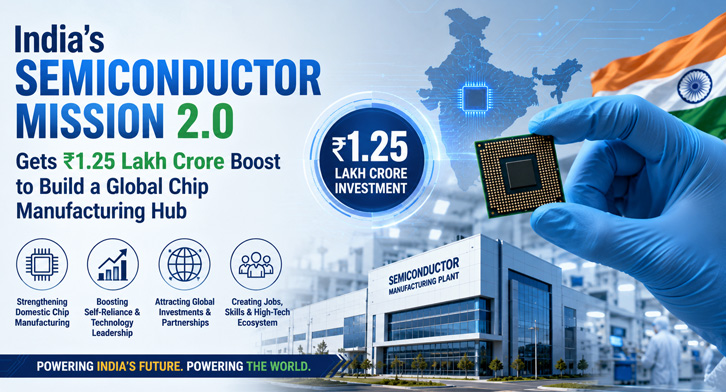
India’s Semiconductor Mission 2.0 Gets ₹1.25 Lakh Crore Boost to Build a Global Chip Manufacturing Hub

India has taken a major step toward becoming a global electronics powerhouse. The Expenditure Finance Committee (EFC) has officially approved the proposal for the India Semiconductor Mission (ISM) 2.0, earmarking an allocation of ₹1.25 lakh crore (US$13.21 billion). The proposal now awaits final approval from the Union Cabinet.
This new phase represents a massive expansion in domestic high-tech manufacturing, aiming to secure global technology supply chains and transition India from a chip consumer to a primary global chip manufacturer.

ISM 1.0 vs. ISM 2.0: The Strategic Expansion

To understand the scale of India’s semiconductor ambitions, the table below breaks down the growth and shift in strategy from the initial phase to the newly proposed mission:

Metric / Focus Area

ISM 1.0 (First Phase)

ISM 2.0 (Proposed Phase)

Budget Allocation

₹76,000 crore (US$8.03 billion)

₹1.25 lakh crore (US$13.21 billion) (~64% Increase)

Core Ecosystem Goal

Attracting basic fabrication (Fab) facilities

Strengthening the entire value chain (Raw materials, Equipment, IP)

Approved Projects

12 Manufacturing Projects

Focus on scaling commercial production & market integration

Total Investment Pipeline

-

₹1.64 lakh crore (US$17.33 billion)

Design Support

24 DLI projects backed

Scaling advanced tool access for 105+ companies

What is India Semiconductor Mission 2.0?

India Semiconductor Mission (ISM) 2.0 is the government’s next phase of investment aimed at creating a complete semiconductor ecosystem within the country.
Unlike the first phase, which primarily focused on attracting fabrication facilities, ISM 2.0 aims to strengthen the entire semiconductor value chain by supporting:
The initiative was announced as part of the Union Budget 2026–27 and aligns with India’s broader vision of becoming a global electronics manufacturing hub.

Government Focus: From Chip Design to Global Manufacturing

Union Minister for Electronics and Information Technology Ashwini Vaishnaw stated that ISM 2.0 will prioritize:
The government’s strategy is designed not only to manufacture chips but also to establish India as a center for semiconductor research, design, and innovation.

Progress Under India Semiconductor Mission 1.0

India has already made notable progress under the first phase of the Semiconductor Mission.
Manufacturing Projects Approved
The government has approved 12 semiconductor manufacturing projects, including:
Together, these projects represent an investment pipeline worth approximately ₹1.64 lakh crore (US$17.33 billion).

Growth in India's Chip Design Ecosystem

India is also strengthening its semiconductor design capabilities.
Achievements include:
These achievements are strengthening India’s semiconductor innovation ecosystem by enabling startups and technology firms to develop homegrown chip technologies.
Commercial Production Begins
India’s semiconductor manufacturing journey is entering the commercial production stage.
Two semiconductor facilities have already been inaugurated, while CG Semi is expected to commence commercial operations on July 4, 2026. Several additional semiconductor projects are expected to become operational later this year.
The transition from project approvals to commercial manufacturing represents a major milestone in India’s ambition to become a trusted semiconductor manufacturing destination.

Why This Matters for Logistics and Supply Chains

The semiconductor industry is one of the world’s most strategically important sectors. A stronger domestic semiconductor ecosystem can significantly improve supply chain resilience and reduce dependence on overseas suppliers.
For the logistics sector, this could lead to:
As semiconductor production scales, logistics providers will play a critical role in handling sensitive components, supporting just-in-time manufacturing, and enabling global distribution.

FAQs

What is India Semiconductor Mission 2.0?
India Semiconductor Mission 2.0 is the government’s next-phase initiative to build a complete semiconductor ecosystem through investments in chip manufacturing, design, equipment, materials, and supply chains.
The government has proposed ₹1.25 lakh crore (US$13.21 billion) for ISM 2.0, subject to Cabinet approval.
The government has approved 12 semiconductor manufacturing projects with a combined investment pipeline of around ₹1.64 lakh crore (US$17.33 billion).
The mission aims to reduce India’s dependence on imported semiconductors, strengthen supply chains, attract global investment, generate skilled jobs, and position India as a major semiconductor manufacturing hub.

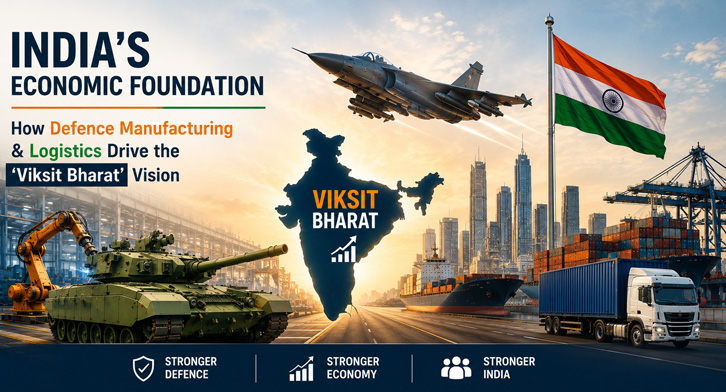
India’s Economic Foundation: How Defence Manufacturing & Logistics Drive the ‘Viksit Bharat’ Vision

India’s ambition to transition into a fully developed nation by 2047—under the foundational banner of Viksit Bharat—is moving away from abstract policy and transforming into a tangible industrial reality. Speaking at the valedictory session of the Vibrant Gujarat Regional Conference (VGRC) in Vadodara, Defence Minister Rajnath Singh emphasized that India’s long-term sovereignty relies on a three-pronged foundation: robust economic growth, technological self-reliance, and uncompromised national security.

What began in 2003 as a state-level investment summit has evolved into a powerhouse of national alignment. The Central Gujarat edition of the conference alone culminated in 3,759 MoUs yielding over ₹3.34 lakh crore in investment commitments, laying down a massive blueprint for India’s upcoming industrial decade.

1. Defence Manufacturing as a Multiplier, Not Just a Shield

Historically, military spending was viewed primarily as an economic drain—a necessary expense for national defense. Today, India’s strategy treats defence manufacturing as a core driver of domestic industrial health.
The government’s aggressive push for Aatmanirbhar Bharat (self-reliance) has systematically expanded local manufacturing ecosystems, reducing critical dependencies on foreign imports while stimulating domestic capital.

The Metric that Matters: Driven by policy overhauls like the Defence Acquisition Procedure (DAP), India’s annual defence production reached an all-time high of ₹1.78 lakh crore in FY 2025–26. Concurrently, defence exports skyrocketed by over 62% in the last fiscal year to hit a record ₹38,424 crore, supplying indigenous hardware to over 80 countries.

This manufacturing surge triggers a massive economic multiplier effect across several domains:

2. Unlocking the Logistics Boom: Connecting Factories to Frontiers

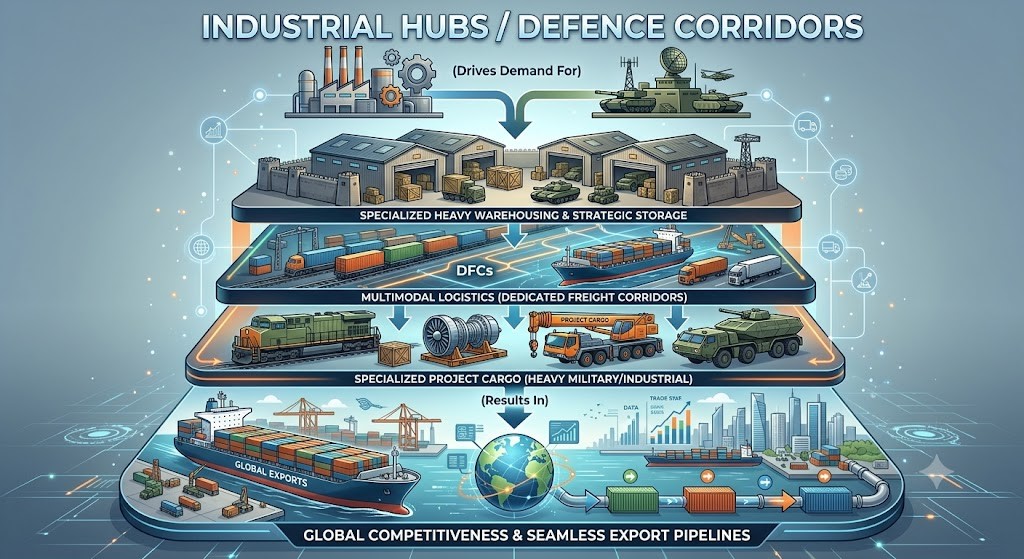
When a nation doubles its domestic industrial output, its physical supply chains must scale accordingly. The growth of major manufacturing hubs—including Central Gujarat’s massive Dholera and Mandal-Becharaji Special Investment Regions—presents an unprecedented growth opportunity for India’s logistics and infrastructure sectors.
As manufacturing scales up, the logistics sector must pivot from traditional retail freight forwarding to handle complex, high-value industrial supply chains. This shift requires immense upgrades in:

Manufacturing Drivers vs. Logistics Demands

Industrial Growth Driver

Logistics Infrastructure Demand

₹38,424 Cr Defence Exports

Advanced port infrastructure, secure cold-chains, and multi-country customs compliance systems.

Dholera & Mandal-Becharaji SIRs

Heavy-haul multimodal rail/road integration via the DMIC corridor to handle high-volume outflows.

Smart GIDC Industrial Estates

Tech-enabled, secure, and strategically located ancillary warehousing hubs for raw components.

3. Technology and Geopolitical Autonomy

The geopolitical realties of 2026 dictate that true national sovereignty is tied directly to technical self-reliance. As global supply chains face ongoing regional disruptions, dependence on foreign intellectual property poses a major national risk.
By reserving 25% of the defence research and development budget for private startups and academia, and running innovation pipelines like iDEX, the government is deliberately anchoring deep-tech R&D within Indian borders. This ensures that the technology powering India’s industrial base remains resilient against global volatility, shaping the modern definition of a developed nation.

FAQs

What are the three pillars of Viksit Bharat?
According to Defence Minister Rajnath Singh, the three interconnected pillars required to build a developed India by 2047 are a strong economy, rapid technological advancement, and robust national security.
Defence manufacturing acts as an economic multiplier. It stimulates domestic industrial production, reduces foreign capital drainage by substituting imports, fosters private sector innovation, creates high-skilled jobs, and integrates local MSMEs into highly technical global supply chains.
The expansion of heavy manufacturing and defense production exponentially increases regional demand for high-capacity freight forwarding, specialized project cargo movement, multimodal port infrastructure, and tech-enabled industrial warehousing.
The VGRC has scaled the ethos of the main global summit down to regional levels. The Central Gujarat edition in Vadodara successfully secured over ₹3.34 lakh crore in investment commitments across heavy industries, pharmaceuticals, green energy, and defense production.

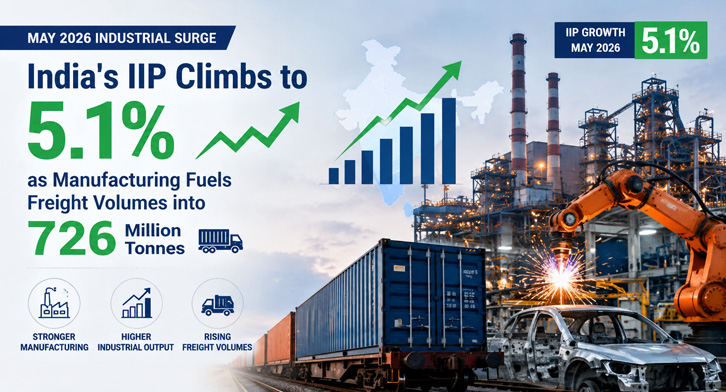
May 2026 Industrial Surge: India’s IIP Climbs to 5.1% as Manufacturing Fuels Freight Volumes

Fresh government data reveals that India’s Index of Industrial Production (IIP) accelerated to a 5.1% year-on-year growth rate in May 2026, outperforming April’s 4.9% mark. Driven by a 5.5% expansion in manufacturing and a 12.9% spike in capital goods, this industrial uptick directly triggers higher domestic cargo movement, rising freight demand, and increased container utilization for NVOCCs and freight forwarders.

Manufacturing and Capital Goods Lead the Economic Momentum

India’s industrial sector is demonstrating sustained upward momentum, backed by strong domestic consumption and robust infrastructure spending. Despite a minor 1.6% contraction in the mining segment, the broader production landscape has shown remarkable resilience. According to the Ministry of Statistics and Programme Implementation (MoSPI), positive growth was recorded in 16 out of the 23 major manufacturing segments.
Key Growth Sectors by Output (May 2026):
The double-digit leap in capital goods is a vital leading indicator for the economy. It proves that businesses are actively investing in heavy machinery, factory expansions, and physical infrastructure—factors that inevitably generate sustained, long-term commercial freight.

MoSPI Adjusts Strategy with New Output PPI Deflator

In a significant structural update, MoSPI has modernized its data gathering by introducing an updated methodology for the IIP Base Year 2022–23 tracking series.
The agency has phased out the Wholesale Price Index (WPI) in favor of the Output Producer Price Index (Output PPI) as its primary deflator. By capturing actual factory-gate transaction prices rather than volatile wholesale market shifts, this transition aligns India’s economic reporting with global statistical benchmarks. The overhaul directly adjusts how volume is calculated across 234 product groups, which account for roughly 36% of the total IIP weight.

Logistics and Freight Forwarding: Preparing for Higher Throughput

This 5.1% industrial expansion has a direct, cascading effect on Indian supply chains. Increased production mandates rapid logistical adaptation across multiple operational fronts:
With macroeconomic indicators pointing toward a stable growth trajectory, the outlook for logistics, warehousing, and transport networks remains highly favorable heading into the second half of the year. MoSPI’s next data release for June 2026 is scheduled for July 28, 2026.

FAQs

What is the latest update on India's industrial growth for May 2026?
India’s Index of Industrial Production (IIP) registered a year-on-year growth of 5.1% in May 2026, reflecting an upward shift from the 4.9% expansion noted during April 2026.
The manufacturing industry led the way with a 5.5% expansion, heavily supported by a 20.8% surge in electrical equipment and a 14.5% rise in motor vehicles. Additionally, the electricity and gas utilities sector expanded by 9.9%.
MoSPI transitioned from the Wholesale Price Index (WPI) to the Output Producer Price Index (Output PPI). This update provides a more accurate reflection of true factory output and producer-side pricing, matching global standards.
Higher factory output increases the total volume of goods entering the supply chain. This directly boosts demand for shipping containers, increases port and warehouse utilization, and creates more business for NVOCCs and freight forwarding networks.

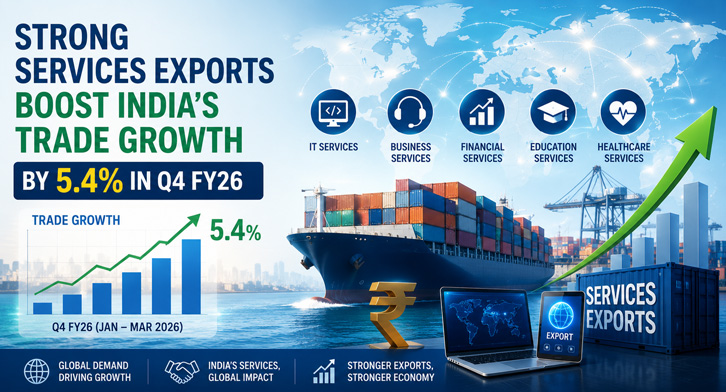
Strong Services Exports Boost India’s Trade Growth by 5.4% in Q4 FY26

India’s overall trade expanded 5.4% to US$1.84 trillion during the fourth quarter of FY26, according to NITI Aayog’s latest Trade Watch Quarterly report. Although merchandise exports declined, strong growth in services exports helped strengthen India’s external trade performance and improve the country’s trade balance.
Services exports increased 9% year-on-year to US$111 billion, while services imports rose 4.1% to US$50.7 billion. As a result, India’s services trade surplus widened to US$60.4 billion, offsetting the merchandise trade deficit. The report identifies services exports as a key pillar of India’s external sector stability.
India also maintained its position as the world’s eighth-largest services exporter in 2025. Over the past decade, services exports nearly tripled from US$156 billion to US$416 billion, registering a 10.3% CAGR, significantly above the global average of 6.6%. The country further strengthened its leadership in telecom and IT services, increasing its global market share from 9.5% in 2015 to 14.9% in 2025.
The report highlights that India’s export markets are becoming more diversified, with Europe’s share of services exports rising while dependence on North America has gradually declined. India’s pharmaceutical sector also continued its strong performance, with exports reaching US$25.8 billion in 2025 and formulated drugs accounting for US$22 billion.
Overall, the findings demonstrate the growing resilience of India’s export ecosystem, with services, technology, and pharmaceuticals emerging as major drivers of long-term trade growth and global competitiveness.

Key Highlights:

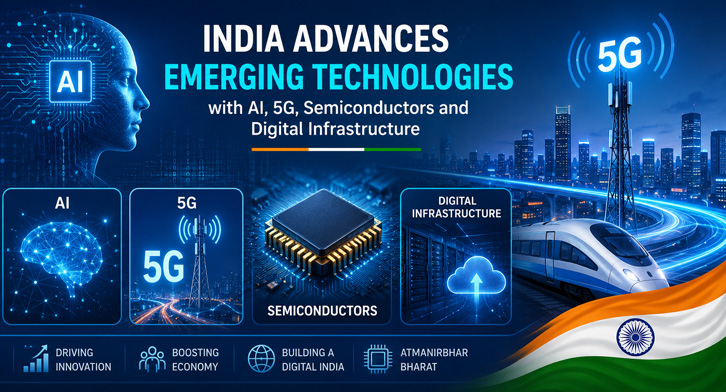
India Advances Emerging Technologies with AI, 5G, Semiconductors and Digital Infrastructure

India Strengthens Its Position as a Global Technology Leader

India is rapidly emerging as a global technology powerhouse through sustained investments in digital infrastructure, artificial intelligence (AI), semiconductors, quantum computing, cloud computing, blockchain, cybersecurity, and supercomputing. These strategic initiatives are strengthening the country’s innovation ecosystem and supporting the Government’s long-term vision of Viksit Bharat 2047.
With mission-driven technology programmes and robust policy support, India is transforming from a technology consumer into a technology creator while enhancing its global competitiveness.

Digital India Programme Accelerates Digital Transformation

The Digital India Programme has become the foundation of India’s digital transformation by significantly expanding connectivity across the country.
Optical fibre coverage increased from 19.35 lakh route kilometres in 2019 to 42.36 lakh route kilometres in 2025, while internet connections surged from 25.15 crore in 2014 to 102.86 crore in 2026. These developments have improved digital access for businesses, government services, education, healthcare, and financial inclusion.

India Achieves One of the World's Fastest 5G Rollouts

India has successfully completed one of the fastest 5G deployments globally, with services now reaching 99.9% of districts.
The nationwide rollout is enabling faster digital connectivity, supporting Industry 4.0, smart cities, digital businesses, IoT applications, and advanced communication technologies.

India Climbs the Global Innovation Rankings

India’s sustained investment in technology, research, digital governance, and innovation has significantly enhanced its international standing.
The country improved from 81st place in 2015 to 38th in the Global Innovation Index 2025, reflecting stronger research capabilities, digital public infrastructure, startup growth, and technology-driven economic development.

Viksit Bharat 2047: Building a Technology-Driven Future

According to the Government, India’s trusted digital governance systems, expanding research ecosystem, international technology partnerships, and investments in skill development are helping the nation transition into a global technology creator.
Continued investments in AI, semiconductors, quantum technologies, cybersecurity, cloud computing, and digital infrastructure are expected to accelerate innovation-led economic growth, strengthen self-reliance in critical technologies, and position India as a key player in shaping the future global technology landscape.

Key Highlights:

India’s Steel Capacity Utilization Reaches 90% Milestone on Heavy Infrastructure Demand

India’s steel sector continues to demonstrate powerful momentum, with domestic steel demand rising 9% year-on-year in May 2026 and 8.7% in FY26-to-date. According to a report by Kotak Institutional Equities, the industry’s capacity utilization is expected to remain above 90% in the medium term, supported by robust demand growth that is projected to outpace capacity additions. Steel exports also increased by 30% year-on-year to 0.5 million tonnes in May 2026. India’s expanding infrastructure pipeline, manufacturing growth, and urbanization are expected to continue driving high steel consumption over the coming years.
The sustained capacity utilization above 90% signals an unprecedented structural shift in India’s industrial architecture. Historically, heavy metallurgical sectors have suffered from cyclical overcapacity, leaving production lines underutilized. However, the current momentum is tightly linked to capital expenditure programs funded by the Union Budget, which have funneled massive capital directly into national highway networks, high-speed rail corridors, and urban mass transit systems.
This localized consumption boom is structurally altering corporate balance sheets across the domestic steel sector. With steel plants operating at near-maximum performance, companies are generating substantial free cash flows, enabling them to de-lever their debt and invest in next-generation green steel technologies. Furthermore, the 30% surge in outbound steel trade highlights that Indian steel mills are maintaining cost-competitiveness in global shipping lanes, successfully penetrating alternative markets across Europe, Southeast Asia, and the Middle East despite intense international trade competition.

Key Highlights:

cargonet-logo-icon
Cargonet Cargo Software Logo

Feedback & Reward program

Submit the Feedback and avail the Rewards.

1. Your satisfaction & reliability on CargoNet ?

2. Your Rating on Support & co-ordination team?

3. Satisfaction on the look and feel of CargoNet ?

4. Please specify any 2 best features that you feel more helpful in CargoNet?

5. Please specify any 2 best reports that you are taking on regular basis?

6. Are you using Copy Job option in CargoNet Software?

7. Are you using Automatic DSR (Daily Status Report) Option? It automatically sends reports to customer about the shipment status

8. Are you using Automatic Outstanding Reports option? Period Auto outstanding reminders to customer

9. Any other thoughts to improve in CargoNet? Please share.

* Join our Reward Program by recommending CargoNet (Cash Rewards Awaiting)

“Thanks for your feedback. Our goal is to create the best possible product, support & service, and your thoughts, ideas & suggestions play a major role in helping us identify opportunities to improve.”

Cut AI cost,
not performance

discover how top Freight Forwarding companies  reduce AI-related expense and speed up operation with CargoNet AI, we will show it how
Share your information for instant access :