
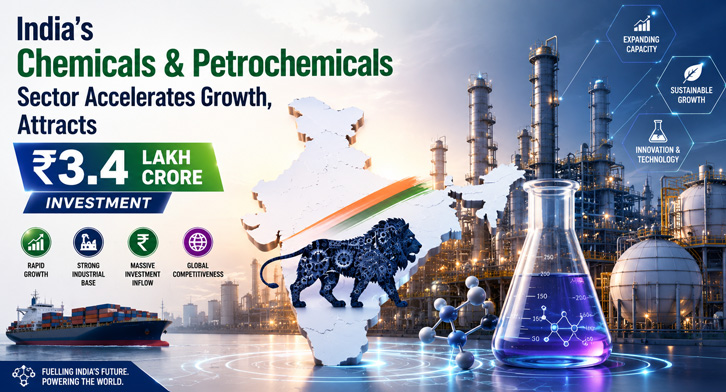
India’s chemicals and petrochemicals industry has recorded strong expansion over the past 12 years, supported by government policy reforms, new manufacturing infrastructure, investment incentives, research initiatives and skill development.
The sector is increasingly becoming an important pillar of India’s manufacturing, export and supply-chain ecosystem, with major investments flowing into Petroleum, Chemicals and Petrochemicals Investment Regions (PCPIRs).
Key Takeaways
- ₹3.4 lakh crore invested across three operational PCPIRs.
- Nearly 3.7 lakh jobs generated through PCPIR-linked development.
- More than 2,200 chemical manufacturing units established in PCPIRs.
- Chemical-sector FDI reached ₹1,04,895 crore during 2014–2026.
- Government implemented 37 Quality Control Orders (QCOs) to improve manufacturing standards.
- 10 Plastic Parks approved, with four having completed infrastructure.
- CIPET expanded to 51 centres across India.
- Nearly 6.72 lakh professionals trained by CIPET.
- Union Cabinet approved the BHAVYA Rasayan Scheme, with an outlay of ₹3,030 crore.
India’s Chemical Manufacturing Sector: What Is Driving the Growth?
India’s chemicals and petrochemicals industry has undergone substantial transformation over the last decade.
Government initiatives focused on manufacturing capacity, infrastructure, investment promotion, technology development and workforce training have helped create a stronger industrial ecosystem.
The growth also supports the broader Viksit Bharat 2047 and Atmanirbhar Bharat objectives by encouraging domestic production and reducing dependence on imported chemical products.
PCPIRs Become Major Industrial Investment Hubs
Three operational PCPIRs are currently playing a significant role in India’s chemical manufacturing landscape:
- Dahej, Gujarat
- Visakhapatnam–Kakinada, Andhra Pradesh
- Paradeep, Odisha
Together, these regions have attracted approximately ₹3.4 lakh crore in investments, generated employment for nearly 3.7 lakh people, and supported the establishment of more than 2,200 chemical manufacturing units.
PCPIR Development at a Glance
Indicator
Reported figure
Operational PCPIRs
3
Investment attracted
₹3.4 lakh crore
Employment generated
~3.7 lakh
Chemical manufacturing units
2,200+
Key locations
Gujarat, Andhra Pradesh, Odisha
These industrial clusters are important not only for manufacturing but also for logistics, warehousing, transportation, ports, chemical storage and multimodal supply chains.
Chemical Sector FDI Shows Strong Momentum
Foreign investment has also increased significantly.
According to the figures provided, FDI inflows into the sector reached ₹1,04,895 crore between 2014 and 2026, compared with ₹45,240 crore during 2004–2014.
Period
FDI inflow
2004–2014
₹45,240 crore
2014–2026
₹1,04,895 crore
This investment growth indicates increasing confidence in India’s chemical manufacturing capabilities and its potential as a global production and export base.
Government Pushes Quality and Domestic Manufacturing
The Government has introduced 37 Quality Control Orders (QCOs) aimed at improving product quality and addressing the availability of sub-standard imports.
At the same time, 10 Plastic Parks have been approved, with four already having completed infrastructure.
Together, these measures are designed to strengthen domestic manufacturing and improve competitiveness across the chemicals and plastics value chain.
Research, Technology and Skills Gain Importance
India’s chemical-sector growth is also being supported by investments in technology and human capital.
The Central Institute of Petrochemicals Engineering & Technology (CIPET) has expanded its network to 51 centres, including 19 centres established since 2014.
CIPET has reportedly:
- Trained nearly 6.72 lakh professionals
- Completed approximately 8.53 lakh technology-support service assignments
- Expanded technical and skill-development capabilities across the country
The Institute of Pesticide Formulation Technology (IPFT) has also transferred 64 pesticide formulation technologies to industry.
In addition, IPFT received ₹28.69 crore from the Department of Biotechnology to establish a Biofoundry Facility focused on biopesticides and advanced biological formulations.
₹3,030 Crore BHAVYA Rasayan Scheme
One of the major recent initiatives is the BHAVYA Rasayan Scheme, approved by the Union Cabinet with an outlay of ₹3,030 crore.
The scheme is expected to establish three plug-and-play Chemical Parks.
The objective is to:
- Increase domestic chemical manufacturing
- Reduce import dependence
- Attract private investment
- Improve manufacturing infrastructure
- Strengthen India's global competitiveness
- Support exports and employment
Why This Matters for Logistics and Supply Chains
The expansion of India’s chemical and petrochemical manufacturing base could create significant opportunities across the logistics sector.
More chemical production means greater demand for:
- Specialized chemical transportation
- Tanker and bulk logistics
- Hazardous-material handling
- Improve manufacturing infrastructure
- Port-linked logistics
- Containerized chemical movement
- Multimodal transportation
- Supply-chain visibility and tracking
- Compliance and documentation
- Digital freight management
The concentration of manufacturing activity around PCPIRs and chemical parks can also encourage the development of integrated manufacturing-to-port supply chains.
For logistics companies, this represents an opportunity to build specialized capabilities around the movement and storage of chemical products.
India’s Chemical Industry: Growth Outlook
The combination of manufacturing investments, chemical parks, infrastructure development, quality standards, technology transfer and workforce development is strengthening India’s position in the global chemicals and petrochemicals market.
The next phase of growth is likely to depend on how effectively India connects manufacturing capacity with ports, logistics infrastructure, domestic distribution networks and export markets.
For the logistics industry, the expansion of chemical manufacturing could therefore become an important source of long-term demand for specialized and technology-enabled supply-chain services.
At a Glance
India’s chemical and petrochemical sector is moving toward a more integrated manufacturing ecosystem, supported by investment, infrastructure and policy initiatives. As production capacity expands, the opportunity extends beyond chemical manufacturers to logistics providers, ports, warehouses, technology companies and supply-chain operators.
Frequently Asked Questions
What is driving the growth of India's chemicals and petrochemicals sector?
Policy reforms, infrastructure development, investment promotion, manufacturing capacity expansion, research, skill development and initiatives aimed at reducing import dependence are key growth drivers.
How much investment have India's PCPIRs attracted?
The three operational PCPIRs at Dahej, Visakhapatnam–Kakinada and Paradeep have attracted approximately ₹3.4 lakh crore in investment.
How much FDI did India's chemical sector receive between 2014 and 2026?
The sector received approximately ₹1,04,895 crore in FDI between 2014 and 2026, according to the figures provided.
How many chemical manufacturing units have been established in the PCPIRs?
More than 2,200 chemical manufacturing units have been established across the three operational PCPIRs.
What is the BHAVYA Rasayan Scheme?
The BHAVYA Rasayan Scheme is a government initiative with an approved outlay of ₹3,030 crore to establish three plug-and-play Chemical Parks and strengthen domestic chemical manufacturing.
How can chemical-sector growth affect logistics?
Higher chemical production can increase demand for specialized transportation, bulk logistics, hazardous-material handling, warehousing, port logistics, compliance systems and digital supply-chain management.