
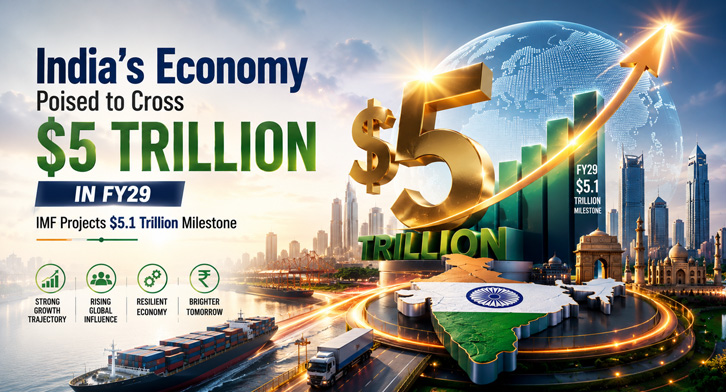
India is on course to cross the $5 trillion economy milestone in FY29 (2028–29), with the International Monetary Fund (IMF) projecting the country’s nominal GDP to reach approximately $5.1 trillion, according to figures cited by Union Finance Minister Nirmala Sitharaman in the Rajya Sabha.
The projected milestone underscores India’s continued economic expansion and highlights the importance of infrastructure, manufacturing, logistics, digitalisation and trade competitiveness in supporting the country’s long-term growth ambitions.
India’s $5 Trillion Economy: Key Highlights
- $5.1 trillion: Projected size of India’s economy by FY29.
- FY29 milestone:India is expected to cross the $5 trillion threshold by 2028–29.
- Public capital expenditure: Continued infrastructure investment remains a key growth driver.
- Manufacturing push: PLI schemes are supporting investment and domestic production.
- Logistics infrastructure: PM GatiShakti and the National Logistics Policy are aimed at improving multimodal connectivity and reducing logistics inefficiencies.
- MSME support: Government measures are designed to strengthen small and medium-sized businesses.
- Trade expansion: Free Trade Agreements are expected to improve market access and strengthen India's trade resilience.
- Strategic sectors: Semiconductors, clean energy and advanced manufacturing are emerging as important growth areas.
- Digital infrastructure: Expansion of India's digital public infrastructure is supporting wider economic formalisation and efficiency.
What Is Driving India Towards the $5 Trillion Economy?
India’s projected economic expansion is being supported by a combination of public investment, manufacturing growth, infrastructure development, digitalisation and trade reforms.
1. Higher Infrastructure Investment
Public capital expenditure continues to play an important role in expanding roads, railways, ports, airports and industrial infrastructure.
Improved connectivity can reduce transportation bottlenecks, support faster movement of goods and improve supply-chain efficiency across manufacturing and trading hubs.
2. Manufacturing and the PLI Push
The Production Linked Incentive (PLI) programme is supporting investments across strategic manufacturing industries.
Greater domestic manufacturing capacity could create additional demand for:
- Freight transportation
- Warehousing
- Industrial logistics
- Port and terminal services
- Multimodal transportation
- Supply-chain technology
3. PM GatiShakti and National Logistics Policy
India’s logistics transformation is closely linked to infrastructure and multimodal connectivity.
PM GatiShakti focuses on integrated infrastructure planning, while the National Logistics Policy aims to improve logistics efficiency and reduce friction across the movement of goods.
For businesses, better integration between road, rail, ports, airports and logistics facilities can help reduce transit delays and improve supply-chain reliability.
4. Expanding Global Trade
India is also strengthening its position in global trade through Free Trade Agreements and efforts to diversify export markets.
Improved market access can support growth in sectors such as:
- Engineering goods
- Electronics
- Pharmaceuticals
- Automotive products
- Chemicals
- Textiles
- Food and agricultural products
5. Strategic Emerging Industries
The government is increasingly focusing on industries expected to shape India’s next phase of economic growth, including semiconductors, clean energy and advanced manufacturing.
The development of these industries is likely to generate new logistics requirements involving specialised transportation, industrial warehousing, international freight and time-sensitive supply chains.
India’s $5 Trillion Economy and the Logistics Sector
India’s economic expansion has a direct connection with logistics.
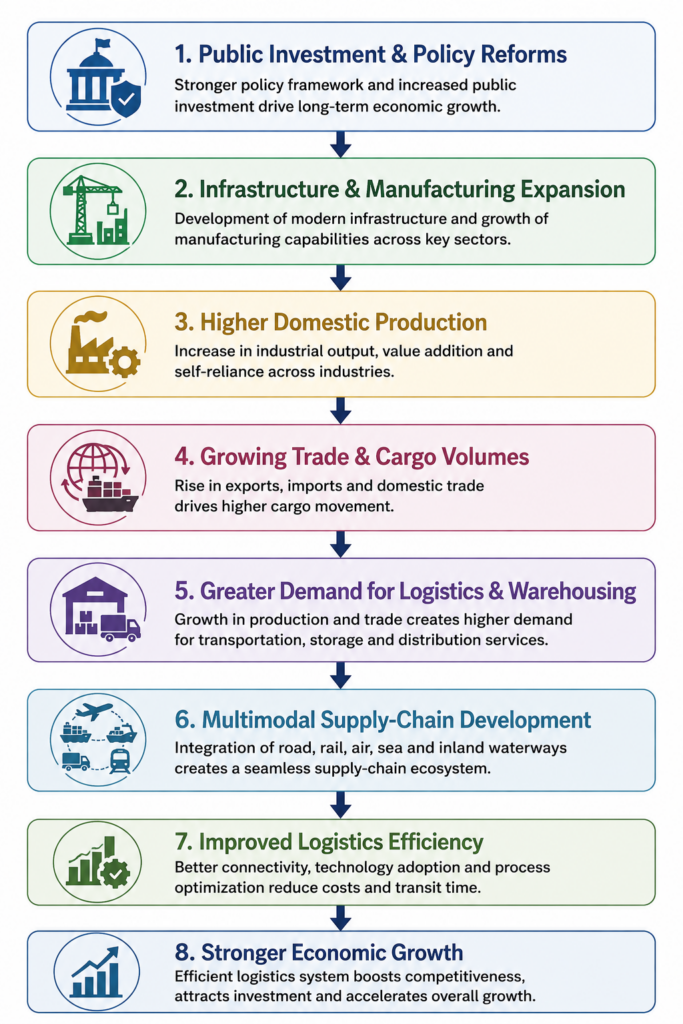
As manufacturing capacity, exports, imports and domestic consumption increase, the demand for efficient cargo movement and supply-chain infrastructure is also expected to rise.
Potential Economic Impact Chain
Key Sectors That Could Benefit
Sector
Potential Impact
Ports & Shipping
Higher EXIM cargo volumes and demand for efficient port connectivity
Road Logistics
Increased domestic freight movement
Rail Freight
Greater demand for cost-efficient long-distance cargo transportation
Warehousing
Expansion of manufacturing and distribution networks
Freight Forwarding
Higher international trade and multimodal shipment volumes
Manufacturing Logistics
More demand for inbound and outbound supply-chain services
Technology
Greater adoption of digital logistics and supply-chain platforms
MSMEs
Wider participation in domestic and international supply chains
What Does a $5 Trillion Indian Economy Mean for Logistics?
A larger economy generally translates into greater movement of raw materials, components, finished products and international cargo.
For India’s logistics industry, the next phase of growth could therefore focus not only on increasing capacity but also on improving visibility, automation, multimodal coordination and operational efficiency.
Technology-enabled logistics platforms can help businesses manage growing shipment volumes while reducing manual processes, documentation errors and fragmented data.
Outlook: India’s Economic Growth Could Accelerate Logistics Transformation
The projected $5.1 trillion economy by FY29 represents more than a headline economic milestone. It could also mark an important phase in India’s transformation into a larger manufacturing, trading and logistics hub.
Continued investment in infrastructure, manufacturing, digital systems and trade connectivity will be critical to translating economic growth into greater supply-chain competitiveness.
For the logistics sector, the opportunity lies in building a more connected, technology-driven and multimodal logistics ecosystem capable of supporting India’s expanding domestic and international trade.
Frequently Asked Questions
When is India expected to cross the $5 trillion economy milestone?
According to IMF projections cited by Finance Minister Nirmala Sitharaman, India is expected to cross the $5 trillion economy mark in FY29 (2028–29).
What is India's projected GDP by FY29?
The IMF projection cited by the government puts India’s economy at approximately $5.1 trillion by 2028–29.
What is driving India's economic growth?
Key drivers include public capital expenditure, manufacturing expansion, infrastructure development, FDI liberalisation, agricultural productivity, digital infrastructure and trade expansion.
How will a $5 trillion economy affect India's logistics sector?
A larger economy could generate higher demand for freight transportation, warehousing, ports, shipping, multimodal logistics and supply-chain technology as domestic production and international trade expand.
How are PM GatiShakti and the National Logistics Policy supporting India's growth?
PM GatiShakti promotes integrated infrastructure planning across transport networks, while the National Logistics Policy focuses on improving logistics efficiency, connectivity and coordination across the supply chain.