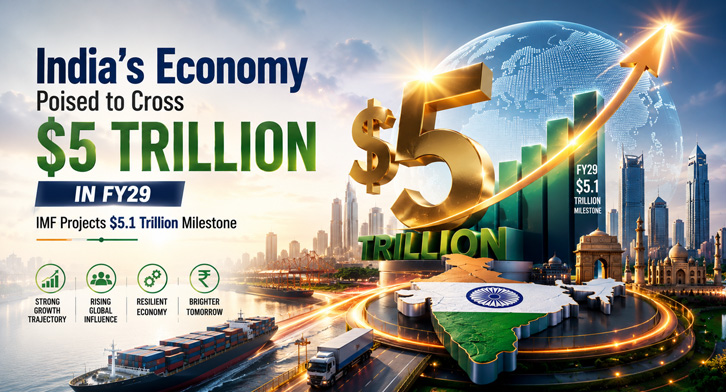
India’s Economy Poised to Cross $5 Trillion in FY29: IMF Projects $5.1 Trillion Milestone

India is on course to cross the $5 trillion economy milestone in FY29 (2028–29), with the International Monetary Fund (IMF) projecting the country’s nominal GDP to reach approximately $5.1 trillion, according to figures cited by Union Finance Minister Nirmala Sitharaman in the Rajya Sabha.
The projected milestone underscores India’s continued economic expansion and highlights the importance of infrastructure, manufacturing, logistics, digitalisation and trade competitiveness in supporting the country’s long-term growth ambitions.

India’s $5 Trillion Economy: Key Highlights

What Is Driving India Towards the $5 Trillion Economy?

India’s projected economic expansion is being supported by a combination of public investment, manufacturing growth, infrastructure development, digitalisation and trade reforms.
1. Higher Infrastructure Investment
Public capital expenditure continues to play an important role in expanding roads, railways, ports, airports and industrial infrastructure.
Improved connectivity can reduce transportation bottlenecks, support faster movement of goods and improve supply-chain efficiency across manufacturing and trading hubs.
2. Manufacturing and the PLI Push
The Production Linked Incentive (PLI) programme is supporting investments across strategic manufacturing industries.
Greater domestic manufacturing capacity could create additional demand for:
3. PM GatiShakti and National Logistics Policy
India’s logistics transformation is closely linked to infrastructure and multimodal connectivity.
PM GatiShakti focuses on integrated infrastructure planning, while the National Logistics Policy aims to improve logistics efficiency and reduce friction across the movement of goods.
For businesses, better integration between road, rail, ports, airports and logistics facilities can help reduce transit delays and improve supply-chain reliability.
4. Expanding Global Trade
India is also strengthening its position in global trade through Free Trade Agreements and efforts to diversify export markets.
Improved market access can support growth in sectors such as:
5. Strategic Emerging Industries
The government is increasingly focusing on industries expected to shape India’s next phase of economic growth, including semiconductors, clean energy and advanced manufacturing.
The development of these industries is likely to generate new logistics requirements involving specialised transportation, industrial warehousing, international freight and time-sensitive supply chains.

India’s $5 Trillion Economy and the Logistics Sector

India’s economic expansion has a direct connection with logistics.
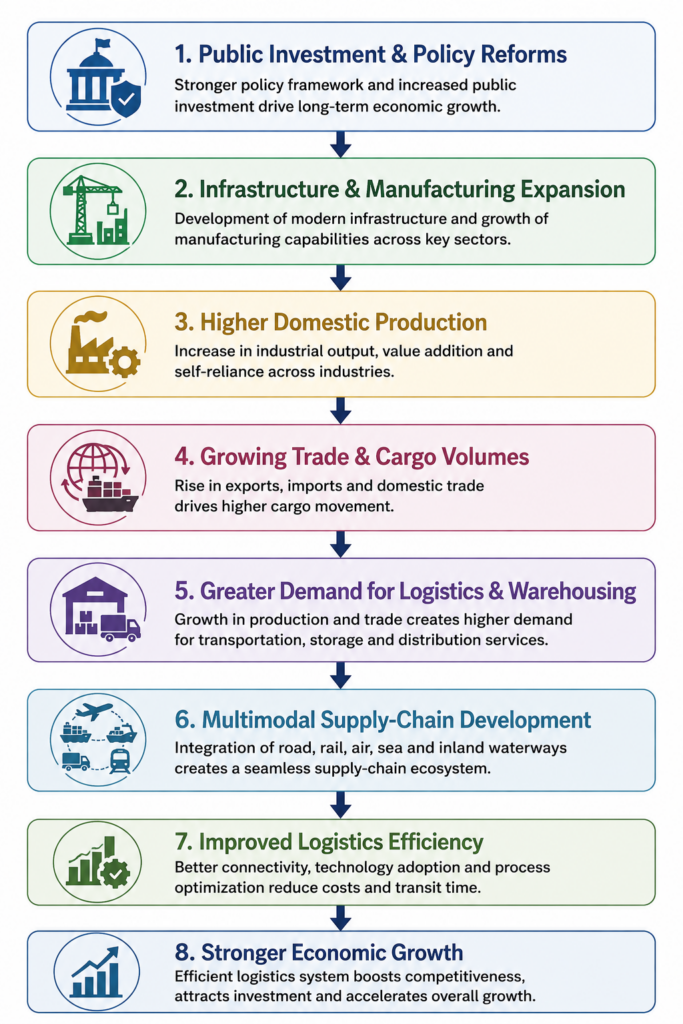
As manufacturing capacity, exports, imports and domestic consumption increase, the demand for efficient cargo movement and supply-chain infrastructure is also expected to rise.
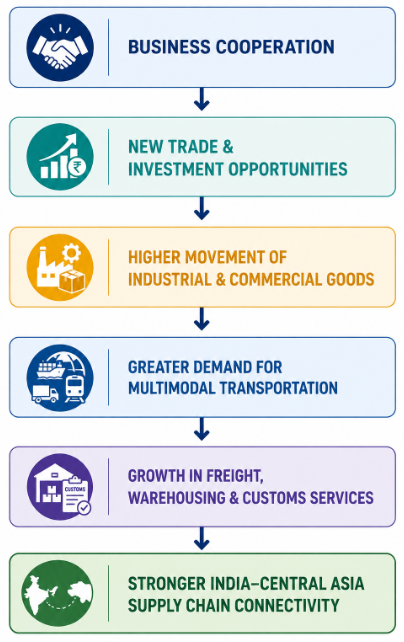
Potential Economic Impact Chain
Key Sectors That Could Benefit

Sector

Potential Impact

Ports & Shipping

Higher EXIM cargo volumes and demand for efficient port connectivity

Road Logistics

Increased domestic freight movement

Rail Freight

Greater demand for cost-efficient long-distance cargo transportation

Warehousing

Expansion of manufacturing and distribution networks

Freight Forwarding

Higher international trade and multimodal shipment volumes

Manufacturing Logistics

More demand for inbound and outbound supply-chain services

Technology

Greater adoption of digital logistics and supply-chain platforms

MSMEs

Wider participation in domestic and international supply chains

What Does a $5 Trillion Indian Economy Mean for Logistics?

A larger economy generally translates into greater movement of raw materials, components, finished products and international cargo.
For India’s logistics industry, the next phase of growth could therefore focus not only on increasing capacity but also on improving visibility, automation, multimodal coordination and operational efficiency.
Technology-enabled logistics platforms can help businesses manage growing shipment volumes while reducing manual processes, documentation errors and fragmented data.

Outlook: India’s Economic Growth Could Accelerate Logistics Transformation

The projected $5.1 trillion economy by FY29 represents more than a headline economic milestone. It could also mark an important phase in India’s transformation into a larger manufacturing, trading and logistics hub.
Continued investment in infrastructure, manufacturing, digital systems and trade connectivity will be critical to translating economic growth into greater supply-chain competitiveness.
For the logistics sector, the opportunity lies in building a more connected, technology-driven and multimodal logistics ecosystem capable of supporting India’s expanding domestic and international trade.

Frequently Asked Questions

When is India expected to cross the $5 trillion economy milestone?
According to IMF projections cited by Finance Minister Nirmala Sitharaman, India is expected to cross the $5 trillion economy mark in FY29 (2028–29).
The IMF projection cited by the government puts India’s economy at approximately $5.1 trillion by 2028–29.
Key drivers include public capital expenditure, manufacturing expansion, infrastructure development, FDI liberalisation, agricultural productivity, digital infrastructure and trade expansion.
A larger economy could generate higher demand for freight transportation, warehousing, ports, shipping, multimodal logistics and supply-chain technology as domestic production and international trade expand.
PM GatiShakti promotes integrated infrastructure planning across transport networks, while the National Logistics Policy focuses on improving logistics efficiency, connectivity and coordination across the supply chain.
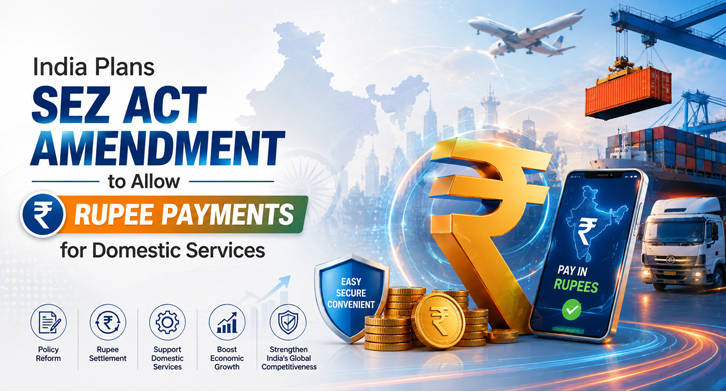
India Plans SEZ Act Amendment to Allow Rupee Payments for Domestic Services

India is considering a major policy change that could make it easier for Special Economic Zone (SEZ) units to serve customers within the country. The Commerce Department is preparing a Cabinet note proposing an amendment to the Special Economic Zones Act, 2005, which would allow SEZ-based companies to receive payments in Indian rupees for eligible services supplied to customers in the Domestic Tariff Area (DTA).

The proposed reform aims to remove a long-standing foreign-exchange requirement that has increased transaction costs and restricted domestic business opportunities for SEZ-based service providers. If approved, the move could particularly benefit maintenance, repair and overhaul (MRO), defence manufacturing, engineering and IT services.

Key Highlights

Why Is the Government Considering the Change?

Under the existing SEZ framework, services supplied by SEZ units to customers in the DTA are subject to a foreign-exchange payment requirement. This creates an additional layer of complexity when the customer and service provider are both operating in India.
In practice, a domestic customer may have to arrange payment in foreign currency even when the underlying service is entirely domestic. The SEZ service provider may then convert the foreign-currency proceeds back into Indian rupees.

Industry representatives say this process creates unnecessary currency-conversion costs, banking charges and administrative procedures, making SEZ-based service providers less attractive to domestic customers.

The proposed amendment seeks to address this issue by removing the foreign-exchange requirement for qualifying services.

What Could Change for SEZ Businesses?

The proposed amendment would create a more practical payment mechanism for SEZ units supplying services to Indian customers.

Current Framework

Proposed Framework

Foreign-exchange payment requirement for specified DTA services

INR payment proposed for eligible domestic services

Currency conversion may be required

Reduced need for currency conversion

Additional banking and transaction costs

Potentially lower transaction costs

Greater complexity for domestic buyers

Greater complexity for domestic buyers

Restrictions on some specialised services

Wider potential domestic market for SEZ service providers

The government is seeking to address what industry stakeholders describe as an imbalance in the current framework: the foreign-exchange condition applies to services, while the same requirement does not operate in the same way for goods.

MRO and Defence Could See Major Benefits

The proposed reform could be particularly significant for India’s MRO and defence manufacturing ecosystem.

Several SEZ-based facilities currently face difficulties in supplying maintenance and overhaul services to domestic organisations because of the foreign-currency payment requirement.
For instance, MRO facilities located in MIHAN Nagpur SEZ and GMR Aero SEZ in Hyderabad have faced challenges in serving domestic airlines under the existing payment framework.
The issue is also relevant to defence manufacturing. L&T MBDA Missile Systems’ SEZ facility in Coimbatore has highlighted difficulties in providing maintenance and overhaul services to the Indian defence establishment when payments have to be structured in foreign currency.
For defence organisations and government departments, paying an Indian service provider in foreign currency can create an unnecessary operational and financial complication.

Potential Impact on India's Logistics and Industrial Ecosystem

Although the proposal primarily concerns SEZ taxation and payment regulations, its effects could extend across India’s wider industrial and logistics ecosystem.
A more flexible domestic market for SEZ-based service providers could encourage greater use of specialised capabilities located within SEZs. This could support sectors such as aviation MRO, engineering services, defence equipment maintenance, technology services and industrial support operations.
Greater domestic sourcing could also reduce the need for organisations to look outside SEZ ecosystems for specialised services.
Potential Impact Chain

IT and Engineering Services Could Also Benefit

The proposed change is not limited to physical industrial services.
SEZ-based IT companies could gain greater flexibility in supplying software development and other technology services to Indian public-sector organisations and government departments.
Engineering companies operating from SEZs could similarly find it easier to serve domestic customers without the additional foreign-exchange payment mechanism.
This could open a larger domestic market for specialised capabilities already operating within India’s SEZ ecosystem.

Stakeholder Consultations Underway

The proposal has reportedly been discussed among the Commerce Department, Reserve Bank of India, Ministry of Finance and representatives of the SEZ sector.
The next major step would be Cabinet consideration. If the Cabinet approves the proposal, the required legislative amendment would then need to go through Parliament before the revised provision could take effect.
Therefore, the proposed change should currently be viewed as a policy proposal rather than an implemented regulatory change.

Key Facts at a Glance

Particular

Details

Proposed reform

Amendment to the SEZ Act

Main change

Allow INR payments for eligible domestic services

Existing issue

Foreign-exchange payment requirement for certain DTA services

Key beneficiaries

MRO, defence, engineering and IT companies

Potential benefit

Lower transaction and currency-conversion costs

Key stakeholders

Commerce Department, RBI, Finance Ministry and SEZ industry

Approval required

Cabinet and Parliament

Expected outcome

Greater domestic sourcing and improved SEZ competitiveness

What the SEZ Reform Could Mean for India

The proposed amendment could help align India’s SEZ framework more closely with the realities of the domestic services economy.
SEZs were established to promote exports, investment and economic activity. However, restrictions that make it difficult for SEZ-based companies to serve Indian customers can limit the utilisation of specialised infrastructure and capabilities already available within these zones.
Allowing eligible domestic services to be paid for in rupees could remove one such barrier.
For sectors such as aircraft MRO, defence maintenance, engineering and technology, the change could help connect SEZ capabilities more effectively with India’s domestic demand.

Outlook: A More Flexible Role for SEZs in India's Domestic Economy

If approved and implemented, the proposed amendment could expand the role of SEZs beyond their traditional export-oriented focus by making it easier for specialised service providers to participate in India’s domestic economy.

The potential benefits include lower transaction costs, easier domestic procurement, improved utilisation of SEZ infrastructure and stronger linkages between SEZ businesses and Indian industries.

For India’s logistics, aviation, defence and manufacturing sectors, greater access to specialised domestic services could contribute to more integrated and cost-efficient supply chains.
The key question now is whether the proposed amendment receives Cabinet and parliamentary approval and what specific services and payment conditions will be covered under the final framework.

Frequently Asked Questions

What is the proposed SEZ Act amendment?
The government is considering an amendment that would allow eligible SEZ units to receive payments in Indian rupees for services supplied to customers in the Domestic Tariff Area.
The proposal aims to reduce currency-conversion costs, banking charges and administrative complications associated with the existing foreign-exchange payment requirement.
MRO, defence manufacturing, engineering and IT services are expected to be among the key beneficiaries.
Easier domestic access to SEZ-based MRO, engineering and specialised industrial services could support aviation, manufacturing, defence and other supply-chain activities.
No. The proposal still requires the necessary government approvals, including Cabinet and parliamentary approval, before it can become law.

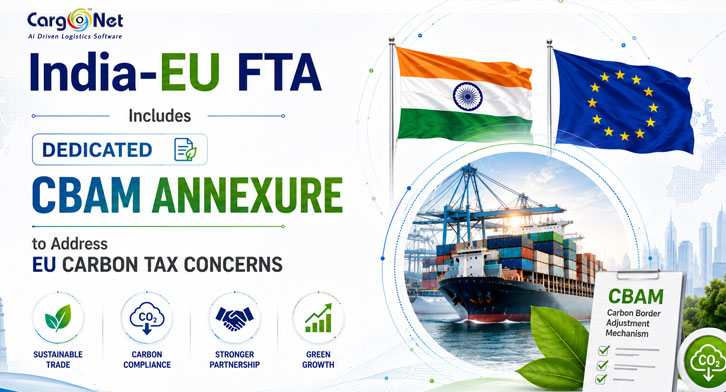
India-EU FTA Includes Dedicated CBAM Annexure to Address EU Carbon Tax Concerns

india-eu

The proposed India-European Union Free Trade Agreement (India-EU FTA) includes a dedicated annexure to address concerns surrounding the European Union’s Carbon Border Adjustment Mechanism (CBAM), particularly for small and medium-sized enterprises (SMEs).

According to Darpan Jain, Additional Secretary in India’s Department of Commerce, CBAM was one of the major areas of negotiation during the India-EU trade talks. The agreement contains provisions intended to improve flexibility, compliance support and engagement between Indian and EU authorities on carbon pricing and verification.

The legal review, or “legal scrub,” of the trade agreement has been completed. The pact could be signed in 2026 and is expected to be implemented from 2027, subject to completion of the necessary procedures.

Key Highlights

What Is CBAM and Why Does It Matter to Indian Exporters?

The Carbon Border Adjustment Mechanism (CBAM) is the European Union’s system for addressing the carbon emissions associated with certain imported goods.

For Indian exporters, CBAM creates an additional compliance requirement because businesses may need to calculate, report and verify the emissions embedded in products exported to the European market.

This is particularly important for carbon-intensive industries such as steel, aluminium, cement and fertilisers.

For smaller exporters, the challenge is not limited to the potential carbon cost. Businesses also need reliable emissions data, appropriate verification and familiarity with EU compliance requirements.

India-EU FTA Creates a Framework for CBAM Cooperation

CBAM reportedly required significant negotiating attention during the India-EU FTA discussions.

The agreement’s dedicated annexure is intended to create a framework through which India and the EU can continue engaging on CBAM-related concerns.

One important area is the possibility of recognising carbon prices already paid in India when determining the treatment of exported goods under the EU mechanism.

This could become particularly relevant for Indian manufacturers that already face domestic carbon-related costs or introduce measures to reduce the emissions intensity of their production.

Three Key Areas of CBAM Cooperation
  1. Future flexibility
  2. The agreement provides for engagement on flexibility that may become available under CBAM as the EU’s carbon-border framework evolves.
  1. SME compliance
  2. Smaller businesses may face difficulties in calculating embedded carbon emissions, obtaining verification and understanding EU requirements. The agreement includes provisions aimed at addressing these concerns.
  1. Recognition of carbon pricing
  2. India will be able to engage with EU authorities regarding carbon prices paid within India and how these may be taken into account under the EU framework.
India-EU FTA and CBAM: What Changes for Exporters?

Area

Potential Impact on Indian Businesses

Carbon emissions data

Exporters will need reliable information on embedded emissions

Verification

Businesses may need recognised verification processes

Compliance

SMEs could face additional reporting and documentation requirements

Carbon pricing

India can engage with EU authorities on carbon costs already paid domestically

Steel & aluminium

Carbon-related compliance will be particularly important

Fertiliser & cement

Exporters may need stronger emissions measurement systems

India-EU trade

Greater regulatory clarity could support long-term trade planning

FTA implementation

Expected from 2027, subject to required procedures

How CBAM Could Affect India's Logistics and Supply Chain Sector

The implications of CBAM extend beyond manufacturers and exporters.

As carbon-related documentation becomes increasingly important, freight forwarders, customs brokers, logistics providers and supply-chain technology companies may also need to support customers with better data visibility and documentation.

Export shipments to the EU could increasingly require information connecting:

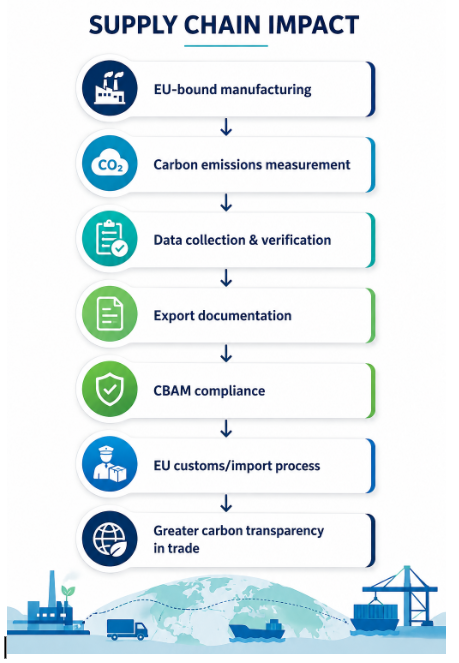
Product → Manufacturer → Production Emissions → Carbon Data → Verification → Customs Documentation → EU Import

This creates an opportunity for logistics technology platforms to integrate carbon-related information into existing shipment and trade workflows.

From Production to EU Customs: The Carbon Compliance Journey 
supply-chain-impact

Why the India-EU FTA Matters for Trade

The India-EU FTA is expected to have implications beyond tariff reduction. Regulatory cooperation could become increasingly important as international trade moves toward greater carbon transparency.

For Indian exporters, the ability to demonstrate accurate emissions data and comply with EU requirements could become an important part of maintaining competitiveness in the European market.

For SMEs in particular, early investment in digital documentation, emissions tracking, data management and compliance processes could help reduce the administrative burden associated with CBAM.

What Indian Exporters Should Prepare For

Businesses exporting carbon-intensive products to the EU should consider preparing for the changing regulatory environment rather than waiting for implementation.

Recommended priorities:

Índia-EU FTA Timeline

Date/Period

Development

January 27, 2026

India and EU announced conclusion of FTA negotiations

July 2026

Legal scrub of the agreement completed

2026

Agreement could be formally signed

2027

Expected implementation, subject to required procedures

The Bigger Picture

The India-EU FTA comes at a time when trade policy and climate policy are increasingly interconnected.

For Indian exporters, access to the European market will increasingly depend not only on price and product quality but also on the ability to demonstrate compliance with evolving environmental requirements.

The dedicated CBAM provisions in the proposed FTA could provide a platform for India and the EU to address practical challenges faced by exporters, particularly SMEs.

For the logistics industry, this also signals a broader shift toward data-driven trade compliance, where shipment information, customs documentation, carbon data and verification records increasingly need to work together.

The proposed India-EU FTA’s dedicated CBAM annexure could provide Indian exporters with greater clarity on one of the most significant emerging barriers to EU market access.

While CBAM compliance will remain an important challenge, closer India-EU engagement on carbon pricing, verification and SME support could help businesses adapt as the agreement moves toward potential implementation in 2027.

FAQs

What is the India-EU FTA?
The India-EU Free Trade Agreement is a proposed trade pact between India and the European Union designed to strengthen bilateral trade and economic relations through improved market access and regulatory cooperation.
CBAM stands for Carbon Border Adjustment Mechanism. It is an EU framework designed to address the carbon emissions associated with certain imported products.
CBAM is particularly relevant to carbon-intensive products including steel, aluminium, fertilisers and cement.
The proposed agreement contains a separate CBAM annexure covering issues including future flexibility, compliance challenges, verification and discussions concerning carbon prices paid in India.

SMEs may face challenges in calculating embedded carbon emissions, maintaining the required data, obtaining verification and ensuring that their verification processes meet EU requirements.

The agreement could be signed in 2026 and is expected to be implemented from 2027, subject to the completion of the required procedures.
The agreement provides scope for India to engage with EU authorities on whether carbon prices paid in India can be taken into account under the EU framework.
Exporters should strengthen emissions measurement, data management, verification, digital documentation and compliance processes, particularly for goods sold into the EU market.

India and Bhutan Approve 12 New Development Projects Worth ₹332 Crore, Sign ₹4,000 Crore Credit Line 

Development-project
India and Bhutan have strengthened their economic and development partnership with the approval of 12 new development projects worth ₹332 crore (approximately USD 34.8 million) and the signing of a ₹4,000 crore (approximately USD 419 million) concessional Line of Credit.

The agreements were announced during the fifth India-Bhutan Development Cooperation Talks, where officials reviewed the progress of India-supported projects and discussed priorities under Bhutan’s 13th Five-Year Plan.

The latest commitments are expected to support infrastructure development, social-sector initiatives and economic growth in Bhutan while further strengthening India-Bhutan connectivity, cross-border trade and regional economic cooperation.

Key Highlights

What Did India and Bhutan Agree On?

The two countries reviewed the implementation of India-supported development projects across multiple sectors and approved 12 additional projects as part of their ongoing development cooperation.

The discussions were held during the fifth India-Bhutan Development Cooperation Talks, co-chaired by India’s Foreign Secretary Vikram Misri and Bhutan’s Foreign Secretary Dasho Pema Lektup Dorji.

The talks focused particularly on projects aligned with Bhutan’s 13th Five-Year Plan.

Bhutan also acknowledged India’s contribution to the country’s socio-economic development through infrastructure and development assistance.
India-Bhutan Development Cooperation at a Glance

Area

Latest Development

New projects approved

12

Project value

₹332 crore

Approx. project value

USD 34.8 million

New Line of Credit

₹4,000 crore

Approx. credit value

USD 419 million

Development plan

Bhutan's 13th Five-Year Plan

Additional cooperation

Health sector

Ecological projects inaugurated

Thimphu Ecological Park and Olakha Park

India-Bhutan Projects Strengthen Regional Connectivity

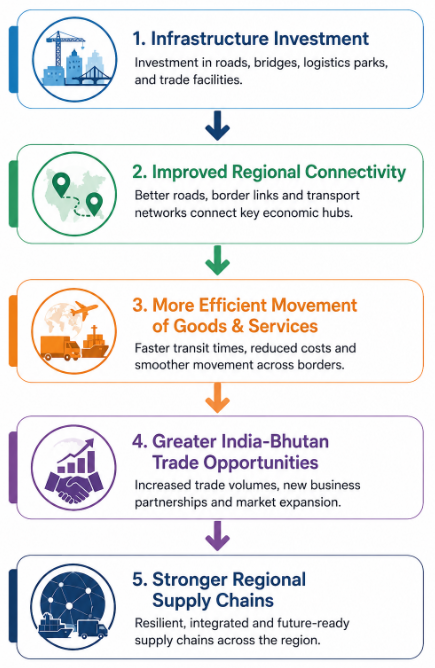
Although the latest announcement focuses primarily on development cooperation, increased investment in infrastructure and economic projects can also have implications for India-Bhutan trade and logistics.

Bhutan relies heavily on connectivity with India for access to regional and international markets. Infrastructure development can therefore influence the movement of goods, supply-chain efficiency and connectivity between Bhutanese economic centres and Indian gateways.

A stronger infrastructure ecosystem can potentially support:

blog-ecosystem
For logistics companies and freight operators, developments involving roads, economic infrastructure, border connectivity and trade facilities are important because they can influence cargo movement, transportation demand, transit times and supply-chain planning.

India-Funded Ecological Projects Inaugurated in Thimphu

As part of the bilateral development partnership, the two foreign secretaries virtually inaugurated the Thimphu Ecological Park and Olakha Park.
Both projects were developed under the “Green Infrastructure and Open Spaces in Thimphu” initiative and funded by India.
The projects add an environmental and urban-development dimension to India’s development cooperation with Bhutan, alongside the broader focus on economic infrastructure and social development.

Why the ₹4,000 Crore Credit Line Matters

The new ₹4,000 crore concessional Line of Credit provides an important financial framework for supporting development priorities in Bhutan.

For Bhutan, access to concessional financing can help accelerate infrastructure and development initiatives while supporting long-term economic priorities.

For India, stronger economic cooperation with Bhutan reinforces its role in supporting regional connectivity and economic integration in South Asia.

From a logistics perspective, infrastructure investment can have a multiplier effect by creating demand across areas such as:

India-Bhutan Trade and Logistics: What Could Change?

The latest development cooperation agreements could create opportunities beyond the individual projects themselves.

As Bhutan expands infrastructure and economic capacity, demand for the movement of construction materials, machinery, equipment and other project-related cargo could increase.

Improved infrastructure can also help businesses plan cross-border shipments more efficiently and strengthen supply-chain links between Bhutan and India.

Potential Logistics Impact

Logistics Area

Potential Impact

Cross-border freight

Potential increase in cargo movement

Project logistics

Higher demand for infrastructure-related cargo

Road transportation

Greater importance of India-Bhutan road connectivity

Warehousing

Potential demand around growing economic activity

Customs & documentation

Continued importance of efficient cross-border processes

Supply chains

Stronger integration between Indian and Bhutanese markets

India-Bhutan Cooperation Under the 13th Five-Year Plan

The latest discussions demonstrate India’s continued engagement with Bhutan’s development priorities under the country’s 13th Five-Year Plan.

The partnership covers a broad range of areas rather than being limited to a single infrastructure segment. Development cooperation includes economic development, social infrastructure, environmental initiatives and health-related cooperation.

This broader approach could help strengthen the foundation for long-term economic activity and connectivity between the two neighbouring countries.

What This Means for Freight Forwarders and Logistics Companies

For freight forwarders, transport operators and supply-chain companies operating in or connected to the India-Bhutan trade corridor, infrastructure developments are important signals for future cargo demand.

Companies may need to monitor:

Digital freight management systems can also become increasingly important as cross-border trade volumes and documentation requirements grow.

Key Takeaway

While the agreements are primarily focused on development, their impact could extend to regional connectivity, infrastructure logistics, cross-border freight and supply-chain activity.

For logistics and freight-forwarding businesses, the development of India-Bhutan infrastructure is a trend worth monitoring as the two countries deepen economic integration and work toward their long-term development objectives.

FAQs

What new projects have India and Bhutan approved?

India and Bhutan have approved 12 new development projects worth ₹332 crore (approximately USD 34.8 million) as part of their bilateral development cooperation.

India and Bhutan signed a concessional Line of Credit worth ₹4,000 crore (approximately USD 419 million).

The projects are being implemented in alignment with priorities under Bhutan’s 13th Five-Year Plan.

The bilateral development partnership covers multiple areas, including infrastructure, socio-economic development, environmental initiatives and health-sector cooperation.

The Thimphu Ecological Park and Olakha Park were virtually inaugurated under the Green Infrastructure and Open Spaces in Thimphu project funded by India.

Infrastructure and economic development can potentially increase demand for cross-border transportation, project cargo, construction logistics, warehousing and supply-chain services.

India provides Bhutan with critical access to regional markets and transportation networks. Stronger bilateral infrastructure cooperation can therefore support the movement of goods and improve economic connectivity.

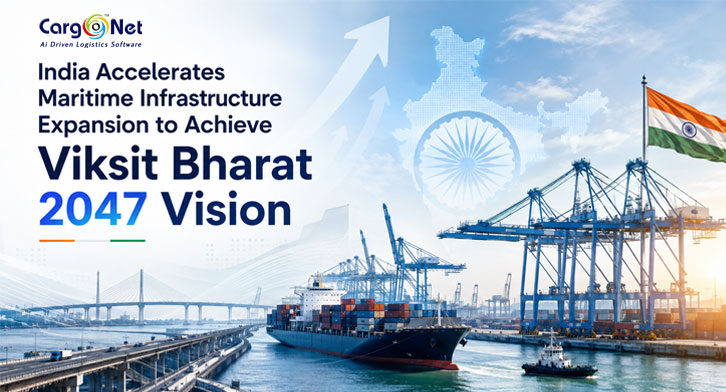
India Accelerates Maritime Infrastructure Expansion to Achieve Viksit Bharat 2047 Vision

Viksit
According to official data released during a high-level review meeting by the Ministry of Ports, Shipping and Waterways (MoPSW), India is rapidly accelerating its maritime infrastructure expansion to achieve the government’s Viksit Bharat 2047 vision. Led by Union Minister Sarbananda Sonowal, the national strategy focuses on port capacity building, greenfield shipbuilding clusters, digital transformation, and inland waterways development.
Coordinated execution across major ports, the Inland Waterways Authority of India (IWAI), and private sector partners aims to position India as a leading global logistics and maritime powerhouse over the next two decades.

Key Strategic Highlights & Targets

India's Maritime Expansion at a Glance

Strategic Initiative

Progress / Target Parameter

Target Timeline

Additional Port Capacity

700+ MTPA total (306 MTPA Major / 193 MTPA Non-Major)

By 2030

Mechanisation Capacity

183 MTPA additional capacity via automation

By 2030

Cargo Mechanisation Rate

Increase from 76% to 93%

By 2030

Maritime Digitalisation

100% paperless documentation & tracking

By 2030

PPP Cargo Share

Increase from 44% to 85%

By 2030–31

Inland Waterways Cargo

200+ Million Tonnes

Achieved

Shipbuilding Output

+41% growth (40,923 GT to 57,637 GT)

YoY Benchmark

India's Maritime Expansion at a Glance

MoPSW data highlights three mega infrastructure projects as primary anchors for expanding India’s deep-water port capacity:

Project Name

Location / Scope

Expected Capacity

Timeline

Vadhavan Port

Maharashtra (All-weather deep-draft port)

164 MTPA

2030–31

Tuticorin Outer Harbour

Tamil Nadu (Deepening & terminal expansion)

39 MTPA

Under Development

Kandla Tuna Tekra Terminal

Gujarat (Multipurpose cargo terminal)

33 MTPA

2027–28

Together with operational improvements and brownfield enhancements, these initiatives form a broader strategy to add 682 MTPA of specific terminal capacity across the country.

Mechanisation and 100% Digitalisation

To reduce vessel Turnaround Time (TAT) and lower national logistics costs, MoPSW is modernising infrastructure through two core pillars:

Expanding Private Capital via Public-Private Partnerships (PPP)

Private sector participation is central to funding and operating modern port infrastructure. Under current MoPSW projections:

Mechanisation and Digitalisation to Improve Port Efficiency

The Ministry aims to modernise India’s ports by increasing mechanised cargo handling from 76% in FY 2025–26 to 93% by 2030. Greater automation is expected to reduce vessel turnaround time, improve productivity, and lower logistics costs.

Digital transformation is another major priority. The government plans to achieve 100% digitisation across the maritime ecosystem, enabling paperless documentation, integrated logistics platforms, real-time cargo visibility, and enhanced operational transparency.

Private Investment to Play a Larger Role

Public-Private Partnership (PPP) projects will continue to drive India’s maritime expansion.
By 2030–31:

Shipbuilding Industry Records Strong Growth

India’s shipbuilding sector is gaining momentum as the government seeks to reduce import dependence and strengthen domestic manufacturing.

Domestic shipbuilding output increased by 41%, rising from 40,923 Gross Tonnes (GT) in 2024 to 57,637 GT in 2025.

The government has granted in-principle approval for large shipbuilding clusters in:

Each cluster is designed with an annual production capacity of 1.2 million GT.

Additional approvals for Maharashtra and Odisha are expected in 2026.

Shipbuilding Value Continues to Rise

The value of ships being built in India has increased significantly.
Planned Shipbuilding Clusters

MoPSW has granted in-principle approval for five large greenfield shipbuilding clusters, each designed with an annual production capacity of 1.2 million GT:

Shift Toward High-Value Vessel Construction

Financial Metric

Previous Benchmark

Current Value

Scale Increase

Average Vessel Contract Value

₹41 Crore

₹212 Crore

>5× Growth

This financial increase underscores India’s evolving industrial capability to design, build, and integrate complex commercial and technological vessels domestically.

Industry & Stakeholder Impact Analysis

FAQs

What is India's maritime expansion plan under Visit Bharat 2047?
India’s maritime expansion plan aims to add over 700 MTPA of port capacity by 2030, achieve 100% maritime digitalisation, boost domestic shipbuilding via five mega-clusters, and raise PPP cargo handling to 85%.
The flagship port expansion projects include the all-weather Vadhavan Port in Maharashtra (164 MTPA), the Tuticorin Outer Harbour project in Tamil Nadu (39 MTPA), and the Kandla Tuna Tekra Terminal in Gujarat (33 MTPA).
Port cargo mechanisation speeds up vessel turnaround time, increases terminal handling capacity, reduces manual labor risks, and significantly lowers overall national logistics costs for trade competitiveness.
The government is establishing five greenfield shipbuilding clusters in states like Tamil Nadu, Andhra Pradesh, and Gujarat—each with a 1.2 million Gross Tonnes (GT) annual capacity—while providing targeted infrastructure incentives.
Complete maritime digitalisation enables paperless trade documentation, automated customs clearance, real-time cargo visibility, reduced port congestion, and improved transparency across multimodal logistics networks.

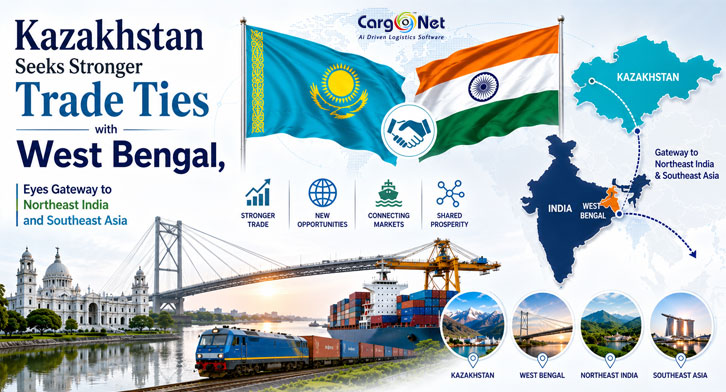
Kazakhstan Seeks Stronger Trade Ties with West Bengal, Eyes Gateway to Northeast India and Southeast Asia

Trade-ties

Kazakhstan is looking to strengthen its trade and investment relationship with West Bengal, viewing the Indian state as a strategic gateway to Northeast India and Southeast Asian markets.

Kazakhstan’s Ambassador to India, Yeskarayev Azamat, highlighted the growing business potential between Kazakhstan and West Bengal while addressing an interactive session organized by the Merchants’ Chamber of Commerce & Industry (MCCI).

The ambassador said Kazakhstan is seeking to expand economic cooperation with India, with West Bengal emerging as an important focus region. Potential areas of collaboration include pharmaceuticals, mining, energy and manufacturing.

Key Highlights

Kazakhstan Targets New Business Opportunities in West Bengal

Speaking at the MCCI event, Ambassador Azamat said Kazakhstan is actively working to expand economic engagement with India. The country is engaging with government representatives, businesses, political leaders and academic institutions to identify opportunities for stronger bilateral cooperation.

West Bengal’s strategic location makes it particularly attractive for Kazakhstan. The state provides access to India’s eastern and northeastern markets and has potential to support broader commercial connections with Southeast Asia.

The growing interest could create opportunities across multiple sectors, particularly where industrial investment and cross-border movement of goods are involved.

Focus Areas for India-Kazakhstan Economic Cooperation

Sector

Potential Area of Cooperation

Logistics Relevance

Pharmaceuticals

12

12

Mining

₹332 crore

₹332 crore

Energy

USD 34.8 million

USD 34.8 million

Manufacturing

₹4,000 crore

₹4,000 crore

September Business Delegation to Strengthen Engagement

A high-level business delegation from Kazakhstan is scheduled to visit India in September. According to Ambassador Azamat, the delegation will meet leading Indian companies, including the Tata Group, to explore potential areas of commercial cooperation.

A business forum is also planned in Chennai, providing an additional platform for Indian and Kazakh businesses to discuss partnerships and investment opportunities.

Logistics Impact: What Stronger Trade Could Mean

Greater commercial cooperation between Kazakhstan and West Bengal could eventually support additional cargo movement between businesses in Central Asia and eastern India.

Potential logistics implications include:
Logistics impact

For freight forwarders and logistics companies, increased activity across pharmaceuticals, mining, energy and manufacturing could create opportunities for sea freight, air cargo, project logistics, customs clearance, warehousing and multimodal transportation services.

Why West Bengal Matters for Regional Trade

West Bengal’s geographic position gives it strategic importance in India’s eastern trade network. Its connectivity with eastern and northeastern India could make the state relevant for businesses seeking access to these markets.

For Kazakhstan-based companies, stronger commercial engagement with West Bengal could therefore provide opportunities to explore India’s eastern economic corridor while also building relationships with businesses connected to Southeast Asian markets.

What This Means for Freight Forwarders
If bilateral business activity expands, logistics providers could see opportunities in:
The development also highlights the growing importance of connecting Central Asian markets with India’s eastern logistics network.

India-Kazakhstan Trade: A Potential Logistics Opportunity

The proposed business engagements signal Kazakhstan’s broader interest in expanding its economic footprint in India. For West Bengal, stronger commercial ties could bring new investment opportunities while increasing the state’s relevance as a regional trade and logistics gateway.

For the logistics sector, the key opportunity will be translating stronger business relationships into efficient cargo connectivity, reliable multimodal networks and streamlined cross-border trade processes.

FAQs

Why is Kazakhstan interested in West Bengal?

Kazakhstan sees West Bengal as a potential gateway to India’s eastern and northeastern markets as well as Southeast Asia

The areas highlighted include pharmaceuticals, mining, energy and manufacturing.

A high-level business delegation from Kazakhstan is scheduled to visit India in September 2026.

The delegation is expected to hold discussions with leading Indian companies, including the Tata Group.

Greater trade and investment could increase demand for freight forwarding, multimodal transportation, warehousing, customs services and specialized cargo logistics.

West Bengal can provide commercial access to eastern and northeastern India and has potential connections with wider Southeast Asian trade networks

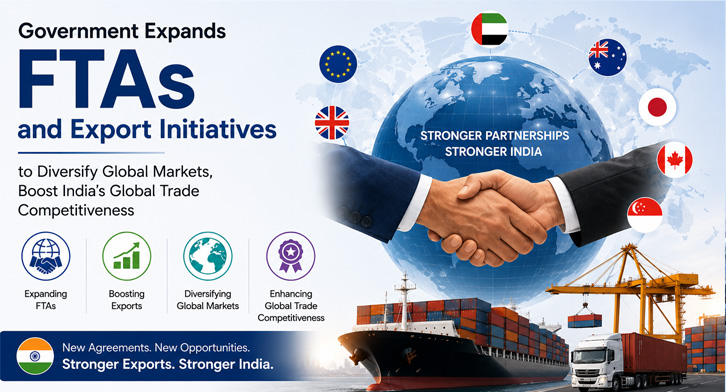
Government Expands FTAs and Export Initiatives to Diversify Global Markets, Boost India’s Global Trade Competitiveness

India Strengthens Global Trade Strategy with New FTAs and ₹25,060 Crore Export Promotion Mission

India is accelerating its global trade ambitions by expanding its Free Trade Agreement (FTA) network and launching large-scale export promotion initiatives designed to diversify export markets, improve supply chain efficiency, and enhance the global competitiveness of Indian businesses.
In a written reply in the Lok Sabha, Jitin Prasada said the government is actively negotiating new trade agreements with major economies while implementing multiple export-focused programs to support businesses, particularly MSMEs, startups, and labour-intensive industries.
The strategy combines market access through FTAs with investments in logistics infrastructure, export financing, digital trade, and regulatory reforms to help Indian exporters compete more effectively in global markets.

Key Highlights

Countries Covered Under India's Trade Strategy

Status

Countries

FTAs Signed / Concluded

UAE, Australia, Oman, United Kingdom, New Zealand

FTA Negotiations Underway

European Union, Canada, Israel, Peru, Eurasian Economic Union

These agreements aim to:

Export Promotion Mission: ₹25,060 Crore Investment

The Government has allocated ₹25,060 crore (approximately US$2.67 billion) under the Export Promotion Mission for the period FY2026–FY2031.
Major Focus Areas

Initiative

Objective

Trade Finance

Improve exporter access to funding

Export Credit

Increase working capital availability

Quality Compliance

Help businesses meet international standards

Branding Support

Build global recognition for Indian products

Logistics Improvement

Reduce transportation costs

Market Intelligence

Identify new export opportunities

Cross-Border E-commerce Gets Major Boost

Recognizing the rapid growth of global digital trade, the Government is introducing measures to simplify cross-border e-commerce exports.
Key Reforms

These initiatives are expected to significantly benefit:

Logistics Infrastructure Driving Export Growth

Improving logistics efficiency remains a central pillar of India’s export strategy.
Major initiatives include:
These measures are expected to reduce logistics costs, shorten delivery timelines, and improve India’s export competitiveness.

Industries Expected to Benefit

Several export-oriented sectors are likely to gain from expanded market access and lower trade barriers.

Sector

Expected Impact

Textiles

Higher exports through preferential tariffs

Apparel

Improved competitiveness in global markets

Leather

Greater access to developed markets

Engineering Goods

Expanded international demand

Pharmaceuticals

Easier market access

Food Processing

New export opportunities

Handicrafts

Growth through e-commerce exports

MSME Manufacturing

Better global market reach

Market Impact Snapshot

Area

Expected Outcome

Export Markets

Greater diversification

Logistics

Lower export costs

Trade Agreements

Wider market access

MSMEs

Increased export participation

E-commerce

Faster international expansion

Employment

Growth in labour-intensive industries

Global Competitiveness

Stronger position in international trade

Why This Matters for the Logistics Industry

The government’s integrated trade strategy is expected to generate increased demand across the logistics ecosystem.
Key opportunities include:

FAQs

What is India's Export Promotion Mission?
The Export Promotion Mission is a ₹25,060 crore government initiative for FY2026–FY2031 that supports exporters through trade finance, export credit, logistics improvements, branding, quality compliance, and market intelligence.
India has concluded or expanded FTAs with the UAE, Australia, Oman, the United Kingdom, and New Zealand, while negotiations continue with the European Union, Canada, Israel, Peru, and the Eurasian Economic Union.
FTAs help reduce tariffs, improve market access, remove non-tariff barriers, increase investment, and create new export opportunities across multiple industries.
MSMEs will benefit from easier market access, export financing, digital export platforms, e-commerce export hubs, logistics support, and export facilitation centres.
Efficient logistics reduce transportation costs, improve delivery timelines, enhance supply chain reliability, and make Indian exports more competitive in international markets.

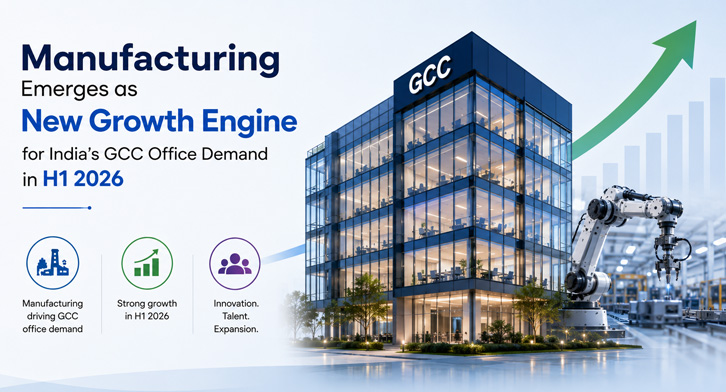
Manufacturing Emerges as New Growth Engine for India’s GCC Office Demand in H1 2026

India’s manufacturing sector has emerged as the largest contributor to office leasing by Global Capability Centres (GCCs) during the first half of 2026, highlighting the country’s transformation into a global hub for engineering, research, product development and advanced manufacturing.
According to a recent Vestian report, manufacturing accounted for 29% of total GCC office leasing, overtaking the traditionally dominant IT and business services sectors. The shift reflects increasing investments by multinational companies in high-value engineering, electronics, automotive, industrial technology and semiconductor operations across India.
The growing demand is being supported by government initiatives such as Make in India, the Production Linked Incentive (PLI) Scheme, improved industrial infrastructure and India’s expanding pool of skilled engineering talent.
As global enterprises continue relocating strategic functions closer to innovation ecosystems, India is increasingly becoming a preferred destination for next-generation GCCs focused on product development, digital engineering and supply chain innovation.

Strategic Market Snapshot: H1 2026

Market Metric

Indicator / Value

Strategic Context

Manufacturing Share of GCC Leasing

29%

Leading growth driver across commercial real estate

Previous Sector Leader

IT & Business Services

Replaced by high-value engineering & design GCCs

Preferred Asset Class

Grade A Commercial Space

High demand for ESG-compliant, modern tech parks

Top Performing Cities

Bengaluru, Pune, Chennai, Hyderabad

Concentrated industrial-tech & engineering hubs

Core Operational Focus

Advanced R&D, EV Design, Chipsets

Move from back-office support to core engineering

Manufacturing-Led GCC Office Demand

Indicator

H1 2026

Manufacturing Share of GCC Leasing

29%

Leading Growth Segment

Manufacturing

Office Space Demand

Rising

Key Focus Areas

Engineering, R&D, Product Design

Major Growth Drivers

Manufacturing, Semiconductors, Electronics

Why Manufacturing GCCs Are Expanding Rapidly

Growth Driver

Impact

Make in India

Boosts manufacturing investments

PLI Scheme

Encourages global production expansion

Skilled Engineering Workforce

Supports innovation and product development

Competitive Operating Costs

Reduces operational expenditure

Digital Infrastructure

Enables smart manufacturing and Industry 4.0

Expanding Supply Chains

Strengthens global manufacturing networks

Several structural factors are accelerating manufacturing-led GCC investments in India.

Key Industry Sectors Driving GCC Leasing Growth

Manufacturing-focused GCC investments are concentrated across high-tech, capital-intensive verticals requiring specialized engineering talent and modern workspace infrastructure:

Why This Matters

The rapid expansion of manufacturing GCCs marks a significant shift in India’s economic landscape. Rather than functioning solely as back-office support centres, GCCs are increasingly leading innovation, engineering, product development and strategic decision-making.
This evolution is expected to:

Why Manufacturing GCCs Are Expanding Rapidly in India

Several government policy interventions and structural cost advantages continue to accelerate investments from global enterprises:

Expert Perspective

Manufacturing-led GCC growth signals India’s transition from a cost-efficient outsourcing destination to a global innovation and engineering powerhouse. As investments continue across advanced manufacturing and digital technologies, GCCs are expected to play an increasingly strategic role in global business operations.

FAQs

Why are manufacturing GCCs growing in India?
Manufacturing GCCs are expanding due to government initiatives such as Make in India and the PLI Scheme, along with India’s skilled workforce, competitive costs and improving industrial infrastructure.
Manufacturing accounted for 29% of GCC office leasing in India during the first half of 2026.
Automobiles, electronics, semiconductors, industrial engineering, product development and supply chain technologies are leading manufacturing GCC investments.
They create skilled jobs, increase commercial real estate demand, strengthen innovation capabilities and improve India’s position within global manufacturing value chains.

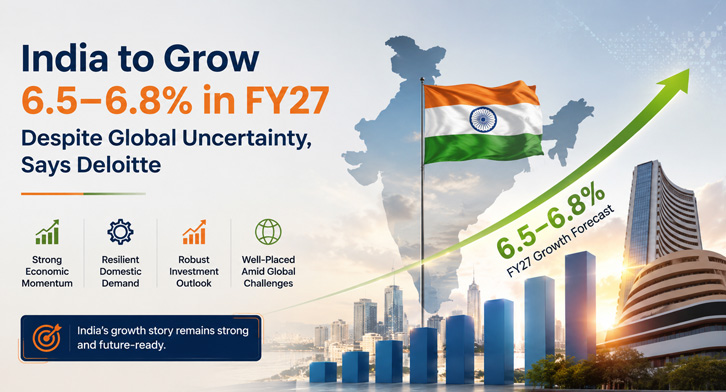
India to Grow 6.5–6.8% in FY27 Despite Global Uncertainty, Says Deloitte

Deloitte’s FY27 GDP Growth Outlook: The Macro Picture

Despite persistent global headwinds—including geopolitical tension, volatile commodity prices, and supply chain realignments—India remains on track as one of the world’s fastest-growing major economies. Deloitte forecasts India’s real GDP growth at 6.5%–6.8% for FY27, closely aligning with the Reserve Bank of India’s (RBI) projected baseline of 6.60%.
While global trade conditions remain uncertain, India’s domestic fundamentals—backed by strong consumer demand, capital expenditure in infrastructure, and strategic manufacturing incentives—provide a resilient foundation for long-term supply chain expansion.

Economic Metric

Forecast / Value

Strategic Impact on Logistics & Freight

Deloitte FY27 GDP Forecast

6.5% – 6.8%

Sustained long-term demand across freight corridors

RBI FY27 GDP Target

6.60%

Stable monetary policy supporting fleet expansion

FY26 GDP Baseline

7.70%

Normalization toward sustainable, high-volume growth

Primary Growth Engine

Domestic Consumption

Spikes in retail, e-commerce, and last-mile delivery

Primary Risk Factor

Commodity Inflation

Variable fuel surcharges and rising operating costs

Deloitte's FY27 GDP Growth Outlook

Indicator

Forecast

FY27 GDP Growth

6.5–6.8%

RBI FY27 Forecast

6.60%

FY26 GDP Growth

7.70%

Growth Driver

Domestic Demand

Major Risks

Inflation, Geopolitical Tensions

Key Opportunities

Manufacturing, Infrastructure, FTAs

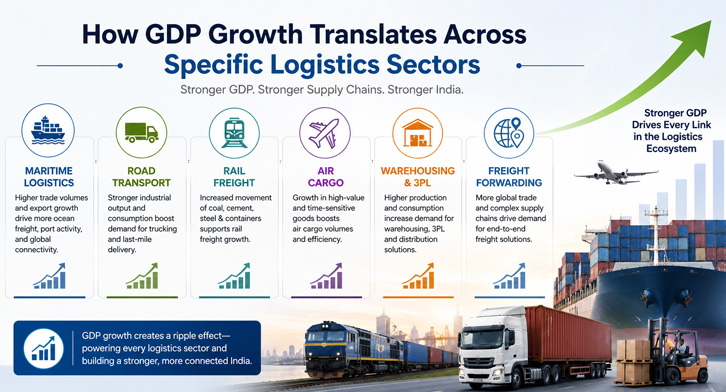
How GDP Growth Translates Across Specific Logistics Sectors

Economic expansion directly feeds into cargo movement. Based on Deloitte’s growth metrics, here is the projected impact across key transport modes:

Why Deloitte Expects Stronger Growth in the Second Half

According to Deloitte, economic momentum is likely to improve in the latter half of FY27 due to several positive factors:
1. Festive Demand

Higher consumer spending during India’s festive season is expected to boost retail sales, manufacturing output, transportation, and logistics activity.

2. Monetary Easing
Lower borrowing costs can encourage businesses to expand operations while supporting investment across infrastructure, manufacturing, warehousing, and logistics.
3. Improving Global Trade Conditions
Although global trade remains uncertain, gradual stabilization could improve export demand and increase freight volumes.
4. Infrastructure Investments
Continued investments in roads, ports, railways, industrial corridors, and logistics parks are expected to strengthen India’s supply chain efficiency.

Key Risks: Inflation and Supply Chain Pressures

While the macro outlook is optimistic, freight operators must prepare for margin volatility due to several ongoing risks identified in the report:

Free Trade Agreements Could Drive Long-Term Growth

Deloitte identifies India’s expanding network of Free Trade Agreements (FTAs) as a major catalyst for long-term economic growth.
The report notes that trade agreements alone are not enough. To maximize their impact, India must also focus on:
These measures can strengthen India’s position as a global manufacturing and export hub.

Inflation Remains the Biggest Challenge

While growth prospects remain strong, inflation continues to pose risks.
Factors contributing to inflationary pressure include:
Persistent inflation could impact household spending, business costs, and overall economic momentum.

What This Means for the Logistics Industry

India’s stronger economic outlook is expected to generate significant opportunities across the logistics ecosystem.

Sector

Expected Impact

Road Freight

Higher cargo movement

Shipping

Increased export-import volumes

Warehousing

Rising storage demand

Rail Logistics

Improved freight movement

Freight Forwarding

Increased international trade

Ports

Higher container throughput

As manufacturing, exports, and domestic consumption continue to expand, logistics providers may benefit from higher shipment volumes and increased demand for integrated supply chain services.

Economic Outlook Snapshot

Growth Drivers

Potential Risks

Domestic Consumption

Inflation

Manufacturing Expansion

Oil Price Volatility

Infrastructure Investment

Geopolitical Conflicts

Free Trade Agreements

Currency Depreciation

Policy Reforms

Global Trade Disruptions

Supply Chain Improvements

Commodity Price Volatility

CargoNet Analysis: How Freight Forwarders & Shippers Should Prepare

To capitalize on India’s FY27 economic momentum while mitigating cost risks, supply chain managers should focus on three strategic priorities:

FAQs

What is Deloitte’s GDP growth forecast for India in FY27?
Deloitte projects India’s GDP growth to be between 6.5% and 6.8% for FY27, positioning India as one of the fastest-growing major global economies.
Sustained economic growth directly boosts cargo movement, resulting in higher road freight volumes, increased demand for Grade-A warehousing, and greater EXIM container throughput across ports.
Growth in H2 FY27 will be driven by festive season retail demand, anticipated monetary easing (lower interest rates), strategic FTA implementations, and ongoing national infrastructure investments.
Primary supply chain risks include volatile crude oil prices, rising fertilizer and commodity costs, critical mineral price spikes, and potential weather disruptions affecting agricultural freight flows.

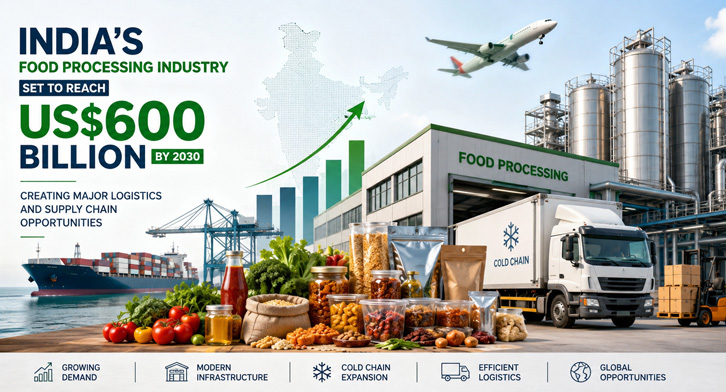
India’s Food Processing Industry Set to Reach US$600 Billion by 2030, Creating Major Logistics and Supply Chain Opportunities

India’s food processing industry is entering a new phase of rapid expansion, with the sector projected to reach US$600 billion (approximately ₹57 lakh crore) by 2030. The growth is expected to be driven by higher value addition, advanced food processing technologies, export expansion, and changing consumer demand for healthier and premium food products.
The projection comes from a joint report released by FICCI and Deloitte during FICCI Foodworld India 2026, highlighting how India’s food ecosystem is shifting from a production-focused model to a value-driven, consumer-centric industry.
This transformation is expected to significantly increase demand for logistics infrastructure, cold chain transportation, warehousing, multimodal freight, and export logistics across India.

Why This Matters for the Logistics Industry

The rapid expansion of food processing will directly impact India’s logistics and supply chain sector.
As more agricultural products move toward processing and exports, companies will require faster, safer, and more efficient transportation networks capable of handling perishable goods.
Key logistics segments expected to benefit include:
The growth is also expected to increase demand for digital freight management platforms capable of tracking shipments, managing compliance, and optimizing transportation costs.

Consumer Trends Driving Growth

India’s food consumption patterns are evolving rapidly.
Consumers are increasingly choosing:
According to the report, the health and functional foods segment is growing at an annual rate of 15–20%, almost double the pace of the overall food market.
These changing preferences are encouraging manufacturers to invest in modern production facilities and advanced supply chains.

Andhra Pradesh Accelerates Food Processing Investments

At the event, Andhra Pradesh announced ambitious plans to become one of India’s leading food processing hubs.
The state aims to:
These initiatives are expected to boost regional logistics networks, industrial warehousing, and freight transportation services.
These changing preferences are encouraging manufacturers to invest in modern production facilities and advanced supply chains.

Government Focus on Global Food Exports

The Ministry of Food Processing Industries also announced plans to develop a “Bharat” brand to promote Indian processed food products in international markets.
The initiative aims to:
Growing exports will further increase demand for efficient freight forwarding, customs clearance, multimodal transportation, and port logistics.

Logistics Impact: What Businesses Should Expect

As India’s food processing industry expands, logistics companies should prepare for increased demand in:
Technology-driven logistics solutions will play a critical role in supporting India’s next phase of food industry growth.

FAQs

What is the projected size of India's food processing industry by 2030?
India’s food processing industry is projected to reach US$600 billion (approximately ₹57 lakh crore) by 2030.
Growth is being driven by higher value addition, increased food processing, export expansion, technology adoption, and rising consumer demand for healthier and premium food products.
Expansion of food processing increases demand for cold chain logistics, refrigerated transportation, warehousing, freight forwarding, export logistics, and supply chain technology.
Only 12–13% of India’s food production is currently processed, leaving significant room for future growth.
Cold chain logistics, food warehousing, freight forwarding, multimodal transport, export logistics, and supply chain automation are expected to see strong demand.
cargonet-logo-icon
Cargonet Cargo Software Logo

Feedback & Reward program

Submit the Feedback and avail the Rewards.

1. Your satisfaction & reliability on CargoNet ?

2. Your Rating on Support & co-ordination team?

3. Satisfaction on the look and feel of CargoNet ?

4. Please specify any 2 best features that you feel more helpful in CargoNet?

5. Please specify any 2 best reports that you are taking on regular basis?

6. Are you using Copy Job option in CargoNet Software?

7. Are you using Automatic DSR (Daily Status Report) Option? It automatically sends reports to customer about the shipment status

8. Are you using Automatic Outstanding Reports option? Period Auto outstanding reminders to customer

9. Any other thoughts to improve in CargoNet? Please share.

* Join our Reward Program by recommending CargoNet (Cash Rewards Awaiting)

“Thanks for your feedback. Our goal is to create the best possible product, support & service, and your thoughts, ideas & suggestions play a major role in helping us identify opportunities to improve.”

Cut AI cost,
not performance

discover how top Freight Forwarding companies  reduce AI-related expense and speed up operation with CargoNet AI, we will show it how
Share your information for instant access :