

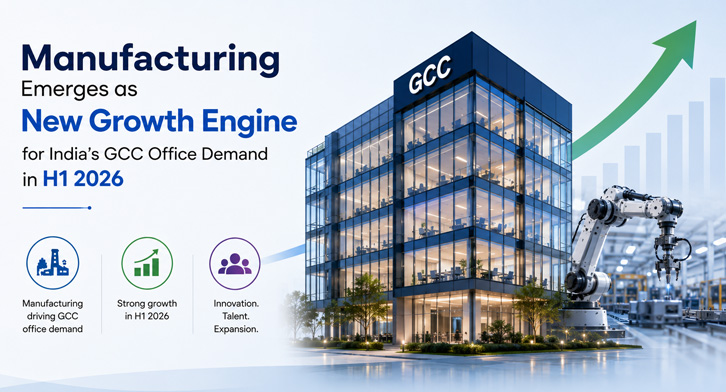
India’s manufacturing sector has emerged as the largest contributor to office leasing by Global Capability Centres (GCCs) during the first half of 2026, highlighting the country’s transformation into a global hub for engineering, research, product development and advanced manufacturing.
According to a recent Vestian report, manufacturing accounted for 29% of total GCC office leasing, overtaking the traditionally dominant IT and business services sectors. The shift reflects increasing investments by multinational companies in high-value engineering, electronics, automotive, industrial technology and semiconductor operations across India.
The growing demand is being supported by government initiatives such as Make in India, the Production Linked Incentive (PLI) Scheme, improved industrial infrastructure and India’s expanding pool of skilled engineering talent.
As global enterprises continue relocating strategic functions closer to innovation ecosystems, India is increasingly becoming a preferred destination for next-generation GCCs focused on product development, digital engineering and supply chain innovation.
Strategic Market Snapshot: H1 2026
Market Metric
Indicator / Value
Strategic Context
Manufacturing Share of GCC Leasing
29%
Leading growth driver across commercial real estate
Previous Sector Leader
IT & Business Services
Replaced by high-value engineering & design GCCs
Preferred Asset Class
Grade A Commercial Space
High demand for ESG-compliant, modern tech parks
Top Performing Cities
Bengaluru, Pune, Chennai, Hyderabad
Concentrated industrial-tech & engineering hubs
Core Operational Focus
Advanced R&D, EV Design, Chipsets
Move from back-office support to core engineering
Manufacturing-Led GCC Office Demand
Indicator
H1 2026
Manufacturing Share of GCC Leasing
29%
Leading Growth Segment
Manufacturing
Office Space Demand
Rising
Key Focus Areas
Engineering, R&D, Product Design
Major Growth Drivers
Manufacturing, Semiconductors, Electronics
Why Manufacturing GCCs Are Expanding Rapidly
Growth Driver
Impact
Make in India
Boosts manufacturing investments
PLI Scheme
Encourages global production expansion
Skilled Engineering Workforce
Supports innovation and product development
Competitive Operating Costs
Reduces operational expenditure
Digital Infrastructure
Enables smart manufacturing and Industry 4.0
Expanding Supply Chains
Strengthens global manufacturing networks
Several structural factors are accelerating manufacturing-led GCC investments in India.
Key Industry Sectors Driving GCC Leasing Growth
Manufacturing-focused GCC investments are concentrated across high-tech, capital-intensive verticals requiring specialized engineering talent and modern workspace infrastructure:
- Automotive & Mobility: EV platform design, autonomous software testing, and battery management engineering.
- Semiconductors & Microelectronics: Very Large Scale Integration (VLSI) chip design, verification, and embedded systems engineering.
- Electronics & Consumer Hardware: Product engineering, IoT design, and global quality control hubbing.
- Industrial Engineering & Smart Manufacturing: Industry 4.0 automation, process optimization, and digital twin architecture.
- Supply Chain & Digital Operations: Real-time global logistics planning, control towers, and predictive supply chain analytics.
Why This Matters
The rapid expansion of manufacturing GCCs marks a significant shift in India’s economic landscape. Rather than functioning solely as back-office support centres, GCCs are increasingly leading innovation, engineering, product development and strategic decision-making.
This evolution is expected to:
- Create high-value engineering jobs.
- Accelerate technology adoption.
- Increase demand for premium commercial real estate.
- Strengthen collaboration between multinational corporations and Indian manufacturers.
- Enhance India's integration into global value chains.
Why Manufacturing GCCs Are Expanding Rapidly in India
Several government policy interventions and structural cost advantages continue to accelerate investments from global enterprises:
- Government Policy Initiatives: Strategic schemes like Make in India and the Production Linked Incentive (PLI) Scheme incentivize multinational corporations to co-locate digital operations alongside physical manufacturing networks.
- Skilled Engineering Talent: India provides a vast annual pool of specialized STEM graduates capable of leading complex product design and R&D functions.
- Competitive Cost Structure: Operational expenditure savings across real estate and engineering talent allow global firms to scale R&D centers efficiently.
- Digital & Physical Infrastructure Growth: Rapid rollouts of modern commercial hubs, 5G enterprise networks, and cloud infrastructure support next-generation smart manufacturing operations.
Expert Perspective
Manufacturing-led GCC growth signals India’s transition from a cost-efficient outsourcing destination to a global innovation and engineering powerhouse. As investments continue across advanced manufacturing and digital technologies, GCCs are expected to play an increasingly strategic role in global business operations.
FAQs
Why are manufacturing GCCs growing in India?
Manufacturing GCCs are expanding due to government initiatives such as Make in India and the PLI Scheme, along with India’s skilled workforce, competitive costs and improving industrial infrastructure.
What percentage of GCC office leasing came from manufacturing in H1 2026?
Manufacturing accounted for 29% of GCC office leasing in India during the first half of 2026.
Which sectors are driving manufacturing GCC growth?
Automobiles, electronics, semiconductors, industrial engineering, product development and supply chain technologies are leading manufacturing GCC investments.
How do manufacturing GCCs benefit India's economy?
They create skilled jobs, increase commercial real estate demand, strengthen innovation capabilities and improve India’s position within global manufacturing value chains.