
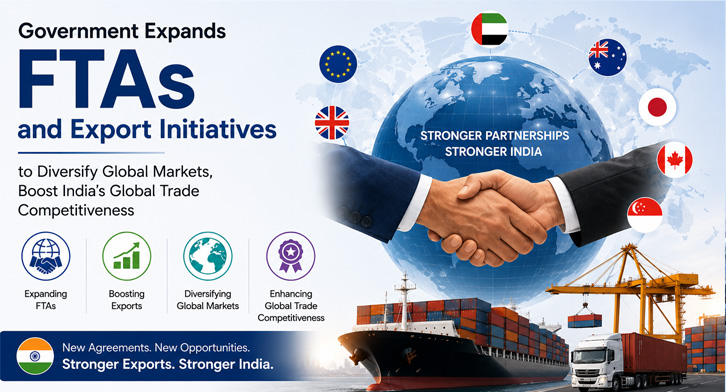
India Strengthens Global Trade Strategy with New FTAs and ₹25,060 Crore Export Promotion Mission
India is accelerating its global trade ambitions by expanding its Free Trade Agreement (FTA) network and launching large-scale export promotion initiatives designed to diversify export markets, improve supply chain efficiency, and enhance the global competitiveness of Indian businesses.
In a written reply in the Lok Sabha, Jitin Prasada said the government is actively negotiating new trade agreements with major economies while implementing multiple export-focused programs to support businesses, particularly MSMEs, startups, and labour-intensive industries.
The strategy combines market access through FTAs with investments in logistics infrastructure, export financing, digital trade, and regulatory reforms to help Indian exporters compete more effectively in global markets.
Key Highlights
- Government expanding India's global FTA network
- ₹25,060 crore Export Promotion Mission launched (FY26–FY31)
- Focus on MSMEs, startups and artisan exports
- Cross-border e-commerce exports receive major policy push
- 65 Export Facilitation Centres operational across India
- PM Gati Shakti improving export logistics infrastructure
- FTAs expected to reduce trade barriers and improve market access
- Government targeting diversified export destinations
Countries Covered Under India's Trade Strategy
Status
Countries
FTAs Signed / Concluded
UAE, Australia, Oman, United Kingdom, New Zealand
FTA Negotiations Underway
European Union, Canada, Israel, Peru, Eurasian Economic Union
These agreements aim to:
- Increase bilateral trade
- Improve investment flows
- Reduce tariffs
- Address non-tariff barriers
- Expand export opportunities
- Improve supply chain integration
Export Promotion Mission: ₹25,060 Crore Investment
The Government has allocated ₹25,060 crore (approximately US$2.67 billion) under the Export Promotion Mission for the period FY2026–FY2031.
Major Focus Areas
Initiative
Objective
Trade Finance
Improve exporter access to funding
Export Credit
Increase working capital availability
Quality Compliance
Help businesses meet international standards
Branding Support
Build global recognition for Indian products
Logistics Improvement
Reduce transportation costs
Market Intelligence
Identify new export opportunities
Cross-Border E-commerce Gets Major Boost
Recognizing the rapid growth of global digital trade, the Government is introducing measures to simplify cross-border e-commerce exports.
Key Reforms
- Pilot E-Commerce Export Hubs
- Simplified courier export procedures
- Faster customs processing
- Streamlined reverse logistics
- Digital export infrastructure
- Better compliance support for MSMEs
These initiatives are expected to significantly benefit:
- MSMEs
- Startups
- D2C Brands
- Handicraft exporters
- Artisans
- Small manufacturers
Logistics Infrastructure Driving Export Growth
Improving logistics efficiency remains a central pillar of India’s export strategy.
Major initiatives include:
- PM Gati Shakti National Master Plan
- Refund of Duties and Taxes on Exported Products (RoDTEP)
- Districts as Export Hubs
- Export Promotion Councils
- Indian Missions abroad
- Industry partnerships
- 65 MSME Export Facilitation Centres
These measures are expected to reduce logistics costs, shorten delivery timelines, and improve India’s export competitiveness.
Industries Expected to Benefit
Several export-oriented sectors are likely to gain from expanded market access and lower trade barriers.
Sector
Expected Impact
Textiles
Higher exports through preferential tariffs
Apparel
Improved competitiveness in global markets
Leather
Greater access to developed markets
Engineering Goods
Expanded international demand
Pharmaceuticals
Easier market access
Food Processing
New export opportunities
Handicrafts
Growth through e-commerce exports
MSME Manufacturing
Better global market reach
Market Impact Snapshot
Area
Expected Outcome
Export Markets
Greater diversification
Logistics
Lower export costs
Trade Agreements
Wider market access
MSMEs
Increased export participation
E-commerce
Faster international expansion
Employment
Growth in labour-intensive industries
Global Competitiveness
Stronger position in international trade
Why This Matters for the Logistics Industry
The government’s integrated trade strategy is expected to generate increased demand across the logistics ecosystem.
Key opportunities include:
- Higher container volumes
- Growth in freight forwarding
- Increased customs clearance activity
- Expansion of warehousing capacity
- Stronger multimodal transportation demand
- Rising cross-border e-commerce shipments
- Greater demand for digital logistics solutions
- Enhanced supply chain visibility and efficiency
FAQs
What is India's Export Promotion Mission?
The Export Promotion Mission is a ₹25,060 crore government initiative for FY2026–FY2031 that supports exporters through trade finance, export credit, logistics improvements, branding, quality compliance, and market intelligence.
Which countries have signed FTAs with India recently?
India has concluded or expanded FTAs with the UAE, Australia, Oman, the United Kingdom, and New Zealand, while negotiations continue with the European Union, Canada, Israel, Peru, and the Eurasian Economic Union.
How will FTAs benefit Indian exporters?
FTAs help reduce tariffs, improve market access, remove non-tariff barriers, increase investment, and create new export opportunities across multiple industries.
How will MSMEs benefit?
MSMEs will benefit from easier market access, export financing, digital export platforms, e-commerce export hubs, logistics support, and export facilitation centres.
Why are logistics important for export growth?
Efficient logistics reduce transportation costs, improve delivery timelines, enhance supply chain reliability, and make Indian exports more competitive in international markets.