
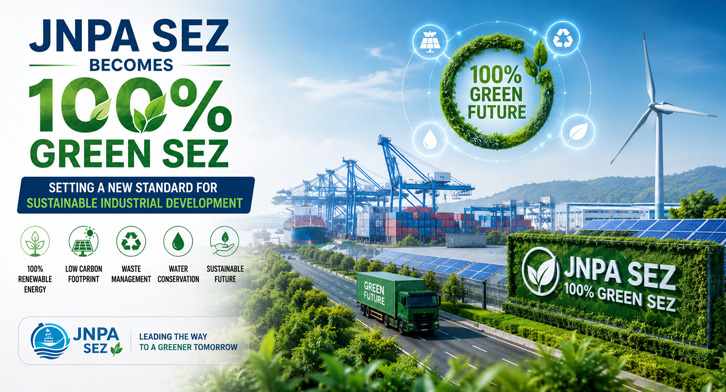
JNPA SEZ Achieves 100% Green SEZ Status
JNPA SEZ has reached a major sustainability milestone by achieving 100% Green Special Economic Zone (SEZ) status, strengthening its position as an emerging model for environmentally responsible industrial development in India.
The achievement comes as India’s logistics, manufacturing and port-led infrastructure sectors increasingly focus on reducing carbon emissions while maintaining economic growth. JNPA SEZ’s approach combines green infrastructure, sustainable mobility and large-scale urban forestry to create a more environmentally resilient industrial ecosystem.
Key Highlights
- 100% Green SEZ status achieved by JNPA SEZ
- More than 2,00,000 Miyawaki trees planted across the zone
- Introduction of electric vehicle (EV)-powered mobility solutions
- Greater focus on environmentally responsible industrial infrastructure
- Contribution toward low-carbon industrial development
- Demonstrates how industrial growth can be combined with environmental sustainability
2 Lakh+ Miyawaki Trees Strengthen the Green Infrastructure
One of the most notable components of JNPA SEZ’s sustainability strategy is its extensive Miyawaki plantation initiative.
More than 2,00,000 Miyawaki trees have been planted, helping create dense green areas within the industrial ecosystem. Miyawaki forests can support biodiversity, improve local air quality and contribute to carbon absorption.
This initiative is particularly significant for industrial zones, where balancing infrastructure expansion with environmental protection is becoming increasingly important.
EV Mobility Adds a New Dimension to Green Logistics
JNPA SEZ has also introduced electric vehicle-powered mobility solutions within the zone.
The move reflects a broader shift toward cleaner transportation across India’s logistics ecosystem. As ports, warehouses, industrial parks and distribution centres increasingly adopt electric mobility, EV infrastructure could become an important component of India’s future low-carbon logistics network.
How JNPA SEZ's Green Model Works
Sustainability Initiative
Potential Impact
Miyawaki plantations
Biodiversity, green cover and carbon sequestration
EV-powered mobility
Lower-emission transportation
Green infrastructure
Reduced environmental footprint
Sustainable industrial planning
Greater long-term resilience
Eco-friendly operations
More resource-efficient industrial ecosystem
Why This Matters for India's Logistics Sector
The significance of JNPA SEZ’s achievement extends beyond a single industrial zone.
India is expanding its logistics and manufacturing infrastructure to support economic growth, exports and supply-chain competitiveness. At the same time, companies and infrastructure developers face growing pressure to make these facilities more sustainable.
Green industrial zones can potentially help address both objectives by combining:
Industrial Growth + Efficient Logistics + Clean Mobility + Green Infrastructure
This integrated approach could become increasingly important as India moves toward more sustainable supply chains.
JNPA SEZ: A Potential Model for Green Industrial Parks
The development demonstrates that sustainability does not necessarily have to be treated as a separate component of industrial development.
Instead, environmental considerations can be incorporated into the design and operation of industrial zones—from plantation and mobility to infrastructure and resource efficiency.
At a Glance
Parameter
JNPA SEZ Initiative
Green certification milestone
Biodiversity, green cover and carbon sequestration
Green plantation
Lower-emission transportation
Sustainable mobility
EV-powered mobility solutions
Primary focus
Green industrial development
Wider relevance
Logistics, manufacturing, ports and SEZ infrastructure
The Bigger Picture
JNPA SEZ’s green transformation comes at a time when sustainable logistics infrastructure is becoming an increasingly important competitive factor.
For India’s logistics industry, the future is likely to involve more than simply moving goods faster and at lower cost. Infrastructure will also need to become cleaner, more resilient and environmentally responsible.
JNPA SEZ’s latest milestone provides an example of how port-led industrial development can incorporate sustainability into its long-term growth strategy.
Frequently Asked Questions
What is JNPA SEZ?
JNPA SEZ is a Special Economic Zone associated with Jawaharlal Nehru Port Authority and forms part of the port-led industrial development ecosystem in Maharashtra.
What sustainability milestone has JNPA SEZ achieved?
JNPA SEZ has achieved 100% Green SEZ status, according to the information provided.
How many Miyawaki trees have been planted at JNPA SEZ?
More than 2,00,000 Miyawaki trees have been planted as part of its green initiatives.
What EV initiative has JNPA SEZ introduced?
The SEZ has introduced electric vehicle-powered mobility solutions within the zone as part of its sustainable infrastructure strategy.
Why are green SEZs important?
Green SEZs can help combine industrial development with environmental management by incorporating cleaner mobility, green infrastructure, biodiversity initiatives and resource-efficient practices.