

Indian Railways has achieved a significant milestone in freight transportation, recording its highest-ever freight loading for October at 145.07 million tonnes (MT). The achievement represents an 8.32% increase compared with 133.93 MT recorded in October 2025, highlighting the continued expansion of rail-based cargo movement in India.
The growth reflects rising demand for freight transportation across key sectors, including agriculture, coal, steel and industrial commodities. Increased coal movement to power plants and stronger food grain transportation also contributed to the railway network’s performance, reinforcing its role in India’s domestic supply chain and multimodal logistics ecosystem.
For India’s logistics industry, higher railway freight volumes indicate growing reliance on rail infrastructure to move bulk commodities efficiently, support industrial production and strengthen connections between manufacturing centres, consumption markets and ports.
Indian Railways Freight Loading Rises 8.32% in October 2026
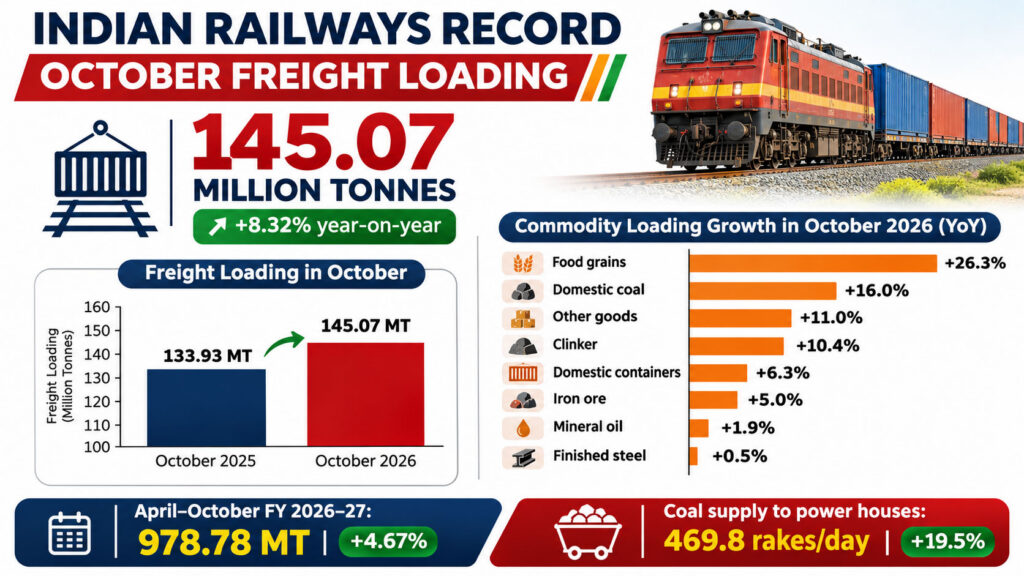
During October 2026, Indian Railways transported 145.07 million tonnes of freight, compared with 133.93 million tonnes in the corresponding month of the previous year. This represents an additional 11.14 million tonnes of cargo handled during the month.
The record monthly performance indicates continued momentum in rail freight operations, supported by improvements in transportation capacity, operational efficiency and commodity demand.
Key figures from October 2026 include:
- 145.07 MT: Total freight loading during October 2026.
- 8.32%: Year-on-year growth in freight loading.
- 11.14 MT: Additional freight transported compared with October 2025.
- 469.8 rakes per day: Average domestic coal supply to power houses.
- 19.5%: Growth in average daily domestic coal rake supply.
Commodity-Wise Freight Loading Shows Broad-Based Growth
Several major commodity categories recorded positive growth during October 2026. Food grains and domestic coal emerged as particularly strong contributors, while other industrial and containerised cargo categories also registered increases.
Commodity
Growth in October 2026
Food Grains
26.3%
Domestic Coal
16.0%
Balance Other Goods
11.0%
Clinker
10.4%
Domestic Containers
6.3%
Iron Ore
5.0%
Mineral Oil
1.9%
Finished Steel
0.5%
Food grain loading recorded the strongest growth at 26.3%, reflecting increased movement of agricultural commodities across the railway network. Domestic coal transportation increased by 16%, highlighting the importance of railways in meeting the fuel requirements of India’s power sector.
Growth in containerised cargo, iron ore, clinker and finished steel also points to continued freight demand from manufacturing, construction and industrial supply chains.
Coal Transportation to Power Plants Increases by 19.5%
Coal remained an important component of Indian Railways’ freight operations during October. To meet the increased fuel requirements of power houses, the national transporter supplied an average of 469.8 coal rakes per day, compared with 393.2 rakes per day in October 2025.
This represents a 19.5% year-on-year increase in daily coal rake supply. The higher movement highlights the importance of rail transportation in maintaining fuel supply chains for thermal power generation.
For the logistics sector, this increase demonstrates the critical role of railway freight services in transporting high-volume commodities over long distances. Efficient coal movement also requires coordination between loading points, railway terminals, power plants and supporting infrastructure.
Indian Railways Crosses 978 Million Tonnes in April–October FY27
The October record contributed to a strong cumulative performance during the first seven months of FY 2026–27.
Between April and October 2026, Indian Railways transported 978.78 million tonnes of freight, compared with 935.10 million tonnes during the corresponding period in FY 2025–26. This represents a year-on-year increase of 4.67%.
Performance indicator
April–October FY27
April–October FY26
Growth
Total freight loading
978.78 MT
935.10 MT
4.67%
Additional freight
+43.68 MT
—
—
The cumulative growth indicates that rail freight demand has remained positive beyond the October monthly record. The figures also highlight the railway network’s contribution to transporting essential commodities and supporting India’s industrial and agricultural supply chains.
The latest figures were published in the Ministry of Railways’ official announcement through the Press Information Bureau on November 4, 2026.
What the Record Freight Loading Means for India’s Logistics Industry
The increase in railway freight loading has implications for several parts of India’s transportation and supply chain ecosystem.
1. Stronger demand for bulk cargo transportation
The growth in coal, iron ore, food grains and clinker movement highlights the continuing importance of railways for bulk commodity transportation. Industries handling large cargo volumes can benefit from efficient rail connectivity between production centres, warehouses and consumption markets.
2. Greater importance of multimodal logistics
The increase in domestic container loading by 6.3% indicates positive movement in containerised rail freight. Better coordination between rail terminals, road transport operators, ports and warehouses can improve end-to-end cargo movement.
3. Increased focus on railway capacity and infrastructure
Higher freight volumes make terminal capacity, wagon availability, loading infrastructure and network efficiency increasingly important. Infrastructure improvements can help reduce operational bottlenecks and support growing cargo demand.
4. Opportunities for freight technology and automation
As freight volumes increase, logistics companies need better visibility into cargo movement, documentation, scheduling and shipment status. Digital freight management platforms, automated documentation and AI-powered shipment tracking can help freight forwarders and logistics operators improve operational coordination.
October 2026 Freight Performance: Important Statistics
Metric
Recorded performance
Highest-ever October freight loading
145.07 MT
October 2025 freight loading
133.93 MT
Year-on-year monthly growth
8.32%
April–October FY27 freight loading
978.78 MT
Cumulative year-on-year growth
4.67%
Food grain loading growth
26.3%
Domestic coal loading growth
16.0%
Daily coal supply to power houses
469.8 rakes
Growth in daily coal rake supply
19.5%
Conclusion
Indian Railways’ record freight loading of 145.07 million tonnes in October 2026 highlights the growing role of rail transportation in India’s logistics and economic activity. Strong growth in food grains, domestic coal, clinker and containerised cargo contributed to the performance.
With cumulative freight loading reaching 978.78 million tonnes during April–October FY27, the railway network continues to support the movement of essential commodities and industrial cargo across the country.
For freight forwarders, transport operators and supply chain businesses, these developments underline the importance of efficient multimodal connectivity, digital freight management and improved shipment visibility.
Frequently Asked Questions
How much freight did Indian Railways transport in October 2026?
Indian Railways transported 145.07 million tonnes of freight in October 2026, recording its highest-ever freight loading for the month.
What was the year-on-year growth in Indian Railways freight loading in October 2026?
Freight loading increased by 8.32% compared with 133.93 million tonnes recorded in October 2025.
Which commodity recorded the highest freight loading growth in October 2026?
Food grains recorded the highest growth among the listed major commodities, increasing by 26.3%, followed by domestic coal at 16%.
How much freight did Indian Railways transport between April and October 2026?
Indian Railways transported 978.78 million tonnes of freight during April–October FY 2026–27, registering 4.67% growth over the corresponding period in the previous financial year.
How much coal did Indian Railways supply to power plants in October 2026?
Indian Railways supplied an average of 469.8 coal rakes per day to power houses, up 19.5% from 393.2 rakes per day in October 2025.