
India and Denmark are looking to deepen their maritime partnership, with green shipping, port modernisation, maritime technology and decarbonisation emerging as key areas of cooperation. Discussions between India’s Union Minister for Ports, Shipping and Waterways, Sarbananda Sonowal, and Denmark’s Minister for Business and Competitiveness, Martin Lidegaard, have opened further opportunities for collaboration in sustainable shipping and maritime infrastructure.
The engagement is part of the broader India–Denmark Green Strategic Partnership, which aims to promote sustainable economic growth, strengthen bilateral trade and accelerate the adoption of environmentally friendly technologies across industries.
India–Denmark Maritime Talks Focus on Green Shipping and Port Modernisation
During his India visit on November 2–3, 2026, Danish Minister Martin Lidegaard visited APM Terminals Mumbai, also known as Gateway Terminals India (GTI), at Jawaharlal Nehru Port in Maharashtra. The visit provided an opportunity to examine India’s expanding container-handling capabilities, port infrastructure investments and the adoption of sustainable technologies in terminal operations.
APM Terminals Mumbai is a joint venture between APM Terminals and the Container Corporation of India (CONCOR). According to Jawaharlal Nehru Port Authority’s terminal information, the facility has a designed annual handling capacity of 1.8 million TEUs, with a 712-metre quay.
The terminal’s expansion also reflects the growing importance of India’s container logistics infrastructure. APM Terminals reports that GTI handled approximately 2.2 million TEUs in 2025 and is targeting a handling capacity of 2.4 million TEUs by 2028, as part of its operational transformation programme. These developments underline the importance of efficient port operations as India’s international trade volumes expand.
Key Areas of India–Denmark Maritime Cooperation
The discussions between the two countries covered several strategic areas that could shape future maritime investments and operational capabilities.
According to the Danish Ministry of Foreign Affairs’ maritime cooperation framework, India and Denmark are already working together on green shipping, alternative fuels, maritime innovation and port digitalisation.
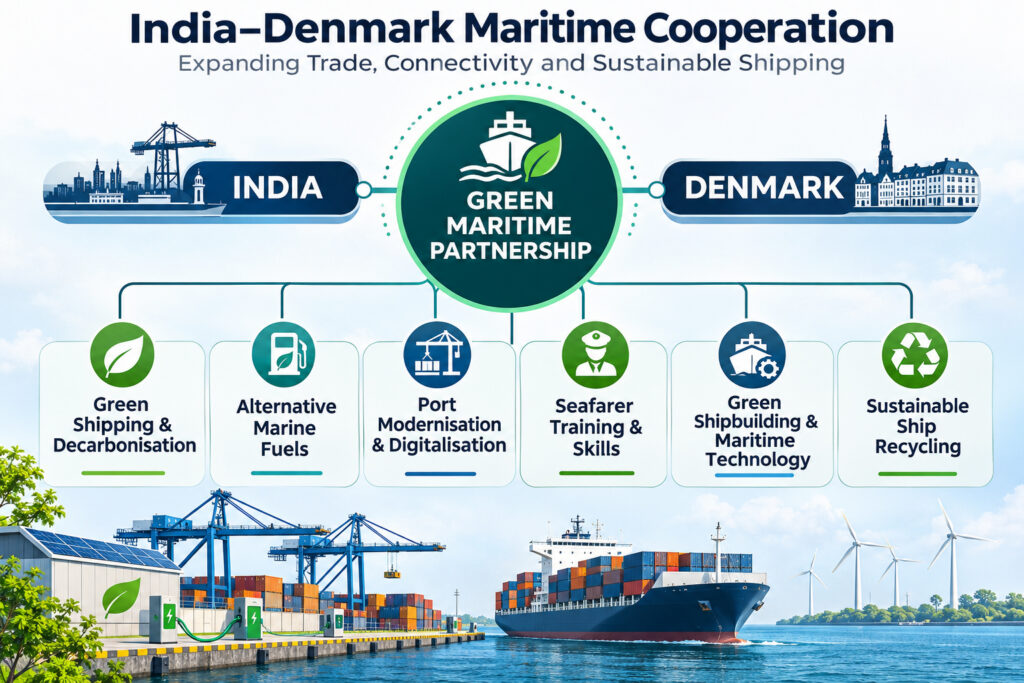
The major areas discussed include:
- Green shipping and decarbonisation: Developing cleaner shipping practices and reducing greenhouse gas emissions from maritime transport.
- Alternative marine fuels: Exploring cleaner fuel options to support the transition towards low-carbon vessels.
- Seafarer training and skill development: Improving maritime education, technical capabilities and professional training.
- Shipbuilding and maritime technology: Encouraging technology exchange and cooperation in sustainable vessel design.
- Sustainable ship recycling: Promoting environmentally responsible ship recycling practices.
- Port modernisation and digitalisation: Improving terminal efficiency through advanced technologies, automation and sustainable infrastructure.
- Regulatory cooperation: Strengthening coordination on maritime regulations, safety standards and international environmental requirements.
India–Denmark Maritime Partnership: Important Developments
The cooperation is supported by several existing initiatives rather than being limited to the latest ministerial discussions.
One important milestone was the establishment of the Indo-Danish Centre of Excellence on Green Shipping in 2025. The centre is intended to support maritime decarbonisation, research and technical collaboration. Furthermore, India’s Directorate General of Maritime Administration confirms that a green shipping corridor pre-feasibility study was conducted between September 2025 and May 2026, with the study currently in draft stage and undergoing further refinement. This work could help identify promising routes for future green shipping corridor development. (DGMA – India Green Shipping Corridor Pre-Feasibility Study).
The commercial relationship is also significant. According to Danish Shipping, Danish-operated vessels made more than 3,000 calls at Indian ports during 2025, demonstrating the importance of India in Denmark’s maritime trade network.
Important Statistics and Infrastructure Details
Parameter
Details
Danish-operated vessel calls at Indian ports (2025)
3,000+
GTI designed annual capacity
1.8 million TEUs
GTI container throughput (2025)
2.2 million TEUs
GTI targeted capacity by 2028
2.4 million TEUs
GTI quay length
712 metres
India–Denmark Green Strategic Partnership
Established in 2020
Indo-Danish Centre of Excellence on Green Shipping
Established in 2025
Sources: Danish Shipping, JNPA and APM Terminals. GTI’s designed capacity and reported throughput are different measures; the throughput figure should not be interpreted as its original design capacity.
How the Partnership Could Benefit India’s Maritime and Logistics Sector
The expanding India–Denmark relationship could create opportunities across several parts of the maritime supply chain.
1. More sustainable shipping operations
Collaboration on alternative fuels and low-carbon technologies could support the transition towards cleaner international shipping.
2. Improved port productivity
Danish expertise in port technology and digitalisation could contribute to more efficient container handling and terminal management.
3. New maritime investment opportunities
Greater cooperation could encourage partnerships between Indian port operators, shipping companies and Danish maritime technology providers.
4. Stronger maritime workforce
Training initiatives could improve the availability of skilled professionals for emerging maritime technologies.
5. Growth in green shipbuilding
Knowledge exchange could support the development of energy-efficient vessels and sustainable shipbuilding capabilities.
For India’s logistics industry, these developments are particularly relevant because port efficiency, vessel turnaround time, fuel costs and environmental compliance directly influence international trade competitiveness.
India–Denmark Maritime Cooperation: How the Initiatives Connect
The following diagram illustrates how bilateral cooperation could translate into practical improvements across shipping, ports and maritime logistics.
Strategic Significance for India’s Shipping Industry
India’s maritime cooperation with Denmark comes at a time when the global shipping industry is facing increasing pressure to reduce carbon emissions, improve energy efficiency and adopt cleaner marine technologies.
The partnership also complements India’s Maritime Amrit Kaal Vision 2047, which aims to strengthen the country’s position as a leading global maritime nation.
The India–Denmark Green Strategic Partnership provides an established framework for cooperation in sustainable development, trade, clean energy and shipping. The maritime collaboration could help Indian companies access Danish expertise in green technologies while creating opportunities for international investment and innovation.
For freight forwarders, shipping lines, port operators and logistics technology providers, the growing focus on digitalisation and sustainable port infrastructure could also accelerate the adoption of smarter and more environmentally responsible logistics operations.
Frequently Asked Questions
What did India and Denmark discuss regarding maritime cooperation in November 2026?
India and Denmark discussed green shipping, maritime decarbonisation, alternative marine fuels, seafarer training, shipbuilding, sustainable ship recycling and maritime regulatory cooperation.
Who represented India and Denmark in the maritime discussions?
India was represented by Union Minister for Ports, Shipping and Waterways Sarbananda Sonowal, while Denmark was represented by Minister for Business and Competitiveness Martin Lidegaard.
What is the Indo-Danish Centre of Excellence on Green Shipping?
It is a bilateral cooperation initiative established in 2025 to promote maritime decarbonisation, green shipping research, innovation and technical collaboration.
Why is APM Terminals Mumbai important for India–Denmark cooperation?
APM Terminals Mumbai, also known as Gateway Terminals India, is a major container terminal at Jawaharlal Nehru Port. Its connection with Danish shipping group A.P. Moller–Maersk makes it an important platform for maritime and port-sector engagement.
How could India benefit from Denmark’s maritime expertise?
India could benefit through cleaner shipping technologies, port digitalisation, maritime training, sustainable shipbuilding and improved operational efficiency.