
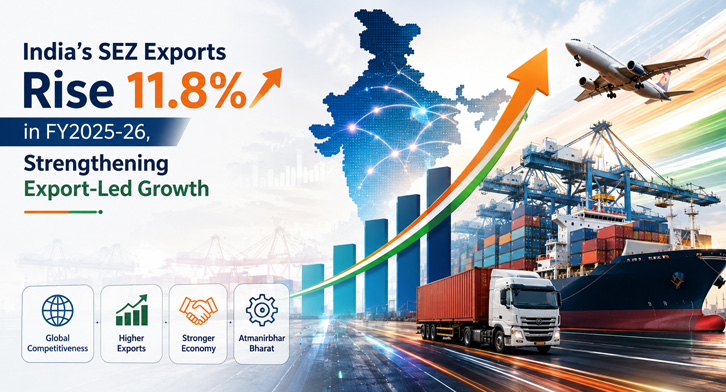
India’s Special Economic Zones (SEZs) continued to strengthen their position as major export hubs in FY2025-26, with exports rising 11.8% year-on-year to approximately ₹16.89 lakh crore.
The growth highlights the growing contribution of SEZs to India’s manufacturing, services, employment and international trade ecosystem, particularly as the country seeks to expand its participation in global value chains.
Key Highlights
- SEZ exports: ₹16.89 lakh crore in FY2025-26
- Annual growth: 11.8% year-on-year
- Previous-year exports: Approximately ₹15.11 lakh crore
- Cumulative investment: More than ₹7.5 lakh crore
- Direct employment: Over 3 million people
- Major sectors: IT/ITeS, engineering, pharmaceuticals, electronics, chemicals, textiles, gems and jewellery
- Policy focus: Ease of doing business, infrastructure development and regulatory simplification
- Emerging opportunities: Electronics, semiconductors, renewable-energy equipment and advanced manufacturing
SEZ Exports Continue to Gain Momentum
Exports from India’s SEZs increased from approximately ₹15.11 lakh crore in FY2024-25 to ₹16.89 lakh crore in FY2025-26, representing an increase of around ₹1.78 lakh crore.
Indicator
FY2024-25
FY2025-26
Change
Change
₹15.11 lakh crore
₹16.89 lakh crore
0.118
Cumulative investment
—
₹7.5+ lakh crore
—
Direct employment
—
3+ million
—
The performance comes as India continues to promote export-oriented manufacturing and services while expanding trade relationships with international markets.
Which Sectors Are Driving SEZ Growth?
SEZ export activity remains diversified across technology-intensive manufacturing, services and traditional export industries.
Key contributors include:
- IT and IT-enabled services – Supporting India's position in global digital and business services.
- Engineering goods – Benefiting from demand for industrial and infrastructure-related products.
- Pharmaceuticals – Strengthening India's role in global healthcare supply chains.
- Electronics – Emerging as an important export-oriented manufacturing segment.
- Chemicals – Supporting industrial and downstream manufacturing supply chains.
- Textiles – Maintaining India's presence in international apparel and textile markets.
- Gems and jewellery – Continuing to contribute to India's merchandise exports.
SEZs Are Becoming More Important to India’s Manufacturing Strategy
The latest export performance is significant because SEZs are increasingly being positioned as integrated hubs for manufacturing, services, logistics and international trade.
Investment in operational SEZs has crossed ₹7.5 lakh crore, while direct employment generated by these zones has exceeded 3 million.
This combination of investment, employment and export activity creates a broader economic impact by connecting manufacturers and service providers with ports, airports, logistics operators, customs facilities and international markets.
Policy Reforms Could Shape the Next Phase
The government has continued to focus on improving the SEZ ecosystem through measures aimed at simplifying regulations, improving infrastructure and making it easier for businesses to operate.
Potential modernization of the SEZ framework could further improve India’s ability to attract:
- Export-oriented manufacturing
- Foreign direct investment
- Global supply-chain operations
- Electronics and semiconductor production
- Renewable-energy equipment manufacturing
- Advanced engineering and industrial production
- Global business and technology services
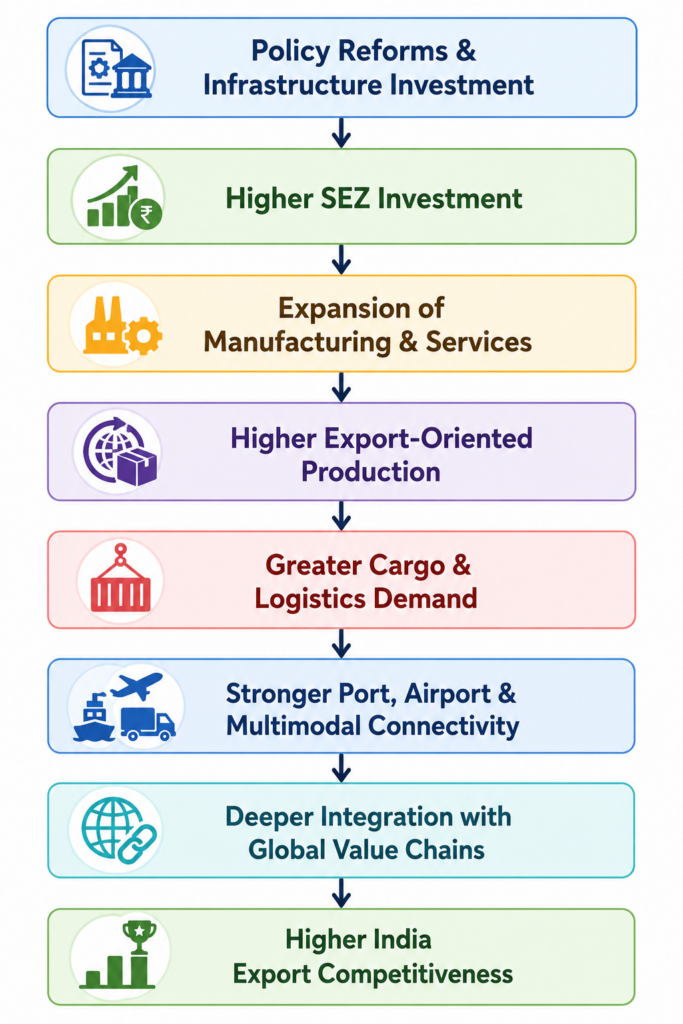
SEZ Export Growth: Impact Chain
What This Means for Logistics
The expansion of SEZ exports could generate additional demand across India’s logistics ecosystem.
Higher production and international shipments can translate into increased requirements for freight forwarding, customs clearance, warehousing, container transportation, port handling and cargo visibility.
For logistics companies, the growth of export-oriented industrial clusters also creates opportunities to provide integrated services connecting SEZ manufacturers with ports, airports and overseas markets.
Outlook
India’s 11.8% SEZ export growth in FY2025-26 points to continued momentum in the country’s export-oriented industrial ecosystem.
As India expands FTAs, promotes domestic manufacturing and seeks a larger role in global value chains, SEZs could become increasingly important hubs for international trade, manufacturing and logistics.
The next phase of SEZ development will depend on how effectively policy reforms, infrastructure investment, technology adoption and global trade opportunities are combined to create a more competitive export ecosystem.
Frequently Asked Questions
How much did India’s SEZ exports grow in FY2025-26?
India’s SEZ exports increased by 11.8% year-on-year in FY2025-26.
What was the value of India’s SEZ exports in FY2025-26?
SEZ exports reached approximately ₹16.89 lakh crore during FY2025-26.
Which sectors contribute significantly to SEZ exports?
Major sectors include IT/ITeS, engineering goods, pharmaceuticals, electronics, chemicals, textiles, and gems and jewellery.
How much investment has been made in operational SEZs?
Cumulative investment in operational SEZs has crossed ₹7.5 lakh crore.
How do SEZs benefit India’s logistics sector?
Growing SEZ production and exports can increase demand for freight forwarding, customs clearance, warehousing, container transport, port services and multimodal logistics.