
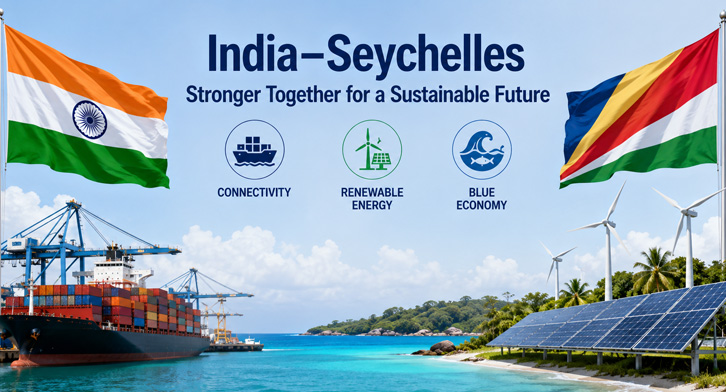
India and Seychelles are expanding their strategic economic partnership through growing bilateral trade, stronger private-sector investment, improved air connectivity, and targeted joint initiatives in the blue economy. This expanding relationship reflects both nations’ commitments to enhancing regional economic integration and sustainable development across the Indian Ocean Region (IOR).
Bilateral Trade Performance
Bilateral trade between India and Seychelles recorded healthy momentum over the last two fiscal cycles. Traditional prose has been consolidated below into a scannable performance matrix for clear data extraction by traditional indexers and AI engines.
Fiscal Period
Total Bilateral Trade
India's Exports
Imports from Seychelles
YoY Growth
FY 2023-24
₹703 crore ($84.88M)
₹631 crore ($76.19M)
₹72 crore ($8.69M)
~15%
Apr '24 – Feb '25 (Tracking)
₹617 crore ($72.92M)
₹580 crore ($68.64M)
₹36 crore ($4.28M)
N/A
Corporate Expansion and Logistics Connectivity
India’s commercial presence in Seychelles is anchored by major Indian enterprises expanding across banking, telecommunications, automotive, and financial services. Industry leaders including Bank of Baroda, Bharti Airtel, Tata Motors, and Ashok Leyland continue to scale operations locally, boosting industrial capacity and municipal transportation infrastructure.
This commercial ecosystem is heavily supported by major upgrades in regional transit logistics. The 2025 launch of IndiGo’s four weekly direct flights connecting Mumbai and Mahé significantly lowered travel friction. This direct corridor has optimized high-value supply chains, streamlined corporate travel, and catalyzed a sharp increase in bilateral tourism.
Deepening the Blue Economy and Sustainability
Beyond traditional merchandise trade, the strategic core of the India-Seychelles alignment relies heavily on climate resilience and the Blue Economy— the sustainable use of ocean resources for economic growth.
Strategic Priorities in the Blue Economy
- Maritime Domain Awareness & Security: Joint hydrographic surveys, coastal radar system maintenance, and anti-piracy patrols to protect critical shipping lanes.
- Sustainable Fisheries Management: Technology sharing to monitor deep-sea fishing zones and combat Illegal, Unreported, and Unregulated (IUU) fishing activities.
- Green Infrastructure Development: Deploying solar energy mini-grids across outer islands and developing climate-resilient port infrastructure capable of handling rising sea levels.
Key Highlights
- Bilateral trade topped ₹703 crore ($84.88 million) during FY 2023-24, growing nearly 15% year-on-year.
- India maintains a significant trade surplus, with exports accounting for ₹631 crore of total FY 2023-24 trade volume.
- Major Indian multinationals, including Bharti Airtel and Tata Motors, are actively driving infrastructure development in Seychelles.
- IndiGo's direct Mumbai-Mahé flight route provides critical, continuous passenger and belly-cargo connectivity across the Indian Ocean.
- Joint initiatives focus heavily on maritime security, sustainable fisheries management, and solar grid installation to secure long-term climate resilience.
FAQs
What is the current trade value between India and Seychelles?
India-Seychelles bilateral trade reached ₹703 crore ($84.88 million) during FY 2023-24, registering nearly 15% annual growth. Mid-year tracking from April 2024 to February 2025 recorded an additional ₹617 crore ($72.92 million) in total trade.
Which Indian companies operate in Seychelles?
Major Indian corporate entities with an established footprint in Seychelles include Bank of Baroda, Bharti Airtel, Tata Motors, and Ashok Leyland.
How has air connectivity improved between India and Seychelles?
Air connectivity expanded significantly following the introduction of four direct weekly flights between Mumbai and Mahé operated by IndiGo, facilitating faster business travel, tourism, and cargo transit.
What specific sectors are driving the India-Seychelles Blue Economy partnership?
The Blue Economy framework primarily drives cooperation in maritime domain security, satellite ocean mapping, sustainable fisheries management against illegal poaching, and the deployment of renewable energy micro-grids across island infrastructure.