

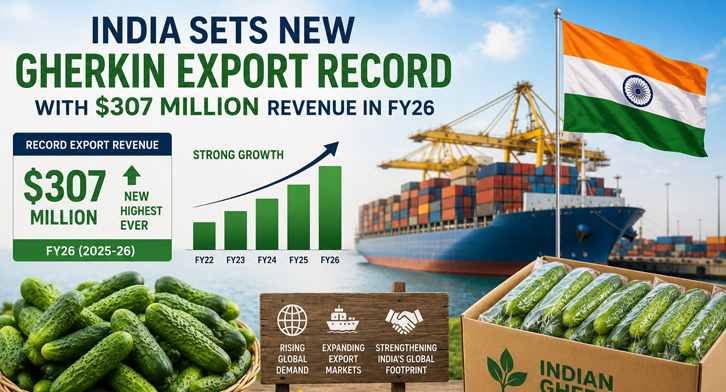
India’s gherkin export industry recorded a historic milestone in FY26, with exports reaching an all-time high of USD 307.61 million. The sector also registered an impressive 8% increase in export volumes, demonstrating strong global demand for Indian-processed pickled cucumbers despite challenging international trade conditions.
The achievement highlights the resilience and competitiveness of India’s agricultural export sector, particularly in value-added food processing.
Strong Global Demand Drives Export Growth
Indian gherkins continue to enjoy strong demand across major international markets due to their consistent quality, competitive pricing, and adherence to stringent food safety standards.
Despite facing restrictive import tariffs in key markets such as the United States, Indian exporters successfully maintained growth momentum by leveraging efficient production systems and robust supply chains.
The performance underscores India’s growing influence in the global processed food and agricultural exports market.
Contract Farming Model Supports Industry Success
A key factor behind the sector’s success is its well-established contract farming ecosystem. Gherkin cultivation is primarily concentrated in Karnataka, Tamil Nadu, and Andhra Pradesh, where farmers work closely with processing companies under structured farming agreements.
This model offers several advantages:
- Assured market access for farmers.
- Consistent quality control throughout the production cycle.
- Improved productivity and crop management.
- Compliance with international food safety and export requirements.
The integrated supply chain enables exporters to meet the demanding standards of overseas buyers while ensuring stable production volumes.
Efficient Supply Chains Strengthen Competitiveness
India’s decentralised processing and sourcing network has helped exporters overcome multiple challenges, including tariff pressures, logistical disruptions, and rising global trade uncertainties.
By maintaining operational efficiency, reliable procurement systems, and cost-effective processing capabilities, Indian companies have continued to strengthen their position in international markets.
The sector’s ability to sustain growth despite external trade barriers reflects the maturity and resilience of India’s agri-processing industry.
India Emerges as a Leading Global Supplier
The record export performance further reinforces India’s status as one of the world’s leading suppliers of processed gherkins. The country’s strong agricultural base, skilled workforce, and export-oriented food processing infrastructure have enabled it to capture a significant share of the global market.
As demand for processed and preserved food products continues to grow worldwide, India’s gherkin industry is well-positioned to expand its global footprint further.
Key Highlights:
- India's gherkin exports reached a record USD 307.61 million in FY26.
- Export volumes increased by 8% year-on-year.
- Growth was achieved despite restrictive US import tariffs
- Karnataka, Tamil Nadu, and Andhra Pradesh remain key gherkin-producing states.
- Contract farming plays a crucial role in ensuring quality and supply consistency.
- Indian exporters continue to benefit from competitive pricing and efficient processing capabilities.
- Strong global demand is driving the expansion of India's processed food exports.
- India has strengthened its position as a leading global supplier of processed gherkins.