
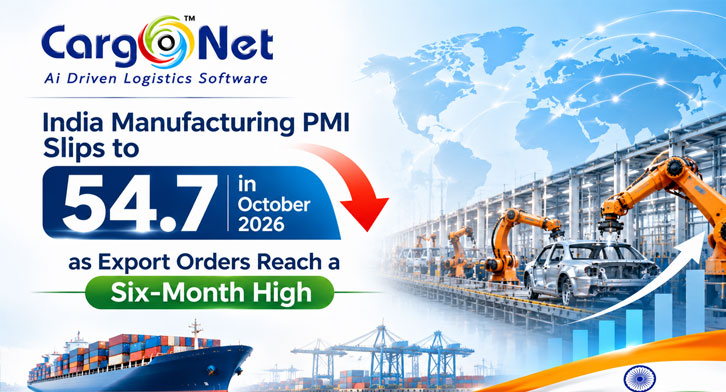
India’s manufacturing sector maintained its growth momentum in October 2026, although the pace of expansion moderated slightly amid slower increases in factory output and domestic orders.
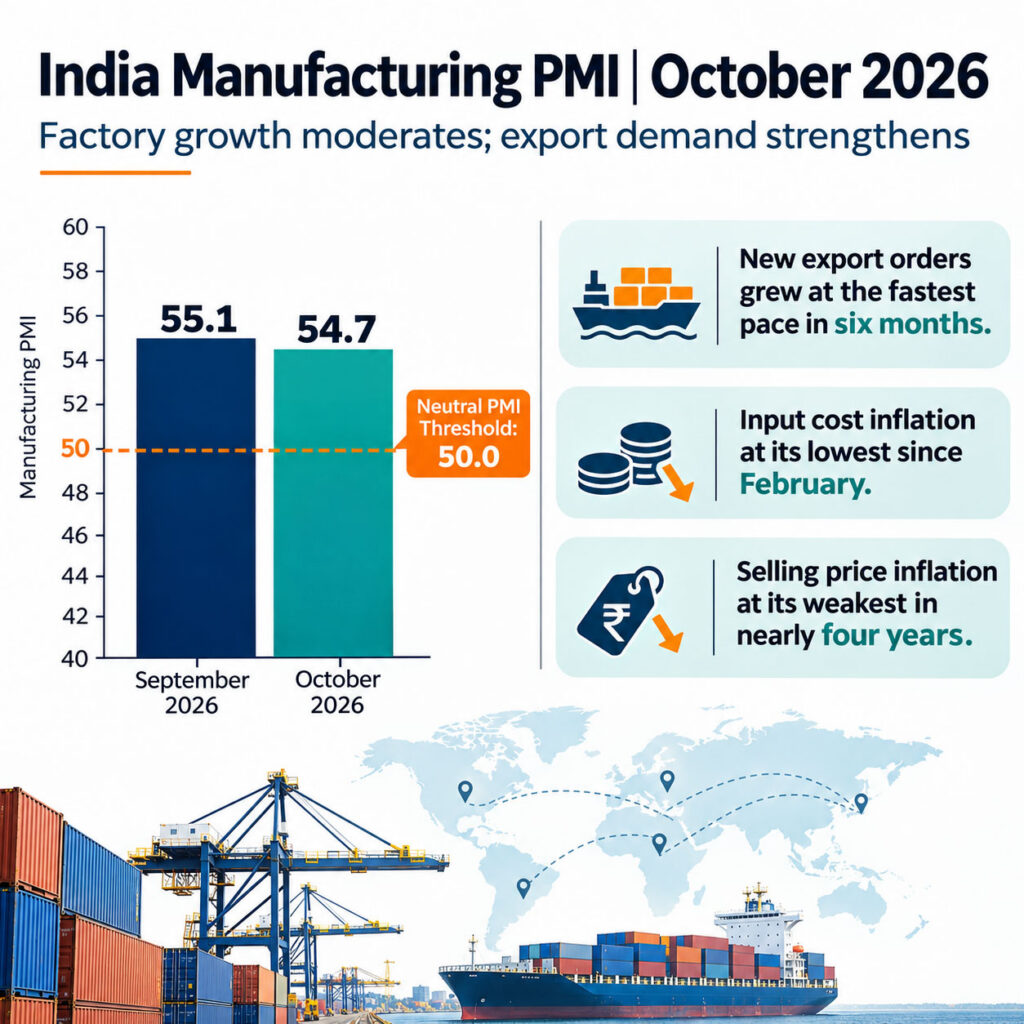
According to the latest HSBC India Manufacturing Purchasing Managers’ Index (PMI), compiled by S&P Global, the manufacturing PMI declined to 54.7 in October from 55.1 in September. Despite the marginal fall, the index remained comfortably above the neutral 50-point mark, indicating continued expansion in manufacturing activity.
The latest survey results, released on November 2, highlight the resilience of India’s manufacturing industry, particularly its ability to attract overseas demand amid changing global economic conditions. The HSBC India Manufacturing PMI report and October survey findings point to stronger international orders as an important source of support for factory production.
Export Orders Reach Their Fastest Growth in Six Months
A major positive development in October was the acceleration in international demand for Indian manufactured goods. New export orders increased at their fastest pace in six months, supported by stronger demand from markets across Asia, Europe, North America and the Middle East.
Manufacturers reported improved business opportunities in Bangladesh, Canada, Indonesia, Nepal, Oman, Saudi Arabia, Sri Lanka, the United Kingdom, the United States and the UAE.
The improvement in overseas orders was attributed to favourable demand conditions, new customer acquisitions and successful marketing initiatives. Stronger export demand also helped sustain factory production, although output growth moderated compared with September.
For India’s export-oriented manufacturing industry, the trend highlights the importance of international market diversification, reliable shipping capacity and efficient supply chain management.
Manufacturing Costs Ease as Price Pressures Moderate
Another encouraging development was the moderation in manufacturing cost pressures.
Input cost inflation declined to its lowest level since February 2026, even though some manufacturers continued to report higher prices for selected raw materials and energy.
Selling price inflation also slowed to its weakest pace in nearly four years, indicating that manufacturers faced less pressure to increase prices for customers.
Easing cost pressures could provide manufacturers with greater flexibility in managing production expenses, protecting margins and maintaining competitive export pricing.
However, fluctuations in energy, raw material and transportation costs remain important factors for manufacturers and logistics providers to monitor.
Manufacturing PMI: September vs October 2026
Indicator
September 2026
October 2026
Manufacturing PMI
55.1
54.7
PMI status
Expansion
Expansion
Export order growth
Strong
Six-month high
Input cost inflation
Higher than October
Lowest since February
Selling price inflation
Higher than October
Weakest in nearly four years
Note: The PMI figures are index readings. Qualitative survey indicators are described rather than assigned invented numerical values.
What the Manufacturing Trends Mean for India’s Logistics Industry
The combination of stronger export orders and sustained manufacturing expansion has important implications for India’s logistics and freight forwarding sector.
1. Potential increase in export cargo movement
Faster growth in export orders could translate into higher cargo volumes across ports, container terminals, air cargo facilities and inland logistics networks if the trend continues. Freight forwarders may see additional demand for export bookings, customs documentation and international transportation services.
2. Greater demand for international freight services
Growing orders from markets such as the US, UK, UAE and Canada could create opportunities for ocean freight, air freight and multimodal logistics providers. Exporters will increasingly depend on competitive freight rates, reliable transit times and efficient shipment coordination.
3. Increased importance of inventory and warehouse management
Manufacturers are building input inventories to prepare for potential supply disruptions and future production requirements. This could increase demand for warehousing, inventory visibility, cargo handling and distribution services.
4. Opportunities for digital freight forwarding and automation
As export operations become more complex, manufacturers and freight forwarders need better visibility across bookings, shipping documents, container movements and financial transactions. Digital freight forwarding platforms and AI-powered logistics solutions can help automate repetitive processes, reduce manual documentation and improve shipment coordination.
5. Supply chain resilience remains essential
Stronger international demand does not eliminate supply chain risks. Manufacturers and logistics providers must continue monitoring freight costs, shipping capacity, supplier reliability and potential disruptions across international trade routes.
Conclusion
India’s manufacturing sector continued to demonstrate resilience in October 2026, despite a modest moderation in its overall growth rate. The six-month high in export order growth and easing input cost inflation provided important support to the industry.
For India’s logistics and freight forwarding sector, stronger international demand could create opportunities across export transportation, warehousing, customs services and digital supply chain management. However, the sustainability of this momentum will depend on global demand conditions, production trends and the ability of businesses to manage supply chain uncertainties.
Frequently Asked Questions
What was India’s Manufacturing PMI in October 2026?
India’s HSBC Manufacturing PMI stood at 54.7 in October 2026, down from 55.1 in September, indicating continued manufacturing expansion.
Why did India’s manufacturing PMI decline in October?
The decline reflected slower growth in factory output and new orders. However, stronger international demand helped support overall manufacturing activity.
How did India’s export orders perform in October 2026?
New export orders recorded their fastest growth in six months, supported by demand from markets across Asia, Europe, North America and the Middle East.
What does a manufacturing PMI above 50 indicate?
A PMI reading above 50 indicates that manufacturing activity is expanding compared with the previous month. A reading below 50 indicates contraction.
How could stronger export orders affect India’s logistics industry?
Stronger export demand could increase requirements for container transportation, ocean and air freight, customs clearance, warehousing and international shipment management.
What does easing input cost inflation mean for manufacturers?
It indicates that the rate of increase in manufacturers’ purchasing costs has moderated, potentially providing some relief in production cost management.