
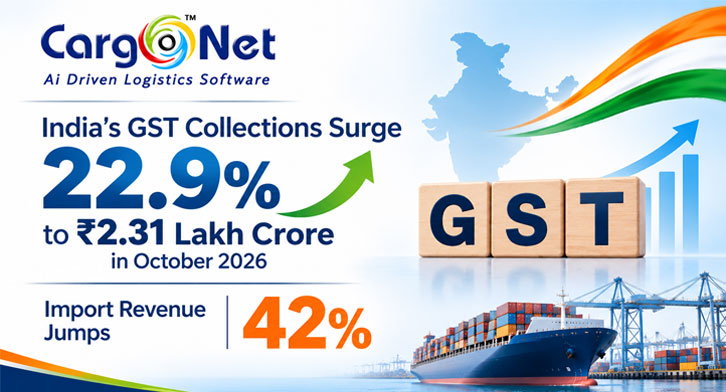
India’s gross Goods and Services Tax (GST) collections surged 22.9% year-on-year to ₹2.31 lakh crore in October 2026, marking the second-highest monthly collection on record. Strong domestic consumption, festive-season purchasing and a sharp increase in import-related tax revenue supported the growth, according to provisional government figures released on November 1, 2026.
The October collection compares with ₹1.88 lakh crore in October 2025 and stands just below the all-time monthly record of approximately ₹2.43 lakh crore recorded in April 2026.
The latest figures also highlight the growing contribution of international trade to India’s tax revenue. GST collections from imports increased 42.2% to ₹72,246 crore, significantly outpacing the 15.8% growth in domestic GST revenue, which reached ₹1.59 lakh crore.
According to the October GST collection report published by Financial Express, the increase reflects stronger revenue generation across domestic transactions and imports. The data provides an important indicator of economic activity, trade flows and potential demand across India’s supply chain ecosystem.
Important Highlights of October 2026 GST Collections
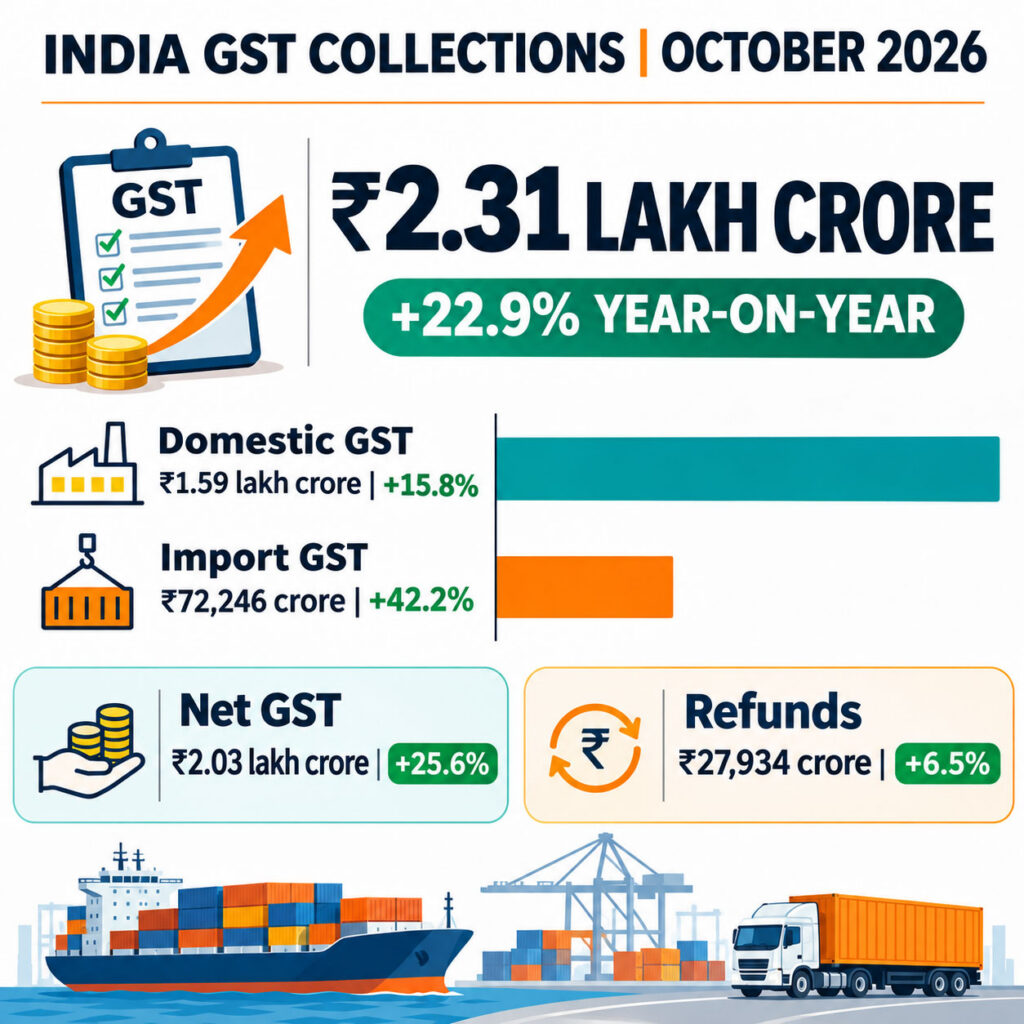
- Gross GST revenue: ₹2.31 lakh crore, registering 22.9% year-on-year growth.
- Import GST revenue: ₹72,246 crore, increasing 42.2%.
- Domestic GST revenue: ₹1.59 lakh crore, growing 15.8%.
- Net GST collections: ₹2.03 lakh crore, up 25.6% after refunds.
- GST refunds: ₹27,934 crore, increasing 6.5%.
- April–October gross collections: ₹14.77 lakh crore, up 13.2%.
- Record comparison: October recorded the second-highest monthly gross GST collection after April’s ₹2.43 lakh crore.
India’s GST Revenue Breakdown for October 2026
The October figures show that both domestic transactions and international trade contributed to the increase in tax revenue. However, import-related GST recorded considerably faster growth.
GST Collection Category
October 2026 Revenue
Year-on-Year Growth
Gross domestic GST
₹1,59,044 crore
15.8%
GST from imports
₹72,246 crore
42.2%
Total gross GST
₹2,31,290 crore
22.9%
GST refunds
₹27,934 crore
6.5%
Net GST collections
₹2,03,356 crore
25.6%
Source: Provisional October 2026 GST collection data, as reported by the Ministry of Finance.
Import-Related GST Revenue Records 42.2% Growth
Import-related GST emerged as a major contributor to October’s revenue increase. Collections from imports reached ₹72,246 crore, compared with ₹50,796 crore in October 2025, representing 42.2% year-on-year growth.
In comparison, GST revenue from domestic sales increased 15.8% to ₹1,59,044 crore.
The stronger growth in import-related collections highlights the importance of international trade in India’s indirect tax revenue. Higher import values, changes in the composition of imported goods and increased import activity can all influence these collections.
For India’s freight forwarding and logistics industry, the figures are particularly relevant. International cargo movement involves multiple interconnected services, including customs clearance, port handling, container transportation, warehousing, documentation and last-mile delivery.
An increase in import-related tax collections can point to greater value moving through cross-border trade channels, although GST revenue alone does not establish an equivalent increase in physical cargo volumes.
Businesses involved in shipping, customs brokerage, freight forwarding and supply chain management will continue to monitor import activity for potential changes in cargo demand and operational requirements.
The Reuters report on India’s October GST collections also highlights the faster growth in net tax revenue, supported by stronger import-related collections.
Domestic Consumption Supports GST Revenue Growth
Domestic GST collections reached ₹1.59 lakh crore in October, registering 15.8% growth compared with the corresponding month last year.
Festive-season purchasing, increased consumer spending and business transactions contributed to the broader demand environment. Higher domestic economic activity can support demand across retail distribution, consumer goods transportation, warehousing and road freight networks.
For logistics service providers, stronger domestic consumption can translate into increased requirements for inventory movement, distribution planning, transportation capacity and regional warehousing.
The combination of domestic revenue growth and rising import-related collections indicates that both internal consumption and international trade remain important contributors to India’s economic activity.
GST Components: CGST, SGST and IGST
The total gross GST collection of ₹2,31,290 crore included revenue from Central GST, State GST and Integrated GST.
GST Component
October 2026 Collection
Central GST (CGST)
₹42,935 crore
State GST (SGST)
₹51,340 crore
Integrated GST (IGST)
₹1,37,015 crore
Total Gross GST
₹2,31,290 crore
Integrated GST accounted for the largest share of the collection, reflecting the importance of inter-state and cross-border transactions in India’s GST system.
GST Refunds Rise 6.5%; Net Revenue Crosses ₹2 Lakh Crore
GST refunds increased 6.5% year-on-year to ₹27,934 crore in October 2026.
After adjusting for refunds, net GST revenue reached ₹2,03,356 crore, compared with ₹1,61,900 crore in October 2025, registering 25.6% growth.
The faster increase in net collections compared with gross collections indicates stronger tax revenue retention during the month.
GST refunds are particularly relevant to exporters and businesses involved in international trade, as timely processing can influence working capital availability and cash-flow management.
April–October FY2026–27 GST Collections Maintain Strong Growth
India’s GST revenue maintained a positive trajectory during the first seven months of FY2026–27.
Between April and October 2026, gross GST collections increased 13.2% to ₹14.77 lakh crore, compared with ₹13.05 lakh crore during the corresponding period of the previous financial year.
Net GST collections also increased 12.6% to ₹12.69 lakh crore.
Financial Period
Gross GST Collections
Growth
April–October FY2025–26
₹13.05 lakh crore
—
April–October FY2026–27
₹14.77 lakh crore
13.2%
Net collections FY2025–26
₹11.27 lakh crore
—
Net collections FY2026–27
₹12.69 lakh crore
12.6%
The sustained growth in tax revenue reflects continued expansion in reported economic transactions and provides a useful indicator for businesses assessing India’s economic and trade environment.
What Rising GST Collections Mean for India’s Logistics and Freight Forwarding Industry
The increase in GST collections, particularly from imports, is relevant to India’s logistics ecosystem because international trade and domestic distribution depend on an interconnected network of ports, customs facilities, warehouses, freight forwarders and transportation operators.
Several areas of the logistics industry could be influenced by stronger trade activity:
1. Higher demand for freight forwarding services
Continued import activity can support demand for ocean freight, air cargo, customs brokerage and multimodal transportation services.
2. Increased container and port-handling requirements
If stronger import collections are accompanied by higher physical cargo volumes, ports, container freight stations and inland container depots may experience additional handling requirements.
3. Greater demand for customs documentation and compliance
International shipments involve multiple documents, including bills of lading, commercial invoices, packing lists and shipping bills. Freight forwarders may need efficient documentation and compliance workflows to manage growing shipment volumes.
4. Expansion of warehousing and distribution activities
Stronger domestic consumption and imported merchandise movement can increase the need for inventory management, storage and transportation services.
5. Greater importance of digital freight management
As trade operations become more complex, logistics companies can benefit from freight forwarding software, automated documentation, real-time shipment tracking and integrated financial management systems.
These are potential operational implications rather than confirmed increases in cargo volumes. Actual demand trends will need to be assessed alongside port traffic, container throughput, customs clearance and merchandise trade statistics.