
India is preparing to strengthen its position in the global sports goods manufacturing industry with the approval of the ₹1,856.67-crore Khelo India Sports Goods Manufacturing Scheme. The initiative aims to expand domestic manufacturing, attract private investment, support MSMEs, reduce import dependence and improve India’s competitiveness in international markets.
The Union Cabinet, chaired by Prime Minister Narendra Modi, approved the scheme on 28 October 2026, with implementation planned from FY2026-27 to FY2033-34. The programme focuses on developing dedicated manufacturing zones, upgrading existing industrial clusters, improving product quality, promoting research and innovation, and expanding export opportunities.
According to the Press Information Bureau’s official announcement, the scheme is designed to establish a globally competitive sports goods manufacturing ecosystem and strengthen India’s participation in international supply chains.
The initiative also supports the broader objectives of Make in India, Aatmanirbhar Bharat and Khelo Bharat Niti 2025, positioning sports manufacturing as a potential driver of industrial growth, employment generation and export-led development.
Key Highlights of the Khelo India Sports Goods Manufacturing Scheme
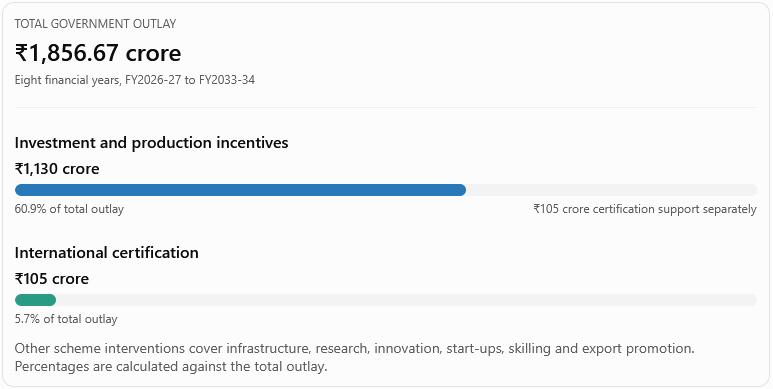
- Total government outlay: ₹1,856.67 crore.
- Implementation period: FY2026-27 to FY2033-34.
- Manufacturing incentives: ₹1,130 crore for anchor investment and turnover-linked support.
- Certification assistance: ₹105 crore for international sports federation certifications.
- Manufacturing infrastructure: Dedicated Sports Goods Manufacturing Zones.
- MSME development: Modernisation of existing sports manufacturing clusters.
- Research and innovation: Centres of Excellence and start-up support.
- Export development: International branding, market access and export promotion.
- Employment opportunities: Potential growth across manufacturing, technology, logistics and allied industries.
How the Scheme Will Transform India’s Sports Goods Manufacturing Industry
The government plans to strengthen India’s sports manufacturing ecosystem through targeted investments, specialised industrial infrastructure and technology development. The programme focuses on addressing the challenges that have limited the growth of domestic manufacturers in international markets.
1. Dedicated Sports Goods Manufacturing Zones to Strengthen Industrial Infrastructure
One of the major components of the initiative is the development of dedicated Sports Goods Manufacturing Zones (SGMZs).
These zones will bring manufacturers, suppliers, testing laboratories, design facilities, prototyping centres and ancillary industries together within integrated industrial clusters.
The government plans to develop these zones through convergence with existing industrial infrastructure under the BHAVYA Scheme and National Industrial Corridor Development Corporation (NICDC) industrial parks.
This cluster-based approach is expected to improve manufacturing efficiency, encourage investment, strengthen supplier networks and reduce operational challenges for sports goods manufacturers.
For international manufacturers and sports brands, these zones could offer opportunities to establish production facilities and build stronger sourcing networks in India.
2. ₹1,130 Crore Incentives to Attract Investment and Expand Production
The scheme allocates a combined ₹1,130 crore towards Anchor Investment Support and Turnover Linked Support.
These incentives are intended to encourage established manufacturers, international sports brands and retail companies to invest in domestic production facilities.
The support is also expected to motivate existing manufacturers to expand production capacity, adopt modern technologies and improve operational efficiency.
By attracting anchor investors, the government aims to strengthen India’s manufacturing ecosystem and create opportunities for smaller suppliers to participate in larger domestic and international supply chains.
3. MSME Support to Strengthen Jalandhar and Meerut Manufacturing Clusters
Micro, Small and Medium Enterprises (MSMEs) play a significant role in India’s sports goods manufacturing industry. According to the government’s Khelo India scheme backgrounder, small and micro enterprises account for nearly 90% of production in the sector.
The initiative aims to upgrade established manufacturing centres, particularly Jalandhar in Punjab and Meerut in Uttar Pradesh.
These clusters are important production centres for sports equipment, including cricket products, balls and other sporting goods.
The proposed interventions include:
- Upgrading existing manufacturing facilities.
- Developing common infrastructure and shared facilities.
- Improving access to advanced machinery and technology.
- Strengthening product testing and quality-control capabilities.
- Supporting smaller manufacturers in expanding their production operations.
Improved infrastructure could help MSMEs increase production efficiency, improve product quality and become more competitive in international markets.
4. ₹105 Crore for International Quality Certification
Meeting international product quality and performance standards is essential for Indian manufacturers seeking to expand their overseas business.
The government has earmarked ₹105 crore for obtaining and renewing certifications from International Sports Federations.
This support is expected to help manufacturers meet international quality requirements and improve the acceptance of Indian-made sports equipment in overseas markets.
Certification is particularly important for specialised equipment used in professional sports, where product safety, durability and performance standards influence purchasing decisions.
5. Research, Innovation and Advanced Manufacturing Technologies
The scheme also places emphasis on research and technology development through the establishment of Centres of Excellence at leading educational and research institutions.
These centres will focus on:
- Advanced sports equipment design and engineering.
- Research in materials science.
- Protective equipment and safety technologies.
- Development of innovative manufacturing processes.
- Product testing and performance evaluation.
- Commercialisation of new technologies.
Start-ups will also receive support to develop innovative products and manufacturing solutions.
These interventions could help Indian manufacturers move beyond traditional product categories and develop higher-value sports equipment for international markets.
6. Export Promotion to Expand India’s Global Market Presence
International market access and branding will be important components of the initiative.
The government plans to leverage the Export Promotion Mission to improve the global positioning of Indian sports goods manufacturers.
The proposed interventions are expected to support international branding, overseas market development, business outreach and improved access to global distribution networks.
For exporters, these measures could create opportunities to develop partnerships with international sports brands, retailers, distributors and procurement networks.
Financial Breakdown of the Khelo India Sports Goods Manufacturing Scheme
The scheme combines investment incentives, certification assistance, manufacturing infrastructure and research support to strengthen the domestic sports goods industry.
Financial component
Allocation
Total scheme outlay
₹1,856.67 crore
Anchor investment and turnover-linked support
₹1,130 crore
International certification support
₹105 crore
Implementation period
FY2026-27 to FY2033-34
Source: Government of India – Official scheme details. The ₹1,130-crore and ₹105-crore allocations are components of the overall scheme outlay, not additional funding.
India’s Sports Equipment Export Potential: A Growing Global Opportunity
The government’s manufacturing initiative comes as international demand for sports equipment creates opportunities for emerging manufacturing economies.
A March 2026 report by NITI Aayog, titled Realising the Export Potential of India’s Sports Equipment Manufacturing Sector, identifies significant opportunities for India to expand its presence in the international sports equipment market.
According to the NITI Aayog’s sports equipment manufacturing report, the global sports equipment market was valued at approximately US$140 billion in 2024 and is projected to reach around US$300 billion by 2036.
India’s current position, however, remains relatively small compared with established manufacturing and exporting countries.
The report identifies the following opportunities:
- India’s sports equipment exports stood at approximately US$275 million in 2024.
- India’s share of global sports equipment exports was around 0.5%.
- Global sports equipment exports reached approximately US$52 billion in 2024.
- India’s sports equipment exports could potentially reach US$8.1 billion by 2036.
- The export opportunity could generate approximately 54 lakh additional direct and indirect jobs.
These are long-term projections rather than guaranteed outcomes. Achieving them will depend on manufacturing competitiveness, technology adoption, product quality, market access and successful implementation of policy interventions.
India’s Sports Equipment Export Opportunity
Indicator
Value
Global sports equipment market (2024)
US$140 billion
Projected global market (2036)
US$300 billion
Global equipment exports (2024)
US$52 billion
India’s equipment exports (2024)
US$275 million
India’s current global export share
Approximately 0.5%
Potential Indian exports by 2036
US$8.1 billion
Potential additional employment
54 lakh jobs
Source: NITI Aayog, March 2026. Figures refer to the sports equipment segment, not the entire sports goods market.
Financial Snapshot: Where the Scheme’s Funding Is Focused
Established Sports Manufacturing Clusters Could Gain Momentum
India’s sports goods manufacturing industry is supported by established industrial clusters, skilled workers and a large network of small businesses.
Jalandhar, Punjab, is known for producing sports equipment, including balls and other sporting goods. Meerut, Uttar Pradesh, is another important manufacturing centre, particularly for cricket equipment and related products.
The NITI Aayog report identifies these clusters as important foundations for India’s export ambitions.
However, manufacturers continue to face challenges such as high raw material costs, limited access to advanced machinery, infrastructure gaps, certification expenses and logistics inefficiencies.
The proposed manufacturing zones and cluster modernisation initiatives could help address these constraints and improve the ability of Indian manufacturers to compete with established exporters such as China and Vietnam.
Read the full NITI Aayog report on India’s sports equipment manufacturing sector for its assessment of industry challenges, export opportunities and recommended policy interventions.
What the Scheme Means for India’s Logistics and Supply Chain Industry
The expansion of sports goods manufacturing could generate opportunities beyond factories and equipment producers. A stronger export-oriented manufacturing ecosystem will also require efficient transportation, warehousing, freight forwarding and international distribution networks.
Several logistics segments could benefit from the expansion.
1. Export freight forwarding
As Indian manufacturers increase overseas shipments, demand for international air freight and ocean freight services could rise. Freight forwarders may find new opportunities to serve sports equipment exporters and international buyers.
2. Industrial warehousing
Manufacturing zones will require organised storage facilities for raw materials, components, semi-finished products and finished sports equipment. This could increase demand for industrial warehousing and inventory management solutions.
3. Containerised cargo transportation
Sports equipment exporters shipping larger consignments will require reliable container availability, competitive freight rates and efficient port connectivity.
4. Packaging and cargo handling
International shipments will require suitable protective packaging, cargo consolidation, handling and quality-control processes to minimise product damage during transportation.
5. Customs clearance and export documentation
Growing export volumes will increase the importance of accurate shipping documentation, customs declarations, product classification and certification management.
6. Multimodal transportation
Improved connectivity between manufacturing clusters, industrial parks, ports and airports will be important for reducing inland transportation costs and improving delivery timelines.
For Indian freight forwarders, logistics service providers and supply chain technology companies, the growth of sports goods manufacturing could create opportunities to serve emerging exporters and established manufacturing businesses.
India’s Manufacturing and Export Strategy: The Road Ahead
The Khelo India Sports Goods Manufacturing Scheme supports the government’s broader objective of strengthening domestic manufacturing and increasing India’s participation in global supply chains.
The initiative complements the recommendations outlined in the NITI Aayog report, which highlights the need to modernise existing manufacturing clusters, develop new industrial facilities, improve access to raw materials, strengthen international branding and build partnerships with global sports brands.
The report also identifies a broader opportunity of approximately US$24 billion in sports-related exports by 2036, covering equipment, apparel, footwear, accessories and allied services. This is distinct from the US$8.1 billion potential specifically identified for sports equipment.
India’s ability to capture these opportunities will depend on coordinated efforts involving government institutions, manufacturers, MSMEs, technology providers, exporters and logistics companies.
Conclusion
The ₹1,856.67-crore Khelo India Sports Goods Manufacturing Scheme marks an important step towards strengthening India’s domestic sports manufacturing industry and expanding its global trade presence.
By combining investment incentives, manufacturing infrastructure, MSME development, international certification and research support, the government aims to build a more competitive and export-oriented manufacturing ecosystem.
For the logistics and freight forwarding industry, the initiative could create new opportunities through increased export shipments, industrial warehousing, containerised transportation and international distribution.
The coming years will be important in determining whether India can translate its manufacturing potential into a stronger position in global sports equipment supply chains.
Frequently Asked Questions
What is the Khelo India Sports Goods Manufacturing Scheme?
It is a Central Government initiative approved on 28 October 2026 to strengthen India’s sports goods manufacturing industry, attract investment, support MSMEs and increase exports.
What is the total budget of the Khelo India manufacturing scheme?
The scheme has a total government outlay of ₹1,856.67 crore for FY2026-27 to FY2033-34.
How much funding is allocated for manufacturing incentives?
A combined ₹1,130 crore is allocated for Anchor Investment Support and Turnover Linked Support.
Which cities are major sports goods manufacturing hubs in India?
Jalandhar in Punjab and Meerut in Uttar Pradesh are two established sports goods manufacturing clusters.
How will MSMEs benefit from the scheme?
MSMEs are expected to benefit from manufacturing cluster upgrades, shared infrastructure, improved technology, certification assistance and better access to production facilities.
What is India’s sports equipment export target for 2036?
NITI Aayog estimates that India’s sports equipment exports could reach approximately US$8.1 billion by 2036.
How will the scheme benefit the logistics industry?
Higher sports goods production and exports could increase demand for freight forwarding, warehousing, container transportation, customs clearance and international supply chain management.