
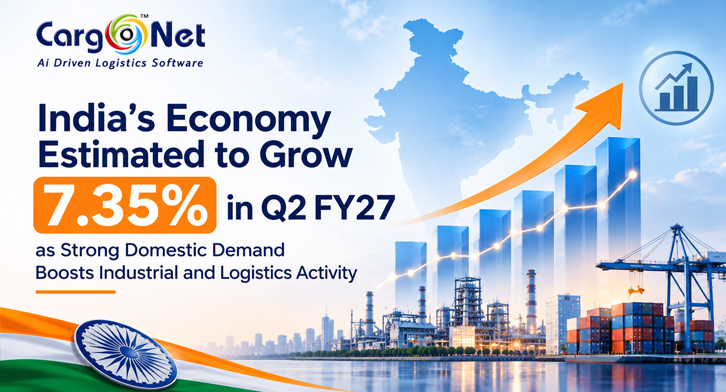
India’s economic growth momentum remained strong during the July–September quarter of FY2026–27, with the Ministry of Finance estimating real GDP growth at 7.35%, supported by resilient domestic consumption, stronger industrial production, rising automobile sales and increased economic activity.
According to the Ministry of Finance’s October 2026 Monthly Economic Review, the latest estimate follows India’s 7.8% GDP expansion in the April–June quarter (Q1 FY27). The assessment indicates that domestic demand and industrial activity continue to support the country’s economic performance despite global uncertainties and inflationary pressures.
The Finance Ministry’s assessment also points to stronger performance across several high-frequency economic indicators, including GST collections, electricity consumption, port traffic, automobile sales and industrial production.
These developments are particularly important for India’s logistics and freight forwarding industry. Higher manufacturing output, consumer demand and international trade activity can create additional requirements for cargo transportation, container handling, warehousing and supply chain management.
According to the Finance Ministry’s October economic review, as reported by The Economic Times, the 7.35% figure is generated through the Department of Economic Affairs’ nowcasting model, introduced in the Economic Survey 2025–26. It is an estimate rather than the final official quarterly GDP figure.
Key Highlights of India’s Q2 FY27 Economic Performance
- 7.35% estimated GDP growth: India’s projected real GDP expansion during July–September 2026.
- 7.8% Q1 GDP growth: The economy recorded strong expansion during April–June 2026.
- 15% GST collection growth: Gross GST collections recorded stronger growth compared with the preceding quarter.
- 25% automobile sales growth: Domestic vehicle sales benefited from improved rural and urban demand.
- 8% industrial production growth: Manufacturing activity remained a major contributor to industrial expansion in August.
- 7.9% core sector growth: India’s eight core industries recorded stronger output growth in September.
- 55.1 manufacturing PMI: Manufacturing business activity strengthened in September.
- 11% export growth: Merchandise and services exports increased year-on-year in September, according to the reported economic review.
These indicators collectively reflect stronger economic activity across manufacturing, consumption, infrastructure, taxation and international trade.
1. India’s Q2 FY27 GDP Growth Estimated at 7.35%
India’s economy is estimated to have expanded by 7.35% in the second quarter of FY27, covering July to September 2026, according to the Finance Ministry’s October Monthly Economic Review.
The estimate follows 7.8% real GDP growth in the preceding quarter. The ministry’s September assessment had indicated growth of approximately 7.3% for Q2, making the latest estimate a marginal upward revision.
The nowcasting model evaluates high-frequency economic indicators to assess the country’s economic performance before the official quarterly GDP numbers are released.
India’s growth outlook also compares favourably with international projections. The International Monetary Fund (IMF) has projected FY27 growth at 7%, while the World Bank, OECD and Reserve Bank of India have projected growth of approximately 7.1%.
The Financial Express report on the Finance Ministry’s Q2 growth estimate explains how industrial output, electricity consumption, GST collections, automobile sales and investment-related indicators contribute to the nowcasting assessment.
For India’s logistics sector, sustained economic expansion can support higher demand for domestic transportation, international freight forwarding, distribution and warehousing services. However, actual freight growth needs to be verified through shipment and cargo-handling statistics rather than inferred directly from GDP growth.
2. Industrial Production and Manufacturing Activity Strengthen
Manufacturing continued to support India’s economic performance during the second quarter of FY27, with industrial production and infrastructure-related industries recording healthy growth.
According to the Ministry of Statistics and Programme Implementation’s August 2026 Index of Industrial Production release on PIB, India’s IIP increased by 8% year-on-year, while manufacturing output expanded by 9%. Electricity and gas supply also recorded growth of 12.3%.
The Index of Eight Core Industries subsequently registered 7.9% growth in September 2026, compared with 5.9% in August, according to the October economic review.
Manufacturing business sentiment also improved. The HSBC India Manufacturing Purchasing Managers’ Index (PMI) increased to 55.1 in September from 52.8 in August. A PMI reading above 50 indicates expansion in manufacturing activity.
The improvement in manufacturing performance has implications for the logistics industry because increased industrial production can generate additional demand for:
- Raw material transportation and industrial procurement.
- Containerised movement of machinery and manufactured goods.
- Domestic distribution of finished products.
- Export cargo handling and international shipping.
- Warehousing and inventory management.
The expansion of manufacturing-linked industries could provide additional business opportunities for freight forwarders, shipping companies and third-party logistics providers.
3. Strong GST Collections and Automobile Sales Reflect Rising Domestic Demand
Domestic consumption remained one of the major contributors to India’s economic momentum during Q2 FY27.
The Finance Ministry’s October review reported that gross GST collections grew by approximately 15% during July–September 2026, compared with around 8.4% growth in the preceding quarter.
Automobile sales also recorded significant growth, increasing by approximately 25% year-on-year during the quarter. Demand across rural and urban markets contributed to the improvement.
However, the automobile growth figure should be viewed alongside the favourable base effect, as vehicle purchases had been deferred in the previous year ahead of GST rate changes.
Higher GST collections indicate stronger reported economic transactions, while rising automobile sales reflect improving consumer and business demand.
These developments can influence freight requirements across multiple supply chains.
For example, higher automobile production and sales can increase transportation demand for vehicles, automotive components, tyres, steel and electronic parts. Similarly, stronger consumer spending can support the movement of FMCG products, electronics, appliances and retail inventory.
The NDTV Profit report on India’s Q2 GDP estimate and economic indicators provides additional details on GST collections, automobile sales and manufacturing performance.
For logistics companies, sustained consumption growth could create opportunities in road transportation, distribution networks, fulfilment centres and last-mile delivery.
4. Rising Port Traffic and Export Activity Support India’s Logistics Industry
Port traffic and freight movement remain important indicators of India’s trade and logistics performance. The Finance Ministry identified stronger port activity among the factors supporting economic momentum during Q2 FY27.
India’s external trade performance also showed improvement. According to IBEF’s October 30 report on India’s Q2 economic performance, merchandise and services exports increased by 11% year-on-year in September 2026, while merchandise exports alone rose by 23.1%.
Electronics and engineering goods were among the important contributors to merchandise export growth.
The increase in export activity is significant for India’s international logistics ecosystem, particularly for freight forwarders, shipping lines, container operators, customs brokers and port service providers.
Higher export and import activity can influence several areas of logistics operations:
- Container transportation: More international cargo can create additional requirements for container movement between factories, warehouses and ports.
- Port operations: Increased cargo volumes can support demand for terminal handling, documentation and vessel-related services.
- Freight forwarding: Exporters and importers require coordinated international transportation, customs clearance and shipment management.
- Warehousing: Growing trade activity can increase demand for cargo storage, consolidation and distribution.
- Multimodal transportation: Businesses may require integrated road, rail, air and sea transportation solutions.
However, rising exports do not automatically translate into equal growth in container traffic. Cargo composition, shipment size, trade routes and port-specific throughput also influence logistics demand.
For India’s freight forwarding industry, export growth in electronics and engineering goods presents an important area to monitor, particularly because these sectors depend on reliable international transportation and coordinated supply chains.
5. Key Economic Indicators Supporting India’s Q2 FY27 Growth
The following table summarises the major economic indicators highlighted in the Finance Ministry’s October 2026 assessment and associated official statistical releases.
Economic indicator
Reported performance
Estimated Q2 FY27 GDP growth
7.35%
Q1 FY27 GDP growth
7.8%
Gross GST collections growth
Approximately 15%
Previous-quarter GST growth
Approximately 8.4%
Domestic automobile sales growth
Approximately 25% YoY
Industrial production growth (August)
8%
Manufacturing output growth (August)
9%
Electricity and gas supply growth (August)
12.3%
Eight core industries growth (September)
7.9%
Manufacturing PMI (September)
55.1
Merchandise and services export growth (September)
11%
Merchandise export growth (September)
23.1%
Sources: Ministry of Finance, PIB, IBEF and reports published on October 29–30, 2026. Figures are rounded and refer to different reporting periods where specified.
6. Global Economic Uncertainties Could Affect India’s Growth Momentum
Despite strong domestic economic indicators, the Finance Ministry has highlighted several risks that could influence India’s economic performance during the second half of FY27.
Elevated crude oil prices, geopolitical tensions, inflationary pressures and uncertainty in global financial markets remain important concerns.
These challenges are particularly relevant for logistics and supply chain businesses because transportation and international shipping operations are closely linked to fuel prices, trade routes and global commodity markets.
Major challenges facing the economy include:
1. Rising crude oil prices
Higher crude oil prices can increase diesel, petrol, aviation fuel and marine fuel expenses. This can raise operating costs for trucking companies, airlines, shipping operators and logistics service providers.
2. Geopolitical tensions and shipping disruptions
Conflict and instability in important trade corridors can affect vessel schedules, transit times, freight rates and cargo insurance expenses.
3. Inflationary pressures
Rising food, energy and industrial input prices can increase manufacturing and distribution costs while affecting consumer purchasing power.
4. Global financial uncertainty
Changes in global interest rates, currency movements and capital flows can influence trade financing, investment and international business activity.
5. Agricultural production uncertainty
Variations in agricultural output can influence rural consumption, food transportation, commodity prices and domestic supply chains.
The Reuters report on India’s FY27 growth outlook and inflation risks provides additional context on the Finance Ministry’s assessment of economic growth and external risks.
For logistics operators, monitoring crude oil prices, shipping disruptions and inflation will remain important for managing transportation costs and maintaining reliable supply chain operations.
7. What India’s Economic Growth Means for Freight Forwarders and Supply Chain Businesses
India’s estimated 7.35% GDP growth provides a positive economic backdrop for the logistics and freight forwarding industry.
As industrial production, consumption and export activity strengthen, businesses may require more efficient transportation, shipment management, cargo handling and inventory distribution.
The developments create opportunities across several logistics segments.
Growing demand for freight transportation
Higher industrial production can increase the movement of raw materials, intermediate goods and finished products. Road transportation and multimodal logistics providers could benefit from increased cargo requirements.
Expansion of international freight forwarding
Stronger export activity, particularly in electronics and engineering goods, can create additional demand for international shipping, air freight, customs clearance and export documentation.
Increased warehousing requirements
Growing consumer demand can encourage businesses to strengthen inventory management, storage infrastructure and distribution networks.
Greater importance of digital supply chain management
As shipment volumes and operational complexity increase, freight forwarders need better visibility across documentation, operations, customer service and finance.
Technology-enabled logistics platforms can help businesses automate repetitive activities, reduce manual data entry and improve coordination between departments.
AI-powered document processing, automated shipment tracking, intelligent data extraction and workflow automation are becoming increasingly relevant to modern freight operations.
For freight forwarding businesses, the opportunity is not simply to handle more shipments but to manage increasing shipment volumes with greater accuracy, visibility and operational efficiency.
8. India’s Economic Growth Outlook for the Remainder of FY27
The Finance Ministry expects domestic consumption, investment activity, structural reforms and healthy credit growth to support India’s economic expansion during the remaining months of FY27.
Recent trade agreements could also strengthen export opportunities and encourage greater participation in international markets.
The IMF has projected India’s FY27 growth at 7%, while the World Bank, OECD and RBI have projected approximately 7.1% growth.
Nevertheless, sustaining economic momentum will depend on managing inflation, energy costs and external economic uncertainties.
For the logistics industry, the coming quarters will be important for assessing whether stronger manufacturing activity and export performance translate into sustained growth in cargo volumes, port throughput and freight transportation demand.
Frequently Asked Questions
What is India’s estimated GDP growth for Q2 FY27?
India’s GDP growth is estimated at 7.35% for Q2 FY27, covering July–September 2026, according to the Finance Ministry’s October Monthly Economic Review.
What factors supported India’s economic growth during Q2 FY27?
Strong domestic consumption, manufacturing output, GST collections, automobile sales, electricity consumption, port traffic and export activity supported economic momentum.
How much did India’s GDP grow in Q1 FY27?
India recorded real GDP growth of 7.8% during April–June 2026.
How much did GST collections increase during Q2 FY27?
Gross GST collections recorded approximately 15% growth during the July–September quarter, compared with around 8.4% in the preceding quarter.
How did India’s manufacturing sector perform in August 2026?
Industrial production increased by 8% year-on-year, while manufacturing output grew by 9%, according to the official IIP release.
How does India’s GDP growth affect the logistics industry?
Economic growth can support demand for freight transportation, international shipping, container handling, warehousing, customs clearance and supply chain management.
What were India’s export growth figures in September 2026?
Merchandise and services exports increased by 11% year-on-year, while merchandise exports grew by 23.1%, according to the reported September figures.
Is the 7.35% GDP figure the final official Q2 FY27 growth rate?
No. It is a Finance Ministry nowcasting estimate. The final official GDP figure is published separately by the National Statistical Office.