
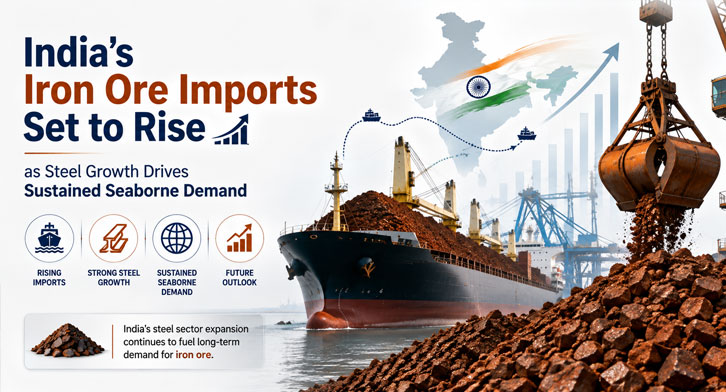
India’s iron ore trade is undergoing a significant structural shift as rapid growth in steel production increasingly absorbs domestic ore supplies and pushes steelmakers toward overseas markets.
The trend, highlighted by Drewry’s analysis of India’s iron ore trade, is becoming more pronounced as the country moves toward its ambitious steel production targets for 2030-31. With domestic steel output expanding faster than iron ore production, imported ore is expected to play a growing role in meeting future raw material requirements.
For the logistics and dry bulk shipping industry, the shift could translate into sustained seaborne iron ore demand, longer shipping routes and increased employment for Capesize vessels.
Key Highlights
- India’s crude steel production increased from around 100 million tonnes in 2020 to more than 160 million tonnes in 2025.
- India’s iron ore exports declined from 52 million tonnes in 2020 to 27 million tonnes in 2025.
- Iron ore imports reached 12.1 million tonnes in 2025, highlighting the growing importance of overseas supplies.
- India is targeting 255 million tonnes of crude steel production by 2030-31.
- Domestic steel production is growing faster than iron ore output, potentially tightening the country’s raw material balance.
- Increasing imports from long-haul suppliers such as Brazil could support higher Capesize demand and tonne-mile growth.
India’s Steel Expansion Is Increasing Raw Material Pressure
India has emerged as the world’s second-largest steel producer, with crude steel output increasing sharply over the past five years.
Production rose from approximately 100 million tonnes in 2020 to more than 160 million tonnes in 2025, representing an annual growth rate of around 10%.
The next stage of expansion is being driven by the government’s National Steel Policy, which targets crude steel capacity of 300 million tonnes and production of 255 million tonnes by 2030-31.
Achieving these targets will require a significant increase in the availability of iron ore and other steelmaking raw materials.
While India’s iron ore production has also expanded, growing at roughly 9% annually over the same period, steel production has increased slightly faster. This divergence is gradually putting greater pressure on domestic ore availability.
India’s Iron Ore Trade Balance Is Changing
That situation has changed.
Investment in ore beneficiation, pelletisation and sintering has allowed domestic steel producers to use more iron ore fines within the country. Consequently, a larger share of domestically produced ore is now being consumed by Indian steelmakers rather than exported.
The change is clearly visible in India’s trade figures.
Indicator
2020
2025
Change
Crude steel production
~100 MT
>160 MT
Strong increase
Iron ore exports
52 MT
27 MT
Significant decline
Iron ore imports
—
12.1 MT
Increasing dependence
Target crude steel production
—
255 MT by 2030-31
Further expansion planned
MT = million tonnes
Iron Ore Imports Become Increasingly Important
India’s iron ore imports increased significantly as domestic steel production strengthened. Imports reached 12.1 million tonnes in 2025, while exports fell to 27 million tonnes.
This represents a major change in the country’s iron ore trade structure.
Rather than relying primarily on domestically produced ore, Indian steelmakers are increasingly using imports to supplement domestic supplies. Competitive international ore prices have also supported the shift toward overseas sourcing.
The development could become even more important as steel production continues to expand toward the government’s 2030-31 target.
What This Means for Global Dry Bulk Shipping
India’s changing iron ore trade has implications well beyond the domestic steel industry.
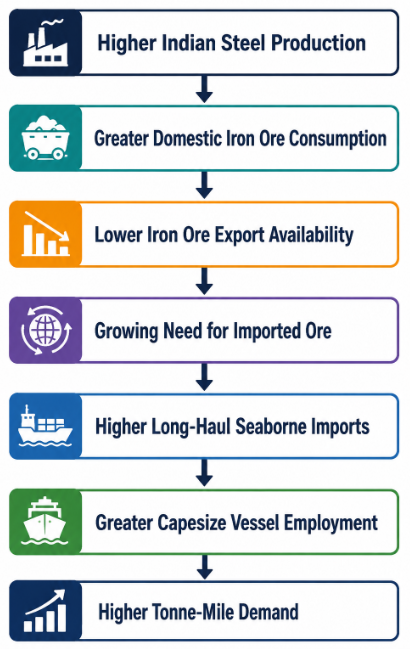
As more Indian-produced ore is consumed domestically, imports are likely to become an increasingly important source of incremental supply. This could create additional demand for seaborne iron ore transportation.
Brazil is already an important supplier to the Indian market. Brazilian cargoes typically involve long-haul voyages to India, generating substantially more tonne-miles than shorter regional routes.
Higher volumes from Brazil and other distant suppliers could therefore have a greater impact on the dry bulk shipping market than the volume increase alone would suggest.
Why Capesize Demand Could Increase
Iron ore is one of the major commodities transported by Capesize bulk carriers. These vessels are particularly suited to large-volume, long-distance movements between major mining regions and steelmaking markets.
If India increasingly sources iron ore from Brazil and other distant suppliers, the resulting longer voyages could increase vessel utilisation and tonne-mile demand.
For shipowners, charterers and dry bulk operators, India’s steel expansion could therefore become an important factor supporting future iron ore shipping demand.
A Structural Change, Not a Short-Term Trend
The evolution of India’s iron ore market points to a broader structural transformation.
Growing steelmaking capacity, greater domestic consumption of iron ore fines and investments in beneficiation and pelletisation are reducing the amount of ore available for export.
At the same time, India’s ambitious steel production targets are likely to increase the country’s requirement for raw materials.
This combination could make imported iron ore an increasingly important component of India’s steel supply chain.
Outlook for India’s Iron Ore Trade
India’s steel industry is entering a new phase of expansion, and ensuring adequate raw material supplies will be critical to achieving the country’s 2030-31 production ambitions.
With domestic iron ore increasingly being absorbed by Indian steelmakers, imports are expected to play a larger role in meeting incremental demand.
For the logistics and maritime sectors, this could mean more seaborne iron ore cargoes, longer-haul trade routes and sustained demand for Capesize vessels.
India’s evolving position in the global iron ore market could therefore become an increasingly important driver of dry bulk shipping demand over the coming years.
FAQs
Why are India’s iron ore imports increasing?
India’s iron ore imports are increasing as domestic steel production grows and a larger share of locally produced ore is consumed by domestic steelmakers. Investments in beneficiation, pelletisation and sintering have also increased the ability of Indian mills to use iron ore fines.
How much iron ore did India import in 2025?
India imported approximately 12.1 million tonnes of iron ore in 2025, according to the data cited in the analysis.
Why are India’s iron ore exports declining?
Iron ore exports have declined because more domestically produced ore is being consumed by Indian steelmakers. Rising domestic steel production and improved processing capabilities have reduced the amount of ore available for export.
How will India’s steel production target affect iron ore demand?
India’s target of 255 million tonnes of crude steel production by 2030-31 is expected to significantly increase demand for iron ore and other steelmaking raw materials.
What is the impact on dry bulk shipping?
Higher iron ore imports could increase demand for seaborne transportation. Long-distance shipments from suppliers such as Brazil could particularly benefit Capesize vessels by increasing vessel utilisation and tonne-mile demand.
Will India become a larger destination for Capesize vessels?
If iron ore imports continue to rise, India could become an increasingly important destination for Capesize vessels, particularly for long-haul cargoes from major exporting countries.