
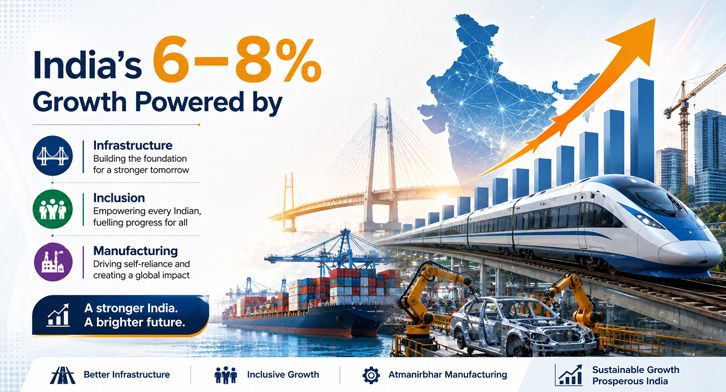
India’s sustained economic growth is gaining global attention, supported by continued investment in infrastructure, digital systems, inclusive development and domestic manufacturing, Union Information and Broadcasting Minister Ashwini Vaishnaw said.
According to the minister, India has maintained a growth rate of around 6% to 8%, placing it among the world’s major growing economies. He identified four pillars supporting this momentum: social infrastructure, digital and physical infrastructure, inclusive growth, and manufacturing. The statement was reported by Akashvani News.
Important Points
- India is sustaining annual economic growth in the 6%–8% range.
- Investment in physical and digital infrastructure is supporting business expansion.
- Inclusive policies aim to extend development benefits across regions and communities.
- Manufacturing remains central to job creation, industrial capacity and exports.
- Improved infrastructure could reduce logistics costs and strengthen supply chains.
- Stronger domestic production may increase freight, warehousing and port activity.
- The growth strategy combines social development with industrial competitiveness.
Four Pillars Supporting India’s Economic Growth
Growth pillar
Primary role
Potential economic effect
Social infrastructure
Expands access to essential services and welfare support
Greater workforce participation
Physical infrastructure
Improves roads, railways, ports, airports and industrial connectivity
Faster movement of goods and people
Digital infrastructure
Expands access to payments, banking and government services
Lower transaction costs and wider market access
Inclusive development
Extends economic opportunities across regions and communities
Broader participation in growth
Manufacturing
Increases domestic production and industrial investment
More jobs, exports and logistics demand
Infrastructure Investment Improving Connectivity
India’s investment in roads, railway networks, airports, ports and logistics corridors is improving connections between manufacturing centres and domestic and international markets.
Better transport infrastructure can help businesses move raw materials and finished products more efficiently. It can also reduce transit delays, support regional industrial development and improve access to consumption centres.
Digital infrastructure is complementing these physical networks. Online payments, digital identification and electronic government services are making banking, education and public services more accessible.
Together, physical and digital infrastructure can make it easier for companies to manage transactions, coordinate supply chains and reach customers across the country.
Inclusive Growth Expands Economic Participation
Vaishnaw emphasised that economic progress should reach people across different income groups, communities and regions.
Social welfare programmes and improved access to digital services can enable more citizens to participate in the formal economy. Financial inclusion can also help individuals and small businesses access payments, government benefits and financial services.
However, sustaining inclusive growth will depend on the creation of productive employment, skills development and better economic opportunities outside major urban centres.
Manufacturing Push Could Strengthen Supply Chains
Manufacturing is a major component of India’s long-term economic strategy. Expanding domestic production can create direct and indirect employment while generating demand for transportation, warehousing, freight forwarding and distribution services.
Government initiatives are also encouraging new industrial capacity and stronger domestic supply chains. India’s manufacturing policy focuses on attracting investment, increasing production and improving the country’s competitiveness in international markets.
A stronger manufacturing base could help India:
- Produce more goods domestically
- Reduce dependence on selected imports
- Increase merchandise exports
- Attract domestic and foreign investment
- Create industrial and logistics employment
- Strengthen supplier and distribution networks
What Does India’s Growth Strategy Mean for Logistics?
Growth in infrastructure and manufacturing is likely to increase cargo movement across road, rail, air and sea networks. This could create new opportunities for freight forwarders, transport companies, customs brokers, ports, warehouses and technology providers.
Development
Likely impact on logistics
Higher manufacturing output
More movement of raw materials and finished goods
Export growth
Greater demand for ports, containers and freight forwarding
New industrial clusters
Expansion of regional transport and warehousing networks
Improved roads and railways
Better first-mile and last-mile connectivity
Digital infrastructure
Faster documentation, payments and shipment coordination
Broader regional development
New cargo origins, destinations and distribution markets
These effects are potential outcomes rather than figures announced by the minister. Their scale will depend on how quickly infrastructure projects are completed and new manufacturing capacity becomes operational.
How Infrastructure and Manufacturing Support Trade
Challenges That Could Influence Future Growth
Maintaining a 6%–8% growth range will require more than infrastructure spending. India will also need to improve project execution, workforce skills, industrial productivity and access to finance.
Important areas to monitor include:
- Speed of infrastructure project completion
- Creation of quality manufacturing jobs
- Logistics and transportation costs
- Availability of skilled workers
- Export competitiveness
- Participation of small and medium-sized businesses
- Distribution of growth across states and regions
Frequently Asked Questions
What is driving India’s economic growth?
According to Ashwini Vaishnaw, India’s growth is being supported by investment in social, digital and physical infrastructure, inclusive development and manufacturing.
What is India’s current growth range?
The minister said India has been growing within a range of approximately 6% to 8%.
Why is infrastructure important for India’s economy?
Infrastructure connects factories, suppliers, markets, ports and consumers. Better connectivity can reduce delays, improve access to services and support business expansion.
How does manufacturing support economic growth?
Manufacturing creates jobs, attracts investment, increases industrial production and supports exports. It also generates demand for logistics, warehousing and transportation.
How could manufacturing growth affect the logistics sector?
Higher production may lead to more domestic and international cargo movement, increasing demand for freight forwarding, customs clearance, transportation, ports and warehouses.
What is inclusive growth?
Inclusive growth means ensuring that economic development creates opportunities and benefits for people across different communities, income groups and regions.