


India-Finland Partnership Enters a New Growth Phase
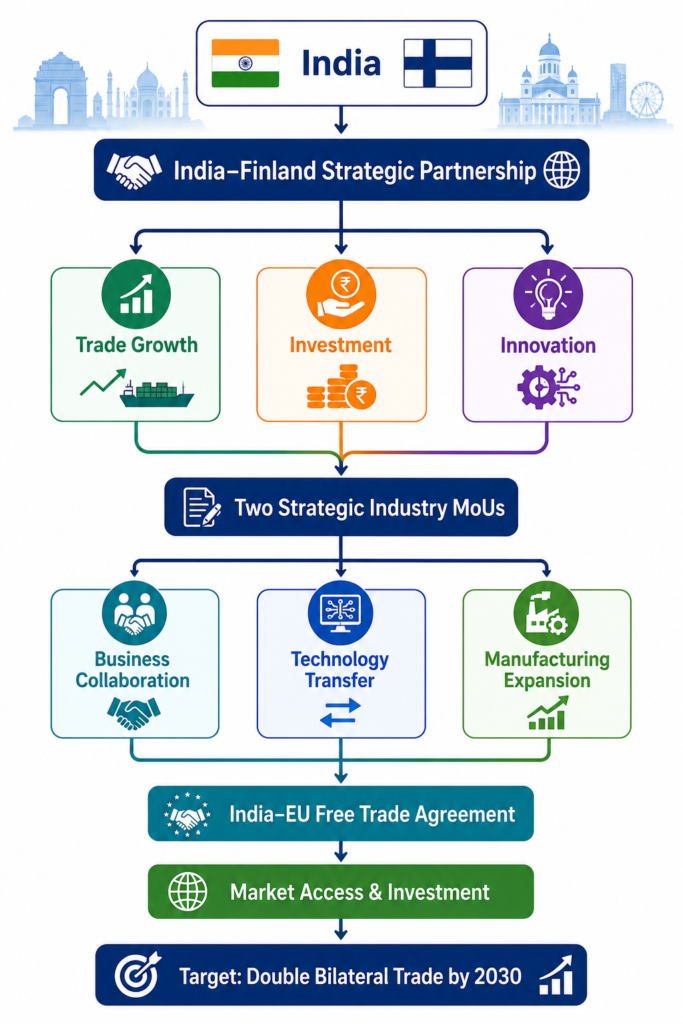
India and Finland have taken another significant step towards strengthening their economic relationship by signing two industry-focused Memorandum of Understanding (MoUs), aimed at accelerating bilateral trade, investment, innovation and industrial collaboration.
The agreements were signed during Union Minister of Commerce and Industry Mr. Piyush Goyal’s official visit to Finland, where he led a high-level Indian delegation to enhance commercial cooperation with one of Europe’s leading innovation-driven economies.
The visit builds upon the recently established India–Finland Strategic Partnership in Digitalisation and Sustainability (March 2026) and gains further momentum from the India-European Union Free Trade Agreement (India-EU FTA), which is expected to unlock new opportunities for businesses across multiple sectors.
Key Highlights
- India and Finland signed two strategic industry MoUs.
- Mr. Piyush Goyal met Finland's Minister of Economic Affairs Dr. Sakari Puisto.
- Discussions focused on trade, investment, innovation and financial cooperation.
- CII partnered with Business Finland and the Confederation of Finnish Industries (EK).
- Both countries aim to double bilateral trade by 2030.
- Collaboration will expand across:
- Digital Technologies
- Artificial Intelligence
- Space Technology
- Clean Energy
- Bioeconomy
- Circular Economy
- Advanced Manufacturing
- Infrastructure Development
- India-EU FTA expected to accelerate bilateral investment and exports.
India and Finland Sign Two Strategic Industry MoUs
To strengthen institutional business cooperation, two Memorandums of Understanding were signed:
Agreement
Objective
Confederation of Indian Industry (CII) – Business Finland
Promote trade, technology partnerships and business collaboration
Confederation of Indian Industry (CII) – Confederation of Finnish Industries (EK)
Expand industrial cooperation, investment and innovation
These agreements are expected to facilitate stronger private-sector engagement, encourage technology exchange and support long-term economic partnerships between Indian and Finnish companies.
Focus Areas of Future Cooperation
The discussions identified several high-growth sectors where both countries can build long-term partnerships.
Sector
Opportunities
Digital Technologies
AI, Software, Digital Infrastructure
Space
Satellite Technologies, Space Innovation
Clean Energy
Renewable Energy, Green Hydrogen
Bioeconomy
Sustainable Industrial Solutions
Circular Economy
Waste Management and Recycling
Infrastructure
Industry 4.0 and Automation
India-EU FTA to Accelerate Trade Growth
The recently concluded India-European Union Free Trade Agreement (FTA) is expected to significantly strengthen India’s commercial engagement with Finland.
The agreement is likely to:
- Improve market access
- Reduce trade barriers
- Encourage foreign direct investment (FDI)
- Support manufacturing partnerships
- Increase technology transfer
- Enhance innovation-led growth
- Strengthen supply chain resilience
With improved trade facilitation, Indian exporters and Finnish technology companies are expected to benefit from faster market expansion and greater investment opportunities.
Bilateral Trade Target: Double by 2030
During the discussions, both governments reaffirmed their commitment to doubling bilateral trade by 2030.
The ambitious target will be supported by:
- Stronger industry collaboration
- Technology partnerships
- Startup ecosystem cooperation
- Sustainable manufacturing
- Research and innovation
- Digital transformation
- Expanded investment flows
Strategic Importance for India
Finland is globally recognized for its leadership in innovation, digital technologies, sustainability and advanced engineering.
Strengthening ties with Finland supports India’s broader objectives of:
- Make in India
- Digital India
- Green Growth
- Advanced Manufacturing
- Energy Transition
- Technology-led Industrial Development
The partnership also complements India’s strategy of diversifying trade relationships across Europe while attracting high-quality investments.
Summary of the India-Finland Partnership
Category
Details
Visit Led By
Union Minister Piyush Goyal
Partner Country
Finland
Major Outcome
Two Industry MoUs Signed
Key Organizations
CII, Business Finland, EK
Focus Areas
Trade, Investment, Innovation
Strategic Sectors
AI, Space, Clean Energy, Infrastructure, Manufacturing
Long-Term Goal
Double Bilateral Trade by 2030
Growth Driver
India–EU Free Trade Agreement
Industry Impact
The strengthened India-Finland partnership is expected to generate new opportunities for:
- Technology companies
- Manufacturing firms
- Renewable energy developers
- Logistics providers
- Infrastructure companies
- Engineering businesses
- Startup ecosystems
- Exporters
- Investors
Improved collaboration in digital technologies and industrial innovation will also enhance supply chain efficiency and support sustainable economic growth.
India–Finland Economic Partnership
FAQs
Why did India and Finland sign new MoUs?
The MoUs aim to strengthen trade, investment, innovation, and industrial cooperation between businesses in both countries.
Which organizations signed the agreements?
The Confederation of Indian Industry (CII) signed agreements with Business Finland and the Confederation of Finnish Industries (EK).
Which sectors will benefit the most?
Digital technologies, AI, space, clean energy, bioeconomy, circular economy, infrastructure, and advanced manufacturing.
How will the India–EU FTA support this partnership?
The FTA is expected to improve market access, reduce trade barriers, encourage investment, and expand collaboration between Indian and European businesses.
What is the bilateral trade goal?
India and Finland aim to double bilateral trade by 2030 through stronger economic and industrial cooperation.
Conclusion
India and Finland are entering a new phase of economic collaboration driven by innovation, sustainability, and strategic investment. The signing of two industry MoUs, combined with the opportunities created by the India–EU Free Trade Agreement, positions both countries to expand trade, accelerate technology partnerships, and build resilient industrial ecosystems. With a shared goal of doubling bilateral trade by 2030, the partnership is expected to create long-term opportunities for businesses, investors, and exporters across high-growth sectors.