
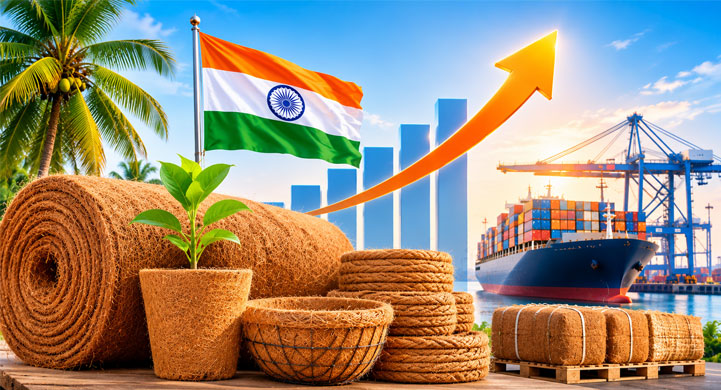
India’s coir and coir product exports reached ₹6,614.40 crore in FY2025–26, rising 305.7% from ₹1,630.33 crore in FY2014–15. The growth highlights the expanding export base of India’s natural fibre industry and its importance to sustainable manufacturing, rural employment and international trade.
According to the Ministry of Micro, Small and Medium Enterprises (MSME), India’s coir sector has strengthened its position in global markets through a broad range of products made from coconut husks. The industry supplies international buyers with coir pith, fibre, yarn, mats and other products used in horticulture, home furnishings and industrial applications.
India’s Coir Export Growth: Key Statistics
The latest figures show a substantial increase in the value of coir exports over the period.
Indicator
Reported figure
Coir exports in FY2014–15
₹1,630.33 crore
Coir exports in FY2025–26
₹6,614.40 crore
Increase over the period
305.70%
Approximate industry turnover
₹16,000 crore
Major export destinations
US, China, Netherlands, Spain and UK
Source: Ministry of MSME, Government of India.
India’s coir exports more than quadrupled in value between FY2014–15 and FY2025–26. The figures represent export value growth in rupee terms, rather than a direct measure of shipment volumes or inflation-adjusted growth.
What Is Driving India’s Coir Export Growth?
Coir is a natural fibre obtained from the outer husk of coconuts. Manufacturers process it into products for domestic use and export markets, creating commercial value from an agricultural by-product.
Several factors support the industry’s export potential:
- Demand for natural materials: Coir products offer alternatives to certain synthetic materials in applications where durability, natural fibre and biodegradability are valued.
- Diverse product applications: Coir is used in mats, rugs, ropes, brushes, mattresses, horticultural growing media and geotextiles.
- Agricultural and rural employment: The industry connects coconut-growing regions with processing units, artisans, manufacturers and exporters.
- Value-added manufacturing: Finished products and specialised applications can help exporters serve different customer segments and markets.
- International market access: Indian exporters supply buyers across major markets, including the United States, China and several European countries.
Major Export Markets for Indian Coir Products
The United States, China, the Netherlands, Spain and the United Kingdom are among the key international destinations for Indian coir products, according to the Ministry of MSME.
These markets provide opportunities for manufacturers and exporters supplying natural fibre products for horticulture, landscaping, home furnishings and other uses.
Exporters seeking to expand internationally need to understand destination-market requirements, product specifications, packaging standards and applicable customs procedures. Consistent quality and reliable shipment execution can also help strengthen relationships with overseas buyers.
How Coir Export Growth Creates Logistics Opportunities
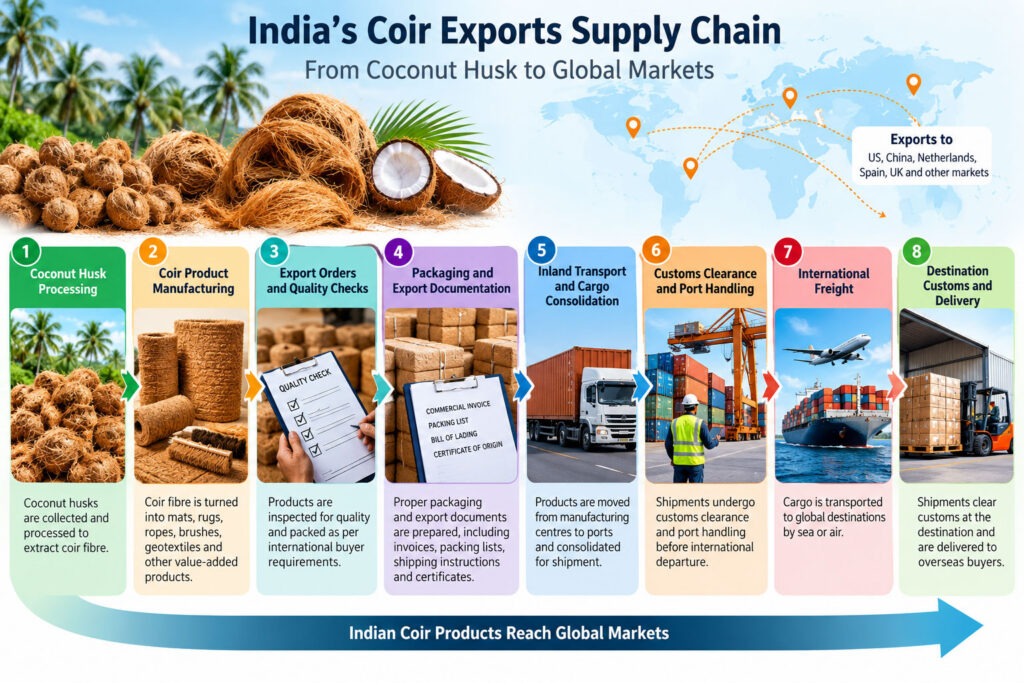
Higher export value can create opportunities across the logistics supply chain, although the actual impact on freight volumes will depend on shipment quantities, product mix and market demand.
Coir exporters and logistics providers may need to coordinate several activities, from factory dispatch to international delivery.
- Export packaging: Protecting coir products during storage, handling and transportation.
- Customs documentation: Preparing commercial invoices, packing lists, shipping instructions and other required export documents.
- Cargo consolidation: Combining smaller consignments where commercially and operationally suitable.
- Port and transport coordination: Moving cargo from manufacturing centres to ports and coordinating onward international transportation.
- Shipment visibility: Tracking cargo milestones and communicating delays or status changes to exporters and overseas buyers.
- Trade compliance: Checking destination-specific requirements and ensuring the correct documentation accompanies each shipment.
For freight forwarders, coir exports represent one segment of India’s broader agricultural and manufactured-goods trade. Logistics providers serving these exporters can explore opportunities in documentation support, multimodal transportation, cargo consolidation and shipment tracking.
Government Support for the Coir Industry
The Ministry of MSME operates the Coir Vikas Yojana to support the sector’s development. The programme includes activities related to technology, skill development, product innovation and the promotion of domestic and international sales.
Such initiatives can help coir enterprises improve manufacturing capabilities, develop value-added products and strengthen their access to export markets.
For small and medium-sized exporters, improved production processes and stronger export-market connections can support long-term competitiveness. However, continued growth will also depend on product quality, cost management, buyer demand and the ability to meet overseas market requirements.
What the Export Growth Means for India's Trade and Logistics Sector
The increase in coir exports highlights the commercial potential of India’s natural fibre industry. It also reinforces the link between agricultural resources, rural manufacturing and international supply chains.
For exporters, opportunities may lie in developing specialised products and reaching new overseas buyers. For freight forwarders, customs brokers and logistics service providers, the focus can be on helping these businesses manage documentation, transport coordination, compliance and shipment visibility efficiently.
As international buyers evaluate natural fibre products for different applications, Indian manufacturers may benefit from combining product innovation with dependable export logistics and customer service.
Frequently Asked Questions
How much were India's coir exports in FY2025–26?
India exported coir and coir products worth ₹6,614.40 crore in FY2025–26, according to the Ministry of MSME.
How much have India's coir exports increased since FY2014–15?
Export value increased by 305.7%, from ₹1,630.33 crore in FY2014–15 to ₹6,614.40 crore in FY2025–26.
Which countries are major markets for Indian coir exports?
Major destinations include the United States, China, the Netherlands, Spain and the United Kingdom.
What are India's main coir export products?
Key products include coir pith, coir fibre, coir yarn and tufted mats. Other products include ropes, rugs, mats and geotextiles.
How can coir export growth benefit freight forwarders?
Potential opportunities include export documentation, cargo consolidation, customs coordination, inland transportation, international freight and shipment tracking. The scale of these opportunities depends on actual cargo volumes and exporters’ logistics requirements.
Why is coir important to India's sustainable manufacturing sector?
Coir uses coconut husks to manufacture commercially useful natural fibre products. It supports agricultural resource utilisation, rural enterprises and the production of alternatives to some synthetic materials.