
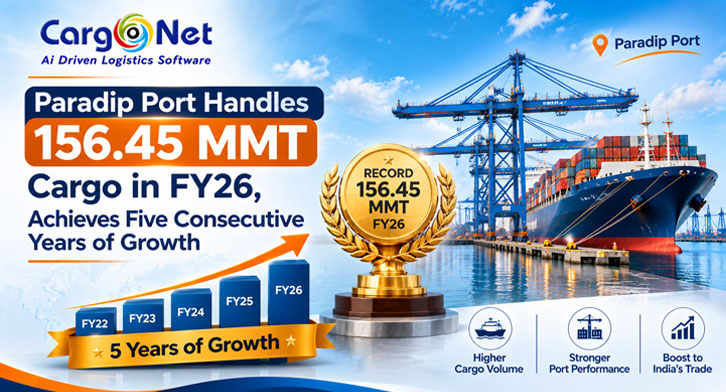
Paradip Port Authority (PPA) has recorded its highest-ever annual cargo throughput of 156.45 million metric tonnes (MMT) in FY 2025–26, marking five consecutive years of cargo growth. The milestone strengthens the port’s position as India’s second-largest major port by cargo volume and reinforces its importance as a key maritime gateway on the eastern coast.
Located in Odisha, Paradip Port has steadily expanded its cargo-handling performance, supported by improvements in operational productivity, infrastructure and stakeholder coordination. Its latest performance also reflects the growing importance of eastern India’s port infrastructure in supporting domestic industries, coastal shipping and international trade.
Important Highlights of Paradip Port’s FY26 Performance
- Record cargo throughput: 156.45 MMT in FY 2025–26, the highest annual volume in the port’s history.
- Five consecutive years of growth: Cargo handling increased from 116.13 MMT in FY22 to 156.45 MMT in FY26.
- 34.7% cumulative growth: The port added 40.32 MMT of cargo throughput over the five-year period.
- 4.02% year-on-year growth: Cargo volumes increased from 150.41 MMT in FY25 to 156.45 MMT in FY26.
- Second-largest major port: Paradip ranked second among India’s major ports by cargo volume.
- Daily cargo-handling record: 7,73,462 metric tonnes handled on March 29, 2026.
- Monthly cargo-handling record: 14.44 MMT handled in January 2026.
These figures are reported in the Paradip Port Authority’s official performance and achievements report.
Paradip Port Cargo Growth: Five-Year Performance
Paradip Port’s cargo-handling performance has maintained a consistent upward trajectory since FY 2021–22. Annual throughput increased from 116.13 MMT in FY22 to 135.36 MMT in FY23, followed by 145.38 MMT in FY24 and 150.41 MMT in FY25.
The port subsequently crossed the 156 MMT mark in FY26, demonstrating sustained growth in cargo movement and strengthening its contribution to India’s maritime trade network.
The five-year comparison shows an increase of approximately 34.7%, equivalent to an additional 40.32 million tonnes of cargo handled annually compared with FY22.
Five-year cargo throughput comparison
Financial year
Cargo handled
Annual growth
FY 2021–22
116.13 MMT
1.38%
FY 2022–23
135.36 MMT
16.56%
FY 2023–24
145.38 MMT
7.40%
FY 2024–25
150.41 MMT
3.46%
FY 2025–26
156.45 MMT
4.02%
Source: Paradip Port Authority. Annual growth percentages are as reported by PPA.
Paradip Ranks Second Among India’s Major Ports
Paradip Port’s FY26 performance is particularly significant in the context of India’s overall maritime cargo movement.
According to the Ministry of Ports, Shipping and Waterways, India’s major ports collectively handled 915.17 million tonnes of cargo in FY 2025–26, recording 7.06% year-on-year growth and exceeding the annual target of 904 million tonnes.
The top three ports by cargo volume were:
Major port
Cargo handled in FY26
Deendayal Port Authority
160.11 MMT
Paradip Port Authority
156.45 MMT
Jawaharlal Nehru Port Authority
102.01 MMT
Paradip’s second-place ranking highlights its increasing importance within India’s maritime infrastructure. Its cargo throughput was only 3.66 MMT below Deendayal Port’s performance during the same financial year.
The figures are available in the Ministry of Ports, Shipping and Waterways’ March 2026 performance summary.
Operational Efficiency Supports Cargo Growth
Higher cargo throughput is not simply a reflection of increasing trade volumes. Port productivity, vessel turnaround, berth utilisation and coordination between terminal operators and logistics stakeholders also influence overall performance.
Paradip Port achieved several operational records during FY26:
Operational parameter
FY26 achievement
Highest daily cargo handling
7,73,462 MT
Highest monthly cargo handling
14.44 MMT
Highest output per ship berth day
35,101 MT
Highest dry bulk unloading from a vessel
1,56,400 MT
These operational milestones indicate the port’s ability to handle substantial cargo volumes while improving productivity across its terminals.
Paradip Port Sets 170 MMT Cargo Target for FY27
Building on its record performance, Paradip Port Authority is targeting cargo handling of more than 170 MMT in FY 2026–27.
The target represents an increase of approximately 8.7% over the FY26 throughput of 156.45 MMT. Achieving this milestone will require continued improvements in cargo-handling infrastructure, berth productivity, vessel operations and connectivity with hinterland markets.
In October 2026, the port authority also held discussions with the Paradip Port Stevedores Association to address operational challenges, improve infrastructure and strengthen stakeholder coordination to support future cargo growth.
The development was reported in Paradip Port Authority’s October 15, 2026 update.
What Paradip Port’s Growth Means for India’s Logistics Industry
Paradip Port’s rising cargo volumes have implications beyond the port itself. As a major maritime gateway for eastern India, its performance is closely connected with industrial supply chains, coastal shipping, bulk commodity transportation and international trade.
The sustained increase in cargo handling could support several areas of the logistics ecosystem:
- Industrial supply chains: Improved cargo-handling capacity can support industries requiring bulk raw materials, including steel, power and manufacturing.
- Coastal shipping: Greater port activity strengthens opportunities for domestic cargo transportation along India’s coastline.
- Export-import trade: Efficient port operations are important for exporters and importers seeking reliable maritime connectivity.
- Rail and road logistics: Increasing cargo volumes create a greater requirement for coordinated inland transportation and cargo evacuation.
- Freight forwarding: Higher cargo movement creates opportunities for freight forwarders, shipping lines, customs brokers and logistics service providers.
For India’s broader maritime sector, the challenge will be to ensure that increasing cargo volumes are matched by efficient cargo evacuation, dependable multimodal connectivity and modern terminal infrastructure.
Conclusion
Paradip Port’s record cargo throughput of 156.45 MMT in FY 2025–26 reflects its growing role in India’s maritime and logistics ecosystem. Five consecutive years of cargo growth, improved operational productivity and its second-place ranking among major ports demonstrate the port’s increasing importance in facilitating domestic and international trade.
With a target of crossing 170 MMT in FY27, Paradip Port is entering another phase of expansion. Its ability to strengthen infrastructure, improve operational efficiency and manage rising cargo volumes will be important for supporting India’s long-term maritime ambitions.
Frequently Asked Questions
How much cargo did Paradip Port handle in FY 2025–26?
Paradip Port Authority handled a record 156.45 million metric tonnes (MMT) of cargo in FY 2025–26, its highest-ever annual cargo throughput.
What is Paradip Port’s cargo growth over five years?
Cargo handling increased from 116.13 MMT in FY 2021–22 to 156.45 MMT in FY 2025–26, representing approximately 34.7% cumulative growth.
What is Paradip Port’s ranking among Indian major ports?
Paradip Port ranked second among India’s major ports in FY 2025–26, behind Deendayal Port Authority.
What is Paradip Port’s cargo-handling target for FY 2026–27?
Paradip Port Authority is targeting more than 170 MMT of cargo handling in FY 2026–27.
Where is Paradip Port located?
Paradip Port is located in Odisha on India’s eastern coastline and serves as an important maritime gateway for eastern and central Indian hinterland markets.