
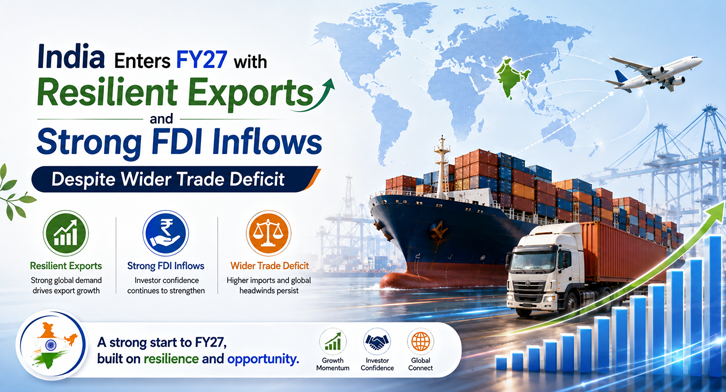
India has started FY2026-27 with a resilient external sector, supported by strong merchandise exports, robust services exports and a renewed flow of foreign direct investment (FDI), even as rising imports continue to widen the merchandise trade deficit.
The Reserve Bank of India (RBI) has highlighted the strength of India’s external position amid elevated crude oil prices, strong domestic demand and continuing global trade uncertainties. While higher imports are putting pressure on the trade balance, strong services exports, remittances and foreign capital inflows are providing important support to the economy.
- India’s merchandise exports reached US$129.3 billion in Q1 FY27, registering 15.9% year-on-year growth.
- Merchandise imports rose to US$216.2 billion, up 19.9% year-on-year.
- The merchandise trade deficit widened as imports grew faster than exports.
- Gross FDI inflows increased to US$30.7 billion during April–June 2026, compared with US$26.7 billion a year earlier.
- Net FDI inflows rose to US$7.9 billion in Q1 FY27 from US$4.8 billion in Q1 FY26.
- Strong services exports and private remittances continue to provide a buffer against the merchandise trade gap.
- India’s foreign exchange reserves remain comfortable, providing protection against external shocks.
India’s Exports Maintain Momentum in FY27
India’s merchandise exports showed strong momentum during the first quarter of FY2026-27.
According to RBI data, merchandise exports increased to US$129.3 billion in Q1 FY27, compared with US$111.6 billion in the corresponding period of the previous year. This represents a 15.9% year-on-year increase.
The growth was supported by sectors including petroleum products, engineering goods and electronic goods, highlighting the increasing diversification of India’s export base.
This resilience is particularly significant as global trade remains exposed to geopolitical tensions, energy-price volatility and changes in trade policy.
Imports Grow Faster, Widening the Trade Deficit
While exports performed strongly, India’s imports expanded at an even faster pace.
Indicator
Q1 FY26
Q1 FY27
Change
Merchandise Exports
US$111.6 bn
US$129.3 bn
0.159
Merchandise Imports
US$180.3 bn
US$216.2 bn
0.199
Merchandise Trade Deficit
US$68.7 bn
US$86.6 bn
↑ US$17.9 bn
The increase in imports reflects strong domestic demand as well as higher purchases of key commodities and manufactured products. Crude oil, electronic goods and gold were among the important contributors to the wider import bill.
For India’s logistics industry, this combination of rising exports and imports points to continued demand for ocean freight, air cargo, customs clearance, warehousing, transportation and multimodal logistics services.
Services Exports Provide a Critical Cushion
India’s external sector is not dependent on merchandise trade alone.
The country’s growing services economy continues to offset part of the merchandise trade deficit. Software services, business services and Global Capability Centres (GCCs) remain important contributors to India’s services exports.
During April–May 2026, India’s services trade surplus increased to US$34.3 billion, compared with US31.7During April–May 2026, India’s services trade surplus increased to US$34.3 billion.
This combination of services earnings and remittance inflows helps reduce pressure on India’s current account despite the widening merchandise trade gap.
FDI Inflows Signal Continued Investor Confidence
Foreign investment is another major strength in India’s external sector.
Gross FDI inflows increased 14.8% year-on-year during April–June 2026, reaching US$30.7 billion, compared with US$26.7 billion during the same period of the previous year.
More importantly, net FDI inflows increased to US$7.9 billion, up from US$4.8 billion in Q1 FY26.
The recovery in foreign investment indicates that global investors continue to view India as an important destination for manufacturing, technology, infrastructure and services investment.
India’s External Sector: What Is Supporting It?
India’s external resilience can be understood through four major pillars:
At the same time, higher crude oil prices and import demand remain important risks to India’s trade balance.
What Does This Mean for the Logistics Industry?
India’s export and import growth has direct implications for the country’s logistics ecosystem.
1. Higher Container Demand
Growing merchandise exports can increase demand for containerised ocean freight, particularly across engineering, electronics and manufactured goods.
2. Rising Air Cargo Opportunities
High-value and time-sensitive products such as electronics, components and technology products can support continued growth in air freight.
3. Greater Demand for Customs Automation
As trade volumes increase, exporters and importers need faster documentation, customs filing and compliance processes.
4. Expansion of Warehousing
Growing manufacturing and import activity can increase demand for regional distribution centres, bonded warehouses and integrated logistics facilities.
5. Stronger Multimodal Logistics
India’s expanding manufacturing and export base is likely to increase demand for coordinated road, rail, port and shipping connectivity.
6. Greater Need for Digital Freight Management
Higher cargo volumes can make manual freight processes increasingly difficult to manage. Freight forwarders and logistics companies can benefit from automation across quotations, bookings, documentation, tracking, invoicing and financial reconciliation.
Q1 FY27 External Sector Snapshot
Area
Q1 FY27 Performance
Logistics Significance
Merchandise exports
US$129.3 bn
Higher outbound cargo demand
Merchandise imports
US$216.2 bn
Increased inbound cargo movement
Trade deficit
US$86.6 bn
Higher import dependence
Gross FDI
US$30.7 bn
Potential manufacturing & infrastructure investment
Net FDI
US$7.9 bn
Stronger external financing
Services surplus
US$52.2 bn
Supports external-sector stability
Net transfers
US$41.4 bn
Additional external-sector support
The RBI’s latest balance-of-payments data also show that the merchandise trade deficit widened to US$85.7 billion in Q1 FY27, while the services surplus increased to “US$52.2 billion and net transfers rose to US$41.4 billion.
The Bigger Picture for India's Trade and Logistics Sector
India’s external sector is entering FY27 with both opportunities and challenges.
On one side, stronger exports, rising services earnings and increased FDI indicate that India’s trade and investment ecosystem remains resilient. On the other, faster import growth and elevated energy costs could continue to put pressure on the merchandise trade balance.
The RBI expects healthy services exports, inward remittances and trade agreements—including the India-UK trade deal—to help mitigate some of the risks facing India’s current account.
For logistics companies, the message is clear: India’s trade volumes are expanding, but managing that growth efficiently will require greater visibility, automation and digital coordination across the supply chain.
What to Watch in FY27
The following factors will be important for India’s logistics and trade outlook during FY27:
- Global crude oil prices
- India's merchandise export growth
- Import demand for electronics, energy and industrial goods
- Global shipping and freight rates
- India-UK trade developments
- Foreign investment trends
- Global trade-policy changes
- Container availability and port congestion
- Growth in manufacturing and electronics exports
- Demand for multimodal transportation
Conclusion
India’s entry into FY27 presents a mixed but fundamentally resilient external-sector picture. Merchandise imports are putting pressure on the trade balance, but strong exports, expanding services earnings, rising remittances and renewed FDI inflows are helping maintain overall stability.
For India’s logistics industry, continued growth in trade and investment could create new opportunities across freight forwarding, container shipping, air cargo, warehousing, customs, transportation and digital supply-chain management.
As global trade becomes more volatile and cargo volumes increase, logistics companies that combine operational efficiency, real-time visibility and automation will be better positioned to capture the next phase of India’s trade growth.
Frequently Asked Questions
Is India's trade deficit increasing in FY27?
Yes. India’s merchandise trade deficit widened in Q1 FY27 as imports grew faster than exports. RBI data put the Q1 merchandise trade deficit at around US$86 billion.
Are India's exports growing in FY27?
Yes. Merchandise exports increased 15.9% year-on-year to US$129.3 billion in Q1 FY27.
How much FDI did India receive in Q1 FY27?
Gross FDI inflows reached US$30.7 billion during April–June 2026, while net FDI inflows increased to US$7.9 billion.
Why is India's trade deficit widening?
Imports are growing faster than exports. Higher demand for crude oil, electronics, gold and other imported goods has contributed to the increase in India’s merchandise import bill.
How can India's export growth affect logistics?
Higher exports can increase demand for container shipping, air cargo, trucking, warehousing, customs clearance, freight forwarding and multimodal transportation services.