
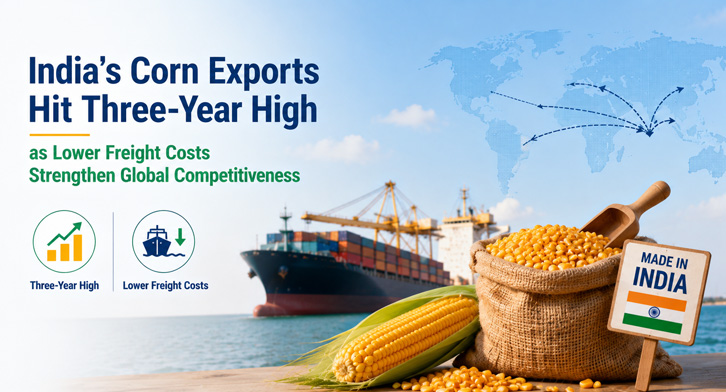
India’s corn (maize) exports have surged to their highest level in three years, driven by declining ocean freight rates, competitive export prices, and improving demand from international buyers. Lower logistics costs have significantly enhanced India’s competitiveness in the global grain market, enabling exporters to secure larger orders across Asia and other key importing regions.
The latest export momentum reflects how efficient logistics and stable agricultural production are helping India strengthen its position as a reliable supplier of feed grains in global markets. With abundant domestic availability and attractive pricing, Indian corn has become increasingly appealing to buyers seeking alternative sourcing destinations.
Key Highlights
- India's corn exports reached a three-year high.
- Lower freight costs improved export competitiveness.
- Strong demand from Asian and global feed grain markets boosted shipments.
- Competitive pricing helped Indian exporters win international orders.
- Improved logistics and shipping conditions supported faster exports.
- Healthy domestic production ensured sufficient exportable surplus.
- Global buyers are diversifying sourcing strategies, benefiting Indian exporters.
- Export outlook remains positive, subject to global prices and crop production.
Why Are India's Corn Exports Rising?
India’s export growth has been primarily fueled by a sharp decline in international freight costs. Lower shipping expenses have reduced the overall landed cost of Indian corn, making it more attractive than supplies from competing exporting nations.
Improved logistics efficiency, better vessel availability, and smoother supply chain operations have also enabled exporters to deliver shipments more competitively and reliably.
As transportation costs decline, exporters are able to offer more competitive prices without compromising margins, strengthening India’s position in international agricultural trade.
Global Demand Continues to Support Indian Corn
International demand for feed grains remains strong due to expanding livestock, poultry, and animal feed industries across several countries.
Many importing nations are also diversifying their sourcing strategies to reduce dependence on a limited number of suppliers. This has created new opportunities for Indian exporters, particularly in Asian markets where competitive pricing is a key purchasing factor.
India’s large harvest and exportable surplus have allowed exporters to respond quickly to growing international demand.
Logistics Costs Become a Competitive Advantage
Freight expenses represent a major component of agricultural export pricing. The recent decline in shipping costs has significantly improved India’s export competitiveness.
Key logistics factors supporting exports include:
- Lower ocean freight rates
- Improved shipping availability
- Faster cargo movement
- Faster cargo movement
- Faster cargo movement
- Reduced overall export costs
These improvements have helped Indian corn compete more effectively against exports from other major producing countries.
Outlook for India's Corn Exports
Industry experts expect exports to remain strong over the coming months, supported by:
- Stable domestic production
- Continued global demand for feed grains
- Competitive export pricing
- Improved logistics infrastructure
- Efficient supply chain management
Industry experts expect exports to remain strong over the coming months, supported by:
- Global corn prices
- Weather and crop output
- International freight rates
- Trade policies
- Currency movements
- Demand from importing countries
Why This Matters for India's Logistics Sector
The increase in corn exports highlights the growing importance of efficient logistics in agricultural trade. Lower transportation costs and improved supply chain performance are enabling Indian exporters to compete more effectively in international markets.
As India’s agricultural exports continue to expand, investments in ports, shipping, warehousing, multimodal transport, and export infrastructure will play a crucial role in sustaining export growth and strengthening India’s position in global food supply chains.
FAQs
Why have India's corn exports reached a three-year high?
India’s corn exports have increased due to lower freight costs, competitive pricing, strong domestic production, improved logistics efficiency, and rising international demand for feed grains.
Which factors are driving India's corn exports?
The key drivers include reduced shipping costs, exportable surplus, growing global demand, efficient logistics, and competitive pricing in international markets.
How do lower freight costs benefit agricultural exports?
Lower freight costs reduce the total cost of exports, making Indian products more price competitive and attractive to overseas buyers.
Will India's corn exports continue to grow?
Export prospects remain positive, although future growth will depend on global commodity prices, crop production, freight rates, and international trade conditions.