
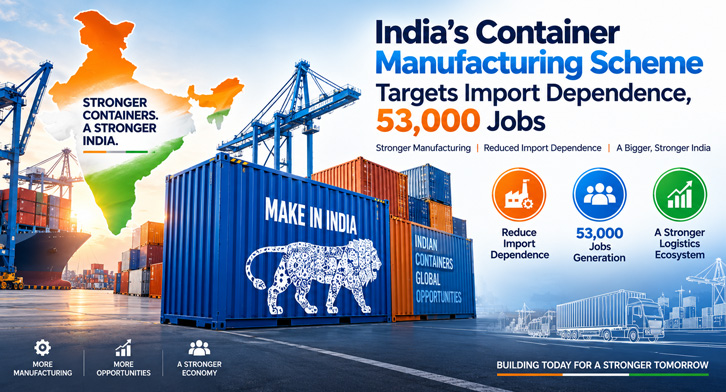
India is moving to build a stronger domestic container manufacturing ecosystem as the government’s proposed Container Manufacturing Assistance Scheme (CMAS) seeks to reduce dependence on imported containers, strengthen supply-chain resilience and create more than 53,000 direct and indirect employment opportunities.
The proposed scheme, announced as part of the Union Budget 2026-27, carries an allocation of ₹10,000 crore over five years. It is aimed at encouraging investments in container manufacturing, expanding production capacity and supporting the development of technologies and a domestic supplier ecosystem.
Key Highlights
- ₹10,000 crore proposed allocation over five years
- More than 53,000 jobs expected to be generated
- Around 3,000 direct jobs and over 50,000 indirect employment opportunities
- Potential investment of approximately ₹99,149 crore
- Proposed development of a fleet of 51 container vessels of different sizes
- Broader manufacturing framework targets capacity of up to 7.5 lakh TEUs annually
- Focus on reducing India's dependence on imported containers
- Expected opportunities for component manufacturers, MSMEs and logistics-equipment suppliers
Why India Wants to Manufacture More Containers
Containers are critical to India’s international trade, particularly for the movement of manufactured goods, agricultural products, engineering products and other export commodities.
However, India’s reliance on imported containers can expose exporters, shipping lines and logistics operators to supply disruptions, repositioning challenges and international market fluctuations.
The proposed CMAS is therefore intended to build greater domestic availability of containers while creating a manufacturing base that can support India’s expanding trade and maritime logistics requirements.
A stronger domestic container industry could also help reduce supply-chain vulnerabilities during periods of global disruption, when container availability and freight equipment positioning become major operational challenges.
₹99,149-Crore Investment Opportunity
According to the government’s estimates, the initiative could support investments of approximately ₹99,149 crore linked to the development of a fleet of 51 container vessels of different sizes as well as domestic container procurement.
This investment potential could create demand across a wider maritime manufacturing and logistics ecosystem rather than being limited to container factories.
Key Indicator
Proposed/Estimated Impact
Government scheme allocation
₹10,000 crore
Scheme duration
5 years
Direct employment
~3,000
Indirect employment
50,000+
Total employment potential
53,000+
Potential investment
~₹99,149 crore
Container vessel fleet
51 vessels
Target annual container manufacturing capacity
Up to 7.5 lakh TEUs
From Container Manufacturing to a Wider Supply Chain
The proposed manufacturing ecosystem is expected to extend beyond the assembly of containers.
Industries supplying critical components and materials could also benefit from the programme. These include manufacturers of corner castings, Corten steel, wooden flooring and other container-related components and equipment.
This could create opportunities for domestic suppliers and small and medium enterprises while increasing the local value addition associated with container production.
India Targets 7.5 Lakh TEUs of Annual Capacity
The proposed CMAS is part of a broader government push to establish a globally competitive container manufacturing industry.
In July, the Ministry of Ports, Shipping and Waterways outlined a wider framework targeting annual container manufacturing capacity of up to 7.5 lakh TEUs.
The framework is expected to combine capital assistance, operational incentives, research and development, testing facilities and technology development to accelerate the growth of the domestic industry.
This approach could help India move beyond simply increasing container volumes and instead build the supporting technology, manufacturing and testing capabilities required for a globally competitive sector.
What the Scheme Could Mean for the Logistics Industry
For freight forwarders, shipping lines, exporters, importers and logistics service providers, increased domestic container production could have several long-term implications.
1. Improved container availability
Greater domestic production could help address shortages and reduce dependence on overseas sources of empty containers.
2. Stronger supply-chain resilience
Domestic manufacturing could provide an additional layer of protection against international supply disruptions affecting the availability of logistics equipment.
3. Growth in domestic manufacturing
Container production could stimulate demand for steel, flooring, fittings, components, machinery and other industrial inputs.
4. Opportunities for MSMEs
Smaller manufacturers and suppliers could participate in the expanding ecosystem through component production and supporting services.
5. Support for India’s maritime ambitions
The initiative aligns with broader efforts to strengthen shipping, shipbuilding and port-related manufacturing capabilities within India.
Why This Matters for Indian Trade
India’s ambition to increase its role in global trade requires not only larger ports and stronger shipping networks but also reliable access to the physical equipment required to move cargo.
Containers are a fundamental part of this infrastructure.
By developing domestic manufacturing capacity, India is attempting to create a more integrated maritime supply chain in which ports, ships, containers, manufacturers and logistics providers are increasingly supported by domestic capabilities.
The move could become particularly important as India’s merchandise trade expands and exporters seek more reliable logistics capacity.
What Happens Next?
The success of the container manufacturing initiative will ultimately depend on how effectively the proposed financial support translates into actual manufacturing capacity.
Key areas to watch will include:
- Speed of scheme implementation
- Private-sector investment commitments
- Development of container manufacturing clusters
- Availability of specialised steel and components
- Technology and testing capabilities
- Integration with Indian ports and shipping networks
- Participation of MSMEs in the supplier ecosystem
- Actual growth in domestic container production
Container Manufacturing Push Could Strengthen
India’s Logistics and Maritime Supply Chain
India’s proposed ₹10,000-crore Container Manufacturing Assistance Scheme represents a strategic attempt to address a critical but often overlooked component of the logistics ecosystem: the availability of containers.
With an estimated potential to generate more than 53,000 jobs, support approximately ₹99,149 crore in investment and contribute to a manufacturing capacity of up to 7.5 lakh TEUs annually, the initiative could have implications well beyond the container industry.
For India’s logistics sector, the bigger opportunity lies in building an integrated domestic ecosystem covering container manufacturing, component production, shipping, shipbuilding, ports and multimodal logistics.
If implemented effectively, the initiative could help India reduce import dependence while strengthening the infrastructure needed to support its ambitions as a major global trading and manufacturing hub.
Frequently Asked Questions
What is India's Container Manufacturing Assistance Scheme?
It is a proposed government initiative designed to promote domestic container manufacturing, reduce import dependence and build a globally competitive container manufacturing ecosystem.
How much has the government allocated for the container manufacturing scheme?
The proposed scheme has an allocation of ₹10,000 crore over five years.
How many jobs could the scheme create?
The initiative is expected to create more than 53,000 jobs, including around 3,000 direct jobs and more than 50,000 indirect employment opportunities.
What is India's proposed container manufacturing capacity?
The broader container manufacturing framework targets annual production capacity of up to 7.5 lakh TEUs.
Why is India promoting domestic container manufacturing?
The objective is to reduce dependence on imported containers, improve equipment availability, strengthen supply-chain resilience and support India’s maritime and manufacturing ecosystem.