
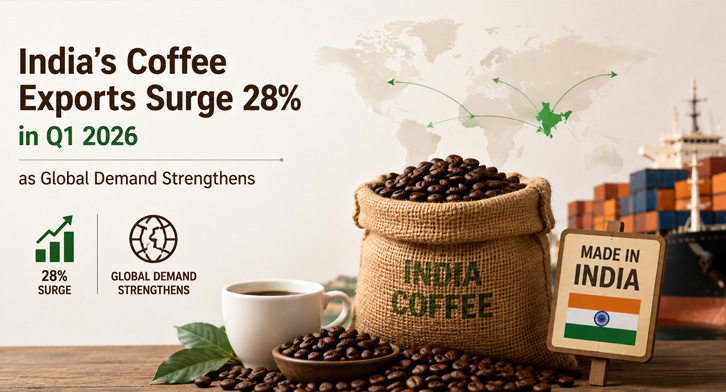
India’s coffee export industry has started 2026 on a strong note, with export volumes rising 28% year-on-year during the first quarter (Q1 2026). Export value also increased by 12%, reflecting sustained international demand for Indian coffee despite fluctuations in global commodity prices.
The strong performance highlights India’s growing reputation as a reliable supplier of premium-quality coffee while creating fresh opportunities for exporters, logistics providers, container shipping companies, and supply chain operators.
The strong performance highlights India’s growing reputation as a reliable supplier of premium-quality coffee while creating fresh opportunities for exporters, logistics providers, container shipping companies, and supply chain operators.
Key Highlights
- Coffee export volumes increased by 28% in Q1 2026 compared to the same period last year
- Export value rose by 12%, supported by healthy overseas demand.
- Strong international demand for both Arabica and Robusta coffee varieties.
- Competitive pricing helped Indian exporters gain market share.
- Improved crop availability supported higher shipment volumes.
- Increased demand for container transportation, warehousing, and inland freight services.
- Exporters continue investing in premium coffee, traceability, and sustainable production.
India's Coffee Exports Continue Upward Momentum
India’s coffee exports witnessed impressive growth during the first quarter of 2026, driven by rising demand from international buyers and improved domestic production. Export volumes climbed by 28% year-on-year, while export earnings recorded a healthy 12% increase, demonstrating the resilience of India’s coffee industry in an evolving global market.
The growth reflects increasing confidence among overseas buyers in Indian coffee, particularly premium Arabica and Robusta varieties that continue to gain popularity across traditional and emerging markets.
Why Are India's Coffee Exports Growing?
Several factors contributed to the strong export performance:
Growing Global Demand
International buyers are increasingly sourcing coffee from India due to its consistent quality, unique flavour profiles, and reliable supply chain. Demand remains strong from established coffee-consuming markets while emerging economies are also expanding their imports.
Competitive Pricing
Indian coffee exporters benefited from competitive pricing, allowing them to remain attractive despite changing global market conditions and increased competition from other producing nations.
Better Crop Availability
Improved harvests and stable production enabled exporters to fulfil larger international orders without major supply disruptions.
Expansion of Premium Coffee
Demand for specialty and premium coffee continues to rise worldwide, encouraging Indian producers to focus on higher-value products with better traceability and sustainable farming practices.
Export Value Grew Despite Softer Global Prices
Although shipment volumes increased sharply, export value grew at a comparatively slower pace.
This indicates that international coffee prices remained relatively soft during the quarter, while the export basket also included a larger share of competitively priced products. Even so, the increase in export earnings demonstrates the industry’s ability to maintain growth despite price volatility in global commodity markets.
Positive Impact on India's Logistics Industry
Higher coffee exports are creating significant opportunities across India’s logistics and supply chain ecosystem.
Growing shipment volumes have increased cargo movement through major ports, leading to stronger demand for:
- Container shipping
- Inland transportation
- Freight forwarding services
- Warehousing and storage
- Export documentation
- Customs clearance
- Port handling operations
- Supply chain management
Coffee-producing regions in southern India, along with export gateways on the western and southern coasts, are witnessing higher logistics activity as exporters accelerate shipments to overseas buyers.
Outlook for Coffee Exports
Industry experts remain optimistic about export performance for the remainder of 2026.
Several factors are expected to support continued growth:
- Expansion into new international markets
- Rising global coffee consumption
- Strong demand for premium and specialty coffee
- Improved sustainability initiatives
- Better traceability across supply chains
- Investments in processing and logistics infrastructure
- Enhanced export competitiveness
If these trends continue, India is well-positioned to strengthen its presence in the global coffee trade while supporting agricultural exports and rural economic growth.
What This Means for the Logistics Sector
For logistics providers, freight forwarders, shipping companies, and warehouse operators, higher coffee exports translate into increased business opportunities.
As export volumes grow, demand is expected to rise for efficient multimodal transportation, temperature-controlled storage, faster customs processing, digital documentation, and reliable international shipping services.
The continued expansion of agricultural exports also reinforces India’s position as an important global logistics and supply chain hub.
FAQs
Why did India's coffee exports increase in Q1 2026?
Coffee exports grew due to stronger global demand, competitive pricing, improved crop availability, and rising demand for premium Arabica and Robusta coffee.
How much did India's coffee exports grow?
Export volumes increased by 28% year-on-year, while export value rose by 12% during the first quarter of 2026.
Why did export value grow slower than export volume?
Global coffee prices remained relatively soft, and changes in the export product mix resulted in export value growing more slowly than shipment volumes.
How do higher coffee exports benefit the logistics industry?
Higher exports increase demand for container shipping, freight forwarding, warehousing, customs clearance, inland transportation, and port logistics services.
What is the outlook for India's coffee exports?
Industry outlook remains positive, supported by expanding global demand, premium coffee exports, sustainable production, improved logistics infrastructure, and growing international market access.