Industrial and Logistics Hubs to Dominate India’s Warehousing Growth

High-activity industrial clusters are expected to account for nearly 70–80% of India’s Grade A industrial and warehousing demand and supply in the coming years, according to a report by Colliers India. The report highlighted that Chennai leads the country with three major high-activity warehousing clusters, reflecting the city’s growing importance in India’s logistics and manufacturing ecosystem.
High-activity clusters are defined as micro markets that have recorded cumulative demand and supply exceeding 4 million sq ft since 2021. These hubs are emerging as the core drivers of India’s logistics expansion and industrial infrastructure growth.

Key Highlights

Infrastructure Driving Warehousing Growth

The report noted that infrastructure development remains a major growth driver for industrial and warehousing demand. Projects such as dedicated freight corridors, logistics parks, expressways and industrial corridors are strengthening connectivity and improving supply-chain efficiency across regions.
Key industrial hubs include:
Southern clusters such as Oragadam and NH16 in Chennai are witnessing strong demand due to seaport access and improved connectivity through the Bengaluru-Chennai Expressway.

Emerging Tier II Markets Gain Momentum

The report also highlighted growing opportunities in emerging Tier II markets including:
These cities are expected to become important supply-chain and distribution centres as e-commerce, manufacturing and export-oriented industries continue to expand across India.
Industry experts believe the rapid expansion of institutional-grade warehousing assets and integrated logistics infrastructure will further strengthen India’s position as a major logistics and manufacturing hub in the Asia-Pacific region.

India-Japan Economic Cooperation Gains Momentum in Technology and Infrastructure

India and Japan are expanding bilateral cooperation in critical minerals, semiconductors and information and communication technology (ICT) to strengthen supply-chain resilience and deepen strategic economic collaboration. The discussions took place during the India-Japan Economy and Investment Forum, where policymakers and industry leaders highlighted the growing importance of partnerships in advanced manufacturing, digital infrastructure and emerging technologies.
Both countries are focusing on enhancing cooperation in semiconductor supply chains, electronics manufacturing, rare earth minerals and clean energy technologies amid rising global demand for diversified and resilient industrial ecosystems. The growing India-Japan partnership reflects a shared vision to reduce dependence on concentrated global supply chains while accelerating technology-driven economic growth.

Key Highlights of India-Japan Cooperation

Semiconductor and Technology Collaboration Expanding

Industry experts noted that India’s rapidly growing semiconductor ecosystem, skilled talent pool and expanding digital infrastructure offer significant opportunities for Japanese investment and technology partnerships.
The discussions also focused on increasing collaboration in:
The partnership is expected to support long-term growth in advanced electronics manufacturing and technology development across both nations.

Critical Minerals to Support Future Industries

India and Japan are also strengthening cooperation in critical minerals and rare earth supply chains, which are essential for industries such as:
Experts believe enhanced collaboration in these sectors could improve supply security and accelerate clean energy transitions in both countries.

India-Japan Strategic Partnership Gains Momentum

India and Japan have continued to deepen economic ties through infrastructure development, industrial corridor projects and technology collaborations under their Special Strategic and Global Partnership framework.
The growing cooperation aligns with India’s broader objective of becoming a global hub for advanced manufacturing, semiconductor production and digital innovation while attracting greater international investments and strengthening technological capabilities.

Bharat Maritime Insurance Pool of USD 1.5 billion now operational

India is planning large multimodal logistics hubs to strengthen cargo connectivity, improve supply-chain efficiency and support growing domestic and international trade. The proposed projects will integrate road, rail, port and inland waterways infrastructure to enable faster and seamless cargo movement across the country.
The initiative has attracted strong interest from global container shipping lines and logistics operators, who view the projects as a major step toward enhancing India’s logistics competitiveness and transport efficiency.

Key Highlights

Officials stated that the logistics hubs will improve connectivity for manufacturing centres, industrial corridors and export businesses while supporting efficient freight transportation across regions. Industry experts believe the projects could position India as a leading regional logistics and manufacturing hub while encouraging greater private sector participation in warehousing, integrated transport and supply-chain infrastructure development.

M.V. Zhong Gu Nan Jing Makes Inaugural Call at NSFT Under HERCULES Service

NSFT proudly welcomed the maiden call of the vessel M.V. Zhong Gu Nan Jing, operated by X-Press Feeders under its HERCULES Service. The arrival of the vessel marks an important milestone in strengthening maritime connectivity between Southeast Asia and the Indian Subcontinent.
The newly introduced HERCULES Service is expected to enhance regional shipping connectivity, facilitate smoother cargo movement and provide wider market access for exporters, importers and logistics stakeholders across the region.

Key Highlights

Strengthening Regional Maritime Connectivity

The launch of the HERCULES Service reflects the growing importance of regional shipping networks in supporting international trade and efficient supply-chain operations. The new service is expected to improve container movement, reduce transit challenges and create enhanced trade opportunities for businesses operating across Asian markets.
To commemorate the maiden call, NSFT organised a special event with representatives from the vessel and shipping line, highlighting the significance of the partnership and the continued expansion of maritime services at the terminal.

Supporting Trade and Logistics Growth

Industry stakeholders believe the addition of new shipping services will help:
With every new vessel service, NSFT continues to reinforce its position as a key gateway for global trade, maritime logistics and international cargo connectivity.

India and Oman Explore New Opportunities in Maritime Trade and Logistics

India and Oman are deepening bilateral maritime cooperation through high-level discussions focused on strengthening partnerships in shipping, logistics, warehousing and port infrastructure development. The strategic meeting was chaired by Venkatesapathy S., Joint Secretary at the Ministry of Ports, Shipping and Waterways, along with an Omani delegation and key Indian maritime industry stakeholders.
The meeting served as an important platform to explore new opportunities for collaboration in maritime connectivity, multimodal logistics infrastructure, supply chain integration and port-led economic development between the two nations.

Key Highlights of India-Oman Maritime Discussions

Focus on Port Development and Logistics Connectivity

During the discussions, both countries emphasised the need to strengthen port-led infrastructure and improve coastal and container shipping connectivity to support growing trade volumes across the Indian Ocean region.
The stakeholders also explored opportunities for:
These initiatives are expected to improve regional trade efficiency and support economic growth between India and Oman.

Smart and Sustainable Maritime Initiatives

The meeting also focused on promoting sustainable and technology-driven maritime solutions. Both sides discussed increasing collaboration in:
Industry experts believe such initiatives can help create more resilient and future-ready maritime ecosystems.

Growing India-Oman Strategic Partnership

The Omani delegation expressed strong interest in expanding partnerships with Indian ports, logistics companies and infrastructure developers. Indian stakeholders highlighted the growing potential for increased trade, investment flows and regional connectivity through stronger maritime engagement.
The discussions concluded with a shared commitment to continue bilateral dialogue, knowledge exchange and collaborative projects aimed at strengthening maritime connectivity, supply chain resilience and long-term economic cooperation between India and Oman.

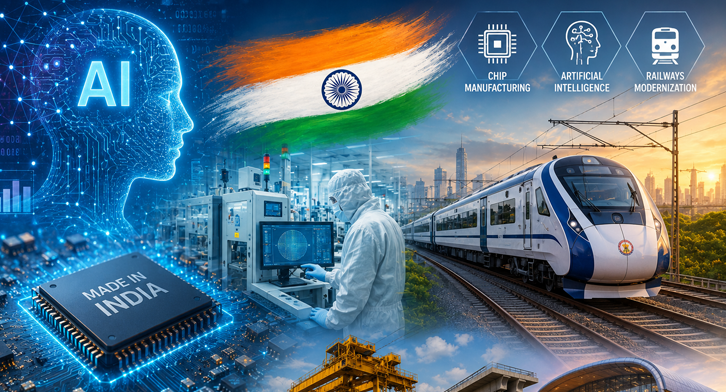
India Focuses on AI, Chip Manufacturing and Railways for Long-Term Economic Growth

India is rapidly emerging as a global technology and manufacturing powerhouse, with artificial intelligence (AI), semiconductors and railway infrastructure expected to play a major role in driving the country’s next phase of economic growth. Speaking at the CII Annual Business Summit 2026, Union Minister Ashwini Vaishnaw stated that India’s continued investments in digital technologies, electronics manufacturing and railway modernisation are strengthening the nation’s industrial competitiveness and long-term economic resilience.
The Minister highlighted that India has made significant progress in railway infrastructure over the past decade, adding nearly 36,000 kilometres of railway tracks and electrifying around 49,000 kilometres of rail lines. Railway capital expenditure also increased sharply to approximately Rs. 2.72 lakh crore (US$ 28.78 billion) in the previous financial year, reflecting the government’s strong focus on infrastructure-led development.
Mr. Vaishnaw noted that India’s emphasis on quality manufacturing, process efficiency and cost competitiveness is helping position the country as a major global manufacturing and technology hub. He further stated that AI is becoming one of the world’s most transformative technologies and can significantly improve productivity, operational efficiency and manufacturing quality across industries.
The Minister also emphasised that expanding semiconductor investments and new electronics manufacturing facilities are laying the foundation for a technologically advanced and self-reliant India. Government initiatives such as the India Semiconductor Mission and India AI Mission are accelerating growth in semiconductor production, digital infrastructure and AI innovation.

Key Highlights

Industry experts believe the combined expansion of railway infrastructure, semiconductor manufacturing and AI technologies could significantly boost employment generation, industrial growth, exports and India’s position in global value chains. The continued focus on technology-driven and infrastructure-led development reflects the government’s broader vision of building a “Viksit Bharat” and transforming India into a leading global innovation and manufacturing economy.

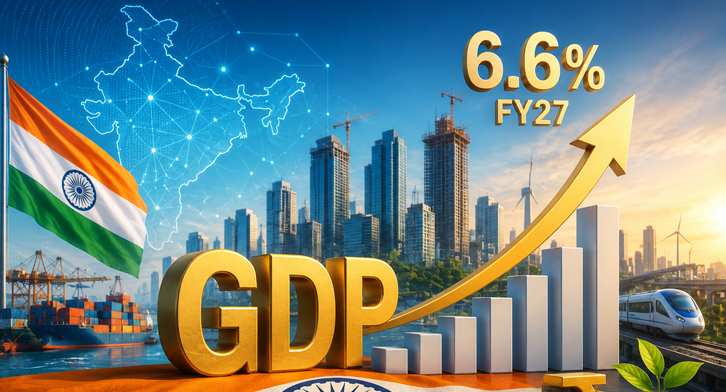
India’s GDP Growth Projected at 6.6% for FY27 Amid Strong Economic Momentum

India’s economy is expected to grow by 6.6% in FY27, according to a latest report released by SBI Research in May 2026. The report highlighted that the Indian economy continues to remain resilient despite ongoing global uncertainties, geopolitical tensions and volatility in international markets.
The report estimates India’s GDP growth for FY26 at 7.5%, while real GDP growth during the fourth quarter of FY26 is expected to remain close to 7.2%, reflecting strong economic fundamentals and sustained domestic demand.

Key Highlights from SBI Research Report

Strong Domestic Consumption Supporting Growth

According to the report, rising domestic consumption, improving rural demand and sustained credit expansion are expected to drive economic momentum in FY27.
Rural consumption remained healthy due to strong agricultural and non-farm activity, while urban demand received support from government fiscal measures, festive spending and improving consumer confidence.

Banking and Credit Growth Remain Robust

The report highlighted significant improvement in banking sector performance during FY26. Credit growth by scheduled commercial banks increased to 16.1%, compared to 11% in the previous financial year.
The second half of FY26 witnessed stronger lending activity, indicating rising investment demand and improving business sentiment across sectors.

Economic Indicators Reflect Stability

SBI Research noted that high-frequency economic indicators continue to reflect stable economic activity despite slight moderation in the final quarter of FY26.
Key sectors including manufacturing, services, infrastructure and retail consumption continued to support India’s growth trajectory amid challenging global conditions.

Challenges and Inflation Risks Ahead

Despite the positive outlook, the report cautioned that fluctuations in crude oil prices, commodity market volatility and possible El Niño weather conditions could create inflationary pressures in the near term.
The report also stressed the importance of structural reforms to:

India Maintains Position as Fast-Growing Major Economy

The latest SBI Research projections reinforce India’s position as one of the world’s fastest-growing major economies. Strong domestic demand, improving financial conditions and continued infrastructure investment are expected to support sustainable economic growth in the coming years.

Strong Infrastructure Demand Drives India’s Construction Equipment Industry Growth

India’s construction equipment industry achieved record-breaking growth in FY 2025-26, driven by rapid infrastructure development, strong government investment and rising global demand for Indian-made heavy machinery. According to the Ministry of Heavy Industries, the sector recorded total sales of 1,40,191 units during the financial year, registering a 3% year-on-year (YoY) increase.

Key Highlights of India’s Construction Equipment Industry Growth

Infrastructure Push Driving Industry Expansion

The continued expansion of India’s infrastructure sector has played a major role in boosting demand for construction machinery and heavy equipment. Large-scale public investments in roads, smart cities, rail connectivity, mining operations and industrial corridors have accelerated mechanisation across the country.
Government-backed infrastructure initiatives have significantly supported manufacturing growth and technology adoption within the industry.

Government Policies Supporting Growth

Several flagship government programmes have strengthened India’s construction equipment ecosystem, including:
Production Linked Incentive (PLI) Scheme
The PLI scheme has encouraged domestic manufacturing, localisation and advanced technology adoption in heavy engineering and industrial equipment production.
National Infrastructure Pipeline (NIP)
The NIP has boosted long-term infrastructure investments across transportation, logistics, energy and urban development sectors.
PM Gati Shakti Programme
The PM Gati Shakti initiative has improved multi-modal infrastructure planning, accelerating construction activities and increasing demand for modern machinery.

Rising Global Demand for Indian Construction Equipment

India’s construction equipment exports witnessed remarkable momentum during FY 2025-26. Indian-made machinery is increasingly gaining acceptance in international markets due to its competitive pricing, improved quality and fuel-efficient technology.
Key export destinations include:
Industry experts believe India is becoming an important player in the global construction equipment supply chain as manufacturers continue expanding production capacity and improving engineering capabilities.

Growing Demand for Advanced Equipment

The market has also seen rising demand for:
This shift reflects the industry’s growing focus on productivity, energy efficiency and modern infrastructure development.

India Remains a Strategic Growth Market as Maersk Reaffirms Long-Term Commitment

Global shipping and logistics leader A.P. Moller–Maersk has reaffirmed its long-term commitment to India following a high-level meeting between Maersk Chairman Robert Maersk Uggla and Prime Minister Narendra Modi in Sweden. The discussions highlighted the growing strategic partnership between India and Maersk, with a focus on ports, logistics infrastructure, maritime development, workforce expansion, and global trade opportunities.

Strengthening India–Maersk Strategic Partnership

Maersk emphasized its continued support for India’s ambitions to become a global maritime and logistics hub, aligning with the country’s long-term trade and infrastructure vision.

Key Highlights:

India Set to Lead G20 Growth in FY27: Moody’s Projects 6.4% GDP Expansion

India is expected to remain the fastest-growing major economy in the world.

In its latest outlook, Moody’s Ratings has projected India’s GDP to grow at 6.4% in FY27, the highest among all G20 economies. The growth outlook reflects strong domestic demand, policy momentum, and a resilient banking system — all critical indicators for the logistics and freight sector.

For businesses in shipping, freight forwarding, warehousing, and cross-border trade, this signals continued expansion opportunities.

What’s Driving India’s Growth?

Moody’s highlights several structural strengths powering the Indian economy:

This steady macroeconomic foundation creates a positive outlook for trade volumes, cargo movement, and infrastructure investment.

GDP Forecast: How It Compares

Here’s how the projections stack up:

While Moody’s estimate is slightly conservative compared to government expectations, India still outpaces other G20 economies in projected growth.

Banking System Outlook: A Key Signal for Trade & Logistics

A stable banking system is critical for working capital, trade finance, and freight credit cycles.
Moody’s notes:
For logistics businesses, this means continued access to funding and trade finance, especially important for freight forwarders and exporters.

Credit Growth & Interest Rate Environment

Lower borrowing costs could further stimulate:

What This Means for the Logistics Sector

For freight forwarders, transporters, and supply chain players:
This macro momentum directly supports sectors like:

How CargoNet Helps Logistics Businesses Capture This Growth

As volumes rise and operations scale, logistics companies need greater visibility, control, and financial clarity. Digital logistics platforms like CargoNet play a critical role in enabling this transition.
CargoNet helps logistics and freight businesses:

Key Takeaways

As India’s economic momentum drives higher trade volumes and more complex supply chains, logistics businesses must evolve with speed and precision. CargoNet enables freight forwarders and logistics companies to operate smarter, stay compliant, and scale confidently in the world’s fastest-growing major economy.
cargonet-logo-icon
Cargonet Cargo Software Logo

Feedback & Reward program

Submit the Feedback and avail the Rewards.

1. Your satisfaction & reliability on CargoNet ?

2. Your Rating on Support & co-ordination team?

3. Satisfaction on the look and feel of CargoNet ?

4. Please specify any 2 best features that you feel more helpful in CargoNet?

5. Please specify any 2 best reports that you are taking on regular basis?

6. Are you using Copy Job option in CargoNet Software?

7. Are you using Automatic DSR (Daily Status Report) Option? It automatically sends reports to customer about the shipment status

8. Are you using Automatic Outstanding Reports option? Period Auto outstanding reminders to customer

9. Any other thoughts to improve in CargoNet? Please share.

* Join our Reward Program by recommending CargoNet (Cash Rewards Awaiting)

“Thanks for your feedback. Our goal is to create the best possible product, support & service, and your thoughts, ideas & suggestions play a major role in helping us identify opportunities to improve.”

Cut AI cost,
not performance

discover how top Freight Forwarding companies  reduce AI-related expense and speed up operation with CargoNet AI, we will show it how
Share your information for instant access :

Get a Demo Now